
STARS: Major | All | Constellations | Chinese | About
22♌25 to 27♌06
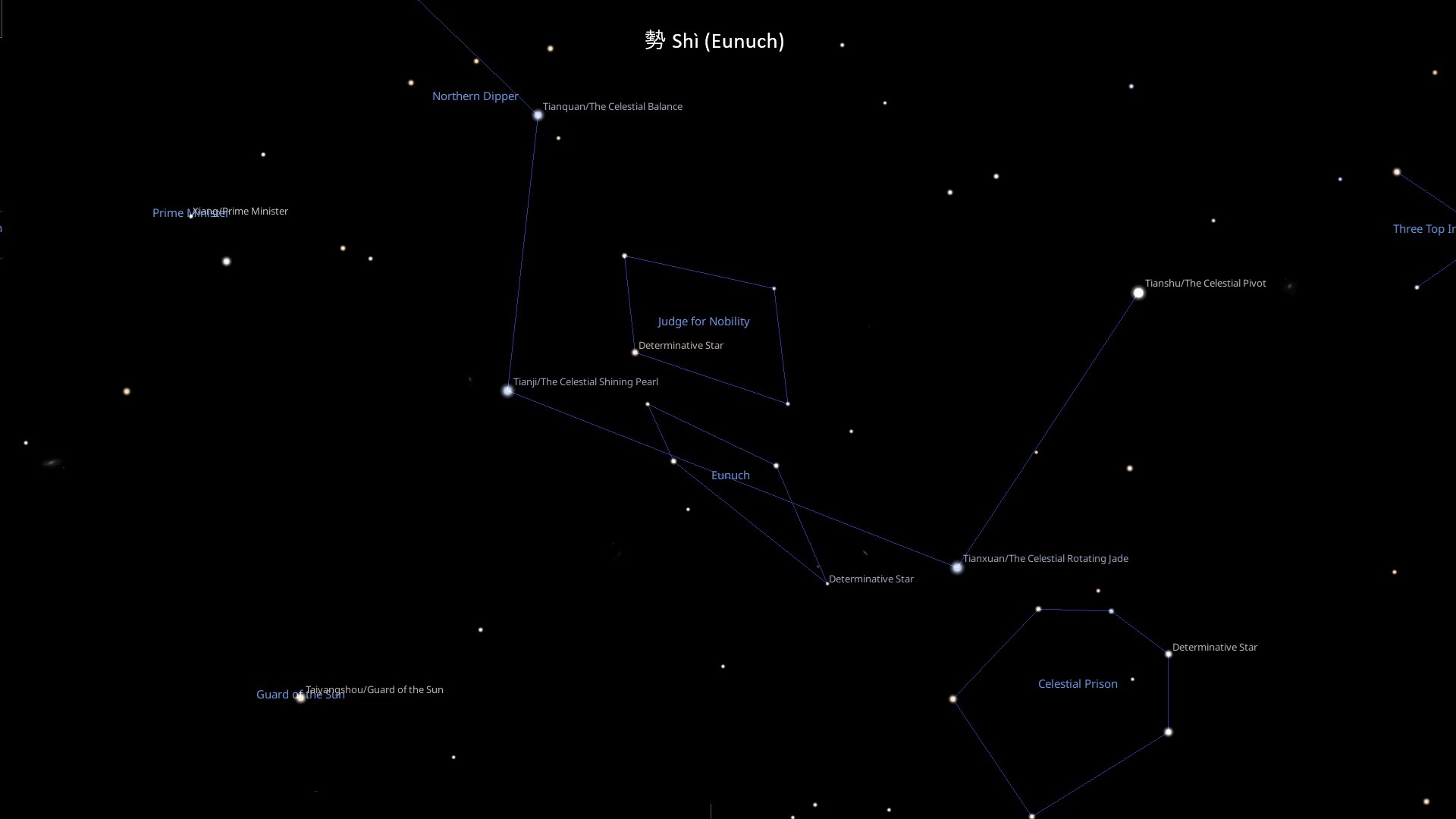
The 36th asterism of the Ziwei (Purple Forbidden) Enclosure is named 勢 Shì, “Eunuch.” It represents the eunuchs in the Royal Palace. The original ancient asterism contains 4 stars in the constellation Ursa Major. [1]
Note: “Shi” has multiple meanings in Chinese astronomy.
勢 Shì (Eunuch) is an asterism in the Ziwei (Purple Forbidden) Enclosure.
室 Shì (Encampment) is the name of the 13th lunar mansion and its 1st asterism.
屎 Shǐ (Excrement) is the name of an asterism in the 21st lunar mansion Shen (Three Stars).
| 2000 | 2050 | IAU | Chinese | Orb |
| 22♌25 | 23♌07 | HD 97302 | Shì Yi (1) | 1°00′ |
| 26♌18 | 27♌01 | HD 100615 | Shì Er (2) | 1°00′ |
| 27♌06 | 27♌49 | HD 101604 | Shì San (3) | 1°00′ |
| 23♌52 | 24♌34 | HD 99283 | Shì Si (4) | 1°00′ |
Shi the Eunuch
22♌25 to 27♌06
Ma Duanlin (1317)
The four stars of Shi (Power), northwest of the Sun, govern the affairs of those who have suffered physical mutilation. If it is not bright, it is auspicious; if it is bright, it signifies eunuchs seizing power. [2]
Note: Sun (阳 Yáng) means the asterism Taiyangshou (Guard of the Sun).
Song History (1346)
The four stars of the Shi constellation are located northwest of the Sun constellation, or, according to another account, north of the Ji constellation. The Shi constellation represents a corrupt, emasculated person who helps fulfill the king’s commands and serves as an inner court official. Its obscurity is auspicious; its visibility indicates the eunuch’s usurpation of power. [3]
References
- Ziwei Enclosure – Baidu Encyclopedia.
- General Examination of Literature, Volume 278, Part 1, Ma Duanlin, 1317.
- Song History, Volume 49, Chapter 2, 1346.