
STARS: Major | All | Constellations | Chinese | About
15♐19 to 27♐31
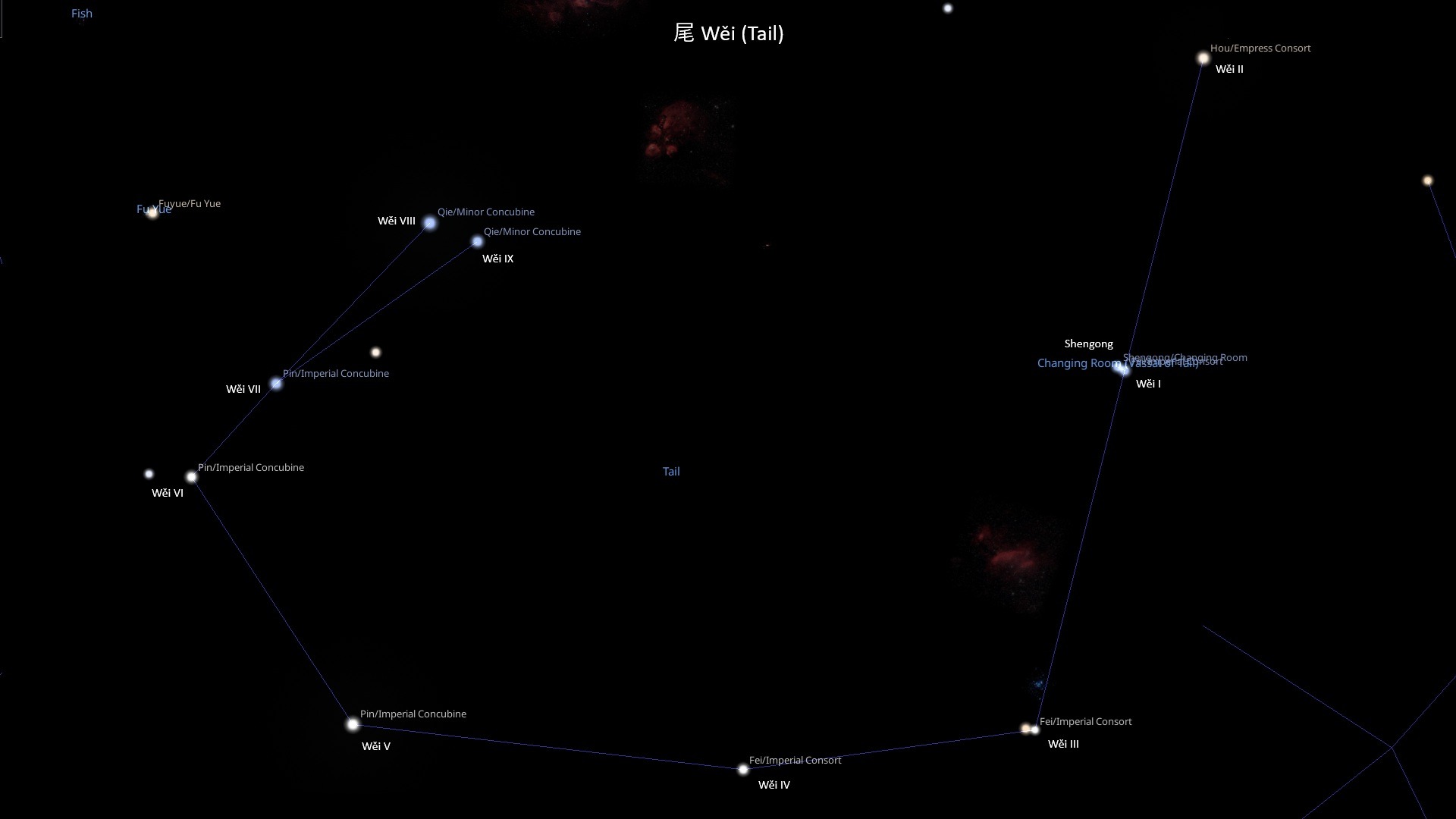
The 6th Chinese lunar mansion is 尾宿 Wěi Su, “Tail Mansion.”
The 1st asterism of the Tail Mansion is called 尾宿 Wěi Su, “Tail Constellation.” It represents the Tail of the Azure Dragon and governs the residence of the empresses and concubines, the center of the harem. This ancient asterism is composed of 9 stars distributed in the constellation Scorpius (the Tail of the Western Scorpion).
The 2nd asterism of the Tail Mansion is called 神宮 Shéngōng, “Changing Room.” It is a vassal of the Tail constellation and represents the inner chamber where women undress. It is a single-star ancient asterism composed of μ² Scorpii and is connected to the 3rd star of the Tail, μ¹ Scorpii. [1]
Note: There are 3 Mansions and 3 Asterisms named “Wei.”
尾 (Wěi) Tail, the 6th Mansion and its 1st asterism.
危 (Wēi) Rooftop, the 6th Mansion and its 1st asterism.
胃 (Wèi) Stomach, the 6th Mansion and its 1st asterism.
| 2000 | 2050 | IAU | Chinese | Orb |
| 16♐09 | 16♐51 | μ¹ Sco | Wěi Su Yi (1) | 1°50′′ |
| 15♐19 | 16♐01 | ε Sco | Wěi Su Er (2) | 2°10′ |
| 17♐07 | 17♐49 | ζ¹ Sco | Wěi Su San (3) | 1°00′ |
| 20♐44 | 21♐26 | η Sco | Wěi Su Si (4) | 1°40′ |
| 25♐36 | 26♐18 | θ Sco | Wěi Su Wu (5) | 2°20′ |
| 27♐31 | 28♐13 | ι¹ Sco | Wěi Su Liu (6) | 1°50′ |
| 26♐28 | 27♐10 | κ Sco | Wěi Su Qi (7) | 2°10′ |
| 24♐35 | 25♐17 | λ Sco | Wěi Su Ba (8) | 2°20′ |
| 24♐01 | 24♐43 | υ Sco | Wěi Su Jiu (9) | 2°00′ |
| 16♐14 | 16♐57 | μ² Sco | Shengong | 1°40′ |
Constellation Wěi, the Tail
15♐19 to 27♐31
Constellation Wěi, the Tail, belongs to the Azure Dragon in the east and forms a curved shape resembling a dragon’s tail. It represents the moon and the fox, belongs to the Fire element, and is also known as the Tail Fire Tiger. The dragon’s tail is the most vulnerable part in a fight; hence, it is considered extremely dangerous. [1]
Suitable activities include wearing protective clothing, building houses, storing treasures, planting grapes and sugarcane, extracting and planting tree roots, preparing medicinal decoctions, distributing Agada medicine and handling strict and rigorous matters like bathing, altar rituals and exorcising curses. [2]
Tail Personality
Those born under the Tail constellation are serious, capable, and cautious. They enjoy competition and should cultivate their character and inner qualities to achieve wealth. Their outwardly cold demeanor may mask inner passion, which can lead to unintended negative consequences. [3]
The Tail possesses extraordinary endurance and an unwavering spirit that never gives up until it achieves its goal. Tail people are energetic, curious and ambitious; they take their dealings with others seriously and dislike lying or concealing their true intentions. They are suited to acquiring wealth through external means and enjoy sensual pleasures and medicine. They are destined for abundant food and clothing, and have many possessions.
The Tail has the strongest combat power among the 28 Mansions. It also has the strongest offensive power and can fight alone. However, the Tail is considered inauspicious, inherently stubborn, somewhat self-centered, stingy, wicked-willed, and prone to quarrels and competition. [2]
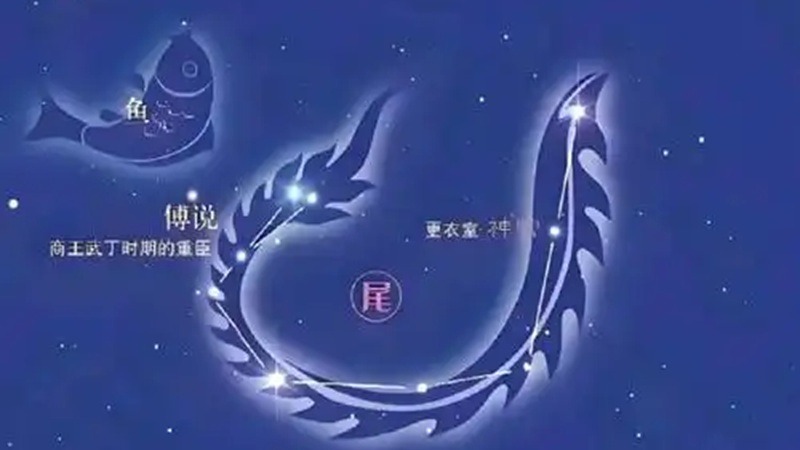
Ma Duanlin (1317)
The nine stars of the Tail constellation resemble a hooked dragon’s tail. The five dots below are called the Tortoise Star. The four horizontal lines above the Tail constellation are the Heavenly River. To the east of the Tail constellation is a star named Fu Yue, and to the east of Fu Yue is a fish-shaped constellation. To the west of the Tortoise Star is a room called the Divine Palace, which is why it sits among the empresses and concubines.
The Tail constellation, at 19 degrees, is the residence of the empresses and concubines, the center of the harem. One zhang to the north is the central axis of the heavens. The first star above (ε Sco) is the empress (Hou); the next three stars (μ¹, ζ¹, η Sco) are the ladies (Fei); and (θ, ι¹, κ, λ, υ Sco) are the concubines (Pin and Qie). The third star (μ¹ Sco) is next to a star (μ² Sco) called the Divine Palace (Changing Room), the inner chamber where women undress.
The Tail constellation also contains nine sons; if their brightness and size are consistent, then the empresses and concubines will not be jealous, the harem will be orderly, and there will be many children. If the stars are faint and dim, the empress will suffer from illness. Distance leads to loss of power; movement leads to discord between ruler and minister, and chaos throughout the land; gathering leads to great floods.
If Jupiter is present and a lunar halo appears, the empress or concubine will die; if Mars is present, internal strife will erupt within the palace; if Saturn is present, it is auspicious; if Mercury is present, trouble will arise within the palace. If a guest star is present, high officials will be executed. Solar and lunar eclipses indicate famine. Another saying is that if Venus and Mars guard it, the harem will rebel. [4]
Song History (1346)
The Wei Xiu (Tail Constellation) consists of nine stars, representing the Emperor’s harem and the ranks of his consorts. The first star at the top (ε Sco) signifies the Hou (Empress); the next three (μ¹, ζ¹, η Sco) represent the Furen [Fei] (high-ranking consorts); the following three stars (θ, ι¹, κ Sco) represent the Pin; and (λ, υ Sco) the Qie (lower-ranking concubines). They also symbolize the Emperor’s nine sons.
If all these stars shine brightly and consistently, it indicates a well-ordered harem and a flourishing imperial lineage. Brightness suggests auspicious news for the Empress and a bountiful grain harvest; dimness, conversely, portends sorrow for the Empress and a failed harvest.
A solar eclipse in this region signifies the onset of illness (among generals), sandstorms (in the region of Yan), military conflict, or funerals (mourning); it also distresses the harem and warns the Emperor not to travel. A solar halo indicates the death of a high-ranking female consort and causes anxiety among generals and ministers.
A lunar eclipse suggests that a high-ranking official may face criminal punishment and brings sorrow to the harem. A lunar halo warns of an epidemic, the possibility of a general amnesty, and anxiety among the leadership; it may also portend floods and distress among the consorts.
If the Moon (Taiyin) transgresses Wei Xiu, it signifies discord among ministers and impending trouble for generals.
If Mercury transgresses Wei Xiu or lingers, it brings floods and epidemics; those in the inner palace guilty of crimes face punishment, and war follows. If it enters the asterism, crops will fail to mature, and the populace will suffer from an epidemic.
If Venus transgresses Wei Xiu, high-ranking officials may incite a military uprising; if it lingers, floods will follow; its movement—entering, exiting, dwelling, or lingering—signals rising grain prices, the outbreak of war, and distress in the harem; if its motion becomes irregular (stationary ?), it foretells the defeat of armies and the fall of cities.
If Mars transgresses Wei Xiu, military conflict is likely; if it remains for twenty days, floods will occur; if it stays for three months, foreign or invading troops will gather; if it enters the asterism, people resort to cannibalism; some also say that internal palace disorder follows.
If Jupiter transgresses Wei Xiu, grain prices will rise; if it enters, a concubine may usurp the status of the primary consort, or an official may seize undue power; if it lingers there, it foretells drought and fire.
If Saturn transgresses Wei Xiu and appears yellow, it brings joy to the consorts; if it enters, it signifies war, famine, or the rise of bandits; if it moves in retrograde, a concubine may rise to the position of a primary female ruler; if it lingers and displays 芒角 (bright rays or horns), it portends a change in the ruling surname or a shift in the political order.
If a guest star (unexpected star or nova) transgresses or enters this region, palace attendants suffer ill omens; if it lingers, a woman of low status may suddenly rise to great power; if it departs, it brings wind and floods, causes misfortune within the harem, leads to the cessation of military campaigns, and results in widespread famine and death.
If a comet transgresses Wei Xiu, it suggests a consort may lead the ruler astray, palace women may be forced to leave, military conflict may arise, and extensive construction or earthworks will occur at the palace gates. If it moves in or out of the asterism, high-ranking officials may be executed, and floods may occur.
If a 孛 “bo” star (a hairy or hazy tailless comet) transgresses Wei Xiu, it signifies heavy earthworks and the execution of high-ranking officials; if it guards this region, palace women will leave; if it appears, there will be great floods and famine.
If a meteor enters or transgresses Wei Xiu with blue coloration, former officials will return; if it appears in spring or summer, there will be gossip in the harem; if it appears in autumn or winter, virtuous officials will be in power. If it appears, the harem will be happy and have children; if it appears white, concubines will die. Whether entering or exiting, timely winds and rains occur, grain ripens, and, if entering, the empress’s relatives receive promotion. If blue-black, mourning for the empress or consorts follows
If blue clouds enter Wei Xiu, foreign countries will surrender; if they appear, ministers will rebel. When red clouds enter, an envoy will come to discuss war. When black clouds enter, feudal lords or guests from other states arrive.
According to the Han Yongyuan bronze instrument, Weixiu spans eighteen degrees; this matches the Tang Kaiyuan traveling instrument. Previously recorded as 120 or 140 degrees from the celestial pole, it is now measured at 124 degrees. Jingyou measurements also indicate eighteen degrees, with the second westernmost star in Weixiu located 128 degrees from the celestial pole and 22 degrees outside the ecliptic. The “Qian Xiang Xin Shu” records it as twenty-seven degrees. [5]
Asterism Shengong the Changing Room
16♐14
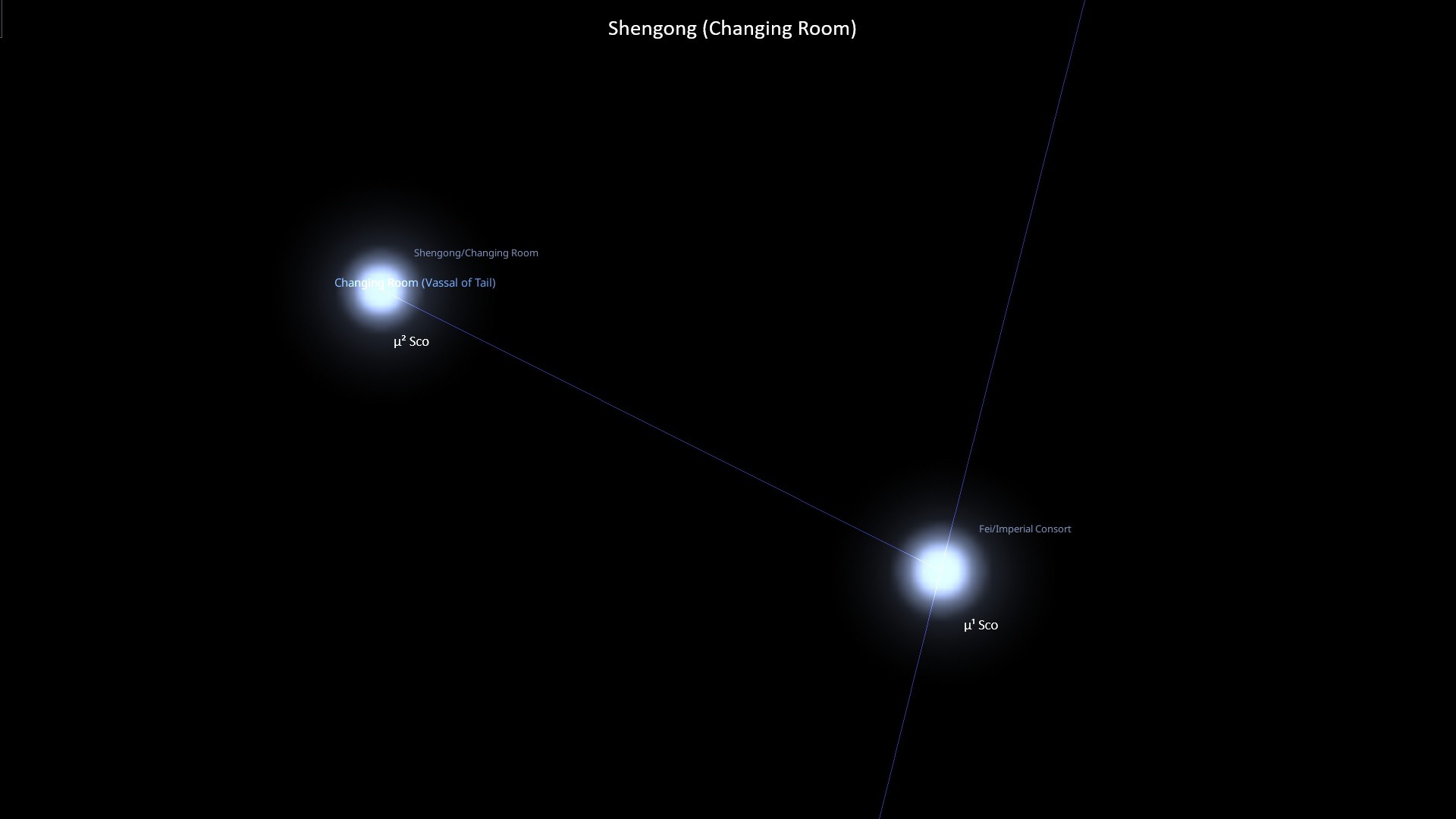
Asterism Shengong (Changing Room) is a vassal of Constellation Wěi, the Tail. It is a single-star asterism of μ² Scorpii, and connected to the 3rd star of the Tail, μ¹ Scorpii.
μ² Sco is called the Divine Palace (Changing Room), the inner chamber where women undress. [4]
Shengong (Star of the Divine Palace) consists of one star (μ² Sco) located beside the third star of Weixiu (μ¹ Sco); it represents the inner chamber where clothes are removed. [5]
References
- Tail (尾宿) – Baidu Encyclopedia.
- Comprehensive Analysis | Unveiling the Personality of the Tail Constellation.
- Twenty-Eight Mansions – Baidu Encyclopedia.
- General Examination of Literature, Volume 279, Part 2, Ma Duanlin, 1317.
- Song History, Volume 50, Chapter 3, 1346.