
STARS: Major | All | Constellations | Chinese | About
16♉56 to 29♉25
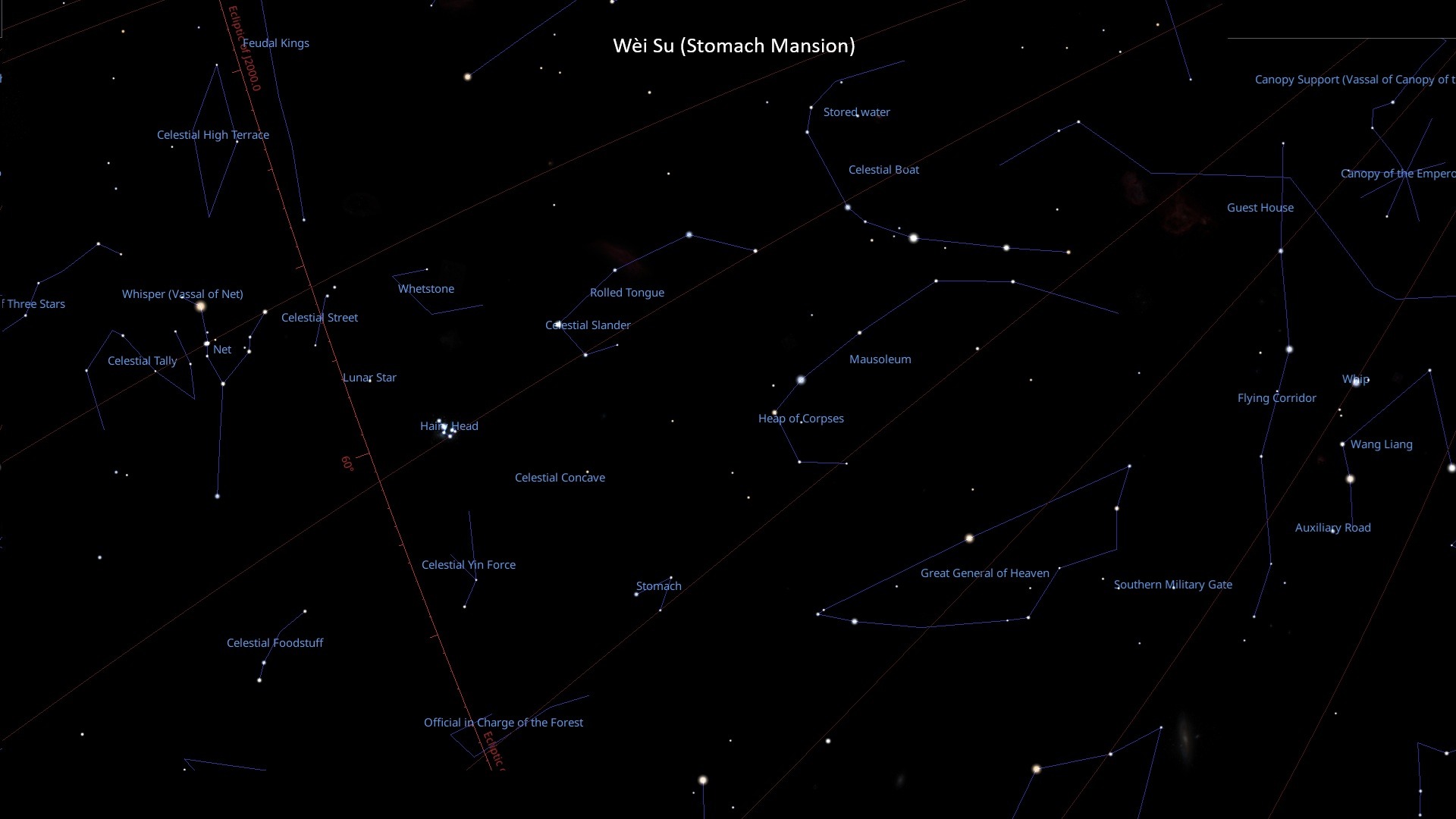
The 17th Chinese lunar mansion is named 胃宿 Wèi Su, “Stomach Mansion.” It is the 3rd of the 7 mansions of the White Tiger of the West. It was called “Heavenly Granary” in ancient times and was responsible for storing grains. Bright stars in the constellation indicate a bountiful harvest, so it is considered an auspicious sign. [1]
The Stomach Mansion contains 7 star officials (asterisms) and 39 stars, distributed in the constellations Aries, Taurus, Cetus and Perseus.
Note:
尾 Wěi, “Tail” is the name of the 6th mansion and its 1st asterism.
胃Wèi, “Stomach” is the name of the 17th mansion and its 1st asterism.
危 Wēi, “Roof” is the name of the 12th mansion and its 1st asterism.
| # | Asterism | English | 2000 | Constellations | Stars |
|---|---|---|---|---|---|
| 1 | Wèi | Stomach | 16♉56 | Aries | 3 |
| 2 | Tiānlǐn | Celestial Foodstuff | 21♉10 | Taurus | 4 |
| 3 | Tiānqūn | Circular Celestial Granary | 00♉03 | Cetus | 13 |
| 4 | Dàlíng | Mausoleum | 20♉50 | Perseus | 8 |
| 5 | Tiānchuán | Celestial Boat | 28♉42 | Perseus | 9 |
| 6 | Jīshī | Heap of Corpses | 23♉54 | Perseus / Camelopardalis | 1 |
| 7 | Jīshuǐ | Stored Water | 09♊45 | Perseus | 1 |
Constellation Wei the Stomach
16♉56 to 18♉22
Those born under the Stomach constellation are strong and unyielding. Their indomitable spirit can lead to rapid advancement, but their ruthlessness can also cause significant ups and downs in life. Cultivating strong interpersonal relationships is crucial for competitiveness.
It belongs to the Earth element and is associated with the pheasant. It is the third constellation in the west, and like the stomach in the human body, the Stomach constellation is like a granary in the sky storing grain, hence the Stomach constellation is generally auspicious.
Construction and repairs will be successful on this day; sacrifices and marriages will be celebrated; and if burials are held on this day, the fields and crops will yield a bountiful harvest.
The stomach, according to the ” Shiming ” dictionary, means “enclosure, a place to receive food.” The “Records of the Grand Historian: Treatise on Celestial Offices” states, “The stomach is the granary of heaven.” [2]
Stomach Pheasant
The person born under the Stomach Mansion is hard-hearted, wicked, and prone to indulging in alcohol and meat. They love to drive, rob, and be violent. They are impulsive and easily angered. They have many enemies. They have many male and female servants.
They are suited for public affairs and virtuous deeds of a ruler. They are also suited for strict discipline, suppressing rebellion and eliminating evil, training subordinates, and ensuring the well-being of horses and other livestock.
Stomach Advice
Considering others is the best way for those born under the Stomach Constellation to accumulate blessings in their later years. Whether at work or in daily life, if they can consistently give to others, their life path will become smoother and smoother.
Confidence and adherence to one’s own values are excellent qualities and often indicate strong management skills. However, it’s important to consider others around you, whose strengths may differ from yours. Is it appropriate to dismiss others simply because they are different? Conversely, no two leaves are alike, and how many people truly share your values? As the saying goes, “The earth is receptive; the superior man, in accordance with this, carries the world with virtue.” If you can maintain an inclusive attitude, viewing the world’s good and bad with a smile, and never forgetting your original aspirations, you will elevate your soul to a higher level.
If you want to run, then run. When luck is bad, being able to travel abroad will have a very positive impact on the fortune of the Stomach Constellation. [3]
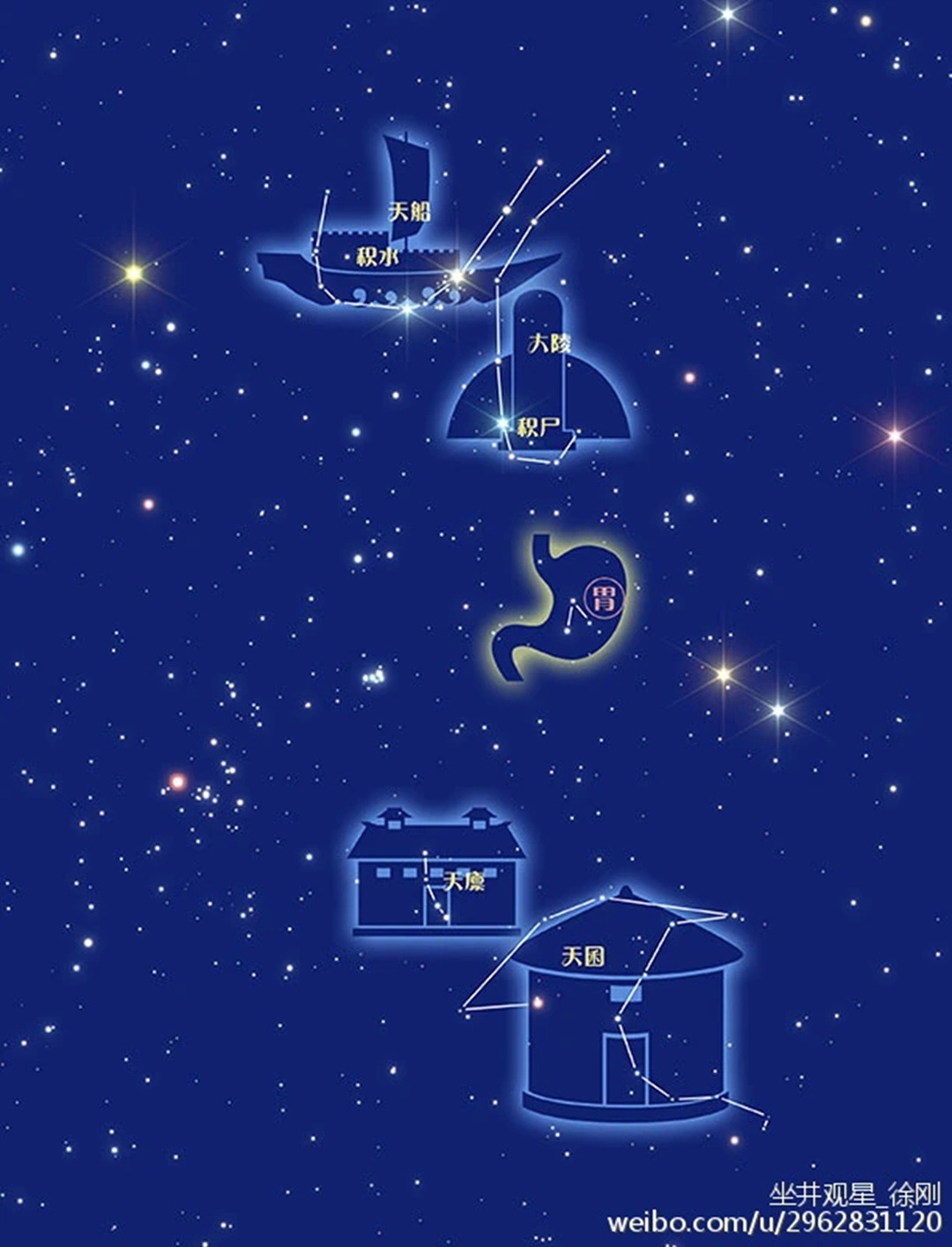
胃宿 Wèi Su
Ma Duanlin (1317)
The Stomach, at 15 degrees, is the Heavenly Kitchen, storing the granary of five grains, also called the Great Beam. When it is bright, the four seasons are peaceful, the world is calm, and the granaries are full; when it is dark, the order of superiors and inferiors is lost; when there are few stars, there is a shortage of grain transport. It is also said that movement indicates transport events, gathering indicates high grain prices and population displacement, and darkness indicates famine and disaster. When the five planets are in conflict, there will be solar and lunar eclipses, comet intrusions, and all bring disaster.
The four stars of the Heavenly Granary are south of the Pleiades, also called the Heavenly Palace. Zhang Heng said that it governs the storage of millet and sorghum for sacrificial offerings. This is what the Spring and Autumn Annals refers to as the Imperial Granary.
The thirteen stars of Tianqun, located south of Wei, belong to the granary category and are responsible for supplying imperial provisions. A bright yellow color indicates a bountiful year; a slight change in color is inauspicious. If Venus and Mars guard it, disaster will occur.
The eight stars of Daling, located north of Wei, govern tombs. A bright and large star, or one with many stars in the center, indicates widespread death and loss, or war.
The nine stars of Tianchuan, located north of Daling, are in the middle of the river. Also called the Boat Star, it governs crossings and also floods and droughts. If not in the middle of the river, the river will be impassable, and floods will occur. If the four stars in the center are equally bright, the world will be at peace; otherwise, war and loss are likely. The same applies to migration. The appearance or disappearance of a comet indicates a great flood and war.
One star in the middle of Daling is called Jishi (积尸). A bright Jishi indicates mountains of dead bodies. Zhang Heng said it is also called Jilin (积廪). A bright and large Jishi, or one with many surrounding stars, indicates abundant death and loss, or war. If it is not visible and dim, it is auspicious. If Mars guards it, there will be widespread weeping.
One star in the middle of Tianchuan is called Jishui (积水), which indicates the looming of floods.
The Astronomical Records of the Song and Liang Dynasties: The three stars of the Stomach constellation are 67.5 degrees from the Southwest Star. The four stars of the Heavenly Granary constellation are 85.5 degrees from the South Star, entering the Stomach constellation at 12 degrees. The thirteen stars of the Heavenly Granary constellation are 91.5 degrees from the Great Star, entering the Stomach constellation at 6.5 degrees. The eight stars of the Great Mound constellation are 54 degrees from the Great Star, entering the Stomach constellation at 7 degrees. The nine stars of the Heavenly Boat constellation are 54.5 degrees from the Great Star, entering the Stomach constellation at 10 degrees. The one star of the Accumulated Corpse constellation is 55 degrees from the Great Star, entering the Stomach constellation at 4 degrees. The one star of the Accumulated Water constellation is 53 degrees from the Great Star, entering the Pleiades constellation at its first degree. [4]
Song History (1346)
The three stars of the Stomach constellation are the celestial kitchen, governing granaries and the storehouse of grains. When they are bright, the world is at peace, granaries are full, and the people are safe; when they move, transportation is underway; when they are dark, granaries are empty; when they gather together, grain is expensive and people are displaced; when many stars are in the center, grain is gathered; when the stars are small, grain is scattered; when they are bright, there is war.
A solar eclipse signifies the execution of a high-ranking official, food shortages, widespread illness, poor harvests, or unfulfilled transport obligations. A solar halo signifies unripe grain.
A lunar eclipse signifies the queen’s sorrow, impending death, famine, and misfortune in suburban sacrifices. A lunar halo signifies that those who initiate military action will be defeated, many pregnant women will die, the ruler will die, there will be heavy rain, landslides, or a broken army. When Jupiter is within a halo, the emperor has virtuous decrees. A lunar halo in the four cardinal months signifies a pardon. When Mars is within a halo, it signifies war. When the moon transgresses a lunar halo, neighboring countries will wage war, the world will suffer famine, foreign countries will be troubled, grain will be poor, and the people will suffer from many illnesses; a change in color signifies misfortune for the general.
When Jupiter invades, the people are worried, and war breaks out; if it guards Wei, the country prospers; if it enters Wei, the laws will change, and the prisons will be empty; if it moves in reverse, the crops will fail, and the country will have no reserves.
When Mars invades, there will be war, granaries will be empty, and nobles will be worried; if it guards, there will be drought, famine, and plague among the people, and foreign armies will be defeated; if it enters, the laws will be changed, and the prisons will be empty; if it moves in or out of Wei around the constellation Gou Si, or invades for more than 100 days, the granaries will be empty, and war will break out.
When Saturn invades, ministers will rebel; if it guards the land, there will be no reserves, but there will be virtuous decrees, and the harvest will be very rich; if it moves in reverse and guards Gou Si, there will be war; if it is red, there will be war and bloodshed; if it is blue, there will be virtuous decrees.
When Mercury invades, its territory will be unsettled; if it guards the land, there will be war, and the country will establish a marquis. Wu Xian said: “There will be drought, the crops will fail, and there will be urgent war”; if it moves in reverse and guards Wei, the granaries will be empty, and there will be floods.
When a guest star invades, the king is worried, and the granaries are full; if it retreats and enters, there will be a pardon; if it guards Wei, a powerful minister will oppress the country, and the grain will not ripen; if it rides on Wei, it will cause fire; if it stays there, the people will starve; if it leaves, its ruler will be worried.
When a comet invadesi, there will be war, ministers will rebel, there will be floods, and the grain will not ripen. When a comet appears, its tributary will rise up, and the king will hate it.
When a meteor invades, the granaries will be empty; if it is red, there will be a fire.
If pale clouds enter or leaves, it will cause the loss of grain purchases; if it is black, the grain in the granaries will rot; if it is bluish-black, there will be war; if it is yellowish-white, the granaries will be full.
According to the bronze instrument of the Yongyuan era of the Han Dynasty, the Stomach constellation is 15 degrees; according to the measurement of the Jingyou era, it is 14 degrees.
The thirteen stars of the Celestial Granary, shaped like the character “乙”, are located south of the Stomach constellation. They belong to the granary category and are in charge of supplying the imperial granaries and grain. If the stars are bright, there will be a good harvest; if they are dim, there will be famine. If the moon invades the palace, there will be grain relocation. If the five planets invade the palace, the granaries will be empty. When a guest star or comet enters the palace, there will be worries about the granaries, and there will be floods and fires. When bluish-white clouds enter, famine strikes and people flee.
The eight stars of Daling, north of Wei, also called Jijing, signify a great mourning. Numerous stars in the center indicate mourning for feudal lords, plague among the people, and war. If the moon invades it, it signifies war, floods, droughts, and widespread mourning. A lunar halo around the front foot signifies a general amnesty. The entry of five planets signifies floods, droughts, war, and mourning. If Mars guards it, there will be widespread mourning. The entry of a comet or a celestial comet signifies plague among the people. If a meteor appears and invades it, there will be piles of corpses below. When pale clouds invade it, there will be war and mourning; if red, many will die in battle.
The star of piled corpses is in Daling. If bright, there will be a great mourning, with corpses piled high. If the moon invades it, there will be rebellious ministers. If five planets invade it, there will be a great disease. If a comet or a celestial comet invades it, there will be a great mourning. When pale clouds enter and invade it, many will die; if black, there will be plague.
The nine stars of Tianchuan, north of Daling, in the middle of the river, are the celestial boat, signifying smooth passage and safe crossing. Shi Shen said, “If it is not in Hanzhong, the ferry and river will be impassable.” If it is bright, the world will be at peace; if it is dim or there is migration, the world will suffer war and loss. If the moon invades it, all rivers will overflow, and ferry crossings will be impassable. If the five planets invade it, water will overflow, and people will migrate. If a comet invades it, there will be great floods. If a guest star invades it, there will be water and war. If a blue cloud enters, the emperor will be worried and cannot sail; if it is red, it signifies war and the use of ships; if it is yellow or white, the emperor will be happy.
The four stars of Tianlin, located south of the Pleiades, are also called Tianlin, which governs the storage of millet and sorghum for sacrificial offerings. This is the image of what the Spring and Autumn Annals refer to as Yulin. It also governs rewarding merit and controls the essentials of the nine grains. If it is bright, the country will be prosperous and the year will be bountiful; if it moves away, the country will be poor; if it is black and sparse, the grain will rot. If the moon invades it, grain will be expensive. If the five planets invade it, there will be famine. If a guest star invades it, the granaries will be empty. If a shooting star enters it, if it is blue, there will be worry; if it is red, there will be drought and fire; if it is yellow or white, the world will have a good harvest. When auspicious clouds enter, locusts, famine, and people flee; red indicates drought; black indicates floods; yellow indicates a bountiful harvest.
The star Jishui, located in the Tianchuan constellation, foretells floods. Its bright upward movement signifies the use of boats and ships. When Mars invades, there is water.
According to the Jin Dynasty records, Daling, Jishi, Tianchuan, and Jishui all belong to the Tianshi Enclosure, while Tianqun and Tianlin are outside the Twenty-Eight Mansions. Wu Mi classifies Tianqun and Daling as belonging to Lou, and also to Wei; Tianchuan belongs to Wei, and also to Mao. The Qianxiang Xinshu states that five stars of Tianqun belong to Lou, and the remaining stars to Wei; three stars west of Daling belong to Lou, and five stars east of Daling belong to Wei, differing from the Bu Tian Ge. [5]
References
- Stomach Constellation – Baidu Encyclopedia.
- Twenty-Eight Mansions – Baidu Encyclopedia.
- Comprehensive Analysis | Unveiling the Personality Traits of the Stomach Constellation.
- General Examination of Literature, Volume 279, Part 2, Ma Duanlin, 1317.
- Song History, Volume 50, Chapter 3, 1346.