
STARS: Major | All | Constellations | Chinese | About
25♒24 to 20♓12
The 13th Chinese lunar mansion is named 室宿 Shi Su, “Encampment Mansion.” It is the 6th of the 7 mansions of the Black Tortoise of the North.
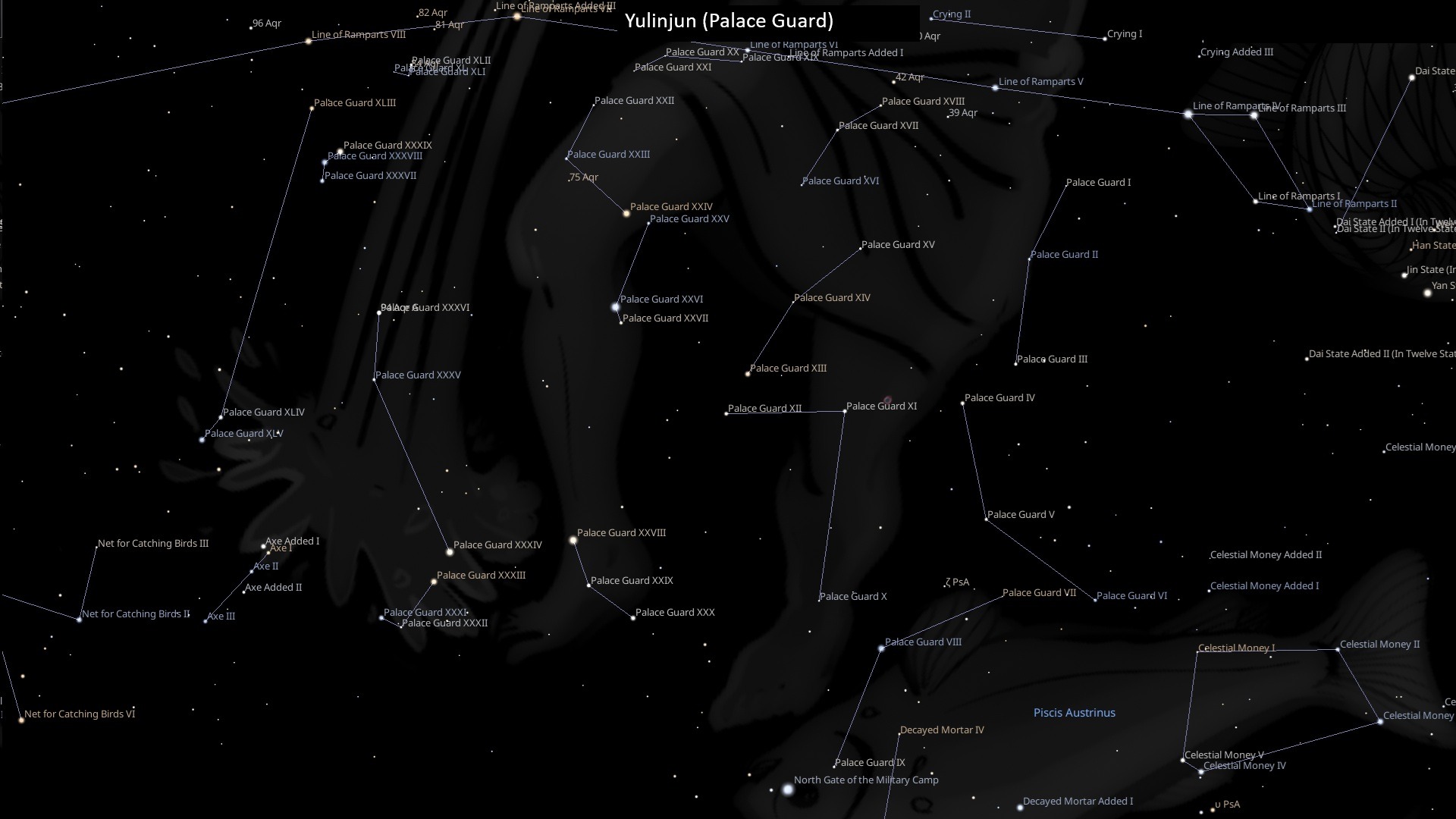
The 5th asterism of the Encampment Mansion is called 羽林軍 Yǔlínjūn, “Palace Guard.” It represents the ancient imperial guards, and is composed of 45 stars distributed in the constellations Aquarius and Piscis Austrinus. [1]
| 2000 | 2050 | IAU | Chinese | Orb |
| 26♒10 | 27♒26 | 29 Aqr | Yulinjun Yi (1) | 1°00′ |
| 27♒39 | 28♒21 | 35 Aqr | Yulinjun Er (2) | 1°00′ |
| 27♒54 | 28♒36 | 41 Aqr | Yulinjun San (3) | 1°00′ |
| 29♒19 | 00♓01 | 47 Aqr | Yulinjun Si (4) | 1°00′ |
| 28♒32 | 29♒14 | 49 Aqr | Yulinjun Wu (5) | 1°00′ |
| 25♒24 | 26♒06 | λ PsA | Yulinjun Liu (6) | 1°00′ |
| 27♒59 | 28♒42 | HD 212448 | Yulinjun Qi (7) | 1°00′ |
| 01♓20 | 02♓02 | ε PsA | Yulinjun Ba (8) | 1°20′ |
| 02♓33 | 03♓16 | 21 PsA | Yulinjun Kiu (9) | 1°00′ |
| 03♓07 | 03♓49 | 20 PsA | Yulinjun Shi (10) | 1°00′ |
| 02♓32 | 03♓15 | υ Aqr | Yulinjun Shiyi (11) | 1°00′ |
| 05♓48 | 06♓30 | 68 Aqr | Yulinjun Shier (12) | 1°00′ |
| 05♓14 | 05♓14 | 66 Aqr | Yulinjun Shisan (13) | 1°00′ |
| 04♓01 | 04♓44 | 61 Aqr | Yulinjun Shisi (14) | 1°00′ |
| 02♓14 | 02♓56 | 53 Aqr | Yulinjun Shiwu (15) | 1°00′ |
| 03♓52 | 04♓34 | 56 Aqr | Yulinjun Shiliu (16) | 1°00′ |
| 02♓56 | 03♓38 | 50 Aqr | Yulinjun Shiqi (17) | 1°00′ |
| 01♓47 | 02♓29 | 45 Aqr | Yulinjun Shiba (18) | 1°00′ |
| 05♓32 | 06♓15 | 58 Aqr | Yulinjun Shikiu (19) | 1°00′ |
| 07♓36 | 08♓18 | 64 Aqr | Yulinjun Ershi(20) | 1°00′ |
| 08♓25 | 09♓08 | 65 Aqr | Yulinjun Ershiyi (21) | 1°00′ |
| 09♓30 | 10♓12 | 70 Aqr | Yulinjun Ershier (22) | 1°00′ |
| 10♓14 | 10♓56 | 74 Aqr | Yulinjun Ershisan (23) | 1°00′ |
| 08♓36 | 09♓18 | τ² Aqr | Yulinjun Ershisi (24) | 1°20′ |
| 07♓59 | 08♓42 | τ¹ Aqr | Yulinjun Ershiwu (25) | 1°00′ |
| 08♓52 | 09♓34 | δ Aqr | Yulinjun Ershiliu (26) | 1°50′ |
| 08♓43 | 09♓25 | 77 Aqr | Yulinjun Ershiqi (27) | 1°00′ |
| 10♓01 | 10♓43 | 88 Aqr | Yulinjun Ershiba (28) | 1°40′ |
| 09♓35 | 10♓17 | 89 Aqr | Yulinjun Ershijiu (29) | 1°00′ |
| 08♓20 | 09♓02 | 86 Aqr | Yulinjun Sanshi (30) | 1°10′ |
| 15♓24 | 16♓06 | 101 Aqr | Yulinjun Sanshiyi (31) | 1°00′ |
| 14♓51 | 15♓33 | 100 Aqr | Yulinjun Sanshier (32) | 1°00′ |
| 14♓37 | 14♓37 | 99 Aqr | Yulinjun Sanshisan (33) | 1°10′ |
| 13♓27 | 14♓09 | 98 Aqr | Yulinjun Sanshisi (34) | 1°30′ |
| 15♓28 | 16♓10 | 97 Aqr | Yulinjun Sanshiwu (35) | 1°00′ |
| 15♓18 | 16♓01 | 94 Aqr | Yulinjun Sanshiliu (36) | 1°00′ |
| 16♓48 | 17♓30 | ψ³ Aqr | Yulinjun Sanshiqi (37) | 1°00′ |
| 16♓44 | 17♓26 | ψ² Aqr | Yulinjun Sanshiba (38) | 1°10′ |
| 16♓19 | 17♓01 | ψ¹ Aqr | Yulinjun Sanshijiu (39) | 1°20′ |
| 14♓52 | 15♓34 | 87 Aqr | Yulinjun Sishi (40) | 1°00′ |
| 14♓28 | 15♓10 | 85 Aqr | Yulinjun Sishiyi (41) | 1°00′ |
| 14♓24 | 15♓06 | 83 Aqr | Yulinjun Sishier (42) | 1°00′ |
| 17♓03 | 17♓46 | χ Aqr | Yulinjun Sishisan (43) | 1°00′ |
| 19♓40 | 20♓22 | ω¹ Aqr | Yulinjun Sishisi (44) | 1°00′ |
| 20♓12 | 20♓54 | ω² Aqr | Yulinjun Sishiwu (45) | 1°10′ |
Yulinjun the Palace Guard
25♒24 to 20♓12
The Yulin Army (Imperial Guards) asterism belongs to the Shi constellation. The name originated from the imperial guards of the Han Dynasty. It consists of forty-five soldiers (stars), divided into fifteen groups of three.
During the Sui and Tang Dynasties, the Tian Wen Xiang Da Fu associated it with natural phenomena such as thunder, lightning, clouds, and rain, continuing the naming logic of “celestial army guarding” from the Han Dynasty. [2]
Ma Duanlin (1317)
The forty-five stars of the Feathered Forest Guard (Yulin), clustered in groups of three, are scattered south of the Ying Shi palace (Encampment), representing the celestial army, governing cavalry and the Wing King (翼王). Numerous and bright stars indicate peace; few and moving stars indicate war; if invisible, the world is in chaos. The presence of Venus, Mars, and Mercury indicates war. [3]
Song History (1346)
Yulin Jun (Feathered Forest Army, Imperial Guards) consists of forty-five stars, grouped and scattered in sets of three. They emerge south of Leibizhen (Line of Ramparts); alternatively, they lie south of Ying Shi (Encampment), arranged east-west in rows. The first row to the north represents the heavenly army, symbolizing cavalry units that flank and guard it (wing guards of the cavalry). If many stars appear here, the nation is at peace; if sparse, military action arises. If no stars are visible within Yulin Jun, all troops have been deployed, and chaos spreads across the land.
If the moon transits through this region, warfare erupts. If Jupiter enters here, feudal lords mobilize their armies and ministers conspire to rebel; they will inevitably suffer defeat and be executed. If Venus enters this region, warfare begins. If Saturn enters here, great floods occur. The entry of the five planets signifies war. If Mars and Venus transit through here, the Emperor will defend himself with troops. If Mars enters and displays red 芒 (bright rays or spikes), those who raise arms in warfare will perish. If a guest star enters here with yellow or white color, it brings good news; if red, it indicates ministerial rebellion. A guest star entering, yellowish-white in color, signifies joy; red signifies ministerial rebellion. A shooting star entering the south, blue in color, signifies impending illness; entering the north, signifies worry for feudal lords; entering the east, reddish-black, signifies impending plots; entering the west, signifies worry for the crown prince. Pale clouds entering the south signify impending worry; entering the north signifies worry for feudal lords; black clouds signify the crown prince and feudal lords should be wary; their departure signifies calamity is averted; yellowish-white clouds are auspicious. [4]
References
- Shu Xiu – Baidu Encyclopedia.
- Imperial Guards – Baidu Encyclopedia.
- General Examination of Literature, Volume 279, Part 2, Ma Duanlin, 1317.
- Song History, Volume 50, Chapter 3, 1346.