
STARS: Major | All | Constellations | Chinese | About
23♓29 to 29♓23
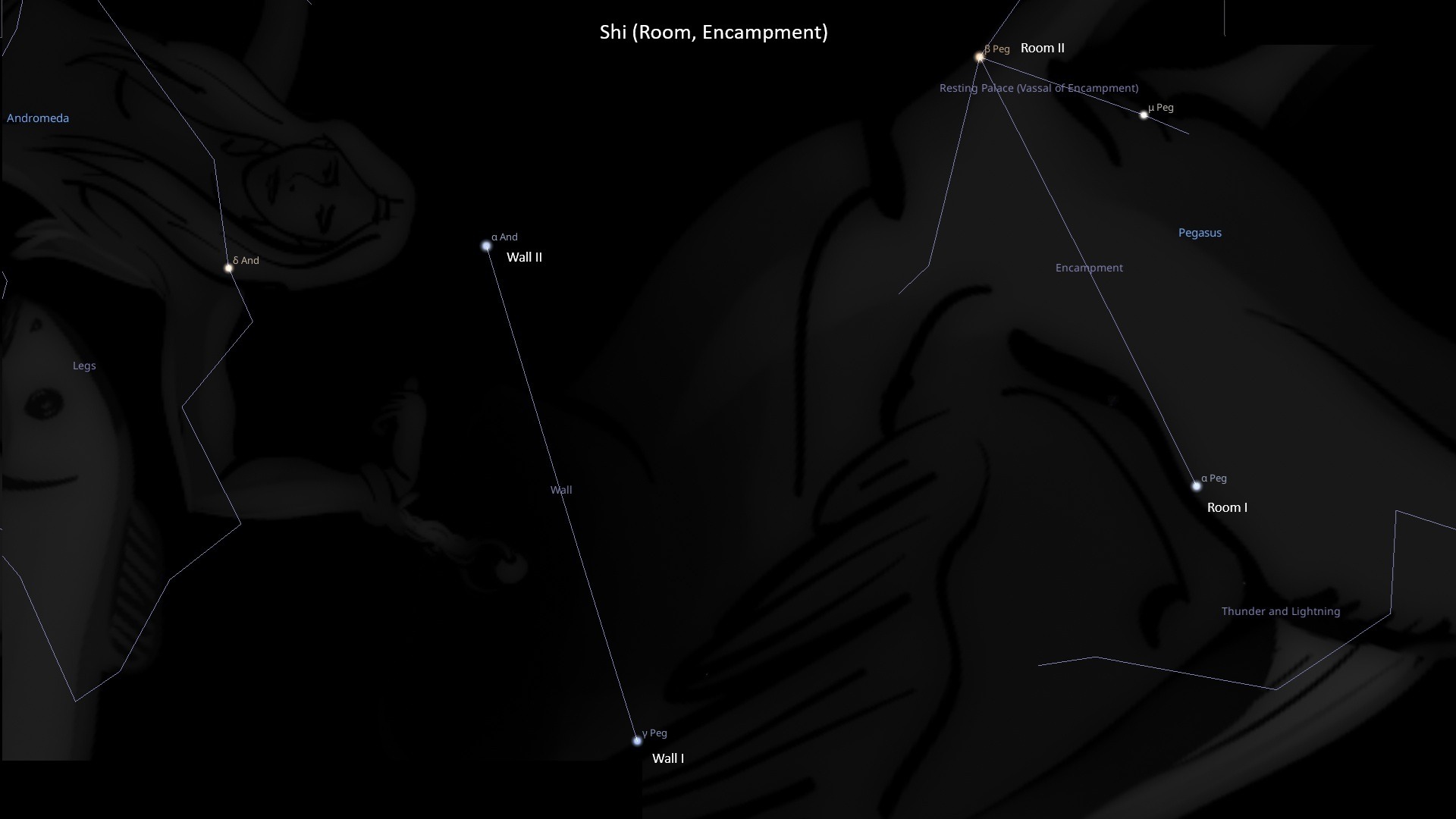
The 13th Chinese lunar mansion is named 室宿 Shi Su, “Room or Encampment Mansion.” It is the 6th of the 7 mansions of the Black Tortoise of the North.
The 1st asterism of the Room Mansion is also called 室 Shi. It represents a military camp and is composed of the 2 main stars of Pegasus. [1]
Note: The name “Shi” appears two times in Chinese astronomy. Asterism 勢 Shì, “Eunuch” in the Zǐ Wēi Enclosure and asterism 屎 Shǐ, “Excrement” in the 21st Mansion Shēn “Three Stars.”
| 2000 | 2050 | Western | Chinese | Orb |
| 23♓29 | 24♓11 | α Peg, Markab | Shi Su Yi (1) | 2°10′ |
| 29♓23 | 00♈05 | β Peg, Scheat | Shi Su Er (2) | 2°10′ |
Constellation Shi the Room
23♓29 to 29♓23
The constellation 室 (Shi) represents the Emperor’s palace, the ancestral temple, and the granaries of the king’s three armies, hence the presence of the Imperial Guards. It also represents the walkways of the detached palace. [2]
The constellation Shi, also known as Xuan Gong, Qing Miao, or Xuan Ming (the water god), is said to remind people to reinforce their houses to survive the harsh winter. The constellations Bi and Shi are similar, possibly implying the need to reinforce the walls of a courtyard.
The Room constellation is majestic and fierce, possessing fighting spirit and competitiveness , a positive and optimistic attitude, and strong desires. Its weaknesses include acting alone, being impulsive and rash, needing to think carefully, and learning to be gentle; excessive boldness can lead to failure.
It belongs to the element of fire and is associated with the pig. It is the sixth mansion in the north, named “Shi” (meaning “room”) because its constellation resembles a house (like a house covering a tortoise and snake). A house is a place to live and a necessity for people, so the Shi mansion is generally considered auspicious.
The day when the Room constellation is in charge is very auspicious. Marriages and sacrifices will be blessed. If a burial is also held on this day, one will surely acquire land and property within three years.
The constellations Shi (室) and Bi (壁) are connected, and were anciently known as Ying Shi (营室) and Dong Bi (东壁). Ying Shi originally consisted of four stars forming a square, with two stars each on the east and west sides, resembling a palace. The *Zhou Guan* (周官) states, ” The tortoise and snake roam in four directions, symbolizing Ying Shi.” Later, Dong Bi separated from Ying Shi, becoming the two constellations Shi and Bi. The lacquer box lid from the tomb of Marquis Yi of Zeng refers to these two constellations as Xi Ying (西萦) and Dong Ying (东萦). The four stars of Dong Bi and Xi Bi form the famous quadrilateral of Pegasus. The *Shi Jing* (诗经) mentions, “In the center of Ding, built in the Chu palace.” During the Spring and Autumn Period, the constellation Shi appeared in the southern sky at dusk in late autumn and early winter. This was the off-season for farming, and people used this time to build houses in preparation for winter, hence the name Ying Shi. A line drawn from Bi Su 2 (壁宿二) to Bi Su 1 (壁宿一) and extended approximately twice its length gives the approximate location of the vernal equinox. [1]
Shi Transits
With Sun: If the house is built and the fields are farmed, then generations of descendants will be close to kings and nobles.
May wealth and glory descend from heaven, and may you live as long as Peng Zu, eight thousand years.
Opening the door and releasing water brings wealth and prosperity, and harmonious marriages bring forth noble children.
If the burial is carried out on this day, the family will prosper and enjoy endless blessings.
Suitable for: weddings, relocation, construction, sacrifices, and well-digging.
Taboo: Funeral ceremonies.
People born on this day may experience setbacks in their youth, but will have hope in their old age. They should be careful to avoid losing items while traveling. [6]
A bright star signifies national prosperity. A dim or small star indicates that sacrifices to gods and spirits will not be offered. Movement indicates construction work; incompleteness indicates worry for descendants. No light and no movement indicate peace throughout the land.
A solar eclipse in Shi signifies the ruler’s worry, the king’s military campaign, or, in another interpretation, the army running out of food and soldiers dying. A solar halo signifies national worry, and the empress’s worry leading to her deposition.
A lunar eclipse, in its portion, indicates construction work and famine. A lunar halo represents water, fire, and wind. If the moon encroaches upon it, it signifies construction work and weeping.
If Jupiter encroaches upon it, there will be an emergency and war; if it enters it, the emperor will grant amnesty, and titles and rewards will be bestowed upon the people; if it is east of Shi, many people will die; if north of Shi, the people will worry; it is also said that if it is guarded, there will be many fires in the palace, the ruler will be uneasy, and the people will suffer from plague.
When Mars afflicts Shi, the harvest will be poor; if it guards the heavens, there will be minor disasters, such as drought or fire, and grain prices will be high; if it guards the heavens in retrograde motion, ministers will plot rebellion; if it enters the heavens, palaces will be built and renovated; if it forms a conjunction with the constellation Gou Si, * the emperor will lose his palace.
When Saturn afflicts Shi, there will be war; if it guards the heavens, the emperor will move his palace, the empress and consorts will be worried, passes and bridges will be blocked, and many nobles will die; if it guards the heavens for a long time, the high officials will dislike it, and it will be resolved with a pardon, which is auspicious; if it moves in retrograde motion, the empress will be unrestrained in her comings and goings; if it stays for sixty days, construction projects will begin.
When Venus afflicts Shi by about five inches, the emperor’s decrees will not be effective; if it guards the heavens, there will be great fear of war, and it will be resolved with a pardon; it also means that the crown prince and empress are plotting; if it guards the heavens in Gou Si * or moves in retrograde motion, the emperor will depose the empress and consorts, there will be a great funeral, and palace women will be unrestrained; if it is one foot away from the palace, the emperor’s authority will not be effective; if it stays for sixty days, the emperor will die; if it enters the heavens, there will be violent armies.
When Mercury afflicts Shi, there will be water; if it enters the heavens, the empress will be worried, and the feudal lords will rise up in the northwest.
When a guest star enters Shi, the emperor will be involved in military affairs; the army will be hungry; the general will leave; and foreign troops will arrive. If it appears in the house, the first to start the war will be defeated.
When a comet appears, the same divination applies; if it enters or exits the palace, the emperor is weak and unable to fight; if it enters or exits the palace, the one who starts the war first will win. Another interpretation is that if it appears in the house, it signifies a great flood. If a comet enters or exits the palace, the one who starts the war first will win; if it appears, there will be minor disasters and chaos in the harem. Wu Mi said: “When a comet appears, its meaning is war and loss; according to the Daoist canon, the house specifically governs war.”
When a meteor enters Shi, the army will lack provisions; in spring and summer, the general will be demoted; in autumn and winter, floods will occur. The divination for the year Yi Si states: “When a meteor appears or exits, if it is yellow and lustrous, the army will have abundant provisions, the five grains will be plentiful, and the country will be peaceful and the people happy.”
When clouds enter Shi, yellow indicates earthworks; pale indicates the emperor’s displeasure; red indicates war and disease among the people; black indicates the emperor’s worry. [2]
* “gou si” pattern (hooking back). [3]
References
- Twenty-Eight Mansions – Baidu Encyclopedia.
- Song History, Volume 50, Chapter 3, 1346.
- Chinese Text Project Dictionary.
I don’t understand anything about this. Which signs fall under Shi? I am Pisces sun, Gemini ascendant. Can you tell us which signs or months and years fall under Shi? thank u dear
Hi Monita.
This is just a tiny Chinese constellation that fits on the last part of our Pisces Sign.
Looking at Puyi, last monarch of China, who ruled as a child, Qing dynasty over by 1912, a dead cat bounce during Japan era, but lived out the rest of his life as a civilian. d.1967
https://postimg.cc/w3HnFBkM
Activate a few comets, asteroid Tungusta, and Scheat and Markab. Sun transit Markab when Jamie post Shia, and Scheat conjunct Tunguska at natal Puyi. Between Puyi birth and Qing over, there is the Tungusta event, and this asteroid named in its honour, and we don’t know where NASA derives naming asteroids, but there’s likely an ephemera where certain events occur and often the case they are useful.
I’m drawn to Puyi, because it’s like moving backwards where he’s bestowed a pension at birth, but a commoner at death, which is sometimes the case with Capricorn, and he has planets in Capricorn and Aquarius constellation. Puyi natal Jupiter conjunct Part of fortune, and it’s having a Uranus transit, and this works well with Shia/Scheat and Moon placements.
The uranus-neptune opposition from 1908 signified the constitutional revolutions around the world against royalism at that time.
Puyi was dethroned by that cuz uranus ruler over his sun and also in other countries like russia, turkey, persia similar things happened.
https://postimg.cc/TyWgymNw
The Last Emperor movie release 4 Oct 1987, Tokyo, time set for midnight. Bernardo Bertolucci, director, movie won 9 Academy awards. Add Sheat and Markab, 9th house, and part of Fortune cusp of 9th. Signature planets in minor grand trine, Uranus apex, where it square Markab, which is having a Sun transit, and this aspect difficult, Sun square Uranus, and view points different everywhere, I’ve read a few, the possible reasons a monarch kept a live past his dynasty, and it’s parlayed somewhat to our time.
https://postimg.cc/rzLYjxHB
Look at NATO chart and Shi Asterism stars. A few asteroids add around NATO Regulus/Saturn, and Sphinx conjunct my Mars, which shows dominant triangle quincunx Pluto, Sun trine Pluto.
Trump needs help to destroy the world? Asteroid Wimberly added, named after an astrophysicist who study ephemera and comets, but it’s discovery date, 11 November 1955, one may be curious and research nuclear testing during that time, and Wimberly conjunct my Chiron in a t-square with NATO part of Fortune and Saturn/Regulus. McNaught, 12 Jan 2007 was an important comet during the time of Wimberly comet work, And other comets show up during the Artwork creation, but I don’t see the citations. They’ve been pilfered, and we know who has monitized the artwork, and enjoy your retirement barbarians. Nuke the planet at your peril, Artwork never go down that road, but abused, misused, and don’t hang the dead on my countries lampposts, plural, Artwork a global work.
M2.7 Solar flare, and we look at it in Europe, 12:15 utc, 16 March
Last time looking at Street Roses has a Hungarian location, and in Budapest, solar flare part of fortune conjunct ascendant, therefore look at Synastry, and it’s a pretty good one with two fully formed grand trines, and perhaps the best one we’ve seen, clearly note the shape, and also Shi stars for reference and add Kutryk, an asteroid of a current astronaut, in amongst Shi asterism.
https://postimg.cc/LJ05zzHv
50% orb, and if one take it to 100% the hexagon pattern.
M1.3 solar flare, long duration, and it is said the flare much stronger than its rating. Looking at it tropical, ascendant and mid heaven, the message is to actually look at it in sidereal
https://postimg.cc/6TCXvdWW
10° Scorpio is about Rising from the ashes, and we include Shi stars, and the duration of the flare long, put together we don’t have a quick fix for an impulsive world. Which may mean the war, but I understand we’ve been moving toward where we are today over several years.