
STARS: Major | All | Constellations | Chinese | About
26♋13 to 28♋36
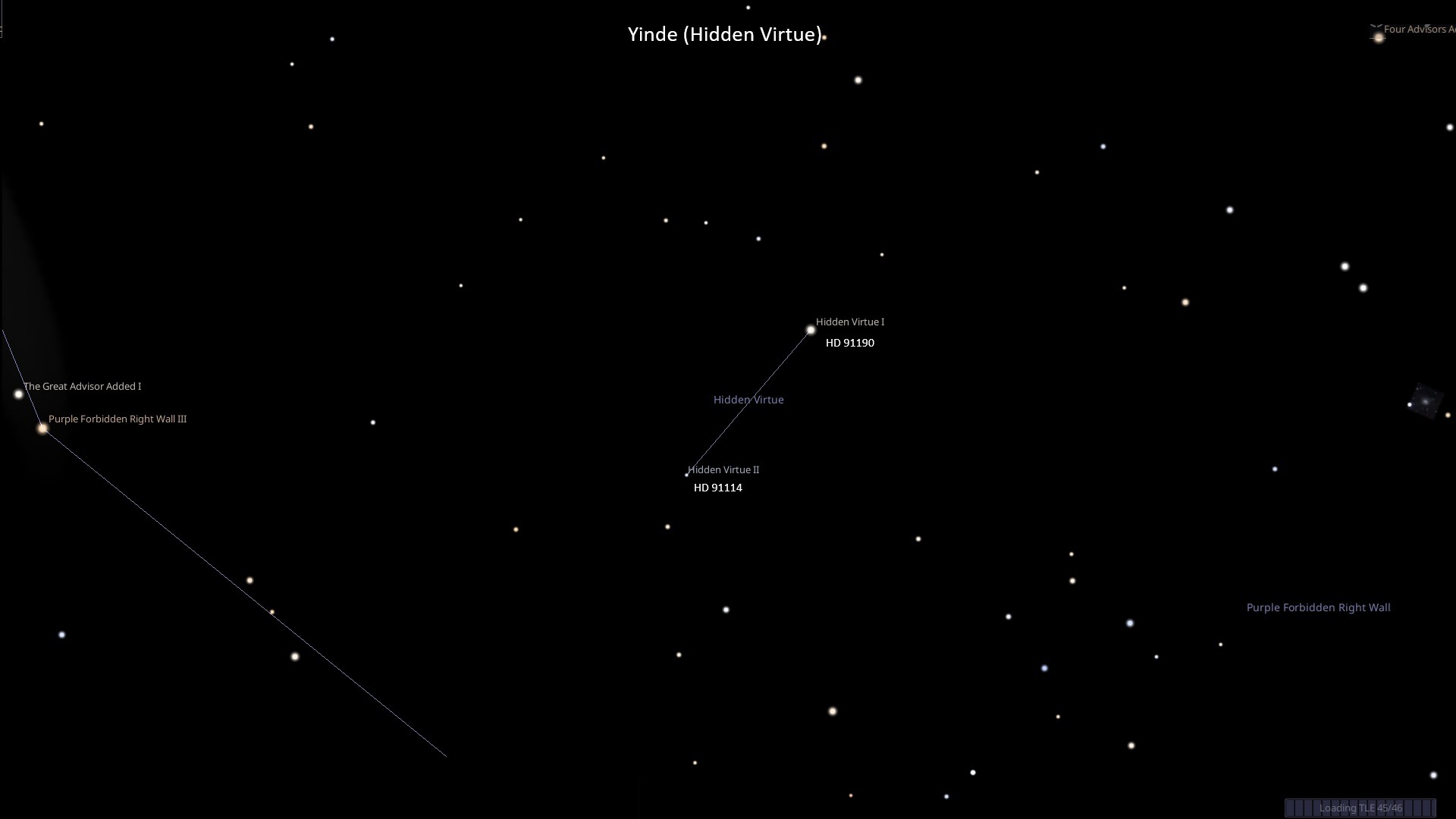
The 7th asterism of the Ziwei (Purple Forbidden) Enclosure is named 陰德 Yīndé, “Hidden Virtue.” It represents the female ruler of the central palace, signifying her benevolence and kindness, as well as the virtuous conduct of “benefiting the people without seeking recognition.” [1] It contains 2 stars in the constellation Draco. [2]
| 2000 | 2050 | IAU | Chinese | Orb |
| 26♋13 | 26♋55 | HD 91190 | Yinde Yi (1) | 1°00′ |
| 28♋36 | 29♋19 | HD 91114 | Yinde Er (2) | 1°00′ |
Yinde the Hidden Virtue
26♋13 to 28♋36
Yinde symbolizes the affairs of the emperor’s harem. Astrologers consider Yinde to be the symbol of the female ruler of the central palace, signifying her benevolence and kindness.
Its name means a form of virtuous conduct, derived from the idea of “benefiting the people without seeking recognition.” In the Book of Celestial Offices, it is described as “seemingly visible yet unseen.”
Yinde is associated with “providing relief and comfort in times of emergency,” directly corresponding to ancient social welfare institutions. It is also known as the “Emperor’s Palace Affairs Star.”
It is adjacent to the two stars of Dali (Chief Judge), which symbolize punishment, forming a celestial pattern of “virtue as the master and punishment as the assistant.” In addition, the two stars of Yinde complete a brightness cycle every 83 years. [1]
Ma Duanlin (1317)
The two Yin Virtue stars are located west of the Minister of the Palace within the Ziwei Palace. They govern the bestowal of virtue. Their divination is best if they are not bright; if they are bright, it indicates a new emperor has ascended the throne. The Sui Shu states: “The two stars west of the Shangshu (Minister of State) are Yin De and Yang De, who govern the relief and pacification in times of crisis.” They are further divided into two seated stars. [3]
Song History (1346)
The two stars of Yin De (Hidden Virtue) are depicted in the Wu Xian diagram, located west of the Shangshu (Royal Secretary). Gan Shi states: “Yin De sits to the right of the Shangshu, and Yang De (Yande I) sits to the right of Yin De (Yangde II). They represent the outer seats of Taiyin (Moon) and Taiyang (Sun), within the Ziwei Enclosure, guarding and assisting the emperor.”
The Tian Guan Shu (The Book of Celestial Offices) describes them as: “three stars in front of the Dipper’s mouth, sharp at the northern end, sometimes visible, sometimes not, called Yin De.” This signifies bestowing virtue without seeking recognition from others. They govern the relief of urgent needs and the comfort of people in distress.
When the star is bright, it indicates the establishment of a crown prince or a female ruler. If a guest star enters the constellation, it signifies drought and famine; if it remains over this region for some time, it signifies the distribution of grain to relieve the people. If a comet enters the constellation, it indicates a rebellion within the imperial harem. If a meteor (shooting star) enters the constellation, it signifies that the emperor’s orders are not obeyed. If clouds enter the constellation, yellow signifies joy; bluish-black signifies sorrow. [4]
References
- Yin De Xing Guan – Baidu Encyclopedia.
- Draco in Chinese astronomy – Wikipedia.
- General Examination of Literature, Volume 278, Part 1, Ma Duanlin, 1317.
- Song History, Volume 49, Chapter 2, 1346.
The pope seems to be giving some relief with his big old party in Spain. Kinda crazy. He’s the only public figure who seems to be having any fun. I mean just to see people joyous in the streets even if short lived offers some relief.
Mayhaps what people consider fun has changed. The sparkly rich and famous are not really portraying fun anymore. As they just manufacture garishness. There is no way for the masses to relate to that now. The too muchness is no longer enough