
STARS: Major | All | Constellations | Chinese | About
18♊38 to 29♊56
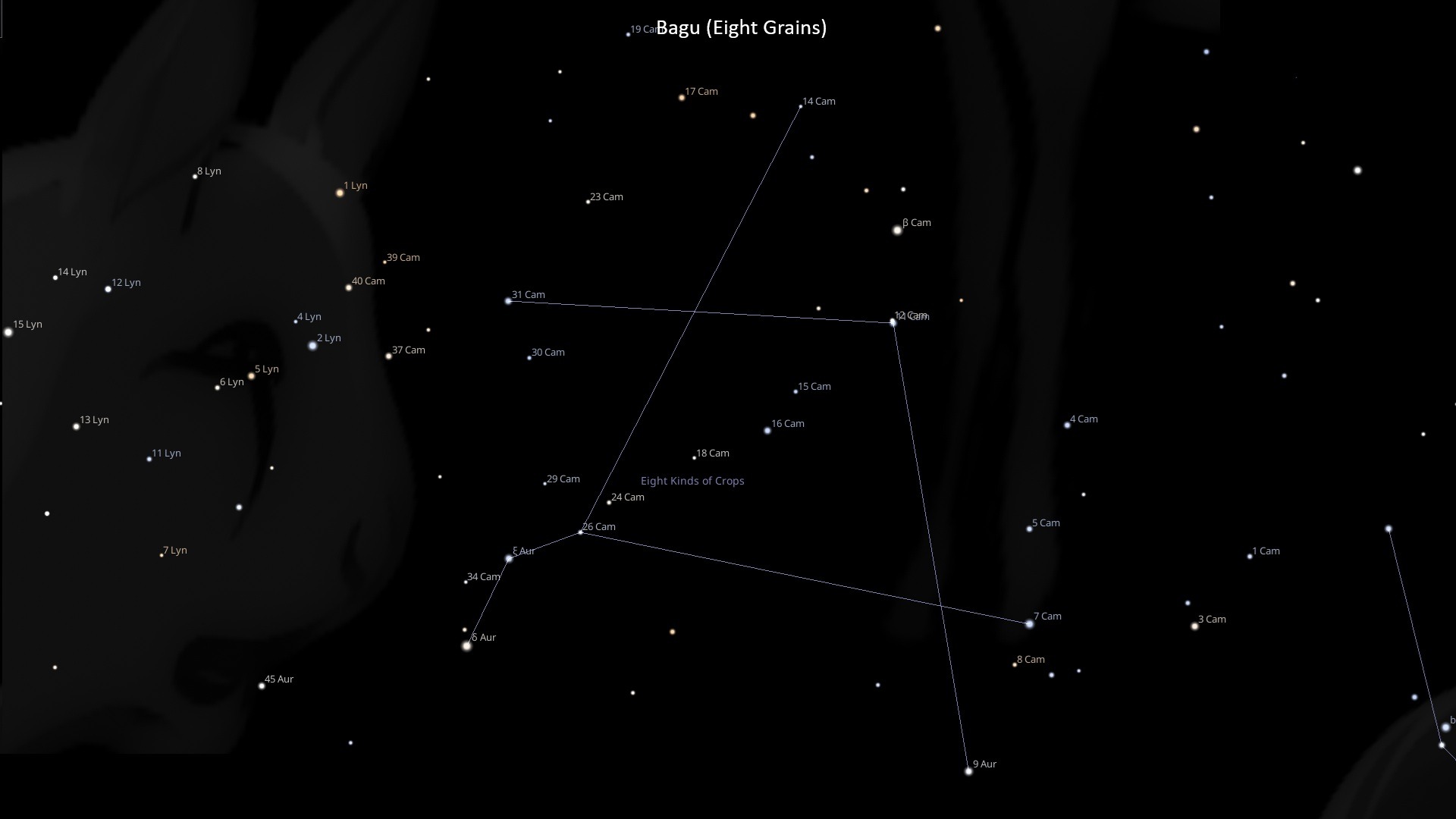
The 23rd asterism of the Ziwei (Purple Forbidden) Enclosure is named 八穀 Bāgǔ, “Eight Kinds of Crops.” The eight grains refer to rice, millet, barley, wheat, soybeans, red beans, chestnuts, and hemp, or they may refer to officials who manage land. The asterism contains 8 stars in the constellations Auriga and Camelopardalis. [1]
| 2000 | 2050 | IAU | Chinese | Orb |
| 29♊56 | 00♋38 | δ Aur | Bagu Yi (1) | 1°30′ |
| 18♊38 | 19♊20 | ξ Aur | Bagu Er (2) | 1°00′ |
| 27♊46 | 28♊29 | 26 Cam | Bagu San (3) | 1°00′ |
| 23♊08 | 23♊50 | 14 Cam | Bagu Si (4) | 1°00′ |
| 19♊16 | 19♊59 | 7 Cam | Bagu Wu (5) | 1°10′ |
| 20♊37 | 21♊19 | 9 Aur | Bagu Liu (6) | 1°00′ |
| 21♊21 | 22♊11 | 11 Cam | Bagu Qi (7) | 1°00′ |
| 29♊13 | 29♊55 | 31 Cam | Bagu Ba (8) | 1°00′ |
Bagu the Eight Grains
18♊38 to 29♊56
Bā Gǔ(八谷) refers to eight kinds of grains or the star official (asterism). As a core term in traditional agricultural civilization, the interpretation of “eight grains” has a dual system of verification:
Wang Yinglin of the Song Dynasty transcribed the Materia Medica commentary system in his Elementary Learning: Animals and Plants. He defined the eight grains as millet, sorghum, rice, millet, foxtail millet, hemp, beans, and wheat.
Miao Wei’s annotations to Li Bo’s Tianwen Xiang Da Fu in the Xu Gu Wen Yuan system, compiled in the Qing Dynasty, proposed a new interpretation, listing the eight grains as rice, millet, barley, wheat, soybean, mung bean, foxtail millet, and hemp. Among them, millet specifically refers to unhulled grains.
The main difference between the two classifications lies in the separate listing of millet and foxtail millet versus the detailed treatment of barley and wheat, reflecting the evolution of crop classification standards in different historical periods.
According to the Book of Divination, the ancients designated the eighth day of the first lunar month as Grain Day and observed that day’s weather to predict the harvest, forming the “seven people, eight grains” calendar culture. In ancient times, people held the “Laba Festival” on that day each year, offering dried food (Laba) to the gods of the eight grains to pray for a good harvest.
The constellation symbolizing the Eight Grains Star was considered an omen of agricultural abundance or scarcity.
Records of the eight-grain planting combinations in agricultural guidance provide empirical evidence for studying ancient crop rotation systems. The differences in the north-south distribution of millet and rice reflect the characteristics of cultivated zoning. [2]
Ma Duanlin (1317)
The Eight Grain Stars are outside the Western Enclosure of the Purple Palace (Ziwe Right Wall), north of the Five Chariots (Wuche). The eight stars govern rice, millet, barley, wheat, soybeans, mung beans, foxtail millet, and hemp. When they are bright, all eight grains will ripen; when they are dark, they will not. If one star is not visible, all eight grains will fail to ripen; if all eight stars are not visible, the people will struggle to survive. [3]
Song History (1346)
Asterism Bagu (Eight Grains) consists of eight stars, located west of Huagai (Canopy of the Emperor) and north of Wuche (Five Chariots); it is also said to lie west of Zhuwang (Feudal Kings).
Wu Mi states: “It governs the prediction of the year’s harvest abundance or scarcity, corresponding to: 1. rice, 2. broomcorn millet, 3. large barley, 4. wheat, 5. large soybeans, 6. small beans, 7. foxtail millet, and 8. hemp.”
Master Gan (220 AD) states: “The Eight Grains asterism is situated to the right of the northern gate of the palace (Ziwe Right Wall); it presides over the emperor’s ceremonial plowing, the forecasting of the harvest, and the management of the imperial food supplies.”
If the stars shine brightly, it is auspicious; if one star vanishes, the corresponding crop fails; if all eight stars are invisible, a great famine ensues. If a guest star enters the Bagu region, grain prices rise sharply. If a comet enters, it heralds floods. If dark clouds or vapors encroach upon it, the eight grain crops will fail to yield a harvest. [4]
References
- Ziwei Enclosure – Baidu Encyclopedia.
- Bā Gǔ – Baidu Encyclopedia.
- General Examination of Literature, Volume 278, Part 1, Ma Duanlin, 1317.
- Song History, Volume 49, Chapter 2, 1346.