
STARS: Major | All | Constellations | Chinese | About
21♌33 to 23♌29
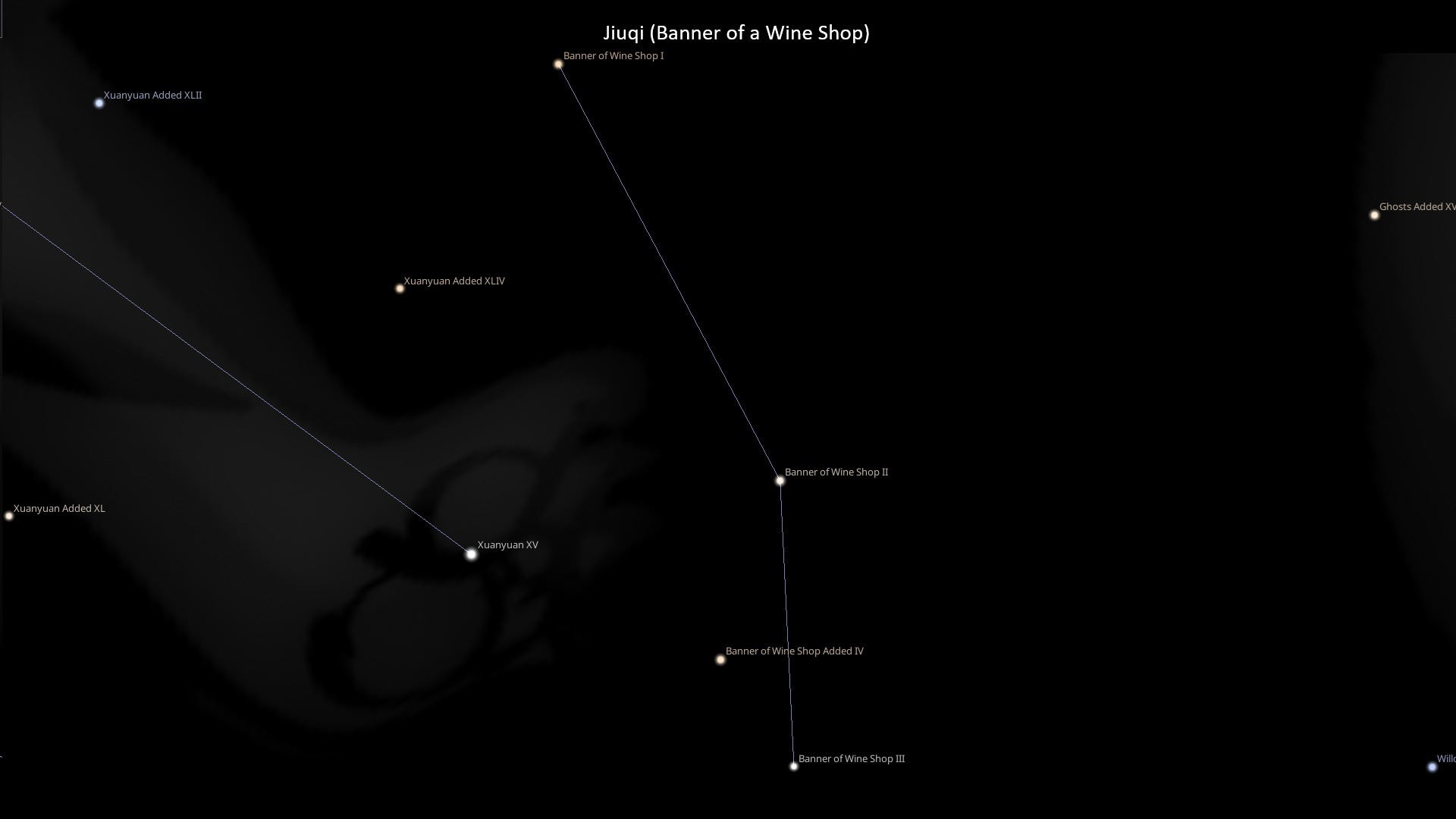
The 24th Chinese lunar mansion is named 柳宿 Liǔ Su, “Willow Mansion.” It is the 3rd of the 7 mansions of the Vermilion Bird of the South.
The 2nd asterism of the Willow Mansion is called 酒旗 Jiǔqí, “Banner of a Wine Shop.” It represents the bar banners outside the tavern attracting customers. It is composed of 3 faint stars of the constellation Leo. [1]
| 2000 | 2050 | IAU | Chinese | Orb |
| 23♌29 | 24♌12 | ψ Leo | Jiuqi Yi (1) | 1°00′ |
| 21♌39 | 22♌21 | ξ Leo | Jiuqi Er (2) | 1°00′ |
| 21♌33 | 22♌15 | ω Leo | Jiuqi San (3) | 1°00′ |
Jiuqi, the Banner of a Wine Shop
21♌33 to 23♌29
The term “wine star” is an ancient Chinese constellation term. It originally referred to the wine flag star in the sky. The Book of Jin: Treatise on Astronomy records that there are “three wine flag stars” in the southeast of the Xuanyuan constellation. The concept of the wine flag star has been mentioned in the Rites of Zhou.
The term originates from the “Wine Star Theory,” which, according to legend, was divinely bestowed upon Yi Di by the Celestial Wine Star Lord and later perfected by Du Kang. This theory integrates the principles of the I Ching with brewing techniques, advocating that brewing requires observing the movements of the twenty-eight constellations, including the Horn, Dipper, Kui, and Well constellations, and combining this with the connection between natural elements such as the sun, moon, water, and fire, and the spirits of heaven and earth. It selects the transition from spring to summer as the optimal time for storage and considers the sixth and ninth months of the lunar calendar inauspicious for brewing. It also standardizes procedures such as site selection, water usage, the use of talismans, the preparation of Chinese medicinal herbs, and sacrificial rites. [2]
Ma Duanlin (1317)
The eight stars of the Willow Constellation have curved heads resembling willow branches. The three stars near the top are called Wine, and the five stars guard the feasts and banquets.
The three stars of the Wine Flag, south of the right corner of Xuanyuan, are the flags of the wine official, in charge of banquets and feasts. Five stars guarding the Wine Flag indicate a grand feast throughout the land, with gifts of wine, meat, and wealth, and bestowal of titles upon members of the imperial family.
The *Astronomical Records of the Two Dynasties* states: The three stars of the Wine Flag are 77 degrees from the pole of the northwest star, entering the Liu constellation at 14 degrees. [3]
Song History (1346)
The three stars of Jiuqi (the wine flag) are located south of Xuanyuan’s right horn, representing the flag of the wine officials and governing banquets, feasts, and food consumption. If these stars are incomplete or missing from view, it signifies a great mourning event in the realm; if rulers indulge excessively in banquets and drinking to the point of drunkenness, it violates proper etiquette and leads to national decline through wine. If the stars remain bright, feasts and entertainment proceed with caution and propriety.
If any of the Five Planets guard Jiuqi (Wine Flag), a grand public feast occurs, with wine and meat bestowed upon the imperial clan as gifts. If Mars transgresses this area, food and drink consumption becomes excessive or immoderate. If Venus transgresses Jiuqi (Wine Flag) constellation, the Three Dukes and Nine Ministers plot against one another. If a guest star or comet transgresses here, the ruler suffers harm due to excessive drinking at the hands of his ministers. If red-colored cloud formations enter Jiuqi region, the sovereign experiences misfortune or mistakes caused by overindulgence in alcohol.
According to the “Jin Records,” Jiuqi Three Stars belong to Tian Shi Yuan (the Heavenly Market Enclosure). The “Bu Tian Ge” assigns Jiuqi to Liu Xiu constellation. According to the “Tongzhan Jing,” it also belongs to Liu and is associated with Qixing (Seven Stars) constellation as well. The “Qian Xiang Xin Shu” also assigns it to Qixing, differing from the “Bu Tian Ge.” Both interpretations are preserved for reference today. [4]
References
- Liu Xiu – Baidu Encyclopedia.
- Wine Star – Baidu Encyclopedia.
- General Examination of Literature, Volume 279, Part 2, Ma Duanlin, 1317.
- Song History, Volume 50, Chapter 3, 1346.