
STARS: Major | All | Constellations | Chinese | About
22♈23 to 03♉57
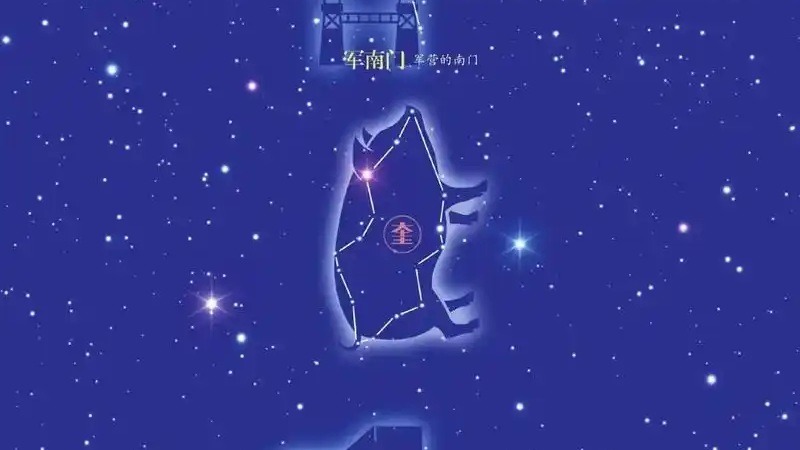
The 15th Chinese lunar mansion is named 奎宿 Kuí Su, “Legs Mansion.” It is the 1st of the 7 mansions of the White Tiger of the West. It represents the Mouth of the White Tiger.
The Legs Mansion contains 9 star officials (asterisms) and 42 stars, distributed in the constellations Andromeda, Cassiopeia, Cetus and Pisces.
| # | Asterism | English | 2000 | Constellations | Stars |
|---|---|---|---|---|---|
| 1 | Kuí | Legs | 20♈35 | Andromeda / Pisces | 16 |
| 2 | Wàipíng | Outer Fence | 14♈09 | Pisces | 7 |
| 3 | Tiānhùn | Celestial Pigsty | 05♈14 | Cetus | 4 |
| 4 | Tǔsīkōng | Master of Constructions | 02♈35 | Cetus | 1 |
| 5 | Jūnnánmén | Southern Military Gate | 06♉25 | Andromeda | 1 |
| 6 | Gédào | Flying Corridor | 02♉28 | Cassiopeia | 6 |
| 7 | Fùlù | Auxiliary Road | 05♉04 | Cassiopeia | 1 |
| 8 | Wángliáng | Wang Liang | 04♉40 | Cassiopeia | 5 |
| 9 | Cè | Whip | 13♉56 | Cassiopeia | 1 |
Constellation Kui the Legs
22♈23 to 03♉57
Those born under the Kui constellation are emotionally rich, straightforward, friendly, and warm-hearted. They pursue truth, goodness, and beauty, and are generally fortunate in life. They lack courage and perseverance, but if they let go of their stubbornness, happiness will be right beside them.
The constellation Kui is composed of sixteen relatively dim stars, shaped like the sole of a shoe, and is considered the mouth of the White Tiger God. It belongs to the element of wood and represents the wolf. As the first constellation in the west, it signifies the celestial treasury; hence, the Kui constellation is generally considered auspicious.
When the constellation Kui is in charge, it is auspicious to set up camp, and all construction and repairs will be very successful. This day is suitable for burials and marriages, and the fields and estates will prosper day by day.
The character奎 (Kui) is defined in the Shuowen Jiezi as “between the two thighs.” The Guangya defines it as “the hip, which is 奎.” The Kui constellation consists of sixteen stars, with its left and right halves resembling two thighs. The Bu Tian Ge describes the Kui constellation as: “A slender waist and a pointed head, like a worn-out shoe, with sixteen stars circling around it.” [2]
Kui Mulang
This Kui Mansion person has a certain destiny. They are destined to inherit property from their grandfather and acquire wealth through business. They are destined to receive more after their possessions are exhausted. They are naturally inclined to give alms without end, and are also skilled in subtle and auspicious deeds. They are suited for a life of leisure and enjoy life’s pleasures. They admire virtuous people and perform virtuous rituals. They are destined to bestow gifts upon men and women without end and receive instruction in Buddhist scriptures.
They are suited to acquiring treasures, building warehouses and livestock pens, calculating livestock, making wine and melting butter, constructing dikes, and grinding medicine. Wearing new clothes and adornment for long journeys is auspicious. Doing good deeds and taking swift action are also favorable.
Kui Advice
While it’s possible to view the world calmly at times and to strictly demand of oneself a positive and healthy attitude in all aspects, going too far can reduce tolerance. This world exists because of darkness; only then do we know that white is white. Quietly observing is also interesting.
One is prone to becoming overly involved with one’s spouse’s family after marriage, neglecting one’s own family of origin. The fortune associated with the Kui constellation is inherited from ancestors; not only will tomb sweeping and ancestor worship bring good luck, but starting with unconditional filial piety towards one’s parents will also bring greater prosperity. Moreover, this is what one should do.
A small number of people born under the Kui constellation are easily influenced by the atmosphere and fall into dangerous love affairs. Multiple relationships will eventually lead to self-destruction. Managing one’s desires well will bring spiritual growth. Good fortune brought by the opposite sex is a natural gift; ultimately, one must master the ability to forge one’s own path in life to truly control one’s destiny. [3]
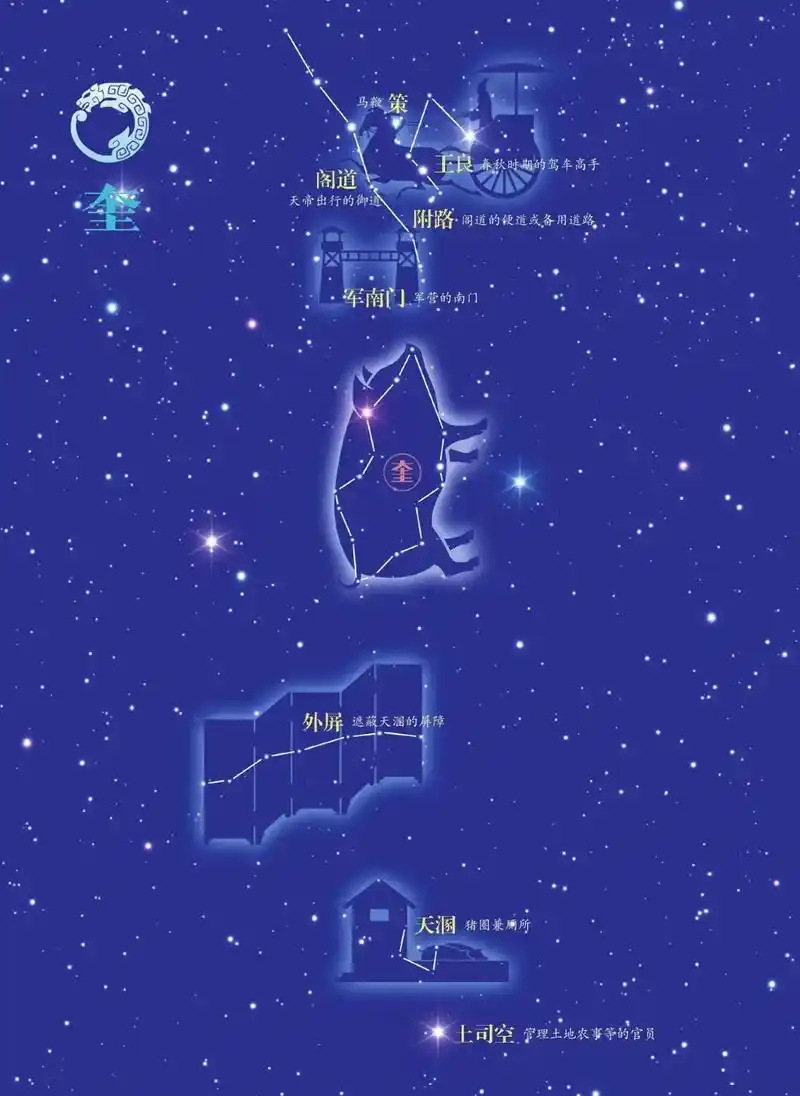
Mansion XV – Kui (Legs)
Ma Duanlin (1317)
Kui, with its slender waist and pointed head, resembles a worn-out shoe, surrounded by sixteen stars. Seven crows lie horizontally below Kui on the outer screen, and seven stars below the screen illuminate the celestial realm, the essence of which lies to the left of Sikong. Above Kui is the constellation of the army at the south gate. Six pavilions in the river resemble a road, with one star shining brightly beside the road. Five stars, including Wang Liang, are associated with flowers, and a strategist is nearby.
Kui, spanning sixteen degrees, is the celestial arsenal. The Shi school refers to it as the Celestial Swine (or Fengshi—the Giant Swine), governing warfare. The region below its nine-foot span constitutes the central path of the heavens; it also governs ditches and waterways. The large star to the southwest (fixed star Shimu) is known as the “Eye of the Celestial Swine” (or the “Great General”). When it shines brightly, the world enjoys peace; if it stirs or wavers, warfare and chaos ensue. If a guest star enters or lingers there, war breaks out; if Venus or Mars lingers there, floods occur. The Treatise of the Sui Dynasty states that if the Emperor is licentious and governance unjust, a “horn” appears on Kui; the movement of this horn heralds war, and within the year, issues regarding ditches or waterways will arise. It is also said that if the central stars of Kui shine brightly, massive flooding occurs. Solar and lunar eclipses, or encroachments by the five planets, all portend misfortune.
The seven stars south of Kui are called Waiping (Outer Screen), serving to shield the Tianhun (Celestial Latrine); their divinatory significance is the same as that of Tianjun (Celestial Granary).
The seven stars of Tianhun lie south of Waiping and represent the celestial latrine; if they become invisible, the populace faces unrest, as is the case with mass migrations.
The single star south of Tianhun is called Tu Sikong (Minister of Works/Earth Official), governing matters of water and soil; if it appears large and brightly yellow, the world is at peace. If a guest star enters it, there will be extensive earthworks and a great epidemic across the land.
The single star known as Jun Nanmen (Southern Gate of the Army) lies southwest of the “General” star and governs the monitoring of entry and exit; if it wavers, the army is on the move; if it disappears, military chaos follows.
The six stars of Gedao (Gallery Road)—located ahead of Wangliang—form a celestial thoroughfare stretching from the Purple Palace to the Milky Way, serving as a path for divine beings. One name for it is Zhu Dao Li (Road of the Son of Heaven); Zhang Heng described it as the route the Son of Heaven takes when traveling to his detached palaces. It is also known as the Wang Liang Flag or the Zi Gong (Purple Palace) Flag; these serve as markers of status and are intended to remain steady, without swaying. If a single star is missing, the imperial carriage route is considered blocked; if the stars waver, it portends an armed uprising within the palace precincts.
The star Fu Lu (Auxiliary Road) lies just south of the Ge Dao (Gallery Road); it serves as a backup route to be used should the main gallery road fail or become impassable. Another name for the asterism is Tai Pu (Grand Charioteer); it governs the driving of the carriage through wind and rain, reflecting the function of the imperial entourage. Its divinatory significance is the same as that of the Ge Dao.
The Wang Liang asterism consists of five stars located north of the Kui (Legs) mansion and within the Celestial River; they represent the officials who drive and manage the Emperor’s carriages. Four of these stars are called Tian Si (Celestial Team of Four Horses), while the star to the side is named Wang Liang (also known as Tian Ma, or Celestial Horse). Movement among these stars signifies the whipping of horses—hence the phrase “Wang Liang whips the horses,” portending a landscape filled with chariots and cavalry. It is also known as Wang Liang (where Liang signifies a celestial bridge), governing travel through wind and rain as well as waterways; consequently, it is sometimes interpreted in relation to fords and bridges. A shift in the stars’ positions indicates the outbreak of war or, alternatively, illness among the horses. If a “guest star” (nova or comet) lingers there, the bridge is considered impassable; if the stars of Metal (Venus) or Fire (Mars) linger there, it signals the threat of war.
The foremost star is called Ce (Whip), representing the charioteer’s whip; it governs the Emperor’s carriage drivers. Situated beside Wang Liang, if it shifts to a position behind the “horses,” it signifies that the fields are filled with chariots and cavalry.
Treatise on Astronomy of the Two Song Dynasties: Of the sixteen stars of the Kui (Legs) Mansion, the large star at the southwest—serving as the determinant star—is 72 degrees from the celestial pole. Of the Waiping (Outer Screen) asterism, the western star is 89 degrees from the pole and enters the Bi (Wall) Mansion at the 8.5-degree mark. Of the Tianhun (Celestial Latrine) asterism, the southwestern star is 97 degrees from the pole and enters the Kui Mansion at the 3-degree mark. The star Tusikong (Master of Works for Earth) is slightly less than 115 degrees from the pole and enters the Bi Mansion at the 9-degree mark. The star Junnanmen (Southern Gate of the Military Camp) is 66 degrees from the pole and enters the Kui Mansion at the 15-degree mark. The star Fulu (Auxiliary Road) is 35.5 degrees from the pole and enters the Kui Mansion at the 5-degree mark. Of the five stars of Wangliang, the western star is 37 degrees from the pole and enters the Bi Mansion at the initial degree. [4]
Song History (1346)
The Kui asterism consists of sixteen stars and serves as the celestial arsenal; it is also known as Tian Shi (Celestial Pig) or Feng Shi (Giant Pig). It governs the use of military force to suppress violence and also presides over ditches and waterways. The large star to the southwest (fixed star Shimu) is called Tian Shi Mu (Eye of the Celestial Pig) or Da Jiang (The Great General); if it shines brightly or wavers, major outbreaks of warfare and flooding will occur.
A solar eclipse here bodes ill for the State of Lu, signaling border conflicts, floods, or droughts; a solar halo signifies war or fire.
A lunar eclipse signifies that ministers who hoard wealth will face troubles. If a halo appears around the moon, it indicates military defeat, high grain prices, generals being executed, and people suffering from epidemics. If the moon transgresses this mansion, disorder will occur in its corresponding region.
If Jupiter encroaches, a close minister will commit treason; if it lingers there, insect plagues, famine, banditry, and a surge in lawsuits will ensue; if it lingers for a long time, northern troops will surrender; if the star appears lustrous, a bumper harvest follows; if it lingers for over twenty days, war breaks out in the territory of Lu; if it lingers while in retrograde motion, the ruler develops a fondness for war, and the populace is displaced.
If Mars encroaches and circles the asterism for over thirty days, misfortune befalls generals and ministers, accompanied by great floods and the displacement of the people; if it lingers for over twenty days, there is warfare in the territory of Lu; if it wavers or moves back and forth, an amnesty will be granted; if it stations itself there, the year sees a bumper harvest; if it remains stationary, subordinates usurp power and lawsuits multiply; if it lingers for over a hundred days, banditry becomes rampant.
If the planet Saturn enters or encroaches upon this asterism, there will be warfare in the states of Wu and Yue (or alternatively, in Qi and Lu), or else conflict and mourning; if it lingers there, a noble woman will hold political power; if it enters and exits, springs and streams will overflow.
If Venus encroaches upon it, there will be great floods, warfare, and frost damage to crops; if it enters, foreign troops will invade the state; if it appears during the day, high-ranking officials or generals will die.
If Mercury encroaches upon it, rivers will burst their banks, warfare will arise, and drought or fire will occur; if it lingers there, the ruler will face anxiety, along with war and drought.
If a guest star encroaches upon it, there will be issues regarding canals or waterways; if it lingers, the ruler will face anxiety, the army will suffer defeat, and treacherous ministers will be close at hand; if it enters, armies will be routed and generals killed; if it halts and does not depart, famine will ensue; if it exits, a strategist will mislead the Emperor.
If a comet encroaches, it signifies famine, warfare, and mourning; if it exits, there will be floods.
If a hairy star (boshi) appears, troops will be deployed, the people will starve, and the state will lack an heir; if it exits, warfare will erupt in the northwest.
If a meteor enters or encroaches, there will be issues regarding waterways, and armies will be routed or generals killed. According to the Yisi Zhan (Divination of the Yisi Year): if a meteor enters or exits with a lustrous yellow-white glow, civil virtues will flourish and military force will be set aside; if it is red like fire and makes a sound, it heralds the use of bows and crossbows; alternatively, if it enters, it signifies the gathering of crowds.
If red clouds or vapors enter or encroach, it signifies warfare; yellow signifies the Emperor’s joy; black signifies anxiety for high-ranking figures.
According to the bronze instrument of the Yongyuan era of the Han dynasty, the Kui trigram was 17 degrees, and the Kaiyuan era of the Tang dynasty was 16 degrees. The old distance from the pole was 76 degrees, and the Jingyou measurement was the same.
Tianhun (Celestial Latrine) consists of seven stars located outside the Southern Screen (Pingnan); it governs the celestial latrine—the place where pigs are kept—and is also known as the heavenly privy. If the stars appear dim, people will lack peace of mind; if the stars shift position, it portends misfortune.
The star Tu Sikong (Earth Minister of Works) is located south of the Jiao (Horn) asterism; it is also known as Tiancang (Celestial Granary) and governs matters related to earthworks. It presides over the assessment of benefits and achievements regarding the construction of cities, the dredging of canals and ditches, and the repair of embankments; at the end of each year, the merits and shortcomings of projects—large and small—across the realm are reported, and rewards or punishments are meted out accordingly. When the star appears large and yellow, the world enjoys peace. If any of the Five Planets encroach upon it, men and women are prevented from farming and weaving. If a comet or “guest star” (nova/supernova) encroaches upon it, floods and droughts ensue, the populace is displaced, major military conflicts erupt, and large-scale earthworks are undertaken. If a guest star lingers there, it heralds earthworks and occasions for mourning. If yellow clouds or vapors drift into the area, earthworks commence, and the capital city is relocated.
The star Ce Yi Xing lies north of Wang Liang; it represents the charioteer of the Son of Heaven and governs the holding of the whip and the driving of the chariot. If a shooting star, a comet, a bei star, or a guest star encroaches upon it, it signifies the outbreak of major warfare, requiring the Son of Heaven to personally lead the campaign in the field; a close approach indicates a plot to rebel among his subjects.
Fulu (Auxiliary Road)—also written as Fu—is a single star located south of the Geda (Gallery Road) asterism; it represents a secondary or branch road. Some say it lies east of Wangliang and governs the Grand Coachman (Taipu) as well as the driving of carriages through wind and rain. If the star displays rays or spikes, it signifies that chariots and cavalry are deployed in the field; if the star vanishes, there will be disruptions to the road network; if it fails to appear, war will break out. If Venus (Taibai) or Mars (Yinghuo) enters this asterism, war ensues. If a comet or broom star encroaches upon it, roads become impassable. If a guest star enters, the price of horses drops. If bluish-white vapors enter, the Grand Coachman faces trouble; if red, he faces execution; if yellow-white, he receives a reward; if black, he faces death.
The six stars of Gedao (the Elevated Corridor) lie ahead of Wangliang; they represent a celestial thoroughfare—a path extending from the Purple Palace (Zigong) used by the River Deity. It is also said to be the route for the Emperor’s carriage corridor, serving as the path for his excursions to detached palaces. If the stars are invisible, the carriage corridor is impassable; if they waver or shake, there is military unrest within the palace precincts. If a comet, bei star, or guest star encroaches upon them, the ruler faces instability in the state or a bereavement. The intrusion of white vapor signifies an urgent matter; black vapor indicates the ruler is ill; yellow vapor heralds a joyous event for the Emperor.
The Wang Liang asterism consists of five stars located north of the Kui mansion and situated within the celestial river; it represents the official responsible for the Emperor’s carriage and horses. Four of these stars are known as Tiansi (Celestial Team of Horses), while the adjacent single star is called Wang Liang—also known as the Tianma (Celestial Horse) star; its movement heralds the filling of the fields with carriages and cavalry. It is also identified as the Tianqiao (Celestial Bridge), governing the control of wind, rain, and waterways. If the stars are incomplete or a “guest star” (such as a nova or comet) lingers there, crossings and bridges will become impassable. Being close to the Gedao (Gallery Road) asterism, disturbances here signal calamities involving rivers or waterways. When the stars shine brightly, the price of horses drops; when they are dim, horses face disaster. If Venus or Mars enter and linger in this area, it portends warfare. If a comet or guest star encroaches upon it, it signifies war and mourning, and bridges across the realm become impassable. Encroachment by a meteor signals the imminent mobilization of a massive army. If a blue cloud-vapor encroaches, the official responsible for the Emperor’s carriage faces the danger of falling from the vehicle; if the vapor is red, Wang Liang faces the threat of an axe or blade.
Wai Ping (The Outer Screen) of Seven Stars, located south of the Kui (Legs) Mansion, governs the obstruction of foul odors.
Junnanmen (The Southern Gate of the Army) is located south of the Tian Da Jiang Jun (Great General of Heaven) asterism; it serves as the southern gate for that figure. It governs the monitoring of comings and goings. If the star is dim, foreign nations will rebel; if it wavers, warfare will erupt; if it shines brightly, distant lands will come to offer tribute.
According to the Bu Tian Ge (Song of Stepping Through the Heavens), the aforementioned stars all belong to the Kui Mansion. Cross-referencing with the Jin Zhi (Treatise on Astronomy in the Book of Jin), the stars Wangliang, Fulu, Gedao, Junnanmen, and Cexing are all located within the Tianshi Yuan (Celestial Market Enclosure); notably absent are stars such as Waiping, Tianhun, and Tusikong—which do appear in the Sui Zhi (Treatise on Astronomy in the Book of Sui). However, the Wu Mi assigns Wangliang, Waiping, and Tianhun to the Bi Mansion, though it also suggests Waiping might belong to the Kui Mansion. The Qianxiang Xinshu (New Treatise on Celestial Phenomena) assigns the westernmost star of Wangliang to the Bi Mansion and the four eastern stars to the Kui Mansion, while assigning the westernmost star of Waiping to the Bi Mansion and the six eastern stars to the Kui Mansion; these classifications differ from those in the Bu Tian Ge. [5]
References
- Kuí Xiù – Baidu Encyclopedia.
- Twenty-Eight Mansions – Baidu Encyclopedia.
- Comprehensive Analysis | Unveiling the Personality Traits of the [Kui] Constellation.
- General Examination of Literature, Volume 279, Part 2, Ma Duanlin, 1317.
- Song History, Volume 50, Chapter 3, 1346.