
STARS: Major | All | Constellations | Chinese | About
02♉28 to 02♊14
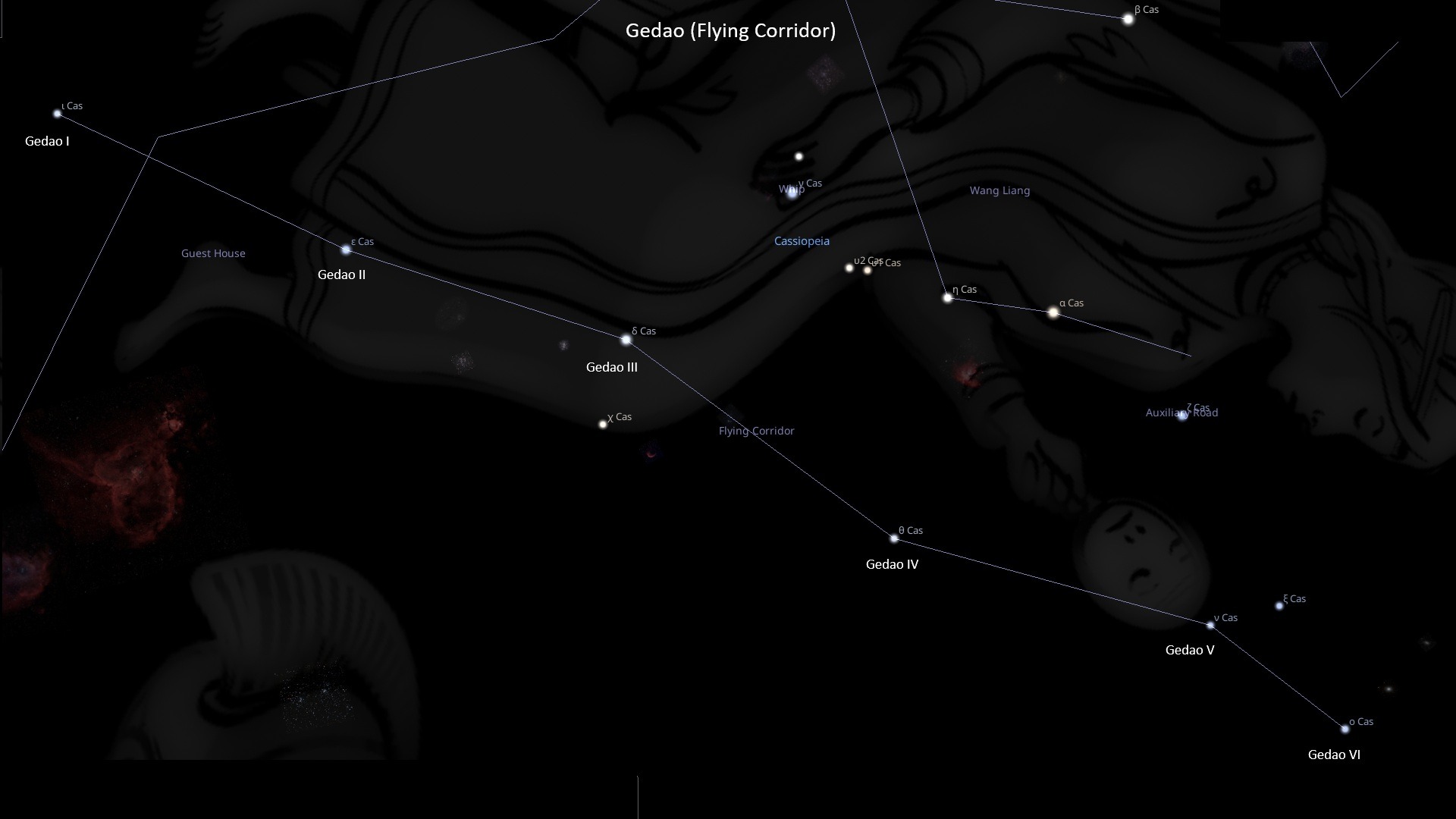
The 15th Chinese lunar mansion is named 奎宿 (Kuí Su), “Legs Mansion.” The 6th asterism of the Legs Mansion is called 閣道 (Gédào), “Flying Corridor.” It represents the elevated walkways between high-rise buildings and is composed of 6 stars of the constellation Cassiopeia. [1]
| 2000 | 2050 | IAU | Chinese | Orb |
| 02♊14 | 02♊56 | ι Cas | Gedao Yi (1) | 1°10′ |
| 24♉46 | 25♉28 | ε Cas | Gedao Er (2) | 1°40′ |
| 17♉56 | 18♉38 | δ Cas | Gedao San (3) | 2°00′ |
| 11♉48 | 12♉30 | θ Cas | Gedao Si (4) | 1°10′ |
| 05♉01 | 05♉43 | ν Cas | Gedao Wu (5) | 1°00′ |
| 02♉28 | 03♉10 | ο Cas | Gedao Liu (6) | 1°10′ |
Gedao the Flying Corridor
02♉28 to 02♊14
The term “阁道” (gé dào), “Pavilion Road,” is a Chinese word that has various meanings, including covered walkway, plank road, and the star official (asterism) in the constellation Kui.
As a covered walkway, a pavilion walkway is an aerial corridor with a roof and walls on the sides between palaces. It was common in the Qin and Han dynasties and was often supported by a stilt structure. As a plank road, it refers to a path constructed by drilling holes in the cliff face and laying wooden planks.
Its concept was first seen in the Records of the Grand Historian regarding Qin Dynasty architecture. It flourished during the Qin and Han dynasties and was used to connect palace buildings. Plank roads were widely used during the Warring States period. [2]
Ma Duanlin (1317)
The six stars of Gedao (Pavilion Road)—located ahead of Wangliang—form a celestial thoroughfare stretching from the Purple Palace to the Milky Way, serving as a path for divine beings. One name for it is Zhu Dao Li (Road of the Son of Heaven); Zhang Heng described it as the route the Son of Heaven takes when traveling to his detached palaces. It is also known as the Wang Liang Flag or the Zi Gong (Purple Palace) Flag; these serve as markers of status and are intended to remain steady, without swaying. If a single star is missing, the imperial carriage route is considered blocked; if the stars waver, it portends an armed uprising within the palace precincts. [3]
Song History (1346)
The six stars of Gedao (the Elevated Corridor) lie ahead of Wangliang; they represent a celestial thoroughfare—a path extending from the Purple Palace (Zigong) used by the River Deity. It is also said to be the route for the Emperor’s carriage corridor, serving as the path for his excursions to detached palaces.
If the stars are invisible, the carriage corridor is impassable; if they waver or shake, there is military unrest within the palace precincts. If a comet, bei star, or guest star encroaches upon them, the ruler faces instability in the state or a bereavement. The intrusion of white vapor (clouds) signifies an urgent matter; black vapor indicates the ruler is ill; yellow vapor heralds a joyous event for the Emperor. [4]
References
- Kuí Xiù – Baidu Encyclopedia.
- Gé Dào – Baidu Encyclopedia.
- General Examination of Literature, Volume 279, Part 2, Ma Duanlin, 1317.
- Song History, Volume 50, Chapter 3, 1346.