
STARS: Major | All | Constellations | Chinese | About
04♉40 to 12♉36
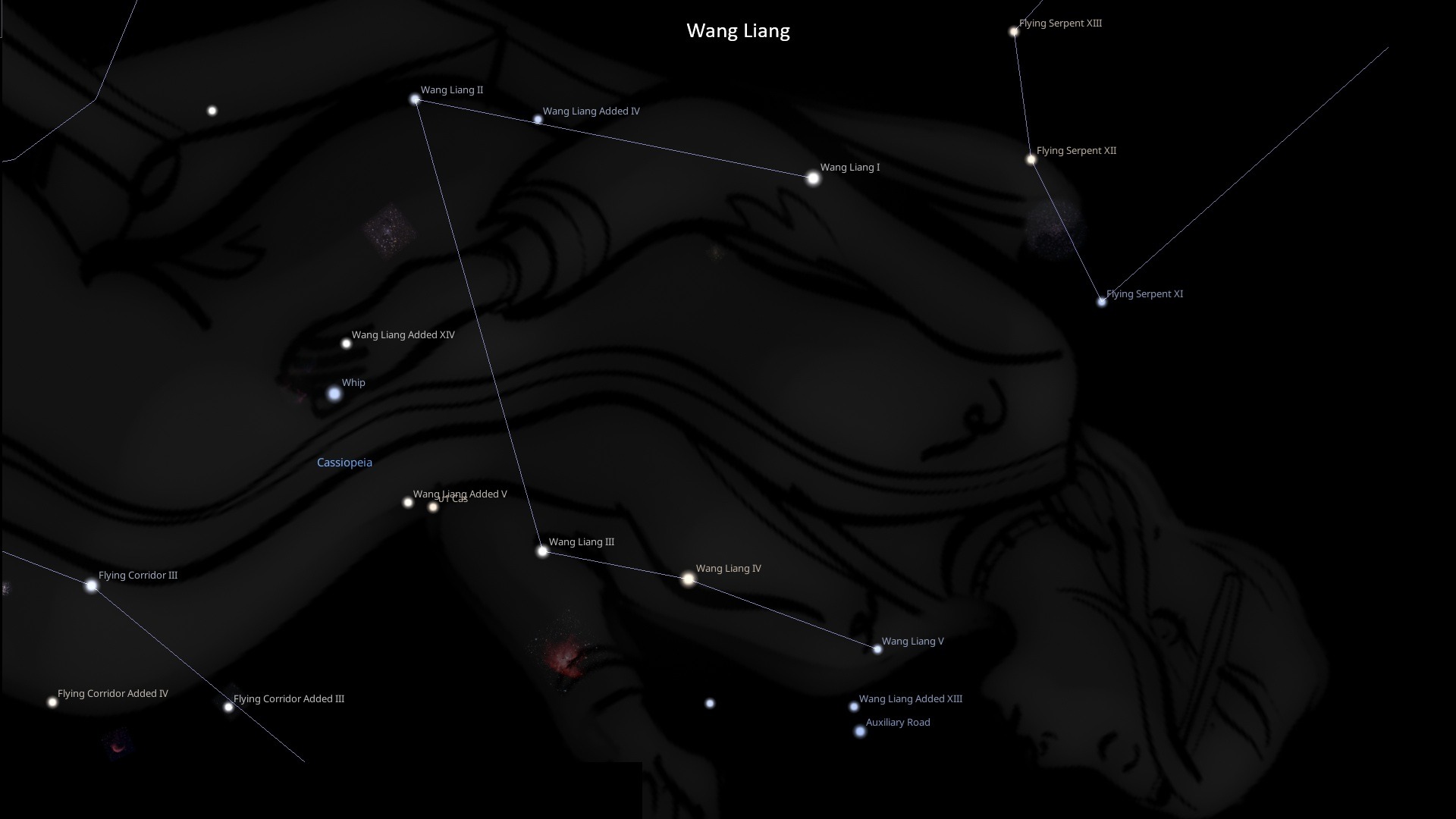
The 15th Chinese lunar mansion is named 奎宿 (Kuí Su), “Legs Mansion.” The 8th asterism of the Legs Mansion is called 王良 (Wángliáng), “Wang Liang.” It represents a famous charioteer during the Spring and Autumn period and is composed of 5 stars of the constellation Cassiopeia. [1]
| 2000 | 2050 | IAU | Chinese | Orb |
| 05♉08 | 05♉50 | β Cas | Wangliang Yi (1) | 2°10′ |
| 12♉36 | 13♉18 | κ Cas | Wangliang Er (2) | 1°20′ |
| 10♉16 | 10♉58 | η Cas | Wangliang San (3) | 1°40′ |
| 07♉47 | 08♉29 | α Cas | Wangliang Si (4) | 2°10′ |
| 04♉40 | 05♉22 | λ Cas | Wangliang Wu (5) | 1°00′ |
Wang Liang
04♉40 to 12♉36
In modern astronomical divisions, the constellation Wang Liang is located within Cassiopeia, specifically corresponding to the sharper “V” shape within the “W” of Cassiopeia.
Wang Liang was a skilled charioteer from the state of Jin during the Spring and Autumn Period; he once drove the chariot for Zao Fu.
In the ancient Chinese system of star officials (asterisms), Wang Liang was imagined as a coachman who rode a heavenly horse and drove the emperor’s chariot on the covered road.
Wang Liang is closely associated with the “Ce” star and the “Gedao” constellation, together depicting the complete celestial phenomenon of Wang Liang whipping his horse and galloping on the Gedao (Pavilion Road).
Wang Liang I (β Cas) represents the charioteer Wang Liang himself, while Wang Liang II to Wang Liang V represent four horses pulling the chariot. [2]
Ma Duanlin (1317)
The Wang Liang asterism consists of five stars located north of the Kui (Legs) mansion and within the Celestial River; they represent the officials who drive and manage the Emperor’s carriages. Four of these stars are called Tian Si (Celestial Team of Four Horses), while the star to the side (β Cas) is named Wang Liang (also known as Tian Ma, or Celestial Horse).
Movement among these stars signifies the whipping of horses—hence the phrase “Wang Liang whips the horses,” portending a landscape filled with chariots and cavalry. It is also known as Wang Liang (where Liang signifies a celestial bridge), governing travel through wind and rain as well as waterways; consequently, it is sometimes interpreted in relation to fords and bridges. A shift in the stars’ positions indicates the outbreak of war or, alternatively, illness among the horses. If a “guest star” (nova or comet) lingers there, the bridge is considered impassable; if Venus or Mars linger there, it signals the threat of war. [3]
Song History (1346)
The Wang Liang asterism consists of five stars located north of the Kui mansion and situated within the celestial river (Milky Way); it represents the official responsible for the Emperor’s carriage and horses. Four of these stars are known as Tiansi (Celestial Team of Horses), while the adjacent single star (β Cas) is called Wang Liang—also known as the Tianma (Celestial Horse) star; its movement heralds the filling of the fields with carriages and cavalry. It is also identified as the Tianqiao (Celestial Bridge), governing the control of wind, rain, and waterways.
If the stars are incomplete or a “guest star” (such as a nova or comet) lingers there, crossings and bridges will become impassable. Being close to the Gedao (Gallery Road) asterism, disturbances here signal calamities involving rivers or waterways. When the stars shine brightly, the price of horses drops; when they are dim, horses face disaster. If Venus or Mars enter and linger in this area, it portends warfare. If a comet or guest star encroaches upon it, it signifies war and mourning, and bridges across the realm become impassable. Encroachment by a meteor signals the imminent mobilization of a massive army. If a blue cloud-vapor encroaches, the official responsible for the Emperor’s carriage faces the danger of falling from the vehicle; if the cloud is red, then Wangliang officials face worries of execution by axe or blade. [4]
References
- Kuí Xiù – Baidu Encyclopedia.
- Wang Liangxing Guan – Baidu Encyclopedia.
- General Examination of Literature, Volume 279, Part 2, Ma Duanlin, 1317.
- Song History, Volume 50, Chapter 3, 1346.