
STARS: Major | All | Constellations | Chinese | About
05♒37 to 14♒34
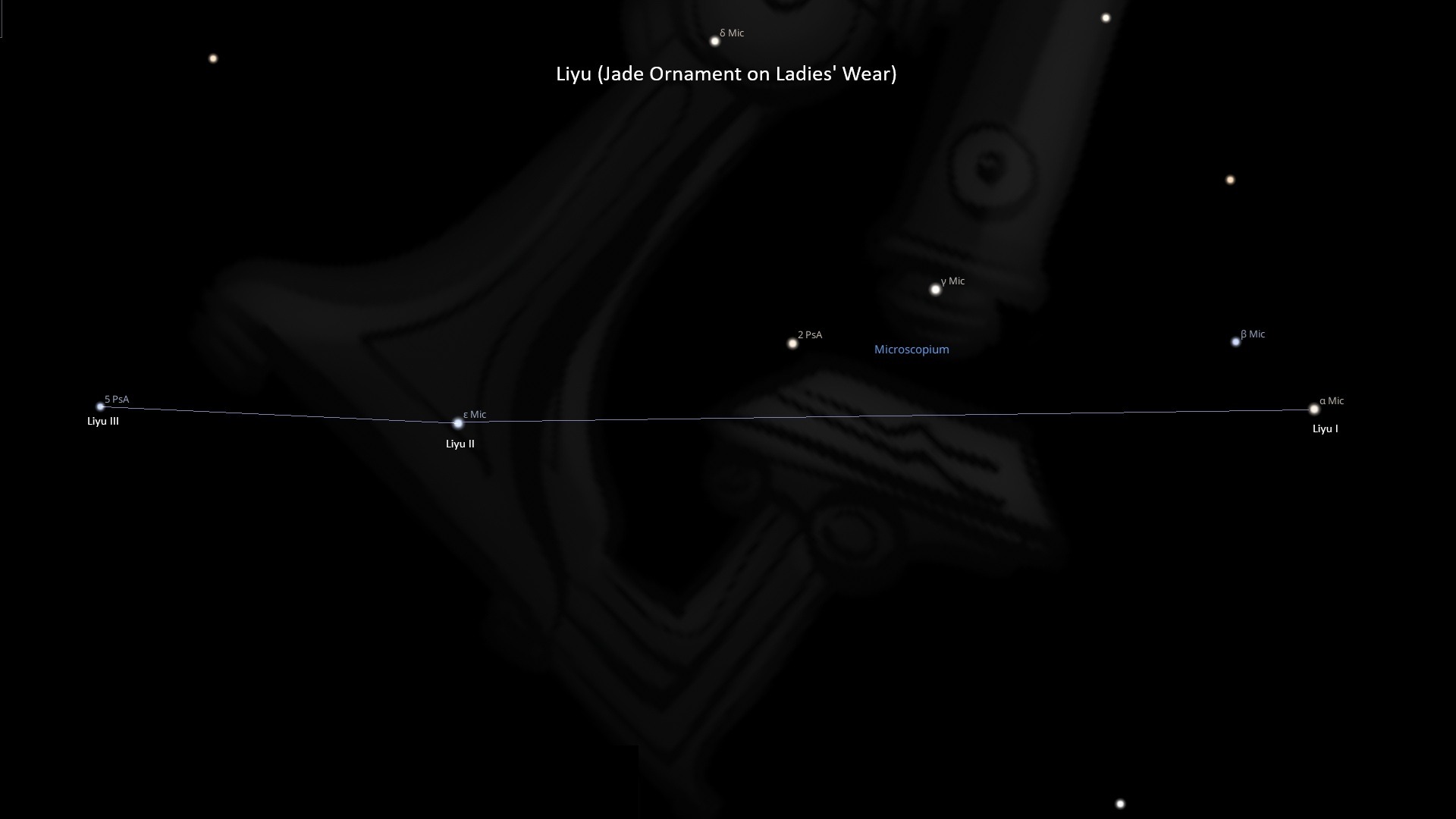
The 11th Chinese lunar mansion is named 虛宿 Xū Su, “Emptiness Mansion.” It is the 4th of the 7 mansions of the Black Tortoise of the North.
The 10th asterism of the Emptiness Mansion is called 離瑜 Líyú, “Jade Ornament on Ladies’ Wear,” representing the attire worn by women when they first meet their in-laws. It is composed of 3 stars from the constellations Microscopium and Piscis Austrinus. [1]
| 2000 | 2050 | IAU | Chinese | Orb |
| 05♒37 | 06♒19 | α Mic | Liyu Yi (1) | 1°00′ |
| 11♒56 | 12♒38 | ε Mic | Liyu Er (2) | 1°00′ |
| 14♒34 | 15♒16 | 5 PsA | Liyu San (3) | 1°00′ |
Liyu the Jade Ornament on Ladies’ Wear
05♒37 to 14♒34
離 [lí] is interchangeable with 缡 (褵). In ancient times, it referred to a sash worn by women on their wedding day. [2] 瑜 [yú] means “fine jade.” [3]
The original, or medieval asterism Liyu, was “arranged in a north-south alignment” as mentioned below. The modern version is horizontal. The only star they have in common is 5 PsA.
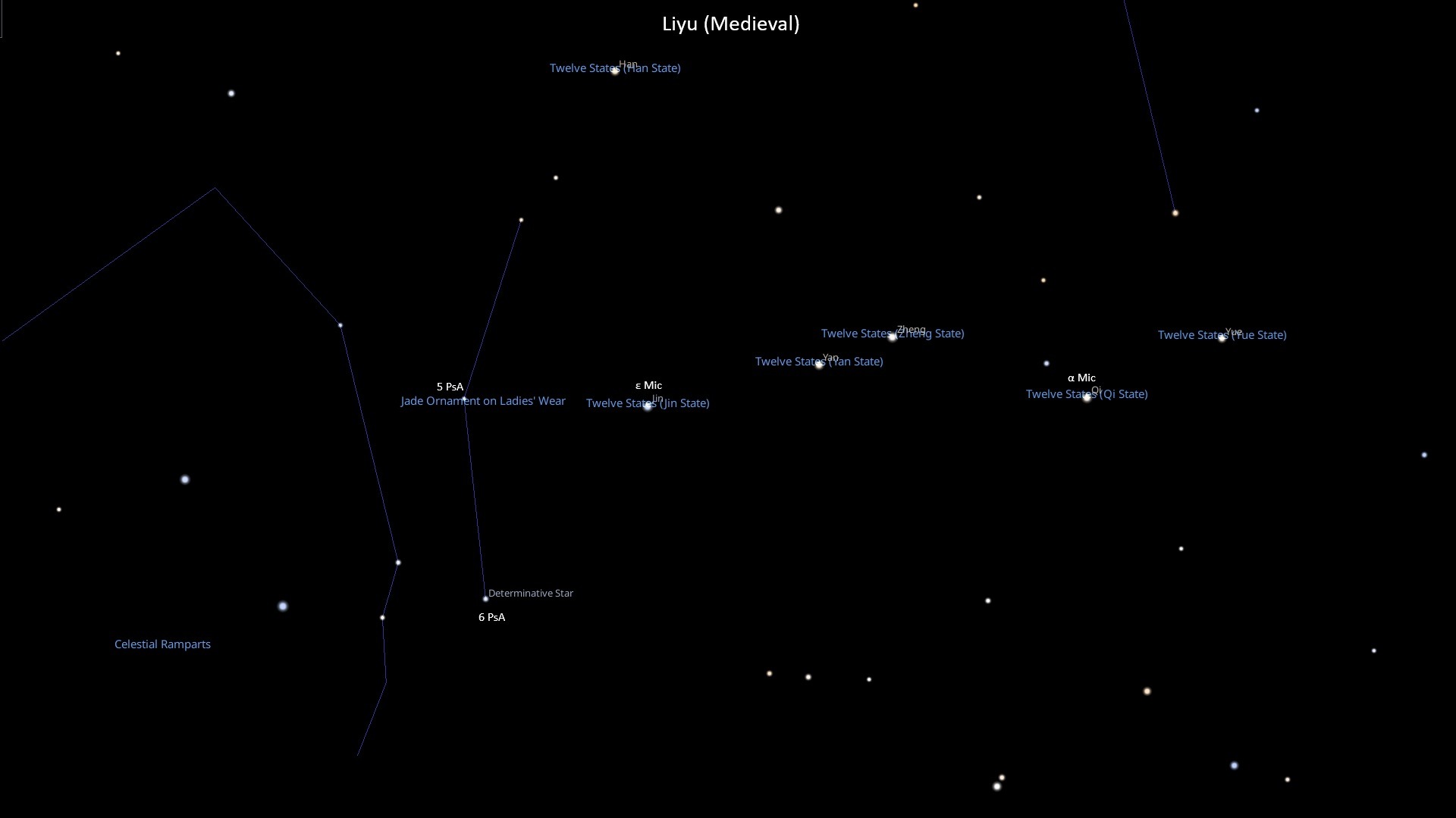
Medieval Asterism Liyu
Ma Duanlin (1317)
The three stars in the east of Qin and Dai, arranged in a north-south alignment, are called Li and Yu. Li refers to a jade scepter, and Yu to a jade ornament; both are women’s clothing. If the stars are faint, the imperial harem will be frugal; if they are bright and large, the women will be extravagant. [4]
Song History (1346)
Liyu consists of three stars located east of Shierguo (Twelve States); according to the Qianxiang Xinshu. they are situated south of Tianleicheng (Celestial Ramparts). “Li” refers to a ceremonial robe, and “Yu” means jade ornaments; both represent the attire worn by women when they first meet their in-laws. If these stars are dim, it indicates frugality among the inner palace (harem); if bright, it signifies extravagance and indulgence by women. If a guest star or comet enters this area, it means there will be no restraint in the inner palace (harem). [5]
References
- Void Rat Sun – Baidu Encyclopedia.
- Li (Chinese Character) – Baidu Encyclopedia.
- Yu (Chinese Character) – Baidu Encyclopedia.
- General Examination of Literature, Volume 279, Part 2, Ma Duanlin, 1317.
- Song History, Volume 50, Chapter 3, 1346.