
STARS: Major | All | Constellations | Chinese | About
20♍16 to 25♍07
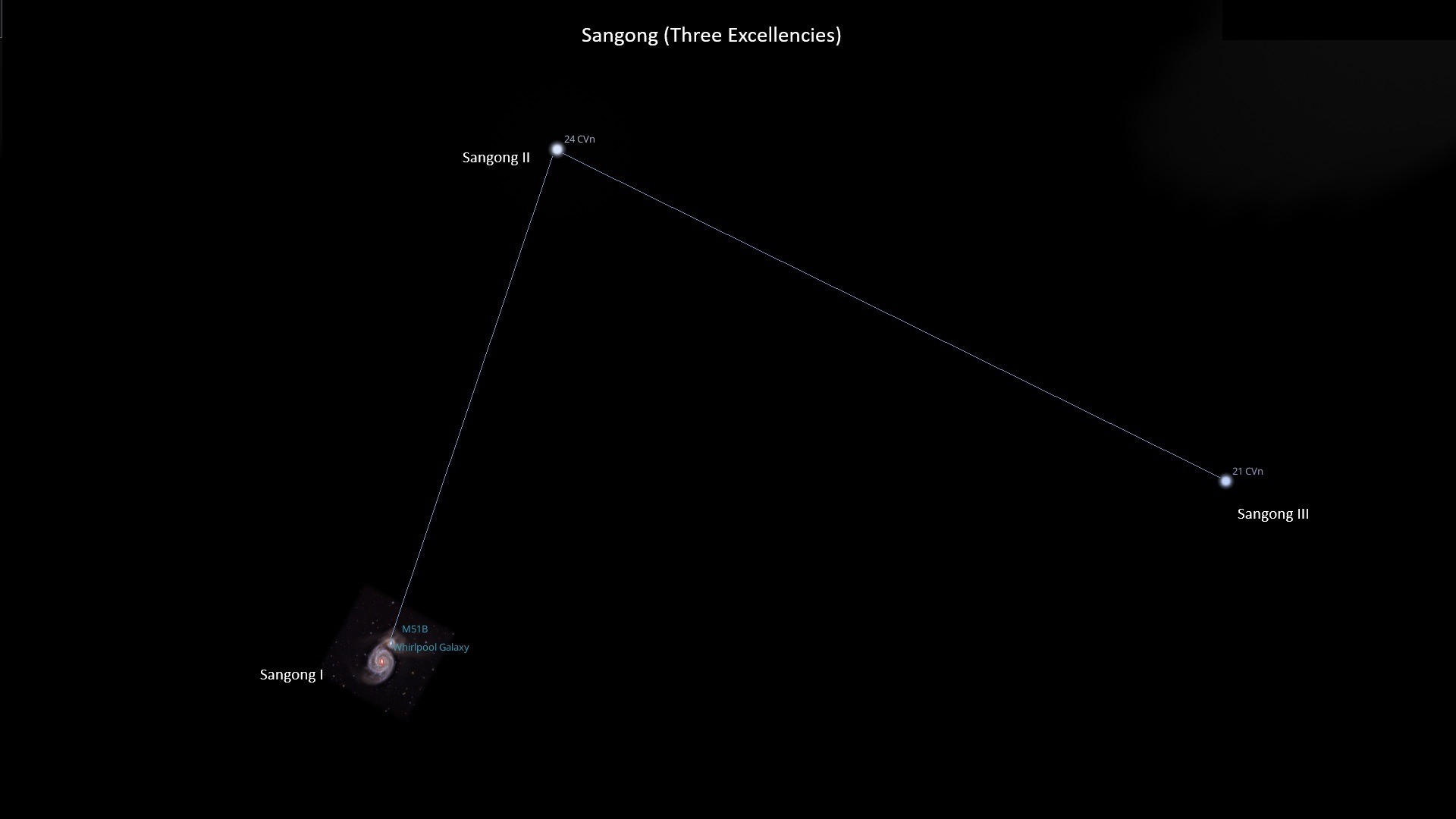
The 28th asterism of the Ziwei (Purple Forbidden) Enclosure is named 三公 Sāngōng, “Three Excellencies,” or “Three Teachers.” It represents the Grand Commandant, Minister of Works, and Minister of Agriculture. The officials responsible for promoting virtue, regulating the seven celestial phenomena, and harmonizing yin and yang. It contains 3 stars in the constellation Canes Venatici. [1]
Note: There is another Sangong used in Chinese astronomy. 三公 Sāngōng, “Three Excellencies,” is also the name of the 4th asterism of the Tai Wei (Supreme Palace) enclosure. It represents court assemblies and audiences held within the palace.
| 2000 | 2050 | IAU | Chinese | Orb |
| 25♍07 | 25♍50 | M51 | Sangong Yi (1) | 1°00′ |
| 24♍22 | 25♍05 | 24 CVn | Sangong Er (2) | 1°00′ |
| 20♍16 | 20♍59 | 21 CVn | Sangong San (3) | 1°00′ |
Sangong the Three Excellencies
20♍16 to 25♍07
The Three Dukes were the three most prestigious official positions in ancient China. According to the Shangshu Dazhuan and the Liji, the scholars of the New Text School of the Western Han Dynasty believed that the Three Dukes referred to the Sima (Grand Commandant), Situ (Minister of Education), and Sikong (Minister of Works). The scholars of the Old Text School of the Western Han Dynasty interpreted them as the Taishi (Grand Tutor), Taifu (Grand Preceptor), and Taibao (Grand Protector) according to the Zhouli.
The Northern Zhou Dynasty restored the old titles of Grand Tutor, Grand Preceptor, and Grand Protector. The Sui and Tang Dynasties continued to use the titles of Grand Commandant, Minister of Works, and Minister of Agriculture. During the reign of Emperor Huizong of the Song Dynasty, the Three Dukes were renamed Grand Tutor, Grand Preceptor, and Grand Protector. From the Yuan Dynasty onwards, the Three Dukes gradually became honorary titles, and after the Ming Dynasty, they were mostly honorary positions. During the Eastern Han Dynasty, the duties of the Three Dukes were clearly defined: the Grand Commandant was in charge of military affairs, the Minister of Works was in charge of civil affairs, and the Minister of Agriculture was in charge of water and land management. The three were of equal status. [2]
Therefore, the asterisms Sansong (Three Excellencies) and Sanshi (Three Top Instructors) of the Ziwei (Purple Forbidden) Enclosure have the same meaning.
Ma Duanlin (1317)
The three stars of the Three Dukes are located east of the handle of the Big Dipper, and west of the handle, representing the Grand Commandant, Minister of Works, and Minister of Education. The main star governs Yin and Yang, assisting the ruler in managing state affairs. Its movement is inauspicious; its presence indicates peace. When Venus and Mars guard it, the Three Dukes face misfortune. [3]
Song History (1346)
The three stars of Sansong, the Three Dukes, are located south of the handle of the Big Dipper and west of the first star of the Dipper’s head, or, according to another account, east of the handle of the Dipper. They symbolize the Grand Commandant, the Minister of Education, and the Minister of Works. Those west of the Dipper’s head are called Sanshi, the Three Masters, whose divination is the same as that of the Three Dukes; all three are officials in charge of spreading virtue, regulating the seven celestial bodies, and harmonizing Yin and Yang. Their movement is inauspicious; their constant presence brings peace. The loss of one star signifies danger to the world; the loss of two stars signifies chaos; the absence of all three signifies disorder in the world. If a guest star invades their territory, the Three Dukes will be worried. If a comet, a meteor, or a meteor strikes their territory, the Three Dukes will die. [4]
References
- Ziwei Enclosure – Baidu Encyclopedia.
- San Song – Baidu Encyclopedia.
- General Examination of Literature, Volume 278, Part 1, Ma Duanlin, 1317.
- Song History, Volume 49, Chapter 2, 1346.