
STARS: Major | All | Constellations | Chinese | About
15♌12 to 26♍56
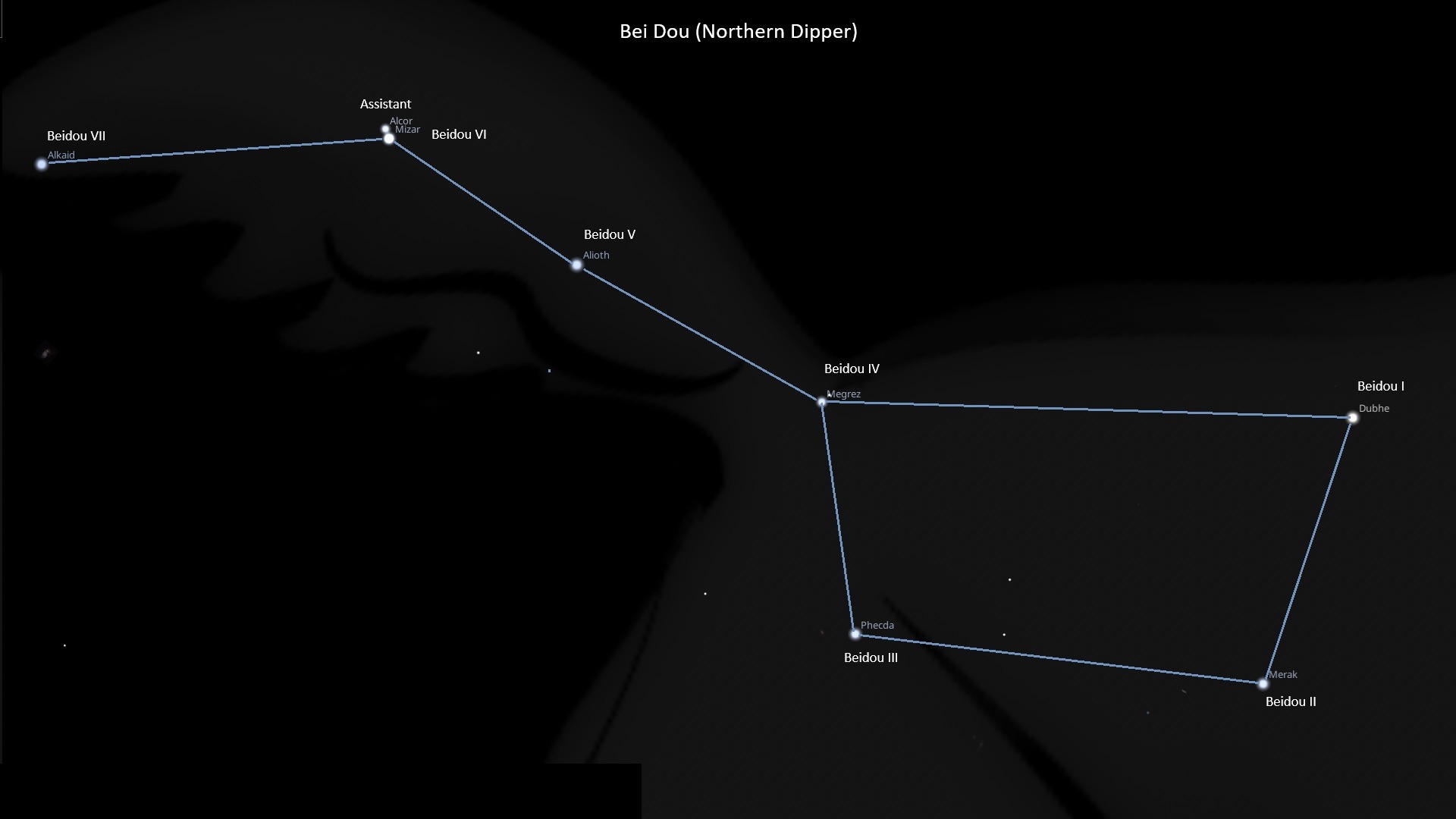
The 37th asterism of the Ziwei (Purple Forbidden) Enclosure is named 北斗 Běidǒu, “Northern Dipper.” It represents the 7 stars of the Big Dipper and symbolizes the emperor’s chariot, which moves from the center to oversee all under heaven, establishing the four seasons, balancing the Five Elements, adjusting seasonal rhythms, and determining the cycles. It is the pivot of the seven celestial bodies and the origin of Yin and Yang. [1] It contains the 7 bright stars plus 1 fainter auxiliary star of the constellation Ursa Major.
The Big Dipper has been one of the most recognizable star groupings throughout history and across many cultures. Despite this, Western astrology has basically ignored these stars. Ptolemy and Robson did not even mention them. Thankfully, they are of great importance in Chinese astrology, and there is a wealth of information available online.
| 2000 | 2050 | IAU | Chinese | Orb |
| 15♌12 | 15♎55 | α UMa | Beidou Yi (1) | 2°20′ |
| 19♌27 | 20♌04 | β UMa | Beidou Er (2) | 2°10′ |
| 00♍29 | 01♍12 | γ UMa | Beidou San (3) | 2°10′ |
| 01♍04 | 01♍57 | δ UMa | Beidou Si (4) | 1°40′ |
| 08♍56 | 09♍39 | ε UMa | Beidou Wu (5) | 2°20′ |
| 15♍42 | 16♍25 | ζ UMa | Beidou Liu (6) | 2°10′ |
| 26♍56 | 27♍39 | η UMa | Beidou Qi (7) | 2°20′ |
| 15♍53 | 16♍36 | g UMa | Fu | 1°30′ |
Big Dipper Astronomy
The inner five stars of the Big Dipper (not Dubhe or Alkaid) are at the core of the Ursa Major Moving Group (Collinder 285). This group of stars shares a common origin in space and time, forming about 300 million years ago. They move in the same direction at similar velocities and share similar chemical compositions.
The stars of the Ursa Major Moving Group are all heading towards a common point in Sagittarius. Dubhe and Alkaid are moving in opposite directions. [2] So over time, the shape of the Big Dipper changes significantly. In 50,000 years, the Big Dipper will face the opposite way. The stars Alkaid to Phecda will then constitute the bowl, while Phecda, Merak, and Dubhe will be the handle. [3]
Big Dipper Mythology
The Big Dipper depicts a ladle, with the bright stars on the tail of the Big Bear forming the handle, while those on the back make up the bowl. The handle and the bowl meet at Delta Ursae Majoris (δ UMa), also known as Megrez.
In the pattern of the Big Dipper, the Mesopotamians and many others saw a wagon; the Greeks, a Bear; the Dutch, a saucepan; and in Ireland and the UK, they saw a plow. The Arabs saw a funeral Bier (the bowl) followed by mourning daughters (the handle). Vedic astronomers observed not only a Bear but also the Saptarishi, “Seven Sages.”
Ancient Chinese astronomers saw a dipper or a chariot, but it has always been known as Bei Dou, “Northern Dipper,” as distinct from Dou, “Dipper,” or the Southern Dipper in the constellation Sagittarius.
Big Dipper Astrology
Ptolemy, Lily or Robson mentioned the Ursa Major constellation but wrote nothing about the Big Dipper asterism or any of its seven stars. Vedic astrologers identify them with the seven Sages and their spiritual significance, but have not interpreted the fixed stars astrologically.
The only reference specifically to the Big Dipper asterism I have found was, “With the early Arab poets, the Banāt stars were an emblem of inactivity aThere are 12 main Chinese Fixed Stars:
There are 12 main Chinese Fixed Stars: [5]
Five belong to the Big Dipper: Dubhe, Merak, Alioth, Mizar and Alkaid.
Six in the Southern Dipper: Tianfu, Kaus Borealis, Polis, Nunki, τ Sge, and Ascella.
The remaining fixed star is Kochab.
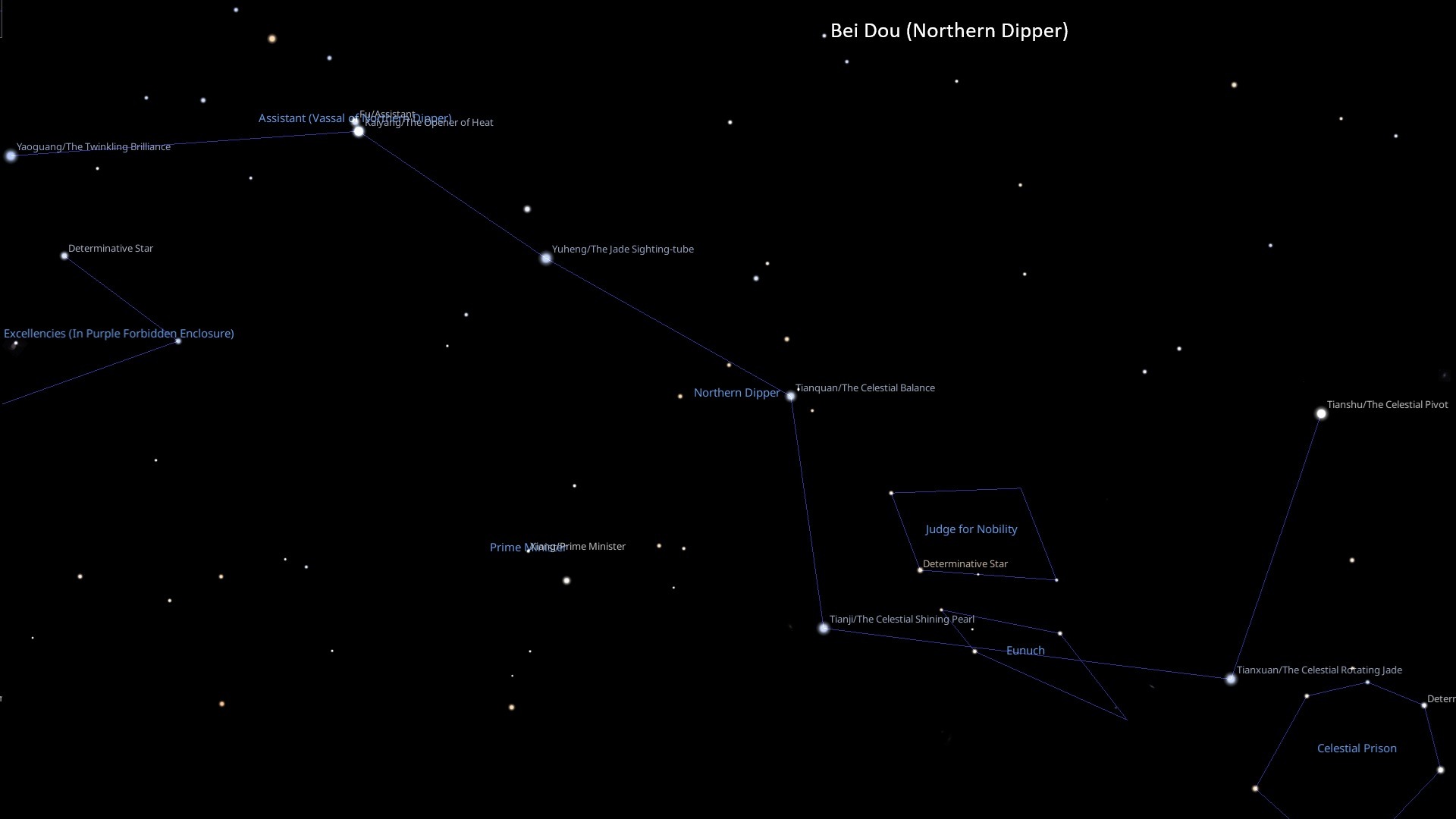
Beidou, the Northern Dipper
The seven stars of the Big Dipper are: Dubhe (the pivot of the seven stars), Merak (meaning beautiful jade, representing rotation), Phecda (meaning shining pearl, representing a mechanism of change), Megrez (representing sovereignty and balance), Alioth (representing balance and equilibrium), Mizar (representing the opening of yang energy), and Alkaid (representing the shaking of light).
In ancient times, they were also called Tanlang, Jumen, Lucun, Wenqu, Lianzhen, Wuqu, and Pojun, respectively.
Beidou, “Northern Dipper,” is the arbiter of the order of heaven and earth, and the seasons of spring, summer, autumn, and winter all follow its direction. The rotation and direction of the Big Dipper’s handle served as a basis for dividing the days and years on Earth, determining the Doujian, the twelve lunar months, and providing a timely guide for agricultural production.
Changes in the Big Dipper can indicate shifts in annual climate and daily temperatures. At the same time, it can also encompass the cycle of cold, heat, dryness, and dampness and clarify geographical location.
The Gan Shi Xing Jing, compiled during the Warring States period (475 – 221 BC), records: “The Big Dipper is called the Seven Luminaries, the princes of heaven, and also the emperor’s chariot.” The king sat on the Big Dipper to inspect the four directions, determine the four seasons, and divide the cold and heat. [6]
| 2000 | UMa | IAU | Chinese Name | Alternative |
| 15♌12 | α | Dubhe | Tan Lang Gredy Wolf Star | Tian Shu Heavenly Pivot |
| 19♌27 | β | Merak | Ju Men Giant Gate Star | Tianxuan Celestial Rotating Jade |
| 00♍29 | γ | Phecda | Lu Cun Celestial Shining Pearl | Tianji Standing-official Salary |
| 01♍04 | δ | Megrez | Wen Qu Star of Wrong-Writing | Tianquan Celestial Balance |
| 08♍56 | ε | Alioth | Lain Zhen Honest and Chaste | Yuheng Jade Sighting-Tube |
| 15♍42 | ζ | Mizar | Wu Qu Wrong Martial | Kaiyang Opener of Heat |
| 26♍56 | η | Alkaid | Po Jun Broken Army Star | Yao Guang Jade Light |
Ma Duanlin (1317)
The Big Dipper has seven stars, with one auxiliary star located north of Tai Wei (太微), representing the pivot of the seven celestial bodies and the origin of Yin and Yang. Therefore, it moves in the center of the heavens, overseeing the four directions, establishing the four seasons, and balancing the five elements. The four stars of the Big Dipper are Xuan Ji (璇玑) [cup: α, β, γ, δ UMa], and the three stars of the Dipper are Yu Heng (玉衡) [handle: ε, ζ, η UMa]. They also symbolize the master of commands and the emperor’s chariot, deriving from the meaning of movement.
Furthermore, the first star [α UMa, Dubhe] of the Big Dipper is called Tian Shu (天枢), the second [β UMa, Merak] Xuan (璇), the third [γ UMa, Phecda] Ji (玑), the fourth [δ UMa, Megrez] Quan (权), the fifth [ε UMa, Alioth] Yu Heng (玉衡), the sixth Kai [ζ UMa, Mizar] Yang (开阳), and the seventh Yao Guang (摇光) [η UMa, Alkaid]. The first four are the “Kui” (魁), and the fifth to seventh are the “Shao” (潓).
The “Shu” (枢) represents Heaven, the “Xuan” (璇) represents Earth, the “Ji” (玑) represents Man, the “Quan” (权) represents Time, the “Yuheng” (玉衡) represents Sound, the “Kaiyang” (开阳) represents Law, and the “Yaoguang” (摇光) represents Stars.
Shi Shi says: The first is the “Zhengxing” (正星), governing Yang virtue, the image of the Son of Heaven. The second is the “Faxing” (法星), governing Yin punishment, the position of the female ruler. The third is the “Lingxing” (令星), governing calamity. The fourth is the “Faxing” (伐星), governing Heavenly principles, punishing the wicked. The fifth is the “Shaxing” (杀星), governing the center, assisting the four sides, killing the guilty. The sixth is the “Weixing” (危星), governing the granaries and grains. The seventh is the “Buxing” (部星), also called the “Yingxing” (应星), governing military affairs.
It is also said that the first governs Heaven, the second Earth, the third Fire, the fourth Water, the fifth Earth, the sixth Wood, and the seventh Metal. It is also said that the first governs Qin, the second Chu, the third Liang, the fourth Wu, the fifth Zhao, the sixth Yan, and the seventh Qi. The “Fuxing” (辅星) is attached to Kaiyang, thus assisting the Dipper in achieving success. It is also said to govern Weizheng, correcting injustice, and the image of the Prime Minister.
When the seven celestial bodies are bright, the nation prospers; when they are dim, the nation suffers calamity. Many stars near the Dipper bring peace; few stars in the Dipper indicate public resentment and numerous lawsuits. No stars in the Dipper indicate a twenty-day amnesty. If the auxiliary stars are bright but the Dipper is dim, the ministers are strong and the ruler weak; if the Dipper is bright but the auxiliary stars are dim, the ruler is strong and the ministers weak. [7]
Song History (1346)
The Seven Stars of the Big Dipper are located north of Taiwei [Enclosure]. The Dipper’s handle carries Longjiao [the dragon’s horns], its central axis aligns with Nandou in Yinnan [southern Dipper], and its head rests at Shen Shou [head of Shen]. It is the emperor’s chariot, which moves from the center to oversee all under heaven, establishing the four seasons, balancing the Five Elements, adjusting seasonal rhythms, and setting all records [determining the cycles]. It is the pivot of the seven celestial bodies and the origin of Yin and Yang.
The first star in Kui [α UMa, Dubhe] is called Tiashu, a central star that governs heaven. It is also said that Shu represents heaven and presides over yang virtue, symbolizing the Son of Heaven [the Emperor]. Its division corresponds to Qin; according to Hanshi Zhi [Records of the Han Dynasty], it governs Xuzhou. The Tianxiang Zhan states: “If the Son of Heaven [Emperor] is disrespectful toward ancestral temples and neglectful [disrespectful] of ghosts and gods [spirits], then this star will appear dim or change color.”
The second [β UMa, Merak] is Xuan, the law star that governs the earth. It is also said that Xuan represents the earth and governs yin punishment, symbolizing the empress or female ruler. Its division corresponds to Chu; according to Hanshi Zhi [Records of the Han Dynasty], it governs Yizhou. The Tianxiang Zhan states: “If one recklessly expands palace buildings or carelessly excavates mountains and hills, this star will become dim or change color.”
The third [γ UMa, Phecda] is Ji, representing humanity, governing fire; it is the commanding star and presides over internal calamities [misfortune]. Its division corresponds to Liang; according to Hanshi Zhi [Records of the Han Dynasty], it governs Jizhou. If a sovereign neglects the people and frequently levies corvée labor [forced labor or conscription], this star will become dim and change color.
The fourth [δ UMa, Megrez] is Quan, representing time, governing water; it is the punishing star that governs heavenly justice and punishes the wicked. Its division corresponds to Wu; according to Hanshi Zhi [Records of the Han Dynasty], it governs Jingzhou. If decrees and commands do not align with the four seasons, this star will become dim or alter in color.
The fifth [ε UMa, Alioth] is Yuheng, representing sound and governing earth; it is the killing star that governs the center, assists the four directions, and executes those guilty of crimes. Its division corresponds to Yan; according to Hanshi Zhi [Records of the Han Dynasty], it governs Yanzhou. If the proper music is abandoned and excessive or licentious sounds are pursued, this star will become dimmed and change color.
The sixth [ζ UMa, Mizar] is Kaiyang, representing the law [the musical pitch standard (律)] and governing wood; it is the dangerous star that oversees the heavenly granary and the five grains. Its division corresponds to Zhao; according to Hanshi Zhi [Records of the Han Dynasty], it governs Yangzhou. If agriculture and sericulture are not encouraged, laws are strict, and virtuous and capable individuals are dismissed, then the ruler will be confused and change color.
The seventh [η UMa, Alkaid] is Yaoguang, representing stars and governing metal; it is the department [regional] star and presides over military affairs. Its division corresponds to Qi; according to Hanshi Zhi [Records of the Han Dynasty], it governs Yuzhou. If a ruler hoards treasures and does not cultivate virtue, this star will become dimmed and change color.
It is also said that the first to fourth stars form Kui, representing Xuanji; the fifth to seventh stars form Biao [Shao], representing Yuheng. Together, they are known as the Seven Rulers [celestial bodies] (Qi Zheng); when these stars shine brightly, their respective states will flourish [indicating a prosperous nation].
The eighth is Bixing, located to the right of the seventh star; it is not visible. According to Hanshi Zhi [Records of the Han Dynasty], it governs Youzhou.
The ninth [80 UMa, Alcor] is Fuxing, located to the left of the sixth star; it is often visible. According to Hanshi Zhi [Records of the Han Dynasty], it governs Bingzhou. According to the Jin Shi [Book of Jin], Fuxing is adjacent to Kaiyang, and serves to assist the Dipper in achieving success; it symbolizes a chancellor [the prime minister]. Its color appears as greenish-yellow [blue-yellow] in spring, reddish-yellow in summer, white and yellow in autumn, and blackish-yellow in winter. If its color changes from its normal color, the nation will suffer war and calamity; if it shines brightly, then the ministers will be powerful.
Many stars around the Dipper indicate stability [peace]; fewer stars within the Dipper suggest that people will live in fear. If Taiyin (the moon) transgresses it, it indicates war, death, or a general amnesty. A white halo passing through three stars is an omen that the ruler should fear. A comet near the Big Dipper indicates danger [for the sovereign]. If a comet transgresses it, it indicates a change of ruler. A shooting star [meteor] that transgresses indicates foreign war [conflict between the host and guest armies]. If a guest star transgresses, it signifies military conflict. If the five planets transgress it, the country will experience chaos and a change of rulership.
Note: The Big Dipper together with Fuxing totals eight stars, yet the Hanshi Zhi [Book of Han] mentions nine stars; Wu Mi and Yang Weide both adopted this account. The Shiji Suoyin [Historical Records: Supplementary Notes] states: “The distance between the Big Dipper stars is nine thousand li [1 li = 0.5 km] each.” Those two Yin Xing [obscure stars] that are not visible have a distance of eight thousand li between them. Dan Yuanzi’s Buthian Ge [Dan Yuan Zi’s Celestial Song] also mentions nine stars; therefore, the Hanshi Zhi [Book of Han] must have a definite basis for this. [1]
The First Four Stars of the Big Dipper
The Chinese term Kui Xing refers to the four stars of the Big Dipper: Dubhe, Merak, Phecda and Megrez. It governs literary fortune and literature.
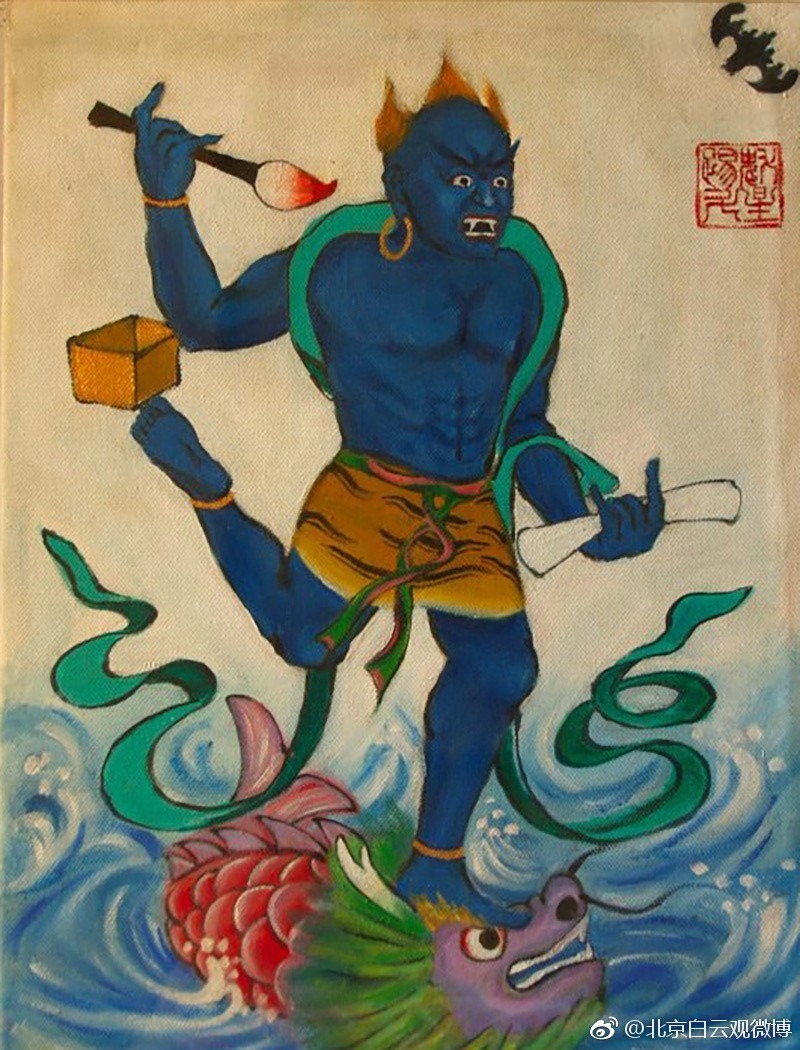
Kui Xing was also the deity of the imperial examination system that originated in the Song Dynasty (960 to 1279). Its image resembles a ghost with red hair and bulging eyes, holding a writing brush in its right hand and standing on the head of a dragon, symbolizing “standing out from the crowd.”
Kui Xing used a vermilion brush to mark the names of candidates, and those who achieved the highest rank were called “Duo Kui.” Scholars worshipped Kui Xing to seek good fortune in examinations, and during the Ming and Qing dynasties, Kui Xing Pavilions and Kui Xing Towers were built in various locations.
The Kui Xing Pavilion was built in 1034 and still exists in Nanjing. It is 15 meters high. The fifth-floor stone carving of “Kui Xing Pointing at the Dipper” depicts Kui Xing holding a writing brush and pointing at the top of a turtle’s head. Embedded on the south side is a plaque that reads Wen Yun Kai Tian, “Literary Fortune Opens the Heavens.” [8]
Kui Xing
The Big Dipper governs death, the Southern Dipper governs life
The saying “The Big Dipper governs death, the Southern Dipper governs life” originates from a system of beliefs about life and death that combines ancient Chinese star worship with Taoist beliefs.
The belief in the Big Dipper and the Southern Dipper can be traced back to the Neolithic Age (5,300 years ago). The Qin Dynasty’s sacrificial system included the Big Dipper and the Southern Dipper. By the Wei and Jin Dynasties, a doctrine formally proposed that “when the Big Dipper falls, one dies; when the Southern Dipper rises, one is born.”
Taoism places the Six Star Lords of the Southern Dipper under the jurisdiction of the Great Emperor of Longevity of the South Pole, whose Heavenly Palace Star Lord governs the continuation of life, while the Seven Star Lords of the Northern Dipper are responsible for judging the register of life and death. This belief spread widely through literary works and took concrete form in architectural practices, such as the construction of the Nanjing Ming City Wall. This system was integrated into Taoist rituals during the Northern and Southern Dynasties, forming complete rituals for warding off misfortune, including lamp and banner ceremonies.
The six stars of the Southern Dipper are located in the Sagittarius Constellation and can be seen in the southern sky on summer nights. The seven stars of the Northern Dipper are visible all year round. Chinese astrology holds that the Southern Dipper corresponds to the vitality of midsummer and the Northern Dipper to the desolation of autumn, forming an astronomical correspondence: “the Southern Dipper governs life, and the Northern Dipper governs death.” Taoist classics regard the Northern Dipper as the “pivot of Yin and Yang,” responsible for judging the souls of the dead and revising the register of life and death.
The Taoist Southern Dipper Scripture stipulates that believers should offer lamps, banners, incense, and candles to pray for longevity, while the Northern Dipper Scripture emphasizes repentance to eliminate disasters. In the Han Dynasty, it was believed that “when the seven celestial stars are bright, the country will prosper; when they are dark, disaster will occur.”
The folk funeral customs of placing the Seven Star Board and painting the Big Dipper on the coffin all reflect the belief of “the soul returning to the Big Dipper.” In Taoist rituals, believers pray for blessings and longevity from the Southern Dipper by lighting Seven-Star Lamps and erecting Longevity Banners.
Astrological beliefs hold that one should worship the Dippers to ward off disasters in one’s birth year. Some temples have halls dedicated to the Northern and Southern Dippers; the Southern Dipper hall houses statues of the Star Lords in red robes, while the Northern Dipper hall houses statues of the Star Lords in white robes, corresponding to the classic description: “The Southern Dipper governs life, those born wear red; the Northern Dipper governs death, those born wear white.” [9]
References
- Song History, Volume 49, Chapter 2, 1346.
- Ursa Major moving group – Wikipedia.
- Big Dipper – Wikipedia.
- Star Names: Their Lore and Meaning, Richard H. Allen, 1889, p.433.
- Fourteen Major Stars – Baidu Encyclopedia.
- The Big Dipper – Baidu Encyclopedia.
- General Examination of Literature, Volume 278, Part 1, Ma Duanlin, 1317.
- Kui Xing – Baidu Encyclopedia.
- The Big Dipper governs death, the Southern Dipper governs life – Baidu Encyclopedia.
Astrology king, I have always enjoyed your weekly and monthly astrology newsletter and articles. However, this particular newsletter on Chinese zodiac lost me. Although, still addicted to your weekly posts. Thanks for all you do !
Love 💕 and hugs,
Angela
I think, I could understand what you said! To give an example, Chinese FengShui is a little popular today in the world, but I heard that it had been originally for persons of power (i.e. kings, extremely riches, e.t.c). If we tried FengShui seriously, it should require a tremendous amount of money and land in advance! Chinese astrology might be also match more for such persons, not for our daily life, perhaps.
Not at all. If you study Taoist Classical Chinese Medicine and Chinese astrology, esp Flying Star school of Fengshui, you’ll find that nothing could be more relevant to the human body and function of the organs and meridians, the movement of yin/yang or Kan/Li (water and fire) inside the body than the very principles which inform Feng SHui. They are completely linked, perhaps in the way fascia links the entire body’s cells but is not obvious using a superficial view of the body. Everyone is a “person of power” and will greatly advance both health and spiritual integrity/growth by looking into how 5 Element Theory and the Directions and qualities of organ health is constantly forming, shaping, reshaping, building or diminishing their body. Chinese FengShui, just like Classical Chinese Medicine, is an entire-lifetime of research, applying its principles, and growth. A genuine cosmology in that NOTHING in the universe, known or unknown, is left out. All are shown persuasively to be connected. Happy reading, learning, applying!
“Who fight opponents with his back to the Big Dipper wins, and who against it lose.” This idea is famous because it was told by KongMing Chuko, the most famous strategist in China. More specifically, he mentioned not Big Dipper but on Alkaid, the Army star. It’s said manifested in a tendency that an army in the North often wins, just like the Civil War, the Vietnam War, and against Napoleon or Hitler. The shape of the Big Dipper are used as charm with which who wear wins. Asian kings and emperors used to have such clothes for their sake, I suppose. But what comes top on my concerning is the last moment of a bad emperor WangMong, who obsessed the incantation too much and smashed by GuangWu, whom I consider the greatest hero in China. Well, I don’t know whether GuangWu might have raid from the North or the South then!
Fascinating stuff. I spend hours every day researching Chinese astronomy. It is linked to every part of ancient Chinese life.
Glad you commented! North looks regarded as the direction of “stationary,” and it’s same as in FengShui of China and Japan, too. Safe to assume it’s because of Polaris and the coldness. It seems something like an admire or reverence for the constellation of the Big Dipper has been still around in Japan today for now. Anyway, when the ordinary Japanese people asked that what did they associate with the Big Dipper, the 70% of them would list up a name of an old famous Japanese comic, probably.
Love the conversation as it is foreign to me. While I do love peace and balance and energy flow and all that, the photos I see of feng shui-ness makes me nervous. It is so stark. So extreme. Will be looking more at the concept. Hope to read more about the Chinese astrology here.
Years ago, there was a conversation about the farmer’s wife whose house was a matted mess. My father’s comment was, have you been in the barn. He was awe struck by the cleanliness, the order. I spoke about it to my nephew. He said, i have worked on that farm. The cows were really nervous. So I guess for myself, I have to say moo.
As far as the country I am living in, I can say thecenergy how is being blocked at every turn. And that does indeed become stifling as well. So I guess instead of promoting energy flow, allowing energy flow, current trend is to control it.
Been a while Vic! I might be able to imagine such nervous FengShui places. If there were their reasons to exist, powered persons would just like the intensive environment for chasing their desires. If we had many planets with fixed stars on the intensive constellation like the Big Dipper, we should have feel good with such states.
I will be mulling this more. Fun stuff. But today I am not serious. I am giddy and fantasize about going into zen mag feng shui
Digs and moving stuff around. It’s only inanimate objects. It’s got to be bigger than that. But like I said, still mulling. Might be time to take some lion’s mane again soon to contemplate the energy feels.🤣
Yeah, repeating experiments steadily should be the only and best way. Uranus and Saturn rule!
By the way, I got a little strange feeling when Alkaid “PoJun” was translated to “Broken Army” or “Captured Army,” as an Asian in the East. If so, Alkaid might be named “JunPo” in China. Cause Chinese language distincts whether a word is a subject or an object with its position, whether it’s before a verb or after. “A star of army destroying” or “Army breaker” could be thought more appropriate. A group of last samurai (in Yamagata prefecture) had raised a flag the Big Dipper on it hoping for Alkaid’s blessing. They lost, but was famous for their strongness. The word “Hagun-sei” in Japanese sounds brave to us. When it came to fighting, ain’t odd to fight beneath the “Broken Army Star” flag?
…And, I’ve read the article of Alkaid now. As implying “Destruction before construction,” the name “Broken Army Star” sounds appropriate. Well, I’ll be silent now. Thank you for reading.
Sorry, let me just say this!
The samurai group with Alkaid was INVINCIBLE in tactics, although its side lost strategically.
For Their honor…
I just read Jamie on Alkid. Thought I was gonna lose my mind until he wrote how to deal with it.
For some reason, it does not seem feng shuish to me. Like has a life of its own.
One has to do what one has to do. But I guess that’s where the need for strategy comes in. Maybe a plan b. I sure the heck ain’t just gonna do it cuz a big Who tells me to and runs me into a wall.
So these fixed stars, is it just conjunctions with planets that have an effect. Or other aspects to them too?
Only conjunction but some say oppositions as well
So, Vic had a conjunction of planets or cusps with Alkaid? Then, we must not get you angry.
In Ibaraki prefecture, there’s a big shrine “Kashima Jingu” built for a Japanese God of martial arts. It’s said that stands as Alkaid on the map, and the other shrines as fixed stars of the Big Dipper exist in a row from “Kashima Jingu” to north. “The Shizu Jinja shrine” is for Dubhe. “The Tsukubasan Jinja shrine” is for Mizar and Alcol, as “The Tsukubasan mountain” is a twin summit. Although a number of shrines in Japan is countless as stars, some of them seem located according to a sort of rules, like FengShui or stars in the sky.
Just for the record, it’s a little time left for the time of conjunction of Sat. and Nep. Excited
The big dipper is one of the first asterism one sees in youth. Someone usually older tells you to line up the cup stars of the large ladle, Dubhe and Merak, and it points to Polaris, which is the North star, and begins the handle in the little dipper. When one figures that out, and the two dippers spin around and around Polaris it becomes another story. One day dippers become political… And dipping takes on all together new meaning.
https://postimg.cc/w3xZmKX4
Chart natal, Dubha,Merkal conjunct 1st house, and the lore, use it to find Polaris. I have to follow Dubha,Merkel quincunx to Capricorn, use a trine to Virgo where Pluto conjunct Uranus, and take the aspects, quintile and sextile to Polaris.
Merak* because Merkel may be confused to a politician who has recently poked her head up, and we know she’s worried about this Artwork because she’s already mentioned the Reformation years were particularly difficult on Central Europe, and wouldn’t want to see that again. However Artwork not shy and recently takes a look at John Wesley, and it rises to the occasion, an organic morpho-genesis Reformation religious development. Would we want a hybrid manufactured consent morphology along the same vein? Some say it’s AI, and that’s our modern era Reformation dis-ease.
Hello Paul as i see above yr sun is only 3 degrees away from 2020 Saturn-Pluto.
Are you glad you still live ?
Otherwise maybe it is yr loose Mercury-Jupiter in Aquarius information overload i cannot cope with.
You are shurely of high intelligence.
Intersting yr Saturn is conjunct Altair too.
So how did you feel this second harsh Pluto-Saturn Transit ? It is not gone by cuz Pluto coming back to yr Saturn..
Can you plz give some personal report of this?
Are you well with all this very challenging transits ? Some kind of Saturn-Pluto double whopper….
Fascinating info. Scary re the Army stuff. But I love how it had obviously been noted over eons that the Big Dipper stars being dim long enough indicated certain weather conditions. Same with most First Peoples everywhere, 10s of 1000s of years ago.
Regards Paul’s mention… organic morpho-genesis Reformation religious… I missed most of the recent TV doco, ABC I think….but gather is basically this.
Years ago, don’t know when, a Christian Queer troupe of family friendly performers in Sydney I think, fed up with the dogma n discrimination, put on shows of irony n sarcasm etc against the hypocrisy n archaic religion. But with also the concerns of material reality of global warming n now dismissed it has all been n so on.
Well guess what, the performances unintentionally morphed into more than just release n amusement for audiences. Anyway long story short, one of the leaders decided to create n register their own version of Queer families n friends Christianity. I’m agnostic but that’s a nice one eh.
Moon conjunct Jupiter, 8:00 am, 26 March 2026, part of Fortune conjunct Street Roses 04Leo22
https://postimg.cc/N5WR6bLW
Street Roses having a Saturn return, Sun transit. Add Alioth conjunct South Node