
STARS: Major | All | Constellations | Chinese | About
16♒14 to 08♓19
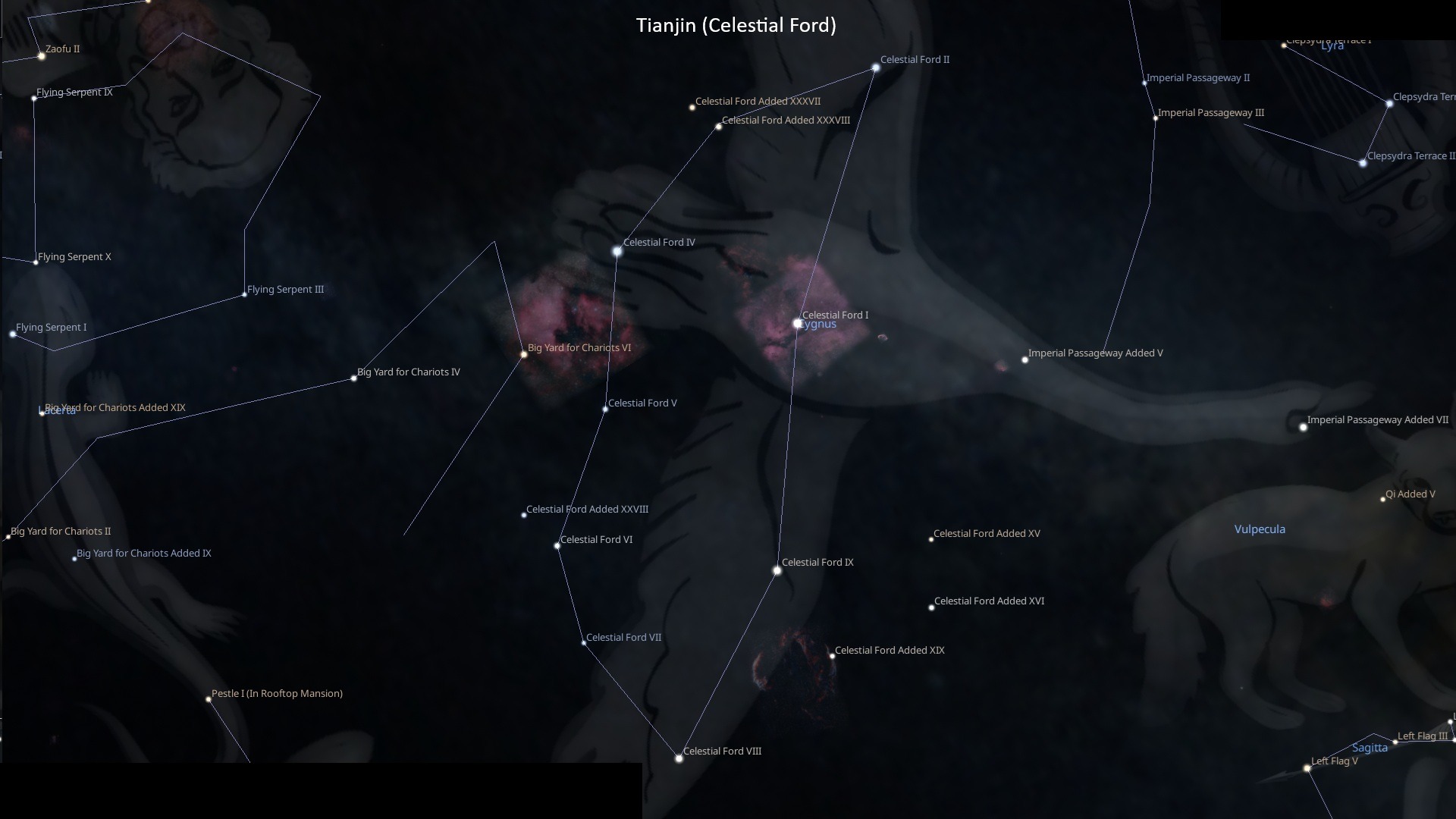
The 10th Chinese lunar mansion is named 心宿 Nǚ Su, “Girl Mansion.” It is the 3rd of the 7 mansions of the Black Tortoise of the North.
The 6th asterism of the Girl Mansion is called 天津 Tiānjīn, “Celestial Ford,” representing the Milky Way Ferry, a bridge spanning the Milky Way. It is composed of 9 stars of the constellation Cygnus. [1]
| 2000 | 2050 | IAU | Chinese | Orb |
| 24♒50 | 25♒32 | γ Cyg | Tianjin Yi (1) | 2°10′ |
| 16♒14 | 16♒56 | δ Cyg | Tianjin Er (2) | 2°00′ |
| 28♒02 | 28♒43 | 30 Cyg | Tianjin San (3) | 1°00′ |
| 05♓19 | 06♓01 | α Cyg | Tianjin Si (4) | 2°30′ |
| 06♓08 | 06♓50 | ν Cyg | Tianjin Wu (5) | 1°30′ |
| 08♓19 | 09♓18 | τ Cyg | Tianjin Liu (6) | 1°30′ |
| 07♓15 | 07♓57 | υ Cyg | Tianjin Qi (7) | 1°10′ |
| 03♓02 | 03♓46 | ζ Cyg | Tianjin Ba (8) | 1°30′ |
| 27♒43 | 28♒27 | ε Cyg | Tianjin Jiu (9) | 2°10′ |
Tianjin the Celestial Ford
16♒14 to 08♓19
The Tianjin Star Official (asterism), belonging to the Nu constellation. Meaning “a ferry crossing in the Milky Way,” it is closely related to the myth of the Cowherd and the Weaver Girl. It is regarded as an important crossing or bridge on the Milky Way, symbolizing the “Celestial River Bridge,” and has no direct relationship with the city of Tianjin.
The asterism contains 9 main stars, and according to the Qing Dynasty book Yixiang Kaocheng, it has an additional 40 stars. The overall shape is roughly equivalent to the body and wings of the constellation Cygnus, and the alignment of stars is described as “bow-shaped,” “slingshot-shaped,” or “boat-shaped,” spanning both sides of the Milky Way.
In the Treatise on Celestial Offices in the Records of the Grand Historian and the Treatise on Astronomy in the Book of Han, the star Tianjin was recorded as “Tianhuang” and “Tianheng,” respectively. Its imagery as a ferry crossing of the Milky Way was already reflected in Qu Yuan’s Li Sao during the Warring States period. And this was confirmed by official historical records in the Book of Jin, Treatise on Astronomy, which states that “the nine stars of the Milky Way are located across the Milky Way, governing the four rivers and bridges, and thus enabling divine communication in all directions.”
On January 3, 2019, China’s Chang’e-4 probe made its first landing on the far side of the moon. Its landing site was named “Tianhe Base.” [1]
Ma Duanlin (1317)
The nine stars of Tianjin, north of Xu and Wei, stretch across Hanzhong, the crossing point of bridges and fords. Their brightness and movement indicate war like quicksand and death like tangled hemp. Their unevenness indicates expensive horses. One star missing means passes and bridges will be impassable; three stars missing mean the world will be overthrown; the absence of a star indicates floods and overflowing rivers, with water bandits becoming kings. [2]
Song History (1346)
The Nine Stars of Tianjin, located north of the Xu constellation (Emptiness) spanning the middle of a river (the Milky Way), are also called the Tianhan and Tianjiang constellations. They govern the four major rivers and bridges, thus allowing divine communication to reach all directions.
If one star is missing, bridges and ferry crossings become impassable; if bright, war will break out; if uneven or misaligned, horses will be expensive; if large, there will be floods; if shifted, the waters will overflow.
If a comet or 孛 (Bo, goblin, abnormally bright star) transits Tianjin, ferry crossings collapse, bridges and riverbanks will be ruined, and there will be bandits on the roads.
If a guest star transits here, bridges will not be repaired; if it guards the area (remains in this position), waterways will be impassable, and ships will be expensive.
When a meteor appears, envoys or messengers will definitely be dispatched; the location should be determined according to the corresponding regions of the sky.
Red clouds entering the area indicate drought; yellow or white clouds indicate a virtuous decree from the emperor; black clouds indicate great floods; blue or green clouds indicate water and worry; their exit indicates the calamity will be averted. [3]
References
- Tianjin (Ancient Chinese traditional star official) – Baidu Encyclopedia.
- General Examination of Literature, Volume 279, Part 2, Ma Duanlin, 1317.
- Song History, Volume 50, Chapter 3, 1346.