
STARS: Major | All | Constellations | Chinese | About
20♍52 to 22♍59
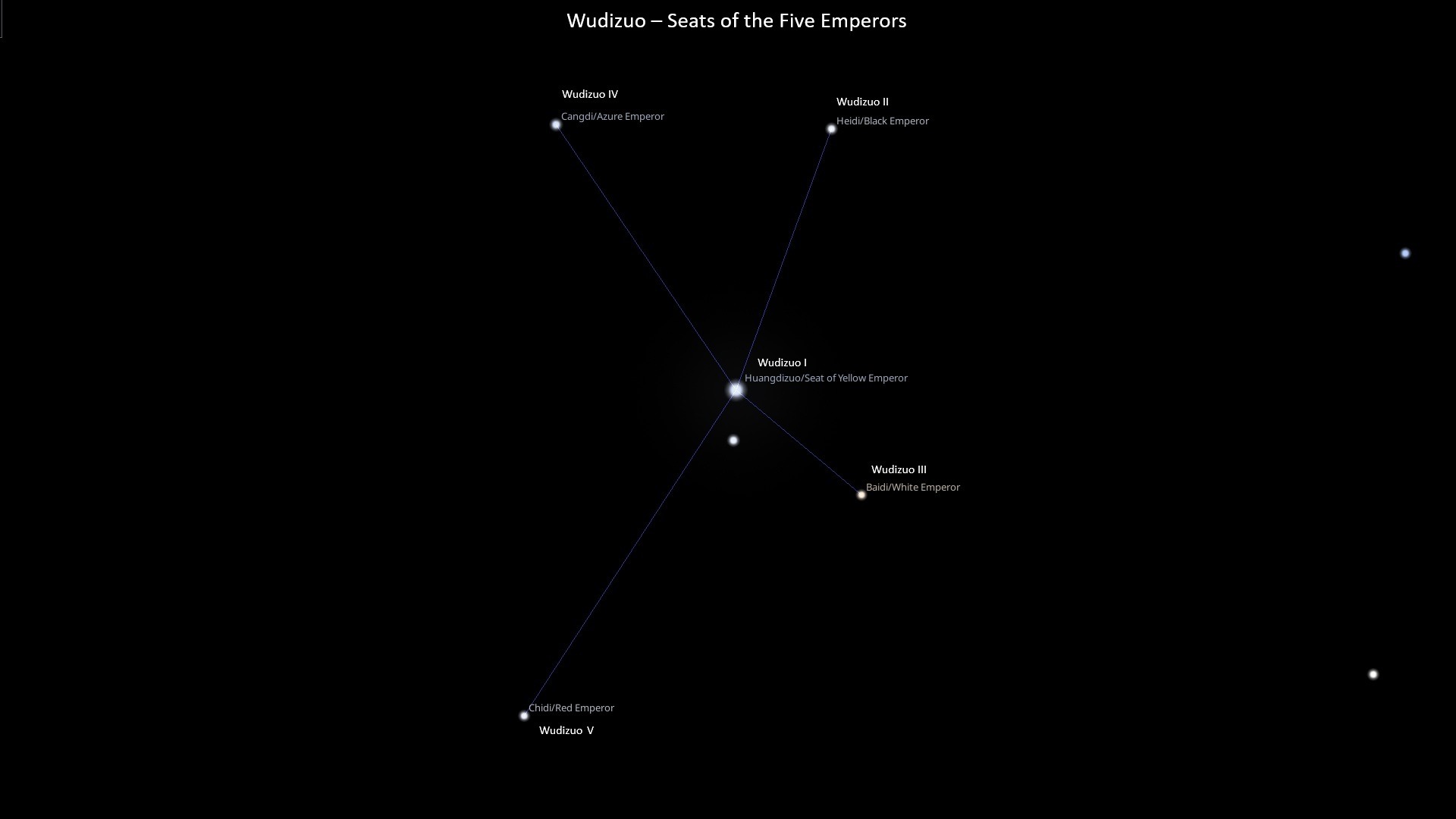
The 8th asterism of the Taiwei (Supreme Palace) Enclosure is named 五帝座 Wǔdìzuò, “Seats of the Five Emperors.” It represents the five seats where the Emperor handles government affairs in different seasons. It is composed of 5 stars of the constellation Leo. [1]
| 2000 | 2050 | IAU | Chinese | Orb |
| 21♍37 | 22♍19 | β Leo | Wudizuo Yi (1) | 2°10′ |
| 20♍58 | 21♍40 | HD 102660 | Wudizuo Er (2) | 1°00′ |
| 20♍52 | 21♍35 | HD 102103 | Wudizuo San (3) | 1°00′ |
| 22♍40 | 23♍22 | 95 Leo | Wudizuo Si (4) | 1°00′ |
| 22♍59 | 23♍41 | HD 102910 | Wudizuo Wu (5) | 1°00′ |
Wudizuo the Seats of the Five Emperors
20♍52 to 22♍59
The Five Emperors’ Seat star official (asterism) is located in the middle of the Taiwei Enclosure. It consists of five stars arranged in a cross shape with the Yellow Emperor Han Shu Ni at the center (β Leonis, Denebola). It is surrounded by the Eastern Azure Emperor Lingwei Yang, the Southern Red Emperor Chi Biao Nu, the Western White Emperor Zhao Ju, and the Northern Black Emperor Zhi Guang Ji.
According to the usual understanding, the Five Emperors’ Seats are the seats of five ancient emperors. However, the Heavenly Emperor is God, and his image is only one. He can have multiple places to do his work, which means he can have multiple imperial seats. The emperor handles different political affairs in different places. Therefore, the Five Emperors’ Seats here are actually the ones the emperor uses to sit in different halls in different seasons to handle political affairs, as recorded in the Mingtang. A year is divided into five seasons, each in a different hall.
In spring, he sits in the position of the Azure Emperor in the East; in summer, he sits in the position of the Flame Emperor in the South; in late summer, he sits in the position of the Yellow Emperor in the Center; in autumn, he sits in the position of the White Emperor in the West; and in winter, he sits in the position of the Black Emperor in the North. [2]
| Wudizuo | Emperor | Dir. | Deity | Season |
| I | Yellow (Han Shuji) | Center | Huangdi Zuowei | Late Summer |
| II | Azure (Lingwei Yang) | East | Cangdi | Spring |
| III | Red (Chi Biao Nu) | South | Chidi | Summer |
| IV | White (Bai Zhao Ju) | West | Baidi | Autumn |
| V | Black (Zhi Guang Ji) | North | Heidi | Winter |
Ma Duanlin (1317)
The Yellow Emperor’s inner seat is a single star (β Leo) within the Taiwei constellation, containing the pivotal spirit. When the emperor acts in accordance with the heavens and stops in accordance with the earth’s will, calmly following the middle way, the five emperors’ seats in the Taiwei constellation will shine brightly. If the Yellow Emperor’s seat is unclear, the ruler should seek wise men to assist him in governing; otherwise, power will be usurped. It is also said that if the five emperors’ seats in the Taiwei constellation are small, weak, bluish-black, the emperor’s country will perish.
The four stars within the four emperors’ inner seats surround the Yellow Emperor’s seat. The eastern star (95 Leo) is the Azure Emperor (Lingwei Yang), the spirit of reverence. The southern star (HD 102910) is the Red Emperor (Chi Biao Nu), the spirit of wrathful anger. The western star (HD 102103) is the White Emperor (Bai Zhao Ju). The northern star (HD 102660) is the god of the Black Emperor (Ye Guang Ji).
Zhang Heng said, “If the five emperors shine brightly together, the world will submit to their rule; otherwise, they will lose their positions.” If Venus, Mars, and Mercury enter the Taiwei constellation and follow the natural order and await their exit, those guarding their assigned positions will be punished by the emperor. [3]
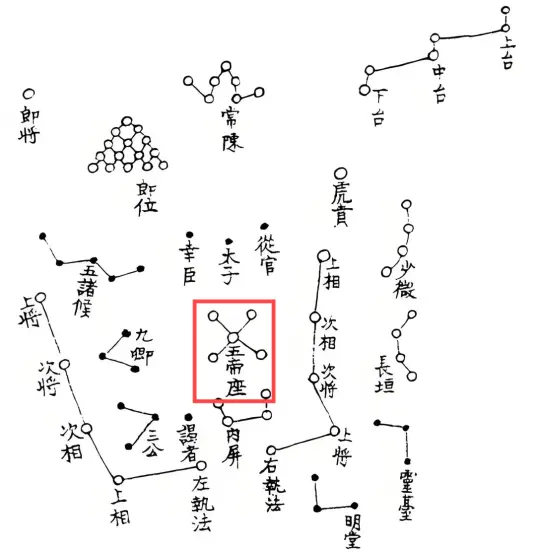
Seats of the Five Emperors
Song History (1346)
The Five Emperors’ seats within contain the Five Stars; one star, located at the center of Taiwei (β Leo), is the Yellow Emperor (Han Shuji), representing the deity governing the central pivot (Huangdi Zuowei).
If the Emperor acts in accordance with celestial order, he gains heavenly favor; if his actions align with terrestrial principles, he secures earthly support. If he proceeds calmly along the central path, clarity and brilliance follow — but if not, the ruler must seek virtuous ministers to assist governance through law; otherwise, power will be lost.
The Four Emperors’ stars flank the Yellow Emperor — each is positioned two degrees away in the four cardinal directions. The eastern star is the Azure Emperor (Lingwei Yang), the god of divine majesty (Cangdi). The southern star is the Red Emperor (Chi Biao Nu), the god of fiery anger (Chidi). The western star is the White Emperor (Bai Zhao Ju), the god of white repulsion (Baidi). The northern star is the Black Emperor (Zhi Guang Ji), the god Heidi.
When the Yellow Emperor’s seat (β Leo) is bright, the Emperor enjoys longevity, and his commands are obeyed; if it appears small, the opposite is true, and power lies with subordinates; if this star disappears entirely, the Emperor dies, and a great man will bear the consequences.
The Moon rising north of the Yellow Emperor’s seat signifies great misfortune; rising south of it signifies lesser misfortune; rising near him signifies the execution of high officials or famine; crossing the Yellow Emperor’s seat signifies rebellious ministers. A lunar halo reaching the Emperor’s seat signifies an imperial pardon. The Hai Zhong Zhan states: If the Moon crosses the Emperor’s seat, the ruler will be displeased.
A celestial body approaching the Emperor’s seat signifies major construction or earthworks. If any of the Five Planets remain in the Yellow Emperor’s seat for an extended period, powerful figures will worry.
When Venus enters, there will be soldiers in the palace.
When Mars invades, there will be war; if it enters the celestial court and reaches the Emperor’s seat, there will be a pardon.
If Mars and Venus enter this position, a powerful minister will appear.
When Jupiter invades, an illegitimate ruler will be enthroned — one who is not rightful to rule.
If Saturn retrogrades and guards the Yellow Emperor’s seat, it serves as a warning of an emperor’s death or overthrow. If any of the Five Planets enters this area with a white hue, chaos and disorder will follow.
A guest star appearing yellowish-white that reaches the Emperor’s seat indicates ministers are presenting beautiful women to the court.
If a comet enters this area, the palace will be in chaos; if it reaches the Emperor’s seat or appears as powdery fluff, war and mourning will occur simultaneously.
A meteor intruding on the Emperor’s seat signifies worry for ministers; if it reaches the Four Emperors’ seats, assistant ministers face misfortune, and many people will die.
If bluish-white clouds reach the Emperor’s seat, the Emperor will be in mourning; if it appears greenish or bluish-red, close ministers intend to conspire against their ruler. If yellow and white in color, it signifies the emperor having a son or grandson
If the Moon transgresses any of the Four Emperors’ seats, mourning spreads across the realm and feudal lords will worry. Any of the Five Planets invading the seats of the Four Emperors brings misfortune and worry. [4]
References
- Taiwei Enclosure – Baidu Encyclopedia.
- Five Emperors’ Throne – Baidu Encyclopedia.
- A General Examination of Literature, Volume 278, Part 1, Ma Duanlin, 1317.
- Song History, Volume 29, Chapter 2, 1346.