
STARS: Major | All | Constellations | Chinese | About
02♌48 to 11♎27
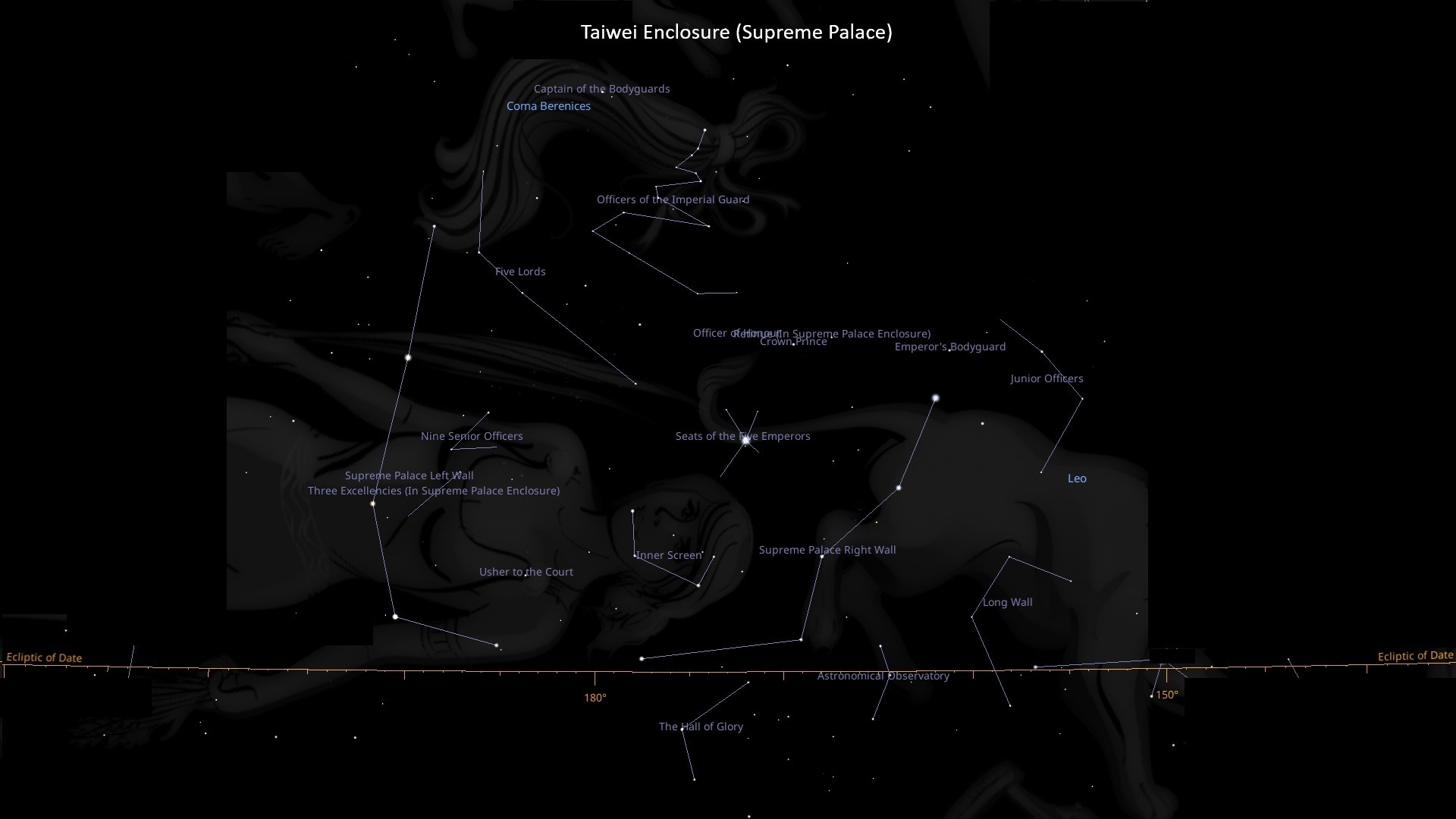
Ancient Chinese astronomers divided the night sky into three enclosures and twenty-eight mansions. The 太微垣; Tài Wēi Yuán, “Taiwei (Supreme Palace) Enclosure,” is one of the three enclosures and is known as the Heavenly Court and the Southern Palace of the Heavenly Emperor.
Taiwei means “government,” and the Taiwei Enclosure represents the seat of power and governance. It is associated with administering the law impartially, supervising promotions, bestowing virtues, receiving talismans from the constellations, and granting authority to all gods, thus easing doubts and resolving disputes.
The Supreme Palace Enclosure is located northeast of the Ziwei (Purple Palace) Enclosure, south of the Big Dipper, and north of the lunar mansions Yi (Wings) and Zhen (Chariot), covering approximately 63 degrees of the sky. [1]
| # | Asterism | English | 2000 | Constellations | Stars |
|---|---|---|---|---|---|
| 1 | Tàiwēizuǒyuán | Left Wall | 04♎50 | Virgo / Coma Berenices | 5 |
| 2 | Tàiwēiyòuyuán | Right Wall | 11♍19 | Leo / Virgo | 5 |
| 3 | Yèzhě | Usher to the Court | 03♎21 | Virgo | 1 |
| 4 | Sāngōng | Three Excellencies | 06♎56 | Virgo | 3 |
| 5 | Jiǔqīng | Nine Senior Officers | 22♍02 | Virgo | 3 |
| 6 | Wǔzhūhóu | Five Lords | 27♍36 | Coma Berenices | 5 |
| 7 | Nèipíng | Inner Screen | 23♍20 | Virgo | 4 |
| 8 | Wǔdìzuò | Seats of the Five Emperors | 20♍52 | Leo | 5 |
| 9 | Xìngchén | Officer of Honour | 22♍02 | Coma Berenices | 1 |
| 10 | Tàizǐ | Crown Prince | 18♍58 | Leo | 1 |
| 11 | Cóngguān | Retinue | 16♍53 | Leo | 1 |
| 12 | Lángjiāng | Captain of the Bodyguards | 29♍52 | Coma Berenices | 1 |
| 13 | Hǔbēn | Emperor's Bodyguard | 10♍29 | Leo | 1 |
| 14 | Chángchén | Imperial Guards | 10♍03 | Canes Venatici / Ursa Major | 7 |
| 15 | Lángwèi | Officers of the Imperial Guard | 22♍04 | Coma Berenices | 15 |
| 16 | Míngtáng | The Hall of Glory | 21♍31 | Leo | 3 |
| 17 | Língtái | Astronomical Observatory | 14♍01 | Leo | 3 |
| 18 | Shǎowēi | Junior Officers | 03♍29 | Leo / Leo Minor | 4 |
| 19 | Chángyuán | Long Wall | 04♍28 | Leo | 4 |
| 20 | Sāntái | Three Steps | 02♌48 | Ursa Major | 6 |
Ancient Chinese astronomers incorporated political order into the framework of cosmic laws. They had recognized the main structure of the Taiwei Enclosure by the 5th century BC. The layout of the Forbidden City closely corresponds to the Taiwei Enclosure.
The Taiwei Enclosure symbolizes the Chinese nation’s eternal pursuit of virtuous governance and an orderly civilization over three thousand years. As the Book of Changes says, “Observe the heavens to discern the changes of time; observe human affairs to transform the world.” [1]
Ma Duanlin (1317)
The Shangyuan Taiwei Palace, its celestial constellations shining brightly in the azure sky. The Duanmen Gate is merely the center of the gate, flanked by the gatekeepers to the east and west. At the gate stands a black-robed attendant (Usher to the Court), followed by the Three Dukes of Wu (Three Excellencies). Behind them are the Three Black Nine Ministers (Nine Senior Officers), and behind them are the Five Black Princes and Ministers (Five Lords). To the west of the four gates is the main screen (Inner Screen), where the Five Emperors sit in the central position (Seats of the Five Emperors). Favored ministers (Officer of Honour) and the Crown Prince accompany the officials, with the Emperor and Empress seated to the east. The Generals and Tiger Warriors stand to the left and right, followed by the Changchen (Imperial Guards) and Lang (Captain of the Bodyguards) positions. The Changchen’s seven stars are perfectly aligned, and the Lang positions are fifteen stars to the east. The two palace walls are arranged with ten stars, corresponding to the number of law enforcement officers on the left and right. Outside the palace is the Mingtang (The Hall of Glory) and the Buzheng Palace, with three Lingtai (Astronomical Observatory) observing clouds and rain. The four stars of Shaowei (Junior Officers) are in the southwest corner, and the two stars of Changyuan (Long Wall) are located to the west. The north gate connects to the Three Platforms (Three Steps) to the west, facing the wall to prevent war.
The ten stars of the Taiwei Enclosure are north of Yi (Wing) and Zhen (Chariot). Zhang Heng said, “This is the palace of the Son of Heaven, the seat of the Five Emperors, and the residence of the twelve princes. Beyond it are the Nine Ministers.” Firstly, Xuanyuan represents power, and Taiwei represents balance. Balance signifies fairness. The Sui Shu states that it also represents the Heavenly Court, where laws and regulations are applied fairly, promotions and the bestowal of virtue are overseen, constellations receive talismans, and all gods examine the conduct of their deities, clarifying doubts and resolving disputes.
Between the two stars in the Southern Barbarian region is Duanmen. To the east is Zuo Zhifa (η Vir, Left Wall I), representing the Court of Justice. To the west is You Zhifa (β Vir, Right Wall I), representing the Censor-in-Chief. The law enforcement is used to expose and punish the wicked and treacherous. East of Zuo Zhifa is Zuo Yemen (Left Flank Gate). West of You Zhifa is You Yemen (Right Flank Gate).
The four stars of eastern enclosure (Left Wall): the first in the south (γ Vir) is Shangxiang; its north is the Eastern Sun Gate; the second (δ Vir) is Cixiang, its north is the Eastern Gate of China; the third (ε Vir) is Cijiang, its north is the Eastern Moon Gate; the fourth (α Com) is Shangjiang, the so-called Four Assistants.
The four stars of the western enclosure (Right Wall): the first in the south (σ Leo) is Shangjiang, its north is the Western Sun Gate; the second (ι Leo) is Cijiang, its north is the Western Gate of China; the third (θ Leo) is Cixiang, its north is the Western Moon Gate; the fourth (δ Leo) is Shangxiang, also one of the Four Assistants.
If the eastern and western enclosures show signs of movement or wavering, it indicates that the feudal lords are plotting against the emperor. If the law enforcement (β Vir and η Vir) shifts, punishments will become more severe. When the moon and five planets enter the Taiwei orbit, it is auspicious; if they violate the central seat, punishment will be imposed.
The star of the Attendant (Usher to the Court), located northeast of the Law Enforcement Star within Taiwei, governs the guests. If it is not seen, foreign countries will not submit.
The three stars northeast of the Attendant are called the Inner Seat of the Three Dukes (Three Excellencies), the residence of the emperor at court assemblies. Zhang Heng said that those who assist the emperor share the same name as the Three Dukes flanking the Dipper.
The three stars north of the Three Dukes are called the Inner Seat of the Nine Ministers (Nine Senior Officers), in charge of all affairs, and their divination is in accordance with the Heavenly Order.
The five stars west of the Nine Ministers are called the Inner Five Feudatories (Five Lords), who serve the emperor but do not go to their own states. If the rituals of the Biyong are performed correctly, the feudal lords of Taiwei will be enlightened.
The four stars of the Screen (Inner Screen) are located inside the Duanmen Gate, south of the emperor’s seat, near the Right Law Enforcement Star (β Vir). The Screen is used to protect the imperial court. The Law Enforcement Star governs the execution of officials; if the stars are bright and clear, the ruler and his ministers will be respectful.
The star of the Yellow Emperor’s Inner Seat, located in Taiwei, contains the spirit of the pivotal point. When the emperor acts in accordance with the will of Heaven and stops in accordance with the will of Earth, calmly following the middle way, the thrones of the Five Emperors in the Taiwei constellation will shine brightly. If the throne of the Yellow Emperor is not bright, the ruler should seek wise men to assist him in governing; otherwise, he will lose power. It is also said that if the thrones of the Five Emperors in the Taiwei constellation are small, weak, bluish-black, the emperor’s country will perish. The four stars of the inner thrones of the four emperors are flanking the throne of the Yellow Emperor. The eastern star is the god of the Azure Emperor, Lingwei Yang. The southern star is the god of the Red Emperor, Chi Biao Nu. The western star is the god of the White Emperor, Bai Zhao Ju. The northern star is the god of the Black Emperor, Ye Guang Ji. Zhang Heng said that if the five emperors shine brightly together, the people will be loyal to them; otherwise, they will lose their positions. If Venus, Mars, and Mercury enter the Taiwei constellation and follow the human path, waiting for them to leave, those who guard their assigned positions will be punished by the emperor.
The star northeast of the emperor’s throne is called the Favored Minister (Officer of Honor), indicating that the ruler is close to his favorite ministers. If it is bright, the favored ministers will be in power; if it is dim, it is auspicious.
The star of the Crown Prince, located west of the favored ministers and north of the seat of the Five Emperors, is the star of the heir apparent. If it is bright and lustrous, the Crown Prince is virtuous; otherwise, he is not. If Venus and Mars guard this position, the Crown Prince will either be deposed or commit treason.
The star of the Attendant Official (Retinue), located northwest of the Crown Prince, governs the attendants. If it is not visible, the Emperor is uneasy; if it is as usual, it is auspicious.
The star of the General of the Palace Guard, located northeast of the Palace Guard’s position, represents the military guard. Zhang Heng said that the current Left and Right Generals of the Palace Guard are these stars; their bright and prominent features indicate that they are likely unstoppable.
The star of the Tiger Warriors, located west of the Taiwei Palace, west of the Prime Minister, and south of the Lower Terrace, represents the cavalry officers of the Jing Shi (Quiet Chamber). Zhang Heng said that they govern the military officials who attend to the Emperor and are associated with the chariots and cavalry.
The seven stars of the Constant Array (Imperial Guards), arranged in a pattern resembling the Big Dipper, are located north of the Palace Guard’s position. These represent the Tiger Warriors who guard the Emperor, signifying strength and resolve. If the stars move, the Emperor himself will be present; if they are bright, the military will be active; if they are dim, the military will be weak.
The Langwei constellation (Officers of the Imperial Guard) has fifteen stars, or some say twenty-four, located northeast of the Emperor’s throne. It is also called Yiwu, and is the Langwei constellation. In the Zhou dynasty, it was the position of Yuanshi; in the Han dynasty, it was the position of Guanglu, Zhongsanqi, Jianyi, Yilang, and Langzhong of the Three Offices. Zhang Heng said it is the same as the current Shangshu Lang. It is auspicious if the stars are of equal size and have consistent brilliance. The Sui Shu states that the Langwei constellation is responsible for guarding. If the star is bright, it indicates a high-ranking official will rob the emperor; it is also called “guest offending the emperor.” If the star is incomplete, it indicates the death of a later official or the execution of a favored minister. If a guest star enters the constellation, it indicates a high-ranking official causing chaos.
The three stars of the Mingtang constellation (The Hall of Glory) are located southwest of the Taiwei constellation, the palace where the emperor governs. Brightness is auspicious, darkness is inauspicious.
The three stars west of the Mingtang constellation are called Lingtai (Astronomical Observatory), responsible for observing clouds and omens, and anticipating disasters. Its divination is the same as that of Siguai.
The two constellations of Shaowei (Junior Officers) and Changyuan (Long Wall) have already been explained as being next to Zhang Xing.
The six stars of the Santai constellation (Three Steps) are arranged in pairs, starting with Wenchang, and then moving to Zhaoyao and Taiwei. It is also called Tianzhu, the position of the Three Dukes. In the heavens, it is called the Three Platforms, which govern the opening of virtue and the proclaiming of talismans. The two stars near the Wen Chang star to the west are called the Upper Platform, which governs destiny and longevity; the next two stars, opposite the Xuan Yuan star, are called the Middle Platform, which governs the central government and the imperial family; the two stars to the east, reaching the Tai Wei star, are called the Lower Platform, which governs fortune and military affairs. This is to illuminate virtue and quell disobedience. The Three Platforms are also called the Heavenly Steps, with Tai Yi above and below. Another name is the Tai Steps. The upper star of the Upper Step represents the emperor, and the lower star represents the empress; the upper star of the Middle Step represents the feudal lords and high officials, and the lower star represents the ministers; the upper star of the Lower Step represents the scholars, and the lower star represents the common people. This is to harmonize Yin and Yang and govern all things. When these stars change, each is interpreted according to its corresponding element. When the ruler and his ministers are in harmony, it is according to their usual order. Zhang Heng said that if the colors are uniform and the ranks are similar, then the ruler and his ministers are in harmony, and the laws are just; if they are not uniform, it is a sign of discord. When Venus and Mars guard the area, war breaks out, and comets are especially severe.
The Song Dynasty Astronomical Records states: The ten stars of Taiwei: Right Law Enforcement, 84 degrees from the pole, 12.5 degrees into the Wing constellation; Left Law Enforcement, 86 degrees from the pole, 1.5 degrees into the Chariot constellation. One star for the Attendant, 83 degrees from the pole, 1 degree into the Chariot constellation. Three stars for the Three Dukes, 84.5 degrees from the eastern star, 6 degrees into the Chariot constellation. Three stars for the Nine Ministers, 75 degrees from the northwest star, 7 degrees into the Chariot constellation. Five stars for the Inner Five Princes, 70 degrees from the western star, 1 degree into the Chariot constellation. Five stars for the Five Emperors’ Seats, 71 degrees from the central star, 1.5 degrees into the Wing constellation. Four stars for the Inner Screen, 80 degrees from the southwest star, 10 degrees into the Wing constellation. One star for the Crown Prince, 66.5 degrees from the pole, 11.5 degrees into the Wing constellation. One star for the Attendant, 64.5 degrees from the pole, 8.5 degrees into the Wing constellation. One star for the Favored Minister, 66.5 degrees from the pole, 15 degrees into the Wing constellation. The fifteen stars of Langwei are 60 degrees from the Southwest Star and 18 degrees from the Wing. The star Langjiang is 47.5 degrees from the North Pole and 11 degrees from the Chariot. The seven stars of Changchen are 51.5 degrees from the East Star and 1 degree from the Chariot. The star Huben is 62 degrees from the North Pole and 2 degrees from the Wing.
The Song Zhongxing Astronomical Records states: “There are five emperors’ seats in the Taiwei Enclosure, and the inner seats of the five emperors are also arranged in the Purple Palace. Why is this? It is because the five emperors always reside in Taiwei and enter the Purple Palace for audience, hence the inner seats.” Then, who are the five emperors? These are the gods Lingwei Yang, Chi Biao Nu, Han Shu Ni, Bai Zhao Ju, and Ye Guang Ji mentioned in the Records. There is already a Heavenly Emperor, so why are there also five emperors? The five emperors, in Heaven, govern the Five Elements; in Earth, they govern the Five Sacred Mountains, each in charge of their respective directions, assisting the Heavenly Emperor. In the past, the Duke of Zhou offered sacrifices to Houji to match Heaven; this is the Great Heavenly Emperor of the Purple Palace in the North Pole. The ancestral temple of King Wen is located in the Mingtang, alongside the Supreme God, and the Five Emperors of Taiwei are located south of the palace. This is the Mingtang mentioned in the “Monthly Ordinances,” which divides the palace into five sections to worship the Five Emperors.
Song History (1346)
The ten stars of the Taiwei Enclosure, according to the Book of Han, are “the Vermilion Bird of the Southern Palace, representing the power and balance.” The Book of Jin states, “This is the imperial court, where the Five Emperors (Wudizuo) reside; it also represents the mansions of twelve feudal lords.” Its outer regions are the Nine Ministers (Nine Senior Officers).
One source says Taiwei Yuan is Heng, which governs balance; it also represents the celestial court — overseeing legal matters and fair judgments, supervising appointments based on virtue, distributing symbols to constellations, examining conduct of deities, and resolving doubts with care.
Between the two stars in the southern enclosure is the Duanmen Gate. To the east (η Vir, Left Wall I) is Zuozhifa, “Left Enforcer,” symbolizing the Court of Justice. To the west (β Vir, Right Wall I) is Youzhifa, “Right Enforcer,” symbolizing the Grand Censor. Zhifa, “Enforcers,” are responsible for exposing and punishing evildoers. Zuozhifa to the east (between η Vir and γ Vir) is Zuo Yimen, “Left Flank Gate.” Youzhifa to the west (between β Vir and σ Leo) is You Yimen, “Right Flank Gate.”
The four stars in the eastern enclosure (Left Wall) are as follows: The first to the south (γ Vir, Left Wall II) is Shangxiang, “Supreme Prime Minister”; north of it lies Dong Taiyang Men, “Eastern Sun Gate.” The second (δ Vir, Left Wall II) is Cixiang, “Second Prime Minister”; north of it is Zhonghua Dongmen, “Eastern Gate of China.” The third (ε Vir, Left Wall IV) is Cijiang, “Second General”; north of it is Dong Taiyin Men, “Eastern Moon Gate.” The fourth (α Com, Left Wall V) is Shangjiang, “Supreme General.” These four are collectively known as the Four Fu (Four Assistants).
The four stars in the western enclosure (Right Wall) are as follows: The first to the south (σ Leo, Right Wall II) is Shanggan, “Supreme General”; north of it lies Xi Taiyang Men, “Western Sun Gate.” The second star (ι Leo, Right Wall III) is Cijiang, “Second General”; directly north of it is Zhonghua Ximen, “Western Gate of China.” The third star (θ Leo, Right Wall IV) is Cixiang, “Second Prime Minister,” with Xi Taiyin Men, “Western Moon Gate,” located to its north. The fourth star (δ Leo, Right Wall V) is Shangxiang, “Supreme Prime Minister.” These four are collectively known as the Four Fu (Four Assistants).
The Book of Han states: “Twelve stars encircle and guard the area, representing vassal ministers: to the west are the Generals; to the east are the Prime Ministers; four stars in the south represent Zhifa (Enforcers); at the center is Duanduanmen (the Central Gate); on both sides are Yimen (Flank Gates).”
The New Book of Qianxiang states: “Ten stars, five each in the east and west, located north of Yi (Wings) and Zhen (Chariot). The northern star in the western enclosure (δ Leo, Right Wall V) is Shangxiang (Supreme Prime Minister), and the right star of the Southern Gate (β Vir, Right Wall I) is the Youzhifa (Right Enforcer). If stars in the eastern or western enclosures display halos (bright light) or show signs of movement and instability, it indicates that feudal lords are plotting against the emperor. If the Enforcer moves, punishments will be more severe.”
If the Moon or any of the Five Planets enter the Taiwei orbital path, it is considered auspicious; however, if they transgress a central position within this area, it signifies punishment.
If the Moon transgresses the Taiwei Enclosure, it is an ill omen for assistant ministers; it also indicates a weak ruler and strong ministers, with military forces in all directions beyond control.
If the Moon transgresses Zhifa (β Vir, η Vir), according to the Haizhong Zhan, “Generals and ministers who are exempted from punishment will have a three-year reprieve period.”
If the Moon enters through the eastern or western gates, or through the left and right Yimen (flank gates), then exits to the south via the Duan Gate (between β Vir and η Vir), it indicates a traitorous minister, and the ruler will be worried.
If the Moon enters the West Gate (Right Wall) and exits through the East Gate (Left Wall), the ruler will be worried, and ministers will abuse the ruler’s authority.
If the Moon transgresses or occupies any of the Four Fu stars (Assistants), it signifies that a minister has violated etiquette, and an assistant minister will be executed.
If the Moon is surrounded by a halo, it indicates the emperor will defend himself with military force. Three lunar halos in Taiwei within one month indicate an imperial pardon will be issued. A lunar eclipse in Taiwei indicates that high-ranking ministers will be worried, and it is a bad omen for the ruler.
When Mercury enters Taiwei, the emperor will suffer, and there will be internal strife; if it enters Tian Ting (the Heavenly Court), the empress will be worried, and there will be great floods; if it guards or enters enters the Left Side Gate (between γ Vir and η Vir) or the Right Side Gate (between β Vir and σ Leo), war will break out, and there will be a pardon; if it enters the Right Side Gate, the empress will suffer disaster, and there will be great floods; if it enters the West Gate and exits through the East Gate, there will be war, mourning, and floods.
When Venus enters Taiwei, it signifies war and ministers killing each other. If it remains in this area for an extended time, there will be military conflict or mourning. If Venus and Saturn jointly transgress the center of the Taiwei Enclosure, it is a bad omen to the ruler. If Venus enters You Yimen (between β Vir and σ Leo) and exits through the Duan Gate (between β Vir and η Vir), a nobleman will seize power. If Venus is seen in Taiwei during the day, the country will suffer war and mourning. If the Moon occults Venus outside the Duan Gate, the country will be attacked by war.
If Mars or Saturn enter the Taiwei Enclosure in retrograde motion, it signifies war and death. If they transgress Shangjiang (α Com), the Supreme Genera will suffer misfortune; if they remain at the Duan Gate (between β Vir and η Vir) for a long time, the nation will face destruction, or the Three Dukes will plot against the Emperor, and ministers will be executed. If Mars or Saturn invade Shangjiang (α Com), it indicates the Emperor will fight on the battlefield, and the Prime Minister will die. If they enter the Taiwei Enclosure with a white color and no halo, there will be famine across the land. If their retrograde movement is irregular, major legal cases will arise. If they invade any gate in Taiwei, the left or right generals will perish; if they enter Tian Ting (the Heavenly Court) south of Neiping (Inner Screen) and exit through Zuo Yimen (between γ Vir and η Vir), the left general will die, and through the Right Side Gate (between β Vir and σ Leo), the right general will die, but if they exit directly through the Duan Gate (between β Vir and η Vir), there will be no harm. If they enter Taiwei and transgress or remain for an extended period, military conflict will occur; if they stay within this area for twenty days, Tingwei (the Court of Justice) will be in charge; remaining in Tian Ting (the Heavenly Court) for ten days results in an imperial pardon. Transgression of the southeast corner of Taiwei indicates a year of famine and suffering by high-ranking law enforcers. If they transgress Shangxiang (δ Leo), a major minister will die.
If Jupiter enters the Taiwei Enclosure, an imperial pardon will occur; if it transgresses, the ministers who enforce the law will be worried. If it enters through the east gate, there will be an emergency military operation throughout the country. If Jupiter remains in this area for a prolonged period, generals, chancellors, and law enforcers will die. If it passes through the Duan Gate (between β Vir and η Vir) and guards the Heavenly Court, great calamity will arrive. If it enters the South Gate (between β Vir and η Vir) and exits through the East Gate (Left Wall), there will be a drought; if it enters the South Gate (between β Vir and η Vir) and exits through the West Gate (Right Wall), the country will suffer a loss or mourn a ruler’s death. If Jupiter moves retrograde, enters the East Gate (Left Wall) and then exits through the West Gate (Right Wall), the country will face destruction and collapse.
When Saturn enters the Taiwei Enclosure, there will be virtuous decrees, and a female ruler will govern. If it moves retrograde and guards any of the ten stars of the Left and Right Wall, there will be misfortune. If Saturn remains for a prolonged period, the nation faces destruction; if it occupies the Right Wall, the emperor will be worried.
If a guest star enters Taiwei and appears yellowish-white, the emperor will be happy; if it enters or exits through the Duan Gate (between β Vir and η Vir), there will be national worries; if it enters the Left Side Gate (between γ Vir and η Vir), there will be drought; if it enters the Right Side Gate (between β Vir and σ Leo), the country will be in turmoil; if it exits from Tian Ting (the Heavenly Court), there will be harsh decrees and war; if it enters Taiwei for thirty days, there will be a pardon; transgression of the Four Fu indicates ill fortune for assistant ministers.
A comet entering Taiwei signifies change in the world; its emergence from Taiwei indicates worry in the palace and fire; transgression of Zhifa (β Vir or η Vir) means law enforcers will be demoted or dismissed. If a comet invades Tian Ting (the Heavenly Court), a new ruler will be enthroned.
A 孛 (Bo, goblin, abnormally bright star) near Yi, close to Shangjiang in Taiwei, signifies war or mourning. A孛 star appearing over the western enclosure (Right Wall) signifies revolution. A孛 star transgressing the Seats of the Five Emperors signifies the downfall of a kingdom and the killing of the ruler.
If a shooting star (meteor) emerges from Taiwei Yuan, ministers will engage in foreign affairs; a large number emerging from the South Gate (between β Vir and η Vir) signifies the death of a noble; shooting stars moving freely across the Taiwei Palace indicate a weak ruler and dominant ministers; a shooting star entering Yi from Duan Gate (between β Vir and η Vir) with light illuminating the earth and producing sound signifies the enthronement of a new king.
If clouds enter or exit the Taiwei Enclosure with a faint bluish hue, it indicates that the ruler has lost his position. Bluish-white or black clouds entering through the Left Flank Gate (between η Vir and γ Vir) or the Right Flank Gate (between β Vir and σ Leo) signify mourning; their exit signifies no harm. Red clouds entering the Left Flank Gate (between η Vir and γ Vir) signify internal strife. Yellowish-white clouds entering the Taiwei Palace signify joy for the ruler and longevity. Clouds entering the left or right side gates signify the emperor’s virtuous decrees. Black or pale clouds entering signify worry for the emperor; their exit signifies no harm. Black clouds shaped like snakes entering through the Left or Right Wall signify mourning.
The Five Emperors sit on the Five Stars, with one star in the Taiwei Enclosure representing the Yellow Emperor, the god of pivotal power. The emperor’s actions align with celestial measure, and his stillness with terrestrial intent. If he acts with composure and follows the middle way, he will be enlightened; if not, the ruler should seek wise advisors to assist him; otherwise, he will usurp power. The Four Emperor Stars flank the Yellow Emperor, each two degrees away in one of the four directions. The eastern star is the Azure Emperor, the god of divine majesty. The southern star is the Red Emperor, the god of fiery anger. The western star is the White Emperor, the god of white repulsion. In the north, there is the god Ye Guangji, the Black Emperor. When the Yellow Emperor sits in the bright position, the emperor enjoys longevity, and his commands are obeyed; if he is weak, the opposite is true, and power rests with his subjects; if he dies, the great man will bear the consequences. The moon rising in the north signifies great calamity; rising in the south signifies lesser calamity; rising close to him signifies the execution of high officials or famine; if it offends the Yellow Emperor’s seat, there will be rebellious ministers. If it reaches the Emperor’s seat, there will be earthworks. If the moon’s halo reaches the Emperor’s seat, there will be a pardon. A divination from the sea: If the moon offends the Emperor’s seat, the ruler will be displeased. If the five planets guard the Yellow Emperor’s seat, the great man will be worried. If Mars and Venus enter, there will be powerful ministers. If Jupiter offends, a ruler who is not his will rise. If Mars offends, there will be war; if it enters the celestial court and reaches the Emperor’s seat, there will be a pardon. If Venus enters, there will be soldiers in the palace. If Saturn retrogrades and guards the Yellow Emperor’s seat, it is a warning of a fallen ruler. If the five planets enter and are white, it signifies chaos. A guest star, yellowish-white in color, approaches the emperor’s seat; ministers present beautiful women. A comet entering the palace signifies chaos; if it approaches the emperor’s seat, or appears like powdery fluff, war and death will ensue. A meteor intruding on the emperor’s seat signifies worry for ministers; if it approaches the seats of four emperors, ministers will worry, and many will die. A pale white aura approaching the emperor’s seat signifies the emperor’s death; blue-red signifies close ministers plotting against their ruler; yellowish-white signifies the emperor having a son or grandson. The moon intruding on the seats of four emperors signifies death throughout the land and worry for feudal lords. Five planets intruding on the seats of four emperors signify worry.
The star of the crown prince, located north of the emperor’s seat, represents the heir apparent. If the heir apparent is virtuous, the star will shine brightly. Clouds entering the palace: yellow signifying joy, black signifying worry. Venus, Mars, guest stars, and meteors guarding or intruding on the emperor’s seat all signify worry. Another interpretation is that if Venus or Mars guard or enter the palace, the crown prince will either be deposed or a usurpation will occur.
The five stars representing the five princes are located west of the Nine Ministers, serving the emperor but not in their respective kingdoms. According to the Qianxiang Xinshu, they are south of the Langwei position; if the rites at the Biyong are observed correctly, the stars will shine; if they are absent, the princes will be dismissed. The star representing the officials is located north of the crown prince, serving as attendants. Its absence indicates peace; if it is not seen, the emperor will be uneasy; if it is as usual, it is auspicious.
The star representing the favored minister is located northeast of the emperor’s seat, constantly attending the crown prince; its darkness is auspicious. According to the Xinshu, it is east of the crown prince; if a blue-red aura enters it, the ministers’ plots against the emperor will fail. The four stars representing the inner screen are located inside the Duanmen Gate, near the Right Enforcer of Law. The screen is used to protect the imperial court.
The stars representing the left and right Enforcers of Law are located on either side of the Duanmen Gate; the left represents the Court of Justice, and the right represents the Imperial Censor, responsible for investigating and punishing traitors. If the emperor and his ministers are respectful, the stars will shine brightly. According to the Qianxiang Xinshu, it is south of the Central Terrace; if it shines, the laws will be just. If the Moon, the five planets, and guest stars invade the palace, the ruler and his ministers will be disrespectful, and the ministers will be dismissed. The presence of Mars and Venus signifies war. The presence of a meteor signifies worry for the Minister of Personnel.
The fifteen stars of the Palace of the Gentlemen, located northeast of the Emperor’s seat, are also called the Palace of the Crow. The officials of the Zhou dynasty, and the officials of the Han dynasty (such as the Grand Master of Ceremonies, the Palace Attendant, the Remonstrator, the Consultant, and the Gentleman of the Palace), are responsible for guarding the palace. If these stars are incomplete, the Empress will suffer calamity, and favored ministers will be executed. If the stars are bright and large, or if a guest star enters the palace, ministers will rebel, and the officials of the Palace of the Gentlemen will worry. The presence of a comet or a comet signifies the loss of power for the Gentlemen of the Palace. The appearance of a comet or a crescent-shaped star next to the palace
signifies rebellion by the Gentlemen of the Palace. Mars guarding the palace signifies war and death. The presence of a red aura signifies war; yellow or white is auspicious; black is inauspicious. The star of the General of the Gentlemen, located north of the Palace of the Gentlemen, is responsible for reviewing military equipment and preparing for war. If we consider the current Left and Right Generals of the Palace Guard, the New Book states: Located northeast of the Taiwei Enclosure. If it is bright, it signifies a minister’s rebellion. If a guest star invades the guard, the general will be executed. If yellow and white auras enter, a reward will be received.
If a shooting star invades, the general will be worried. The seven stars, arranged in a circle like Bi, are located north of the emperor’s seat, signifying the emperor’s guards, the Tiger-like warriors, to establish a strong defense. If the stars move, the emperor will personally lead the army; if bright, military forces will be employed; if dim, weakness will prevail. If a guest star invades, the king will carry out executions.
The three stars of the Nine Ministers are north of the Three Dukes, governing all affairs; this is the image of the Nine Ministers. The New Book of Qianxiang states: Located south of the Five Inner Princes, its divination is the same as the Tianji.
The three stars of the Three Dukes are northeast of the Attendants, the residence of the Inner Princes during court assemblies. The New Book of Qianxiang states: Located south of the Nine Ministers, its divination is the same as the Three Dukes of the Ziwei Enclosure.
The star of the Attendant is located northeast of the Left Enforcer, responsible for praising guests and resolving doubts. The Qianxiang Xinshu states: It is located inside the Taiwei Enclosure Gate, north of the Left Enforcer. When the dynasty is prosperous, all barbarian tribes will pay tribute.
The Three Platforms, consisting of six stars, are arranged in pairs, starting with Wen Chang and extending to Tai Wei. One is called Tian Zhu, representing the positions of the Three Dukes. In the human realm, they are called the Three Dukes; in the heavens, they are called the Three Platforms, governing the proclamation of virtue and prophecy. The two stars closest to Wen Chang to the west are called the Upper Platform, governing destiny and longevity; the next two stars are called the Middle Platform, governing the central authority and the imperial family; the two stars to the east are called the Lower Platform, governing official rank and military affairs; thus they manifest virtue and ward off evil. The Three Platforms also form the Heavenly Steps, with Tai Yi ascending and descending from them. Another name is Tai Steps. The upper star of the upper step represents the emperor, and the lower star represents the empress; the upper star of the middle step represents the feudal lords and the Three Dukes, and the lower star represents the high officials; the upper star of the lower step represents the scholars, and the lower star represents the common people: thus they harmonize Yin and Yang and govern all things. It is also called the Upper Terrace. The upper star governs Yan and Yu, and the lower star governs Jing and Yang. The upper star of the Middle Terrace governs Liang and Yong, and the lower star governs Ji. The upper star of the Lower Terrace governs Qing, and the lower star governs Xu. If the ruler is fond of war, the upper stars of the Upper Terrace will be sparse and red. If he builds palaces and gardens and indulges in sensual pleasures, the upper stars will be converging and horizontal. If the ruler is weak, the upper stars will be cramped and dark. If dukes and marquises rebel and lead their troops into war, the upper stars of the Middle Terrace will be red. If foreign barbarians invade and border states are in turmoil, the lower stars of the Middle Terrace will be sparse and horizontal, and white. If high officials abandon righteousness and embrace evil, the lower stars of the Middle Terrace will be sparse and red. If the people do not obey orders and commit crimes and theft, the lower stars of the Upper Terrace will be black. If people abandon the essential for the trivial and pursue extravagance, the upper stars of the Lower Terrace will be wide and horizontal, and white. When the ruler and his ministers are of good order, taxes are lenient, and punishments are just, the upper ranks will be concerned. When feudal lords pay tribute, and high officials are loyal, the middle ranks will be harmonious. When commoners are compliant and corvée labor is properly performed, the lower ranks will be close. If the ruler is extravagant and frequently deprives the people of their time, the upper ranks will be robbed. If feudal lords are powerful and high officials are greedy, the middle ranks will be alienated. If scholars and commoners pursue trivial matters and powerful figures bully each other, the lower ranks will be lenient. When the three ranks are in balance, yin and yang are in harmony, wind and rain are timely, and the harvest is plentiful, and the world is at peace; if they are not in balance, the opposite will occur. If the three pillars are not complete, the world will be in disarray. When colors are clear and equal, the ruler and his ministers are harmonious, and the government’s decrees are effective; if there are minor flaws, the opposite will occur. If the Heavenly Pillar is not visible, the ruler will dislike it. If the God of Destiny is absent, spring plowing will not be possible. If the God of the Center is not complete, summer weeding will not be possible. If the official salary is incomplete, there will be no harvest in autumn. One interpretation is that if the Three Stars (Santai) are blue, the world will be plagued by illness; red, war; yellowish-brown, virtue; white, mourning; black, sorrow. When the moon enters, the ruler will be worried, the ministers will rebel, and the royal family will betray. If the moon enters with a halo, the Three Dukes will be imprisoned. If a guest star enters, noble ministers will be granted titles and fiefs; if it appears and is pale, ministers will lose their titles; if it guards the Three Stars, high officials will be dismissed, or noble ministers will fall ill. If a comet invades, the Three Dukes will be dismissed. If a meteor enters, the world’s military and generals will be worried; if it reaches the Central Star, generals and ministers will be worried, and the ruler will dislike it. If clouds enter and are pale, the people will suffer greatly; if they are yellowish-white and moist, the people will be at peace, and the ruler will be happy; yellow signifies the joy of generals and ministers; red signifies sorrow; blue-black signifies sorrow for the Three Dukes; pale signifies the dismissal of the Three Dukes.
The two stars of the Upper Terrace are north of Liu, and their northernmost star enters Liu at six degrees. The two stars of the Middle Terrace enter Zhang at two degrees. The two stars of the Lower Terrace are north of the Taiwei Enclosure, and their northernmost star enters Yi at two degrees. The Wu Mi Shu states: The three terraces belong to Gui, and also to Liu and Zhang. The Qian Xiang Xin Shu states: The Upper Terrace belongs to Liu, the Middle Terrace to Zhang, and the Lower Terrace to Yi.
The four stars of the Changyuan Enclosure are south of the Shaowei star, governing the border regions and the north. If Mars enters, northerners will enter China. If Venus enters, the Nine Ministers will plot,
and border generals will rebel. If a comet or a comet invades, the north will be uneasy. If a meteor enters, northern armies will rise and will invade China. The four stars of the Shaowei Enclosure are west of Taiwei, representing the positions of scholars and officials. One is called a Chushi, also a deputy to the emperor, or a Boshi official, or the head of the side gate. The first star in the south is Chushi, the second is Yishi, the third is Boshi, and the fourth is Daifu. If they are bright, large, and yellow, then virtuous scholars will be promoted. When the five planets of the Moon are in conflict with the ruling star, the female ruler will be worried, and the prime minister will be replaced. When the year is in conflict, petty people will be employed, and loyal ministers will be in danger. When Mars is in conflict, virtuous and wise people will decline. When Saturn is in conflict, the prime minister will be replaced, and the female ruler will be worried. When Venus is in conflict, high-ranking officials will be executed; it is also said that the divination should be based on the ruling star of the planet. When a guest star or comet is in conflict, the ruler will be worried, and there will be many treacherous ministers. When a comet is in conflict, meritorious officials will be guilty, or, according to law, ministers will be executed. When a meteor appears, virtuous and good people will advance, and Taoist arts will be used. When clouds enter and turn pale, virtuous people will be worried, and high-ranking officials will be dismissed.
The three stars of the Lingtai (灵诺) are located west of the Mingtang (明堂). The spirit is bright and clear, and the square and high is called the Tai (诺). It is responsible for observing clouds and objects, observing auspicious omens, and anticipating disasters. Wu Mi (武密) says: It is the same as the Siguai (司怪) divination.
The Tiger-like Star (虎賁) is located south of the Lower Terrace Star (下台星), or, according to another account, north of the Western Frontier (西蕃) of Taiwei (太微), south of the Lower Terrace Star (下台). It represents the cavalry officer of the Jing Shi (静室) with the banner. When it is bright, it signifies obedience from the ministers, and
it occupies the same palace as the Chariot-like Star (車騰星). The three stars of the Bright Hall (明堂) are located outside the southwest corner of Taiwei, the palace where the emperor governs. When it is bright, it is auspicious; when it is dark, it is inauspicious. If the five planets, guest stars, or comets invade it, the ruler will be uneasy in his palace.
The Upper Right Taiwei Palace has nineteen constant stars, totaling seventy-eight. However, the Jin Dynasty records four stars each for Shaowei (少微) and Changyuan (长垣), belonging to the Heavenly Market Enclosure (天市垣), which differs from the Step-by-Step Celestial Song (步天歌).
References
- Taiwei Enclosure – Baidu Encyclopedia.
- A General Examination of Literature, Volume 278, Part 1, Ma Duanlin, 1317.
- Song History, Volume 29, Chapter 2, 1346.