
STARS: Major | All | Constellations | Chinese | About
10♍03 to 24♍34
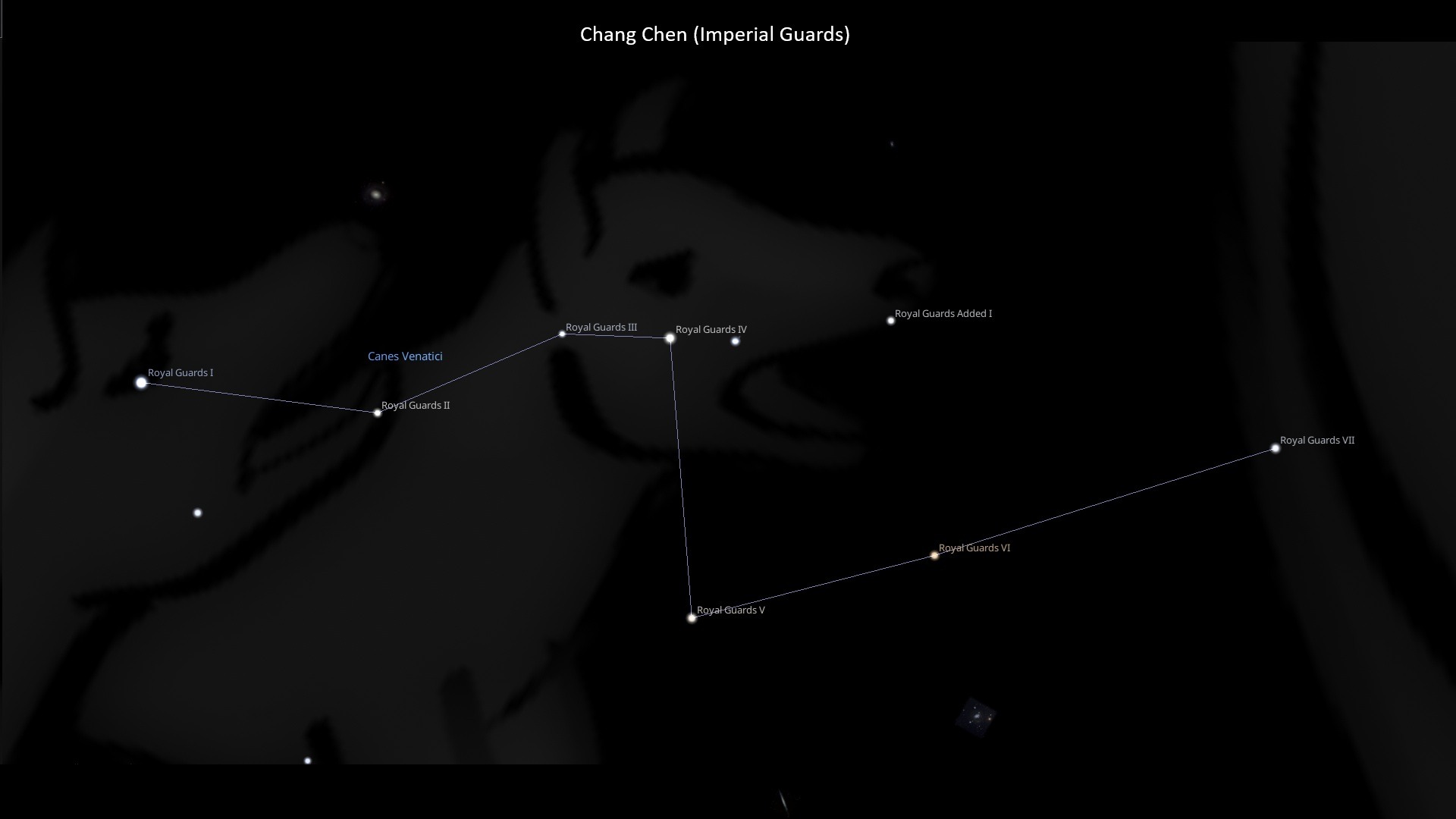
The 14th asterism of the Taiwei (Supreme Palace) Enclosure is named 常陳 Chángchén, “Imperial Guards.” It represents the emperor’s guards and warriors and is composed of 7 stars from the constellations Canes Venatici and Ursa Major. [1]
| 2000 | 2050 | IAU | Chinese | Orb |
| 24♍34 | 25♍16 | α² CVn | Changchen Yi (1) | 2°00′ |
| 21♍30 | 22♍13 | 10 CVn | Changchen Er (2) | 1°00′ |
| 19♍06 | 19♍49 | 9 CVn | Changchen San (3) | 1°00′ |
| 17♍42 | 18♍24 | β CVn | Changchen Si (4) | 1°20′ |
| 17♍34 | 18♍17 | 6 CVn | Changchen Wu (5) | 1°00′ |
| 14♍29 | 15♍11 | 2 CVn | Changchen Liu (6) | 1°00′ |
| 10♍03 | 10♍45 | 67 UMa | Changchen Qi (7) | 1°00′ |
Changchen the Imperial Guards
10♍03 to 24♍34
Ma Duanlin (1317)
The seven stars of the Constant Array (Imperial Guards), arranged in a pattern resembling the Big Dipper, are located north of the Palace Guard’s (Officers of the Imperial Guard) position. These represent the Tiger Warriors who guard the Emperor, signifying strength and resolve. If the stars move, the Emperor himself will be present; if they are bright, the military will be active; if they are dim, the military will be weak. [2]
Song History (1346)
The seven stars are always arranged in a pattern resembling the Big Dipper, positioned to the north of the Seats of the Five Emperors. This signifies the Emperor’s elite guards, forming a powerful defensive force. If the stars move, the Emperor personally leads troops; if they are bright, military forces are employed; if they are dim, the Emperor is weak. If a guest star invades the palace, the ruler will carry out executions. [3]
References
- Taiwei Enclosure – Baidu Encyclopedia.
- A General Examination of Literature, Volume 278, Part 1, Ma Duanlin, 1317.
- Song History, Volume 29, Chapter 2, 1346.