
STARS: Major | All | Constellations | Chinese | About
02♌48 to 07♍21
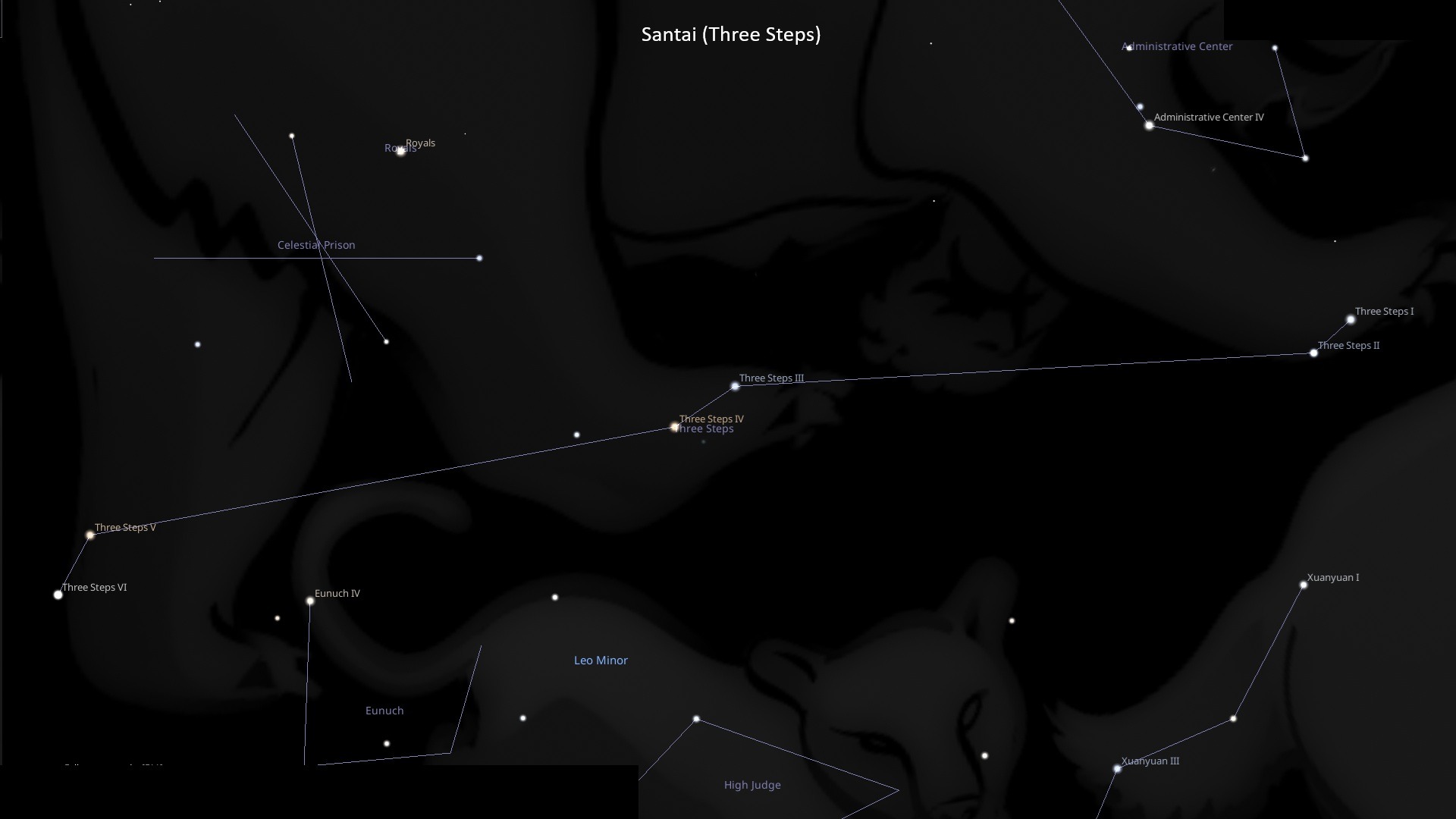
The 20th asterism of the Taiwei (Supreme Palace) Enclosure is named 三台 Sāntái, “Three Steps.” It represents the celestial staircase that the Heavenly Emperor uses to ascend to and descend from the Heavenly Court. It is composed of 6 stars of the constellation Ursa Major. [1]
| 2000 | 2050 | IAU | Chinese | Orb |
| 02♌48 | 03♌30 | ι UMa | Santai Yi (1) | 1°50′ |
| 03♌57 | 04♌39 | κ UMa | Santai Er (2) | 1°40′ |
| 19♌33 | 20♌16 | λ UMa | Santai San (3) | 1°40′ |
| 21♌14 | 21♌57 | μ UMa | Santai Si (4) | 1°50′ |
| 06♍39 | 07♍22 | ν UMa | Santai Wu (5) | 1°40′ |
| 07♍21 | 08♍03 | ξ UMa | Santai Liu (6) | 1°20′ |
Santai the Three Steps
02♌48 to 07♍21
Divided into upper, middle, and lower platforms, the Three Steps are the celestial staircases used by the Heavenly Emperor to ascend and descend from the Heavenly Court. They may refer to the three gods of destiny, the central authority, and the official rank; the Three Dukes; or the three social classes, from the emperor to the common people. [1]
The Three Platforms, also known as the Three Powerful Stars, are a group of stars in the ancient Chinese star system that are part of the Taiwei Enclosure. It consists of six stars of modern Ursa Major, distributed between the Big Dipper and Leo. They are arranged in pairs as Upper, Middle, and Lower Platforms.
The Three Platforms and Six Stars were regarded as a ladder connecting the residence of the Heavenly Emperor (Ziwei Enclosure) and the place where he conducted government affairs (Taiwei Enclosure).
In traditional astrology, the Three Stars are given multiple symbolic meanings. The Book of Jin, Treatise on Astronomy, calls them “Heavenly Pillars,” corresponding to the three high-ranking officials in the human world, who are in charge of lifespan, clan, and military affairs respectively; they are also divided into three levels, “Tai Jie,” symbolizing the ranks from the emperor to the common people. The ancients used their brightness and color (such as green for disease and red for war) to predict good or bad fortune, and associated them with agriculture and the relationship between the emperor and his ministers, regarding them as symbols of integrity and social interaction.
The Three Platforms was a general term for the three positions in the Han Dynasty: the Minister of Personnel, the Censor, and the Attendant. The Minister of Personnel was called the “Central Platform,” the Censor was called the “Imperial Platform,” and the Attendant was called the “Outer Platform.” Together they were called the “Three Platforms.”
The Three Platforms, also known as the Tai Steps, are divided into three steps: upper, middle, and lower. The upper and lower stars on each step have distinct roles. The upper star of the upper step symbolizes the emperor, and the lower star represents the empress. The upper star of the middle step represents the feudal lords and the three dukes, and the lower star represents the ministers and officials. The upper star of the lower step represents the scholars, and the lower star represents the common people. [2]
Three Steps (Santai), proclaiming virtue, prophecy.
Shang Tai (Upper Step), destiny and lifespan.
ι UMa, Shangtaiyi (1st Upper Step), Tiānzǐ (the emperor)
κ UMa Shangtaier (2nd Upper Step), Nǚzhǔ (the empress)
Zhong Tai (Middle Step), central authority and imperial family.
λ UMa, Zhongtaiyi (1st Middle Step), Zhūhóusāngōng (three feudal lords)
μ UMa, Zhongtaier (2nd Middle Step), Qīngdàifu (high officials)
Xia Tai (Lower Step), fortune (official salary) and military affairs.
ν UMa, Xiataiyi (1st Lower Step), Shì (scholars)
ξ UMa, Xiataier (2nd Lower Step), Shùrén (common people)
Ma Duanlin (1317)
The north gate connects to the Three Platforms to the west, facing the wall to prevent war.
The six stars of the Santai constellation are arranged in pairs, starting with Wenchang, and then moving to Zhaoyao and Taiwei. It is also called Tianzhu, the position of the Three Dukes. In the heavens, it is called the Three Platforms, which govern the opening of virtue and the proclaiming of talismans.
The two stars near the Wen Chang star to the west are called the Upper Platform, which governs destiny and longevity; the next two stars, opposite the Xuan Yuan star, are called the Middle Platform, which governs the central government and the imperial family; the two stars to the east, reaching the Tai Wei star, are called the Lower Platform, which governs fortune and military affairs. This is to illuminate virtue and quell disobedience.
The Three Platforms are also called the Heavenly Steps, with Tai Yi above and below. Another name is the Tai Steps. The upper star of the Upper Step represents the emperor, and the lower star represents the empress; the upper star of the Middle Step represents the feudal lords and high officials, and the lower star represents the ministers; the upper star of the Lower Step represents the scholars, and the lower star represents the common people. This is to harmonize Yin and Yang and govern all things.
When these stars change, each is interpreted according to its corresponding element. When the ruler and his ministers are in harmony, it is in accordance with their usual order. Zhang Heng said that if the colors are uniform and the ranks are similar, then the ruler and his ministers are in harmony, and the laws are just; if they are not uniform, it is a sign of discord. When Venus and Mars guard the area, war breaks out, and comets are especially severe. [3]
Song History (1346)
The Three Platforms, consisting of six stars, are arranged in pairs, starting with Wen Chang and extending to the Tai Wei Enclosure (太微垣). One view calls them Tian Zhu (天柱), representing the positions of the Three Dukes (三公). In the human realm, they are called the Three Dukes; in the heavens, they are called the Three Platforms, governing the proclaiming of virtue and prophecy.
The two stars closest to Wen Chang to the west are called the Upper Platform (ι UMa, κ UMa), governing destiny and longevity; the next two stars are called the Middle Platform (λ UMa, μ UMa), governing the central authority and the imperial family; the two stars to the east are called the Lower Platform (ν UMa, ξ UMa), governing fortune (official rank) and military affairs. These are all used to manifest virtue and ward off evil.
Another view considers the Three Platforms to be celestial steps, used by the Taiyi Emperor (太大帝) to ascend and descend. One view considers them to be the Tai Steps (泰阶), with the upper star of the upper step (ι UMa) representing the emperor and the lower star (κ UMa) representing the empress; the upper star of the middle step (λ UMa) representing the feudal lords and the Three Dukes, and the lower star (μ UMa) representing the high officials; the upper star of the lower step (ν UMa) represents the scholars, and the lower star represents the common people (ξ UMa): thus they harmonize Yin and Yang and govern all things. It is also called the Upper Terrace.
It was further believed that the upper star of the upper platform governed Yanzhou and Yuzhou, and the lower star governed Jingzhou and Yangzhou; the upper star of the middle platform governed Liangzhou and Yongzhou, and the lower star governed Jizhou; the upper star of the lower platform governed Qingzhou, and the lower star governed Xuzhou.
If the ruler is fond of war, the upper star of the Upper Terrace (ι UMa) will be sparse and red. If he built palaces and expanded gardens, indulging in sensual pleasures, the two stars of the upper platform (ι UMa, κ UMa) would close together and be arranged horizontally. If the ruler was weak, the two stars of the upper platform (ι UMa, κ UMa) would be close together and dim.
If princes and nobles were to rebel against the emperor and lead their armies into war, the upper star of the middle platform (λ UMa) would appear red. If foreign barbarians invaded and the border prefectures and kingdoms were in turmoil and panic, the lower star of the middle platform (μ UMa) would be sparse and arranged horizontally, appearing white. If high officials abandoned the righteous path and turned to evil, the lower star of the middle platform (μ UMa) would be sparse and appear red.
If the people disobeyed orders and broke the law, becoming thieves, the lower star of the lower platform (ξ UMa) would appear black. If people abandon their primary occupation for secondary pursuits and indulge in luxury, then the upper star of the Lower Terrace (ν UMa) will be widely spaced, arranged horizontally, and appear white.
If the relationship between ruler and minister is harmonious, taxes are reduced, and punishments are just, then the upper ranks (ι UMa, κ UMa) will be closer. When feudal lords pay tribute and high officials are loyal, the middle ranks (λ UMa, μ UMa) will be harmonious. When commoners are compliant, and corvée labor is properly performed, the lower ranks (ν UMa, ξ UMa) will be close.
If the ruler is arrogant and licentious, repeatedly encroaching on the people’s farming season, then the upper ranks (ι UMa, κ UMa) will become competitive. If feudal lords overstep their bounds and ministers are power-hungry and greedy, then the middle ranks (λ UMa, μ UMa) will become distant. If scholars and commoners pursue trivial matters and powerful figures bully each other, the lower ranks (ν UMa, ξ UMa) will widen their distance.
If the three ranks are stable, yin and yang will be in harmony, the weather will be favorable, the harvests will be plentiful, and the world will be at peace; if they are unstable, the opposite will happen. If the stars of the three ranks do not appear in full, the world will be in disarray. If the stars are bright, well-aligned, and symmetrical, the ruler and his ministers will live in harmony, and government decrees will be effectively implemented; if the stars are dim, the opposite will be true.
If Tianzhu (ι UMa) is not visible, the ruler will dislike it. If Siming (κ UMa) is absent, spring plowing will not be possible. If Sizhong (middle step) is not complete, summer weeding will not be possible. If Silu (lower step) is incomplete, there will be no harvest in autumn.
One interpretation is that if the Three Platforms are blue, the world will be plagued by illness; red foretells war; yellow with a lustrous glow foretells benevolence and virtue; white foretells funerals and mourning; black foretells sorrow and trouble.
When the moon enters the Three Platforms constellation, it foretells sorrow for the ruler, rebellion by subjects, and uprisings by nobles. When the moon enters the Three Platforms constellation and a lunar halo appears, it foretells the imprisonment of the Three Dukes.
If a guest star enters the Three Platforms, a high-ranking official will receive rewards, titles, and fiefdoms; if it appears or leaves and is pale, ministers and subordinates will lose their titles; if it guards the Three Stars, high officials will be dismissed, or noble ministers will fall ill. If the guest star’s movement intrudes into the celestial region where the Three Platforms are located and remains stationary, it foretells that a minister will be dismissed, or that many prominent officials will fall ill.
When a comet invades the Three Platforms, the Three Dukes will be dismissed.
When a meteor enters the Three Platforms, it foretells that soldiers and generals throughout the land will face troubles. When a meteor reaches the Central Platform (λ UMa, μ UMa), it foretells troubles for generals and ministers, and the ruler will dislike it.
When clouds enter the Three Platforms and appear pale white,, the people will suffer greatly; when they appear yellowish-white and have a lustrous starlight, it foretells peace for the people and joy for the monarch; when they appear yellow, it foretells joyous events for generals and ministers; when they appear red, it foretells troubles; when they appear bluish-black, it foretells troubles for the Three Dukes; when they appear pale white, it foretells the dismissal of the Three Dukes. [4]
References
- Taiwei Enclosure – Baidu Encyclopedia
- San Tai Xing – Baidu Encyclopedia
- A General Examination of Literature, Volume 278, Part 1, Ma Duanlin, 1317.
- Song History, Volume 29, Chapter 2, 1346.