
STARS: Major | All | Constellations | Chinese | About
07♐48 to 11♐27
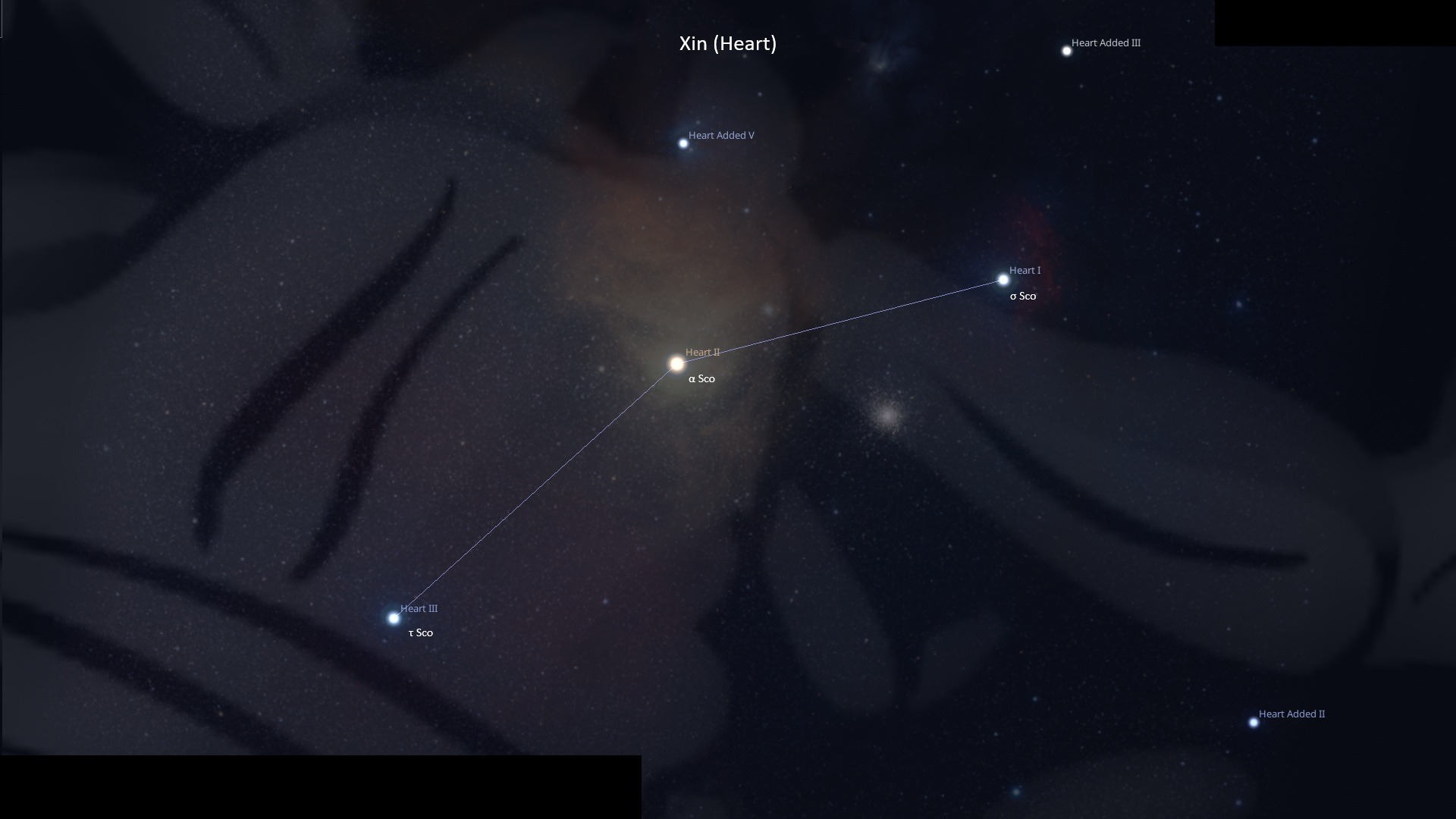
The 5th Chinese lunar mansion is named 心宿 Xīn Su, “Heart Mansion.” It is the 5th of the 7 mansions of the Azure Dragon of the East.
The 1st asterism of the Heart Mansion is also called 心 Xīn, “Heart.” It represents the Heart of the Azure Dragon and the proper position of the Heavenly King. It is composed of 3 stars of the Scorpius constellation. [1]
| 2000 | 2050 | IAU | Chinese | Orb |
| 07♐48 | 08♐30 | σ Sco | Xin Su Yi (1) | 1°50′ |
| 09♐45 | 10♐28 | α Sco | Xin Su Er (2) | 2°40′ |
| 11♐27 | 12♐09 | τ Sco | Xin Su San (3) | 2°00′ |
Constellation Xin the Heart
07♐48 to 11♐27
Those born under the Heart sign are resolute and diligent, averse to evil and promote good, unafraid of hardship, and possess a strong sense of justice; they are capable and therefore often take on more responsibility. Their weakness lies in being overly suspicious, which can sometimes hinder the full expression of their talents and the development of their career.
The heart is the dragon’s heart. The heart star, also known as Antares, was called “fire,” “great fire,” or “merchant star” in ancient times.
It represents the moon and the fox. It is the fifth constellation in the east, and the waist of the Azure Dragon. The heart is associated with fire, and it is the constellation corresponding to the first month of summer. It is often used in conjunction with the Fang constellation to discuss “the center governing the four directions.” The dragon’s waist is the location of the kidneys, the source of metabolism, and should not be taken lightly; therefore, it is often considered inauspicious.
The Heart Star, an inauspicious star, is not without its dangers. Construction or other matters involving men and women will be harmful. Graves should not be buried on this day, as plague and death will occur within three years. [1]
Heart Constellation, also known as Mingtang, symbolizes the palace where the Heavenly King governs. The Heart corresponds to the Moon in the seven luminaries, and its totem is a fox, hence the name Heart Moon Fox.
The Heart is the Great Fire (大火).
Heart 1 (σ Sco) is the Prince or Heart Before Star, or Crown Prince.
Heart 2 (α Sco) is the King or Great Fire (大火), Great Star (大辰), Bright Hall (明堂), Son of Heaven or the Merchant Star.
Heart 3 (τ Sco) is the Slave Son, Illegitimate Son, the Heart After Star or the Commoners.
The three stars of the Heart trigram, namely the Crown Prince, the Heavenly King, and the Concubine, are also known as the “Front Star of the Heart,” the “Middle Star of the Heart,” and the “Rear Star of the Heart,” respectively. These alternative names reflect the early Chinese military system, in which the royal army was commanded by three men, father and sons, with the specific division of labor as follows: the Crown Prince commanded the vanguard, the King commanded the central army, and the Concubine commanded the rearguard.
The concept of the three stars in the Heart triad system is also reflected in the garrison locations of the Yellow Emperor and his two sons. Ancient Chinese considered the south as the front, the north as the rear, the east as the left, and the west as the right. Therefore, at the end of a war for national unification, the three armies ceased their field operations and were stationed in specific regions, thus transforming into military regions. The country was divided into three major military regions : the Southeast Military Region, the Central Plains Military Region , and the Northwest Military Region . Clearly, the vanguard led by the crown prince would be designated to be stationed in the Southeast Military Region, the rearguard led by a son of a concubine would be designated to be stationed in the Northwest Military Region, and the emperor himself would be stationed in the Central Plains Military Region. According to historical records, the Yellow Emperor’s eldest son, Qingyang, was enfeoffed in “Zhu (Zhu),” near present-day Qufu , Shandong ; his eldest son of a concubine , Yigu, was enfeoffed in Ji (present-day Beijing area); and the Yellow Emperor himself was stationed in Xinzheng (present-day Xinzheng City, Henan). Therefore, the garrison locations of the Yellow Emperor and his two sons embody the Heart triad system. The system of the three stars of the heart was also fully manifested in the enfeoffment at the beginning of the Zhou Dynasty: the Duke of Zhou (representing the crown prince of King Wen) was enfeoffed in Qufu (the same fiefdom as the crown prince of the Yellow Emperor, Qingyang ), the Duke of Shao was enfeoffed in Ji (the same fiefdom as the illegitimate son of the Yellow Emperor, Yigu), and King Wu himself lived in the Central Plains and Luoyang region. This “military-state system” was also reflected in the “King Wu kills Zhou” ceremony [2].The Duke of Zhou, King Wu, and Duke Shao walked toward the corpse of King Zhou of Shang , each holding a battle-axe and a sword (as if the three stars of the Heart were moving forward). Each of them used their battle-axe and sword to punish King Zhou and his concubine. This symbolizes the collective punishment of the people of the southeast, northwest, and central regions for the wicked. [2]
Ma Duanlin (1317)
The central star of the Heart (心) is the darkest. Below it are twelve stars in total, clustered in groups of three below the Heart.
The Heart, at six degrees, is also called Great Fire (大火), representing the position of the Heavenly King. The central star is called the Bright Hall (明堂), the Great Star (大辰), representing the proper position of the Son of Heaven.
The star in front represents the Crown Prince; if it is not bright, the Crown Prince will not ascend the throne.
The star behind represents the illegitimate son; if it is bright, the illegitimate son will succeed.
Four feet above the Heart is the central axis of the Sun, Moon, and five planets. If the center is bright, the Way will be prosperous; if it is straight, the earth will shake; if it moves and disappears, the country will perish. It is also said that if the Heart turns black, the great man will have worries; if it is straight, the king will lose power; if it moves, the country will have worries; if it separates, the people will be displaced.
When Venus and Mars clash, bloodshed will not stop. When Saturn and Jupiter clash, or when there is a solar or lunar eclipse, it is inauspicious. A lunar halo indicates war. If Mars guards the center, the country will be without a ruler. When a guest star or a comet clashes, the world will be in chaos.
The Annals of the Two Dynasties of the Song Dynasty: The three stars of the Heart constellation are 114.5 degrees from the western star. [3]
Song History (1346)
The three stars of the Heart constellation represent the proper position of the Heavenly King. The central star is called the Bright Hall (Antares), the position of the Son of Heaven, the Great Star, which governs the rewards and punishments of the world; the star in front is the Crown Prince (σ Sco); the star behind is the commoners (τ Sco).
If the star is straight, the king loses power. If the star is bright and large, the world is united; if the world changes, the heart star is auspicious; if it moves, the army is scattered and the people are displaced.
A solar eclipse indicates that punishments will be unjust, generals and ministers will doubt each other, the people will be hungry, and there will be war and death. A solar halo indicates that the king is worried.
A lunar eclipse in its constellation indicates that the king is displeased, the three high officials are worried, and there will be death among the people. A lunar halo indicates drought, high grain prices, insect infestation, and impending misfortune.
When it is in conjunction with the five planets, it is very ominous.
When the Moon intrudes upon it, the ministers are worried; when it intrudes upon the central and front and back stars, the king is displeased; when it appears north of the heart star, the country will be drought-stricken; when it appears south, the king is worried and war will break out.
When Jupiter intrudes upon it, there will be celebrations, abundant grain, and the submission of the Chinese and barbarians; when its color is unclear, there will be death and drought.
When Mars intrudes upon it, the ministers are worried; when it passes through the heart, there will be famine; when it is in conjunction with Venus, there will be death. It is also said that when Mars is in the yang position, it is joy; when it is in the yin position, it is worry.
It is also said that if a planet guards Xin, it signifies a change in governance; if it violates Xin, it signifies the displacement of people and the dislike of high-ranking officials. If a planet guards Xin to the south, it signifies floods; if it guards Xin to the north, it signifies drought; if it moves in retrograde, it signifies chaos among high-ranking officials.
If Saturn violates Xin, high-ranking officials will rejoice, and the harvest will be plentiful; if it guards it, there will be successful land reclamation; if it stays for thirty days, there will be a pardon; if it stays for a long time, the ruler will be wise; if it violates Antares in the center, there will be fire disasters; if it moves in retrograde, it signifies female interference in politics.
If Venus violates Xin, grain prices will be high, generals will worry, there will be floods, and a major war will occur within a year; if it leaves, its color will be unclear, signifying mourning; if it moves in retrograde and circles around Xin, high-ranking officials will dislike it.
If Mercury violates Xin, high-ranking officials will be affected; if it is in the Yang region, it signifies Yan (a state of peace); if it is in the Yin region, it signifies the northern frontier; otherwise, there will be earthquakes and heavy rains; if it guards Xin, it signifies floods and theft.
If a guest star violates Xin, it signifies drought; if it guards Xin, it signifies fire disasters; if it leaves , grain prices will be high and the people will suffer famine.
If a comet violates Xin, high-ranking officials will doubt each other; if it guards it and then appears, it signifies locusts, famine, and also war. The presence of a comet, in its respective aspects, signifies war, mourning, and the displacement of people.
A meteor streaking across Xin signifies a minister’s rebellion; its entry into Xin indicates the arrival of foreign envoys; its blue color signifies war and worry; yellow signifies earthworks; black signifies misfortune.
Clouds entering Xin, if yellow, indicate joy for descendants; white signifies a rebellious minister nearby; black signifies the crown prince’s guilt.
According to the bronze instruments of the Yongyuan era of the Han dynasty and the Kaiyuan era of the Tang dynasty, the three stars of the Heart constellation are all five degrees apart, 108 degrees from the pole. The Jingyou measurement shows the three stars of the Heart constellation are five degrees apart, 114 degrees from the pole of the first star to the west. [4]
References
- Twenty-Eight Mansions – Baidu Encyclopedia.
- Xīn Xiù – Baidu Encyclopedia.
- General Examination of Literature, Volume 279, Part 2, Ma Duanlin, 1317.
- Song History, Volume 50, Chapter 3, 1346.