
STARS: Major | All | Constellations | Chinese | About
07♐48 to 16♐08
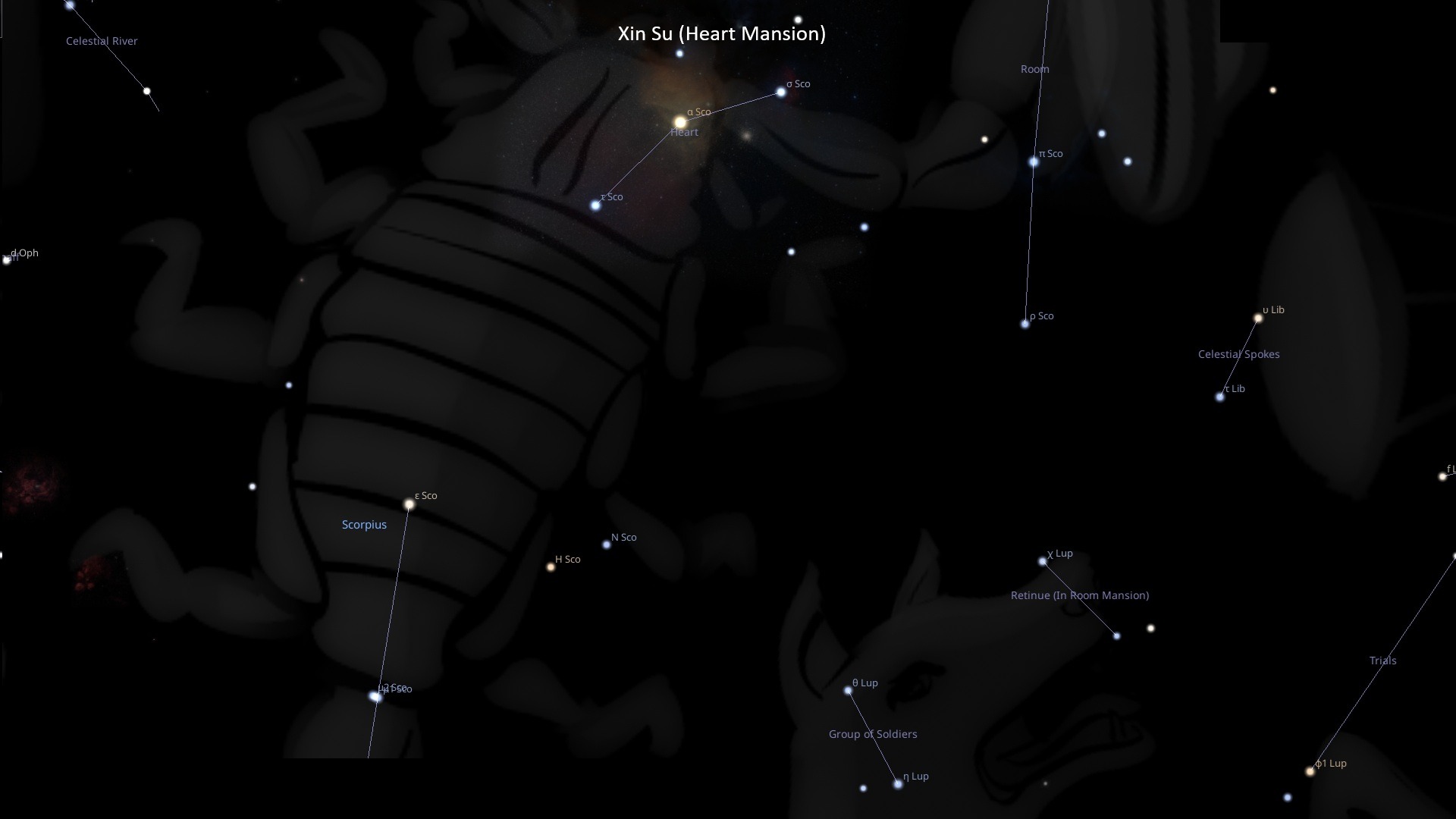
The 5th Chinese lunar mansion is named 心宿 Xīn Su, “Heart Mansion.” It is the 5th of the 7 mansions of the Azure Dragon of the East. It represents the Heart of the Azure Dragon.
The Heart Mansion contains 2 star officials (asterisms) and 5 stars, distributed in the constellations Scorpius and Lupus. [1]
| # | Asterism | English | 2000 | Constellations | Stars |
|---|---|---|---|---|---|
| 1 | Xīn | Heart | 07♐48 | Scorpius | 3 |
| 2 | Jīzú | Group of Soldiers | 05♐46 | Lupus | 2 |
Constellation Xin the Heart
07♐48 to 16♐08
Those born under the Heart sign are resolute and diligent, averse to evil and promote good, unafraid of hardship, and possess a strong sense of justice; they are capable and therefore often take on more responsibility. Their weakness is their tendency to be overly suspicious, which can sometimes hinder the full expression of their talents and the development of their career.
It represents the moon and the fox. It is the fifth constellation in the east, and the waist of the Azure Dragon. The heart is associated with fire, and it is the constellation corresponding to the first month of summer. It is often used in conjunction with the Fang constellation to discuss “the center governing the four directions.” The dragon’s waist is the location of the kidneys, the source of metabolism, and should not be taken lightly; therefore, it is often considered inauspicious.
The Heart Star, an inauspicious star, is not without its dangers. Construction or other matters involving men and women will be harmful. Graves should not be buried on this day, as plague and death will occur within three years.
Xin Yuehu: Wu is an official, a Yang deity, and is governed by the Xin Star Deity. The Xin Star represents fire and is associated with craftsmanship, hence it is located in the east. There are five Yang deities, surnamed Nü, named Tu Zu, with bull heads and human bodies, wearing yellow robes and carrying swords, and governed by the Xin Star Deity. [1]
Heart Moon Fox
The person born under the Heart Mansion is well-liked and respected by their clan and people. Serving a ruler brings them much respect. They are fortunate to suppress evil and receive good fortune.
They are suited to perform the duties required of a ruler, and are also suited to wearing formal attire and ascending to higher positions. They are also suited to capturing elephants, horses, and other livestock. Massage is highly recommended, and their physique will be healthy and robust. They are suited to serving a ruler and employing servants. They are suited to cultivating their hair and engaging in agriculture and sericulture. However, except for performing meritorious deeds, they should not readily give money to others or engage in lending money, as this is considered unlucky.
Heart Advice
Suspicion breeds resentment. Excessive suspicion not only fails to protect oneself but also becomes a sharp knife that damages relationships. Destroying a relationship due to suspicion may lead to some regret many years later.
They usually showcase their best side, but sometimes they like to take advantage of others. However, from different perspectives, it may not be entirely defined as exploitation, but rather as a clever exchange. But if they could be more honest, not just focusing on their own interests, and learn to embrace the achievements of the group, they might see a whole new world.
Others need freedom just like you. Especially in romantic relationships, those who like to control their partner may sometimes put them under their control while enjoying their own freedom elsewhere. This behavior is particularly common among men. Such behavior satisfies their own sense of security, but whether it truly brings them love is worth considering. [2]
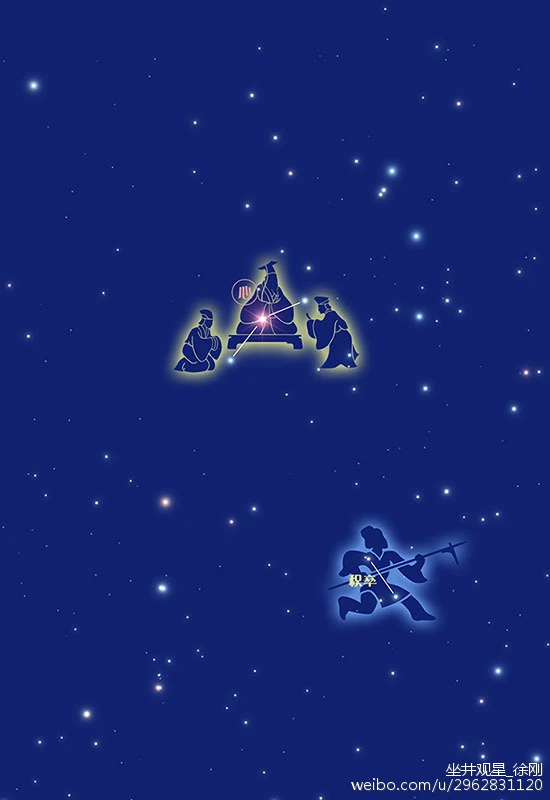
心宿 Xīn Su
Ma Duanlin (1317)
The central star of the Heart (心) is the darkest. Below it are twelve stars in total, clustered in groups of three below the Heart.
The Heart, at six degrees, is also called Great Fire (大火), representing the position of the Heavenly King. The central star is called the Bright Hall (明堂), the Great Star (大辰), representing the proper position of the Son of Heaven.
The star in front represents the Crown Prince; if it is not bright, the Crown Prince will not ascend the throne.
The star behind represents the illegitimate son; if it is bright, the illegitimate son will succeed.
Four feet above the Heart is the central axis of the Sun, Moon, and five planets. If the center is bright, the Way will be prosperous; if it is straight, the earth will shake; if it moves and disappears, the country will perish. It is also said that if the Heart turns black, the great man will have worries; if it is straight, the king will lose power; if it moves, the country will have worries; if it separates, the people will be displaced.
When Venus and Mars clash, bloodshed will not stop. When Saturn and Jupiter clash, or when there is a solar or lunar eclipse, it is inauspicious. A lunar halo indicates war. If Mars guards the center, the country will be without a ruler. When a guest star or a comet clashes, the world will be in chaos.
The twelve stars in total are located southwest of the Heart and the House of Fur (房) constellation, representing the five camps of soldiers. If they are small and faint, it is auspicious; if they are bright, large, and shaking, a great war will break out. When one star dies, troops are dispatched; when two stars die, half the troops are dispatched; when three stars die, all troops are dispatched. If another star guards it, a great war breaks out, and close ministers are executed.
The Annals of the Two Dynasties of the Song Dynasty: The three stars of the Heart constellation are 114.5 degrees from the western star. The twelve stars of the Accumulated Soldiers constellation are 126.5 degrees from the great star, entering the Di constellation at 15 degrees. [3]
Song History (1346)
The three stars of the Heart constellation represent the proper position of the Heavenly King. The central star is called the Bright Hall (Antares), the position of the Son of Heaven, the Great Star, which governs the rewards and punishments of the world; the star in front is the Crown Prince (σ Sco); the star behind is the commoners (τ Sco).
If the star is straight, the king loses power. If the star is bright and large, the world is united; if the world changes, the heart star is auspicious; if it moves, the army is scattered and the people are displaced.
A solar eclipse indicates that punishments will be unjust, generals and ministers will doubt each other, the people will be hungry, and there will be war and death. A solar halo indicates that the king is worried.
A lunar eclipse in its constellation indicates that the king is displeased, the three high officials are worried, and there will be death among the people. A lunar halo indicates drought, high grain prices, insect infestation, and impending misfortune.
When it is in conjunction with the five planets, it is very ominous.
When the Moon intrudes upon it, the ministers are worried; when it intrudes upon the central and front and back stars, the king is displeased; when it appears north of the heart star, the country will be drought-stricken; when it appears south, the king is worried and war will break out.
When Jupiter intrudes upon it, there will be celebrations, abundant grain, and the submission of the Chinese and barbarians; when its color is unclear, there will be death and drought.
When Mars intrudes upon it, the ministers are worried; when it passes through the heart, there will be famine; when it is in conjunction with Venus, there will be death. It is also said that when Mars is in the yang position, it is joy; when it is in the yin position, it is worry.
It is also said that if a planet guards Xin, it signifies a change in governance; if it violates Xin, it signifies the displacement of people and the dislike of high-ranking officials. If a planet guards Xin to the south, it signifies floods; if it guards Xin to the north, it signifies drought; if it moves in retrograde, it signifies chaos among high-ranking officials.
If Saturn violates Xin, high-ranking officials will rejoice, and the harvest will be plentiful; if it guards it, there will be successful land reclamation; if it stays for thirty days, there will be a pardon; if it stays for a long time, the ruler will be wise; if it violates Antares in the center, there will be fire disasters; if it moves in retrograde, it signifies female interference in politics.
If Venus violates Xin, grain prices will be high, generals will worry, there will be floods, and a major war will occur within a year; if it leaves, its color will be unclear, signifying mourning; if it moves in retrograde and circles around Xin, high-ranking officials will dislike it.
If Mercury violates Xin, high-ranking officials will be affected; if it is in the Yang region, it signifies Yan (a state of peace); if it is in the Yin region, it signifies the northern frontier; otherwise, there will be earthquakes and heavy rains; if it guards Xin, it signifies floods and theft.
If a guest star violates Xin, it signifies drought; if it guards Xin, it signifies fire disasters; if it leaves , grain prices will be high and the people will suffer famine.
If a comet violates Xin, high-ranking officials will doubt each other; if it guards it and then appears, it signifies locusts, famine, and also war. The presence of a comet, in its respective aspects, signifies war, mourning, and the displacement of people.
A meteor streaking across Xin signifies a minister’s rebellion; its entry into Xin indicates the arrival of foreign envoys; its blue color signifies war and worry; yellow signifies earthworks; black signifies misfortune.
Clouds entering Xin, if yellow, indicate joy for descendants; white signifies a rebellious minister nearby; black signifies the crown prince’s guilt.
According to the bronze instruments of the Yongyuan era of the Han dynasty and the Kaiyuan era of the Tang dynasty, the three stars of the Heart constellation are all five degrees apart, 108 degrees from the pole. The Jingyou measurement shows the three stars of the Heart constellation are five degrees apart, 114 degrees from the pole of the first star to the west.
The twelve stars of the Accumulated Soldiers constellation (Jizu), located southwest of the Fang constellation, represent five camps of soldiers, signifying guards sweeping away misfortune. Small stars are auspicious; bright stars indicate war; one missing star indicates few soldiers; two missing stars indicate half soldiers; three missing stars indicate all soldiers. Five planets guarding Jizu indicate war; otherwise, close ministers will be executed. A comet or a guest star guarding Jizu indicates a large-scale military campaign, with the emperor personally leading the troops. Clouds encroaching on Jizu, if blue or red, indicate high-ranking officials holding power and intending to discuss military matters.
According to the Bu Tian Ge (Song of Stepping the Heavens), the twelve stars of the Ji Zu (Accumulated Soldiers) belong to the Heart constellation. The Jin Zhi (Records of the Jin Dynasty) places them outside the Twenty-Eight Mansions. The Tang Wu Mi Shu (Military Writings of the Tang Dynasty) aligns with the Bu Tian Ge. The Qian Xiang Xin Shu (New Book of Qianxiang) differs, placing the Ji Zu under the Fang constellation. Both accounts are preserved here. [4]
References
- Twenty-Eight Mansions – Baidu Encyclopedia.
- Comprehensive Analysis | Unveiling the Personality Secrets of the Antares Constellation.
- General Examination of Literature, Volume 279, Part 2, Ma Duanlin, 1317.
- Song History, Volume 50, Chapter 3, 1346.