
05♐46 to 06♐44
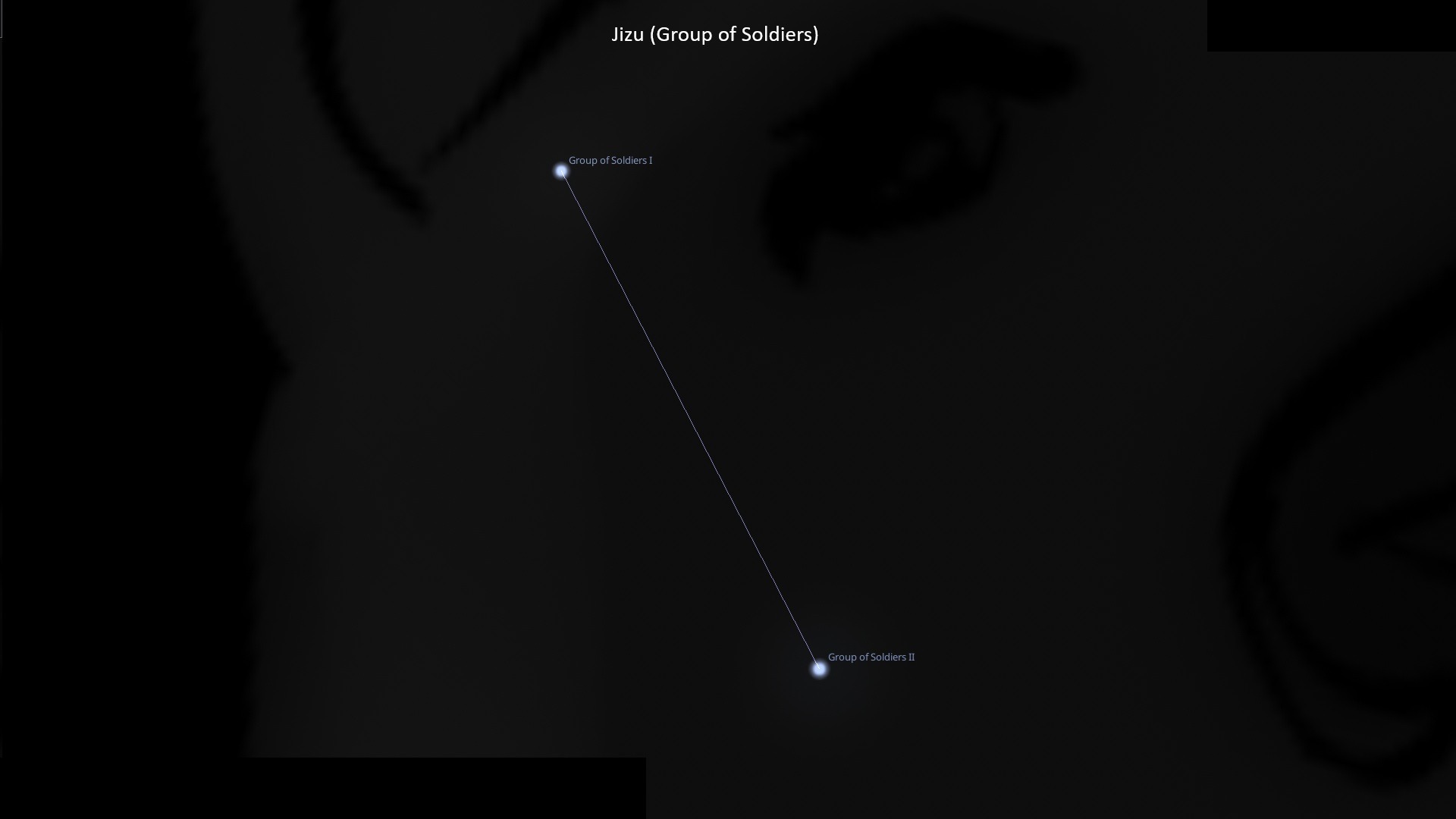
The 5th Chinese lunar mansion is named 心宿 Xīn Su, “Heart Mansion.” It is the 5th of the 7 mansions of the Azure Dragon of the East.
The 2nd asterism of the Heart Mansion is also called 積卒 Jīzú, “Group of Soldiers.” It represents five camps of soldiers, signifying guards sweeping away misfortune. It is composed of 2 stars of the Lupus constellation. [1]
| 2000 | 2050 | IAU | Chinese | Orb |
| 06♐44 | 07♐26 | θ Lup | Jizu Yi (1) | 1°20′ |
| 05♐46 | 06♐28 | η Lup | Jizu Er (2) | 1°40′ |
Asterism Jizu – Group of Soldiers the Heart
05♐46 to 06♐44
Before the Ming and Qing dynasties, the army was represented by twelve stars. The Qing dynasty’s “Yixiang Kaocheng” changed it to two stars, with two additional stars added. [2]
The twelve stars of Accumulated Soldiers, as the constellations under Antares, though dim in brightness, were highly valued by ancient military strategists. These constellations were not only closely related to ancient military strategies but also played a crucial role in historical wars.
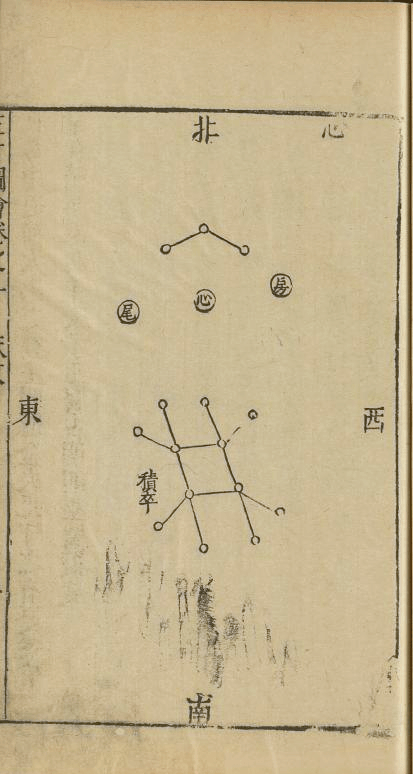
Xin and Jizu
The Eight Trigrams Formation is inextricably linked to the celestial constellations of Jizu. The specific relationship between Jizu and the formation is elaborated in detail in Tang Shunzhi’s *Wubian Qianji* (Military Compilation, First Collection) from the Ming Dynasty. The book describes the image of Jizu, the Heavenly Formation, located southwest of Fangdu, consisting of twelve stars arranged in three concentric circles. The outer circle is surrounded by eight-eight camps, while the inner circle uses four central fortifications as its hub, forming a nine-nine military formation. These stars are interconnected, commanding left, right, front, and back, forming the Four Beasts Formation. Stars facing forward form a bird formation, those facing backward form a snake formation, those facing left form a dragon formation, and those facing right form a tiger formation. Furthermore, there are layouts of Heavenly and Earthly formations, as well as complex variations such as the wind and clouds rising in the four cardinal directions, the Heavenly Rush on the left and right, and the Heavenly Balance in front and back. In divination, the course of military affairs can be predicted by observing the changes in the Ji Zu Star. If the Ji Zu Star disappears, the military strength will decrease accordingly. If one star disappears, the number of troops will be small; if two stars disappear, half the troops will be deployed; if three stars disappear, a large number of troops will be deployed; if all stars disappear, it means that the country will deploy all its troops, and soldiers will be scattered across the plains. [3]
Ma Duanlin (1317)
The twelve stars in total are located southwest of the Heart and the House of Fur (房) constellation, representing the five camps of soldiers. If they are small and faint, it is auspicious; if they are bright, large, and shaking, a great war will break out. When one star dies, troops are dispatched; when two stars die, half the troops are dispatched; when three stars die, all troops are dispatched. If another star guards it, a great war breaks out, and close ministers are executed.
The Annals of the Two Dynasties of the Song Dynasty: The twelve stars of the Accumulated Soldiers constellation are 126.5 degrees from the great star, entering the Di constellation at 15 degrees. [4]
Song History (1346)
The twelve stars of the Accumulated Soldiers constellation (Jizu), located southwest of the Fang constellation, represent five camps of soldiers, signifying guards sweeping away misfortune. Small stars are auspicious; bright stars indicate war; one missing star indicates few soldiers; two missing stars indicate half soldiers; three missing stars indicate all soldiers. Five planets guarding Jizu indicate war; otherwise, close ministers will be executed. A comet or a guest star guarding Jizu indicates a large-scale military campaign, with the emperor personally leading the troops. Clouds encroaching on Jizu, if blue or red, indicate high-ranking officials holding power and intending to discuss military matters.
According to the Bu Tian Ge (Song of Stepping the Heavens), the twelve stars of the Ji Zu (Accumulated Soldiers) belong to the Heart constellation. The Jin Zhi (Records of the Jin Dynasty) places them outside the Twenty-Eight Mansions. The Tang Wu Mi Shu (Military Writings of the Tang Dynasty) aligns with the Bu Tian Ge. The Qian Xiang Xin Shu (New Book of Qianxiang) differs, placing the Ji Zu under the Fang constellation. Both accounts are preserved here. [5]
References
- Twenty-Eight Mansions – Baidu Encyclopedia.
- Xīn Xiù – Baidu Encyclopedia.
- Exploring the Mysteries of the Heart Constellation: From Astrology to Array Formations, Unveiling the Secrets of the Chinese Sky.
- Song History, Volume 50, Chapter 3, 1346.
- General Examination of Literature, Volume 279, Part 2, Ma Duanlin, 1317.