
STARS: Major | All | Constellations | Chinese | About
25♌35 to 29♌01
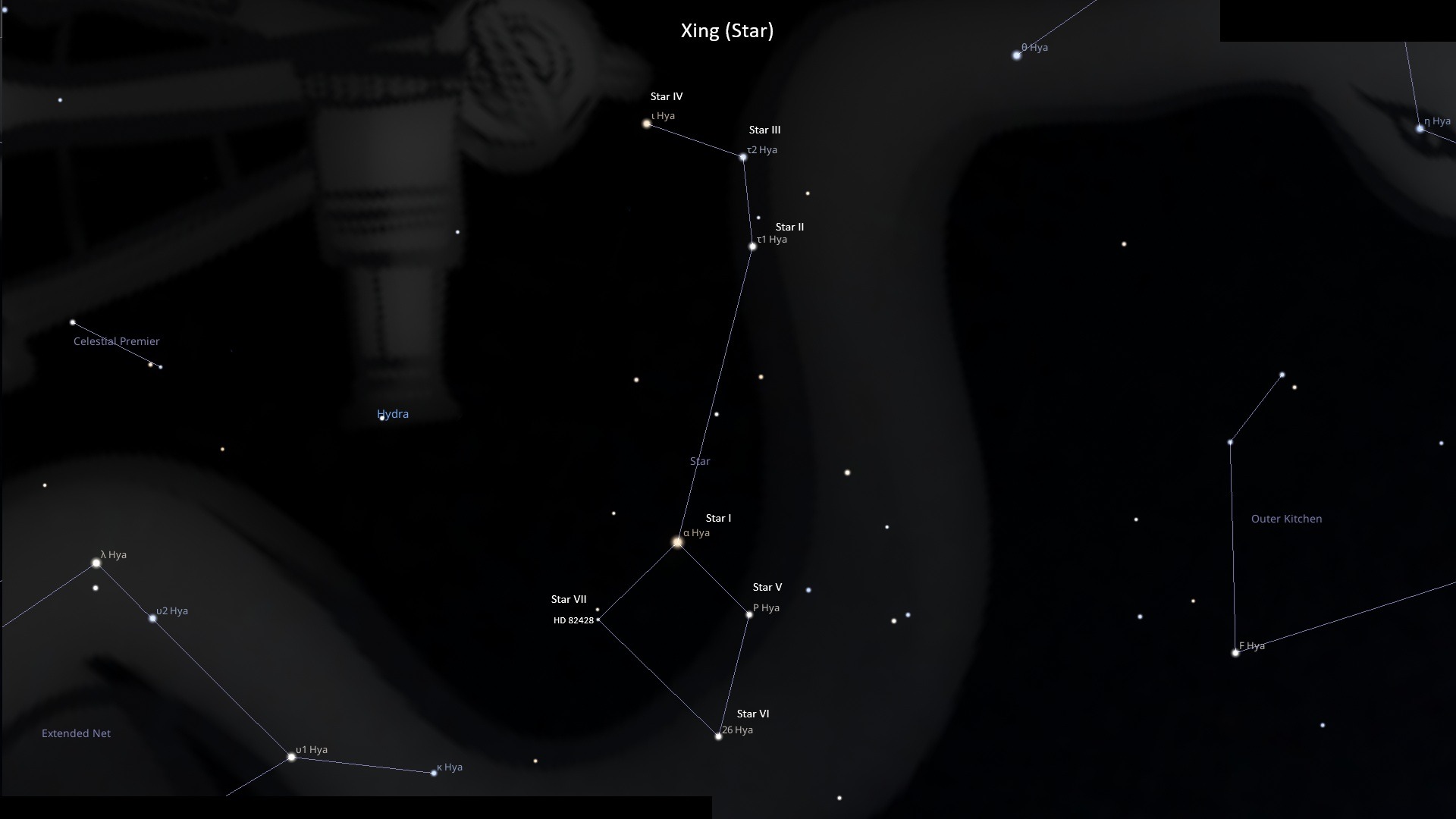
The 25th Chinese lunar mansion is 星宿 Xīng Su, “Star Mansion.” It is the 4th of the 7 mansions of the Vermilion Bird of the South and represents the Vermilion Bird’s neck.
The 1st asterism of the Star Mansion is also called 星 Xīng, “Star,” representing embroidered garments and royal attire, and overseeing sudden or urgent military conflicts. It is composed of 7 stars of the constellation Hydra. [1]
| 2000 | 2050 | IAU | Chinese | Orb |
| 27♌17 | 27♌59 | α Hya | Xing Su Yi (1) | 2°20′ |
| 25♌35 | 26♌17 | τ¹ Hya | Xing Su Er (2) | 1°10′ |
| 25♌45 | 25♌27 | τ² Hya | Xing Su San (3) | 1°10′ |
| 27♌39 | 28♌21 | ι Hya | Xing Su Si (4) | 1°30′ |
| 25♌49 | 26♌31 | P Hya | Xing Su Wu (5) | 1°00′ |
| 26♌32 | 27♌14 | 26 Hya | Xing Su Liu (6) | 1°00′ |
| 29♌01 | 29♌43 | HD 78702 | Xing Su Qi (7) | 1°00′ |
Constellation Xing the Star
25♌35 to 29♌01
Those born under the Xing constellation are naturally intelligent and hardworking, and they yearn for freedom and change; they are the type to achieve great things later in life. Because of their proud personality and aversion to flattery and fawning, they may have poor interpersonal relationships, which could hinder the full expression of their talents.
Xing represents the sun and the horse. It is the fourth constellation in the south, residing in the eye of the Vermilion Bird. Birds’ eyes are often as bright as stars, hence the name “Star.” As the saying goes, “One cannot tolerate a grain of sand in one’s eye”; therefore, this constellation is often considered inauspicious.
When the Xing constellation rules a day, sorrow is omened, misfortune outweighs good fortune, and unexpected disasters are likely. All construction projects are unfavorable, and calamities will repeatedly befall the household.
The Records of the Grand Historian: Treatise on Celestial Offices states, “The seven stars form the neck, representing the official in charge of urgent matters.” The Records of the Grand Historian: Explanatory Notes explains, “The neck refers to the neck of the Vermilion Bird. The official in charge is the throat. Things in the throat do not stay long; hence, it governs urgent matters.”
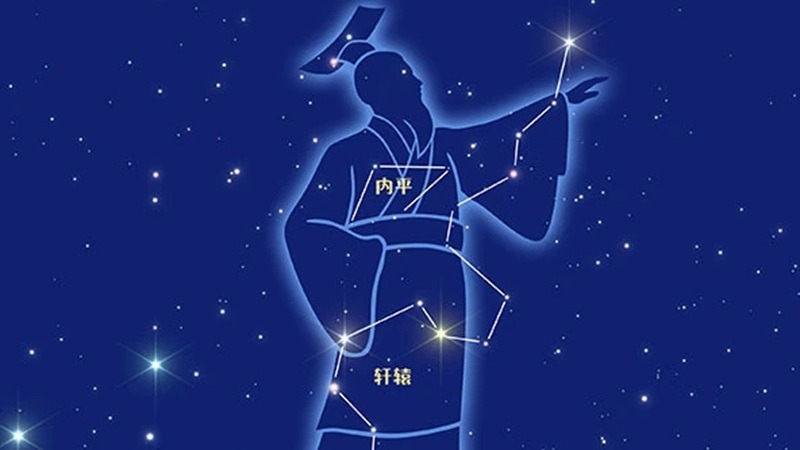
The Song of Walking the Heavens: Seven Stars Like a Hook poem indicates the relative positions of the constellations: “Seven stars like hooks grow beneath the willows, seventeen stars above form the shape of Xuanyuan.” [2]
Xing Xiu (Star Mansion) is the fourth of the seven constellations of the Vermilion Bird in the south and is also known as “Star Sun Horse.” It is located on the neck of the Vermilion Bird. Some say it also resides in the eye of the Vermilion Bird, hence the saying “the eyes of birds are often as bright as stars,” and hence the name “Xing.”
People born under the Star constellation are hardworking, diligent and ambitious. Their destiny belongs to the constellation of generals, which favors professional work. They are serious but stubborn and rebellious. Their career suits creative work such as art and technology. Their wealth is moderate, and they are destined to be associated with land and real estate. Love and marriage tend to come late. They should watch for diseases of the nervous and digestive systems.
The constellation is in a sad state on the day, with more bad luck than good luck and unexpected disasters. All construction is unfavorable, and the family will suffer many disasters. Suitable for: weddings and sowing. Unsuitable for: funerals. [1]
Xing Su
This person, born under this Xing Constellation, is prone to love, contention, and argument, and cannot control their anger and resentment. They cannot provide for their parents while they are alive, only offering sacrifices and remembrance after their death. They possess ample wealth, including servants, livestock, and possessions. They have some fame and good teachers, but also many bad ones. Throughout their lives, they enjoy praying at temples.
Those born under the constellation of Xingxiu are called “stars” because of their unique personalities. They often live in their own world and dislike conforming to others, making them a distinctive constellation. Xingxiu people are generous, broad-minded, and don’t dwell on trivial matters. They pursue their ideals in everything they do and are among the hardest-working of the twenty-seven constellations.
Xing Advice
This world is diverse, and everyone sees it differently. Being too fixated on “myself” will only cause you great suffering. In this world, no one can achieve everything they desire through their own efforts. Therefore, learning to compromise is a wiser, faster way to find happiness than being overly attached to your ideals.
Cherish what you already have. If you’re always looking for a better goal, you’re also negating everything you already have. You’ll always feel dissatisfied with what you have, while something better is still far away. If you can’t cherish what you already have and instead keep denying it, you might ultimately lose something that’s actually very important to you. [3]
Ma Duanlin (1317)
The seven stars are hook-shaped, growing below Liu. The seven stars represent seven degrees. Gan Shi (475 – 221 BC) says they govern the positions of empresses and concubines, as well as virtuous men. If they lose their color or their light flickers, the empresses and concubines will die, and virtuous men will be executed; if they are bright and large, the Way will be established, and the country will prosper. Zhang Heng (78–139 AD) says the seven stars are the neck of the Vermilion Bird, also called Tiandu, which governs embroidered clothing. The History of the Sui Dynasty states they govern urgent military operations and guard against thieves. Therefore, clarity is desired, for clarity ensures the prosperity of the ruler’s way; darkness prevents virtuous and capable men from dwelling, leaving the world empty and the emperor ill. Movement leads to war; separation leads to change in the government. A solar eclipse brings war, famine, and disaster to women. A violation of the Wood element (Jupiter) brings peace; a violation of the Fire element (Mars brings drought; and a violation of the Metal element (Venus) and the Water element (Mercury) brings disaster. A lunar halo or comet signifies war. [4]
Song History (1346)
Qixing (Seven Stars), also known as Tiandu, governs embroidered garments and royal attire, and also oversees sudden or urgent military conflicts.
When these stars shine brightly, the Emperors’ rule flourishes; if they grow dim, virtuous officials depart, and the realm becomes impoverished. If they shift position, warfare erupts; if they separate or disperse, political change occurs.
The Gai Tian (Canopy Heaven) system states: Qixing corresponds to the neck of the Vermilion Bird. The neck represents the essence of civilization and the seat of ceremonial regalia.
A solar eclipse within this asterism signifies unrest for the ruler and punishment for those who guard the gates of power. It is also said that scholars and men of letters may face execution, military uprisings may occur in the corresponding terrestrial regions, and subordinates may incite rebellion. A solar halo indicates distress for the sovereign; if the halo appears blue or greenish and follows a natural, clockwise motion, it bodes well for the eastern military forces.
A lunar eclipse suggests misfortune for the empress and high-ranking officials; it also signifies a year of famine, the displacement of the populace, and a change in the nation’s governance. A halo around the moon also portends drought and calamity for judicial officials.
If Mercury transgresses Qixing, treacherous ministers lurk nearby; if it lingers here for an extended time, troubles arise in the corresponding region, crops and living things fail to mature properly, internal military strife arises, high-ranking officials face punishment, and the populace suffers from epidemics and displacement.
If Venus transgresses Qixing, sudden warfare erupts, with ministers turning rebellious; if it traverses the entire sky, one must guard against deceit and treachery.
If Mars transgresses Qixing, bridges and thoroughfares may become impassable; if it moves retrograde, earthquakes or fires occur. Its appearance, disappearance, lingering, or stationing within this region signifies the loss of territory and catastrophic flooding.
If Jupiter transgresses Qixing, it signals military worries for the Emperor and damage or destruction of the grain harvest.
If Saturn transgresses or resides here, a peaceful and well-governed era emerges with flourishing royal rule; the empress and consorts experience joy.
If a guest star (unexpected star or nova) transgresses Qixing, warfare follows; according to the Divination of Jingzhou (192 – 208 AD): “The rivers will burst their banks, and the people will be forced to flee.”
The appearance of a comet signals chaotic warfare and the execution of high-ranking officials; the Wu Mi text notes: “When a comet emerges from the Seven Stars, shaped like a pestle, it signifies war.”
If a 孛 “bo” star (a hairy or hazy tailless comet) appears in Qixing, rebellious forces erupt within the palace, high-ranking ministers are executed, and senior officials accuse one another of wrongdoing.
If meteors cross the Qixing constellation, war or unrest arises; some sources also say that if they enter this region, they herald the arrival of an urgent imperial envoy. According to the Yisi Zhan “Yisi-year divination” (645 AD): “If meteors enter Qixing, officials in charge of the imperial storehouses will have cause for celebration; fine brocades and embroideries will be presented, and female artisans will be put to use.”
If pale or grayish clouds drift into this region, the nobility faces distress; if they drift out, it indicates that the sovereign is dispatching an urgent envoy. If the color is red, it signifies warfare; if black, it denotes the death of a virtuous scholar; if yellow, it indicates that people from afar have come to offer tribute; if white, it signifies that the Emperor has dispatched an envoy to bestow silk upon the feudal lords. [5]
References
- Xing Su – Baidu Encyclopedia.
- Twenty-Eight Mansions – Baidu Encyclopedia.
- Comprehensive Analysis | Unveiling the Personality Secrets of the Constellations.
- General Examination of Literature, Volume 279, Part 2, Ma Duanlin, 1317.
- Song History, Volume 50, Chapter 3, 1346.