
STARS: Major | All | Constellations | Chinese | About
05♌16 to 06♍24
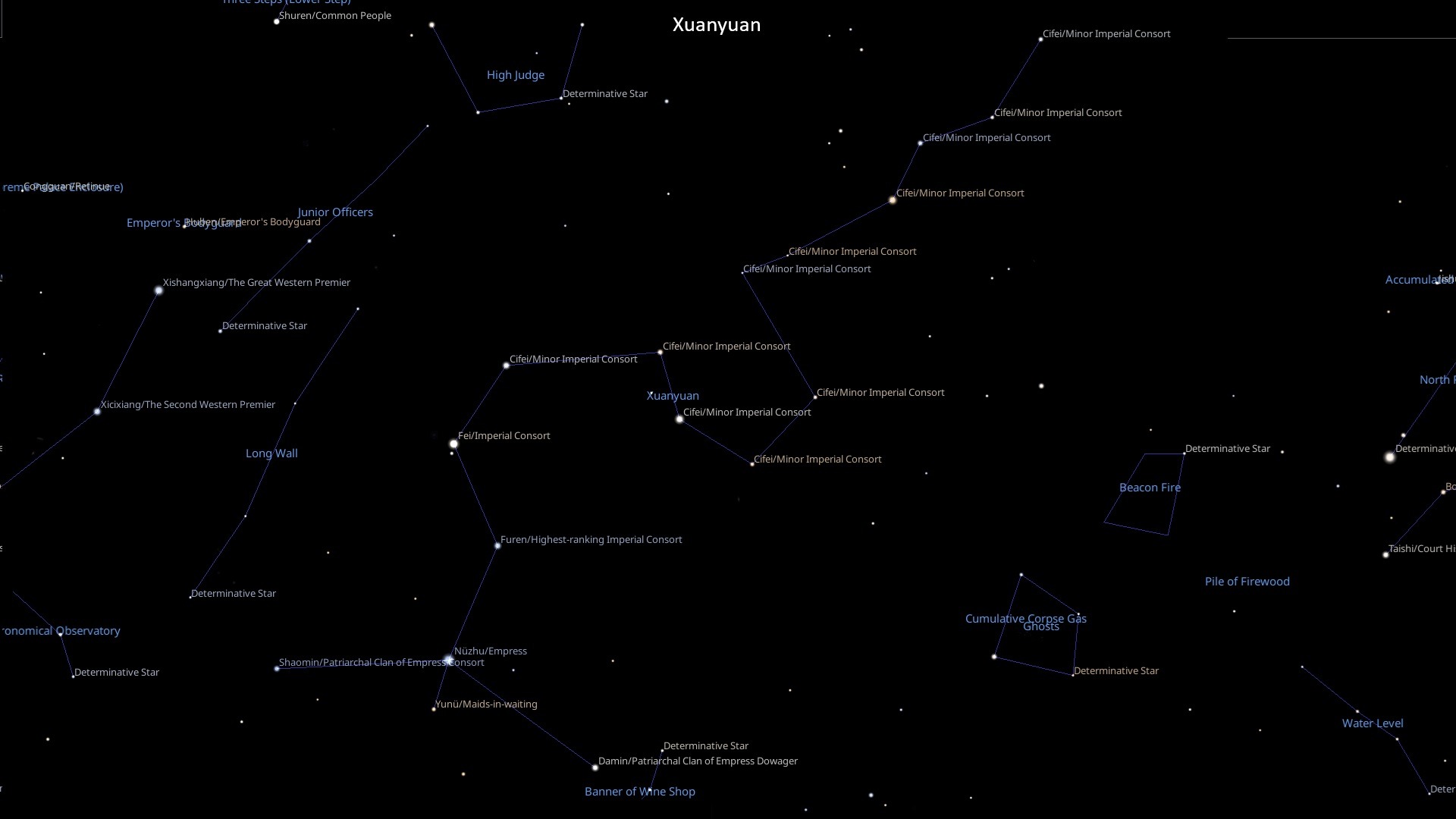
The 25th Chinese lunar mansion is 星宿 Xīng Su, “Star Mansion.”
The 4th asterism of the Star Mansion is called 軒轅 Xuānyuán, “Xuanyuan,” named after the ancient emperor Huangdi Xuanyuan, the Yellow Emperor. The original ancient asterism is composed of 17 stars from the constellations Leo and Lynx. [1]
| 2000 | 2050 | IAU | Chinese | Orb |
| 05♌16 | 05♌59 | 10 UMa | Xuanyuan Yi (1) | 1°00′ |
| 07♌33 | 08♌15 | HD 77912 | Xuanyuan Er (2) | 1°10′ |
| 10♌35 | 11♌17 | 38 Lyn | Xuanyuan San (3) | 1°30′ |
| 11♌51 | 12♌33 | α Lyn | Xuanyuan Si (4) | 1°50′ |
| 16♌12 | 16♌55 | HD 83069 | Xuanyuan Wu (5) | 1°00′ |
| 18♌04 | 18♌46 | 15 Leo | Xuanyuan Liu (6) | 1°00′ |
| 15♌18 | 16♌00 | κ Leo | Xuanyuan Qi (7) | 1°10′ |
| 17♌53 | 18♌35 | λ Leo | Xuanyuan Ba (8) | 1°10′ |
| 20♌43 | 21♌25 | ε Leo | Xuanyuan Jiu (9) | 1°50′ |
| 21♌26 | 22♌08 | μ Leo | Xuanyuan Shi (10) | 1°30′ |
| 27♌34 | 28♌16 | ζ Leo | Xuanyuan Shiyi (11) | 1°40′ |
| 29♌37 | 00♍20 | γ Leo | Xuanyuan Shier (12) | 2°10′ |
| 27♌55 | 28♌37 | η Leo | Xuanyuan Shisan (13) | 1°40′ |
| 29♌50 | 00♍32 | α Leo | Xuanyuan Shisi (14) | 2°30′ |
| 24♌15 | 24♌57 | ο Leo | Xuanyuan Shiwu (15) | 1°40′ |
| 06♍24 | 07♍06 | ρ Leo | Xuanyuan Shiliu (16) | 1°30′ |
| 00♍25 | 01♍07 | 31 Leo | Xuanyuan Shiqi (17) | 1°10′ |
Xuanyuan
05♌16 to 06♍24
The Xuanyuan asterism corresponds to Leo and partly to Lynx. The stars form a winding pattern resembling a dragon and are called the “Yellow Dragon Body” in the Treatise on Celestial Offices in the Records of the Grand Historian. (91 BC)
The asterism is named after the ancient emperor Huangdi Xuanyuan. It was given this name because Regulus was positioned almost on the ecliptic. In its early stages, it may have belonged to the “Five Symbols” system and later became part of the Twenty-Eight Mansions.
Emperor Huangdi Xuanyuan, also known as the Yellow Emperor, is considered the ancestor of the Chinese nation. His image was raised into the sky to form a star deity. [1]
Ma Duanlin (1317)
The seventeen stars of Xuanyuan, north of the seven stars (Xing constellation), represent the god of the Yellow Emperor, the body of the Yellow Dragon, the ruler of the empress and concubines, and the duties of men and women. One is called Dongling; another, Quanxing, the god of thunder and rain. The southern star (α Leo) represents the empress. The next northern star (η Leo) represents the lady, the screen, and the general. The next northern star (γ Leo) represents the concubine and the second general. The next stars all belong to the concubines. The southern small star (31 Leo) represents the empress and concubines. The left star (ρ Leo) represents the lesser people and the lesser empress’s clan. The right star (ο Leo) represents the greater people and the empress dowager’s clan.
It is desired that the stars be small, bright, and yellow. Zhang Heng said that Xuanyuan, with the body of a dragon, is the god of thunder and rain, and the image of the empress’s harem. When Yin and Yang combine, they become thunder when in full force, lightning when agitated, rain when harmonious, wind when angry, fog when chaotic, frost when condensed, dew when scattered, clouds when gathered, rainbows when standing, and unicorns when separated. These are the fourteen transformations, all governed by Xuanyuan. If the star is small and bright yellow, it is auspicious; if it moves, the people will rebel; if it is wide open and vibrating in the east or west, it will lead to ruin. If water, fire, and metal guard it, it signifies an evil female ruler. The Han Shu commentary states that Xuanyuan represents power, Taiwei represents balance, and the five planets guarding it are like the balance’s divination.
The Astronomical Records of the Restoration: Shi Shi said that the Yellow Emperor of the Central Palace had the spirit of a yellow dragon, which was Xuanyuan. Its head rested on Xing and Zhang, its tail hung on Liu and Bing, its body reflected the Three Terraces, and it governed the four seasons, the Central Mountain, the Central Plains, the Yellow River, the Yangtze River, the Han River, the Huai River, and the Ji River, the descendants of the Yellow Emperor, and 360 naked insects. According to Zhang Heng’s Ling Xian, the Azure Dragon coils on the left, the White Tiger fiercely guards the right, the Vermilion Bird spreads its wings in front, the Spirit Tortoise circles behind, and the Yellow Dragon Xuanyuan sits at the center.
Thus, Xuanyuan is one star, making five with the Azure Dragon, White Tiger, Vermilion Bird, and Black Tortoise. Those who discuss stars know only the four beasts, not the Yellow Dragon, indicating an incomplete understanding. Meng Kang said that Xuanyuan represents power, and Taiwei represents balance. Xuanyuan is called the Power Star, hence the name Power. Taiwei Enclosure governs principles, laws, and impartiality, like the balance of a scale, hence the name Balance. The Shi Ji Zheng Yi says that the four Power stars are west of Xuanyuan’s tail, which is incorrect; the four stars west of Xuanyuan are called the Fire Star, governing beacon fires and emergency preparedness. They are not called Power. The character Fire Star (爟) is mistakenly written as Power Star (权). Zhang Shoujie’s explanation is flawed and erroneous.
Furthermore, some say that this star existed as soon as the Qian hexagram appeared. Is Xuanyuan truly a deity of the Yellow Emperor, existing only after the Yellow Emperor? Lü Shi said, “The star Xuanyuan is the Yellow Dragon. The two fish resemble Xuanyuan, hence the name Xuanyuan. Xuanyuan descended from the heavens and was born. The Yellow Emperor knew this, so he called himself Xuanyuan. Xuanyuan is the name, not the actual name. Furthermore, Wang Liang, Xi Zhong, and Zao Fu are all star names; their spirits descended to become people, and after the people left, they returned to being stars. Why doubt Xuanyuan alone? Xuanyuan is originally a star of the Tian Shi Yuan constellation, but within the Zhang constellation’s field, it is governed by the seven constellations of the Vermilion Bird in the south. Although the stars within and outside the Three Enclosures govern different things and have different ranks, none are not subordinate to the Twenty-Eight Mansions. This is because the distribution of the Twenty-Eight Mansions across the celestial sphere cannot be separated from them.”
The Zhongxing Tianwen Zhi, based on Shi Shi’s star book, assigns the Yellow Dragon Xuanyuan to the Twenty-Eight Mansions of the four directions, namely the Azure Dragon, Vermilion Bird, Black Tortoise, and White Tiger, dividing them into five. It is considered to be of the Earth element, residing in the Quail Fire element, for the Five Elements cannot lack Earth. The earth element is indeed associated with the king. Therefore, stars such as Guan, Jishui, Jixin, the Five Lords, Tianzun, Queqiu, Beihe, Nanhe, the Four Rivers, and the Water Position are believed to belong to Xuanyuan. However, the stars below Guan, along with Xuanyuan, are also associated with the Twenty-Eight Mansions. If we now wish to honor Xuanyuan and assign these stars to him, how can Xuanyuan exist outside the Twenty-Eight Mansions, establishing its own zodiacal divisions to accommodate these stars? [2]
Song History (1346)
The seventeen stars of Xuanyuan, located north of the seven stars (Xing constellation), represent the empress and concubines and govern the duties of scholars and officials. Some sources call it Dongling; others call it Quan Xing. It governs the gods of thunder and rain. The southern large star (α Leo) represents the empress; the next northern star (η Leo) signifies the lady (a consort), also representing a screen or barrier and the supreme general; the next northern star (γ Leo) represents the concubine and the secondary general; the remaining stars represent the secondary concubines. The small stars south of the empress’s position (31 Leo) represent female attendants or concubines; the left star (ρ Leo), called Shaomin, represents the lesser people, the empress’s clan; the right star (ο Leo), Taomin, represents the greater people, the empress dowager’s clan.
It is desirable that the stars be small, bright, and yellow. Wu Mi said: “The constellation Xuanyuan represents the empress, consorts and inner palace. The interplay of yin and yang generates thunder through resonance, lightning through agitation, rain through harmony, wind through anger, fog through disorder, frost through condensation, dew through dispersion, clouds through aggregation, rainbow or hongni when formed uprightly, back-shaped qi (a type of cloud) when separated, and earrings-like formations when divided. These twenty-four transformations are all governed by the authority of Xuanyuan.”
If the stars are faint, the empress is uneasy; if they are black, the emperor worries; if they shift, the people will be displaced; if the stars in the east and west are large and vibrating, the empress’s clan will be ruined.
When the moon enters this region, the empress loses power or a fire disaster occurs. If it transgresses the left and right corners, high-ranking ministers will be dismissed for crimes. When the moon directly strikes or resides over the Taomin star (ο Leo), famine results and the Empress Dowager’s clan faces punishment; if it resides over the Shaomin star (ρ Leo), minor famine occurs, and the empress loses authority; when residing over the Nvyu (female attendants) stars, concern or sorrow arises. If a lunar halo appears, it signifies mourning for the empress. If a lunar halo appears, it signifies mourning for the empress. When the moon or any of the Five Planets transgress, encircle, or reside over this region, they all portend calamity for the empress. A lunar eclipse signifies concern or sorrow for the empress.
When Venus transgresses this area, the empress loses power.
When Mars transgresses or resides over Gousi (the Hook), empress and concubines will be disloyal; if it transgresses Nvyu (female attendant) stars, the sovereign’s servants and concubines face concern. When Mars strikes Taomin (ο Leo) or Shaomin (ρ Leo) stars, trouble arises for the emperor’s maternal family; if it remains in this region, executions occur within the palace.
When Jupiter transgresses this region, the empress will lose power; some sources say high-ranking ministers face consequences. If it resides over the Taomin star (ο Leo) for an extended period, a great famine occurs and members of the empress dowager’s family are demoted. If it directly strikes or resides over the Shaomin star (ρ Leo), a minor famine results, and someone in the harem will be dismissed.
When Saturn moves through this region, the empress loses power and mourns.
If a guest star (unexpected star or nova) transgresses this region, close ministers will plot to exterminate the imperial clan.
When a comet or 孛 “bo” star (a hairy or hazy tailless comet) transgresses this area, the empress will become a bandit; some sources say warfare erupts.
If meteors (falling stars) enter this region, the inner palace experiences much slander and disorder. According to Yisi Zhan: “When meteors emerge from here, an imperial envoy is dispatched.” Some sources say this indicates joy for the sovereign’s descendants. [3]
References
- Xuanyuan Star Official – Baidu Encyclopedia.
- General Examination of Literature, Volume 279, Part 2, Ma Duanlin, 1317.
- Song History, Volume 50, Chapter 3, 1346.