
STARS: Major | All | Constellations | Chinese | About
17♎55 to 19♎20
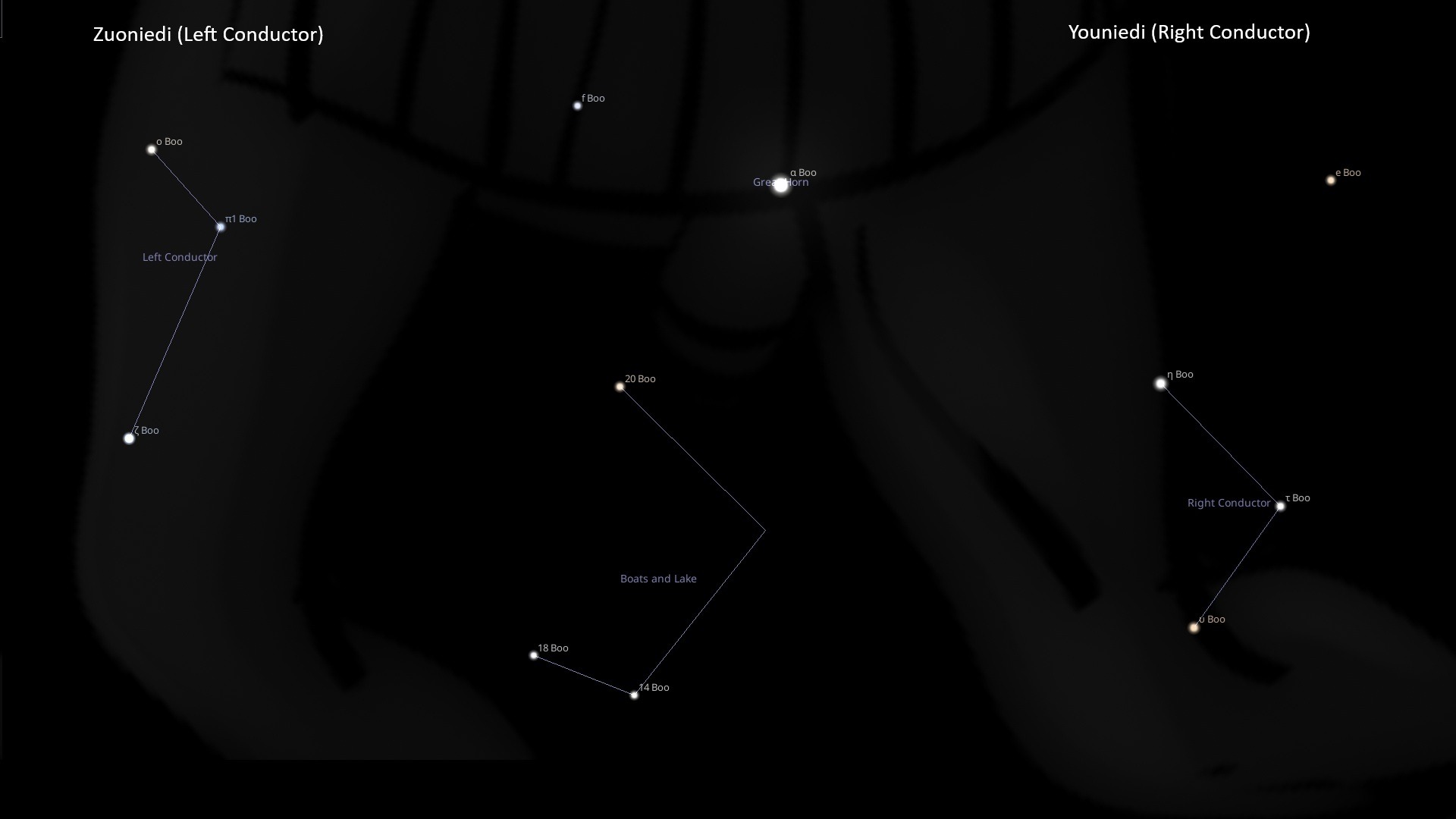
The 2nd Chinese lunar mansion is named 亢宿 Kàng Su, “Neck Mansion.”
The 4th asterism of the Neck Mansion is called 右攝提 Yòunièdī, “Right Conductor,” representing the right-side official who determines the seasons. It comprises 3 stars of the constellation Boötes. [1]
| 2000 | 2050 | IAU | Chinese | Orb |
| 19♎20 | 20♎03 | η Boo | Youniedi Yi (1) | 2°00′ |
| 17♎55 | 18♎38 | τ Boo | Youniedi Er (2) | 1°10′ |
| 19♎12 | 19♎54 | υ Boo | Youniedi San (3) | 1°20′ |
Youniedi the Right Conductor
17♎55 to 19♎20
Yousheti is one of the ancient Chinese star officials, belonging to the Kang constellation, and means “official in charge of determining the seasons.” It contains 3 stars, lies near Arcturus and is opposite the Zuosheti (Zuoniedi) star official. The Tang Dynasty astronomical poem Dan Yuan Zi Bu Tian Ge states, “The left and right stars of the Great Horn are similar in shape like a tripod.” [2]
Ma Duanlin (1317)
The six stars of Sheti (left and right conductor), directly south of the handle of the Big Dipper, govern the establishment of seasons and the observation of auspicious omens. Sheti is a shield that protects the emperor’s seat (Dizuo) and governs the nine ministers. If it is bright and large, the three dukes will be arrogant and domineering. When a guest star enters, the sage is controlled. It can also symbolize a high-ranking official. [3]
Song History (1346)
The six stars of Sheti, three on the left and three on the right, located south of the handle of the Dipper, signify the establishment of seasons and the observation of auspicious or ominous portents. These stars form a shield, flanking the Emperor’s Seat (Dizuo), and represent the nine ministers.
If the stars are bright and large, the three dukes will be arrogant, and the ruler will be weak; if the light is dim and unclear, the world will be at peace; if they draw close to Arcturus, close relatives will plot against the emperor.
When the moon enters this asterism, the ruler faces subjugation. A lunar eclipse is generally considered inauspicious. When Mars or Venus linger here, warfare erupts, and the realm changes rulers. If a comet or broom star enters, the ruler personally leads the army; if it exits, he is subjugated.
If a meteor enters, war breaks out; if it exits, envoys will appear or be dispatched; if one encroaches upon the asterism, high officials will be uneasy. If clouds or vapors enter, red signifies war and anxiety for the Nine Ministers; yellow signifies joy; black signifies the execution of high officials. [4]
References
- Kàng Xiù – Baidu Encyclopedia.
- Right Star Official – Baidu Encyclopedia.
- General Examination of Literature, Volume 279, Part 2, Ma Duanlin, 1317.
- Song History, Volume 50, Chapter 3, 1346.