
STARS: Major | All | Constellations | Chinese | About
05♌25 to 08♌44
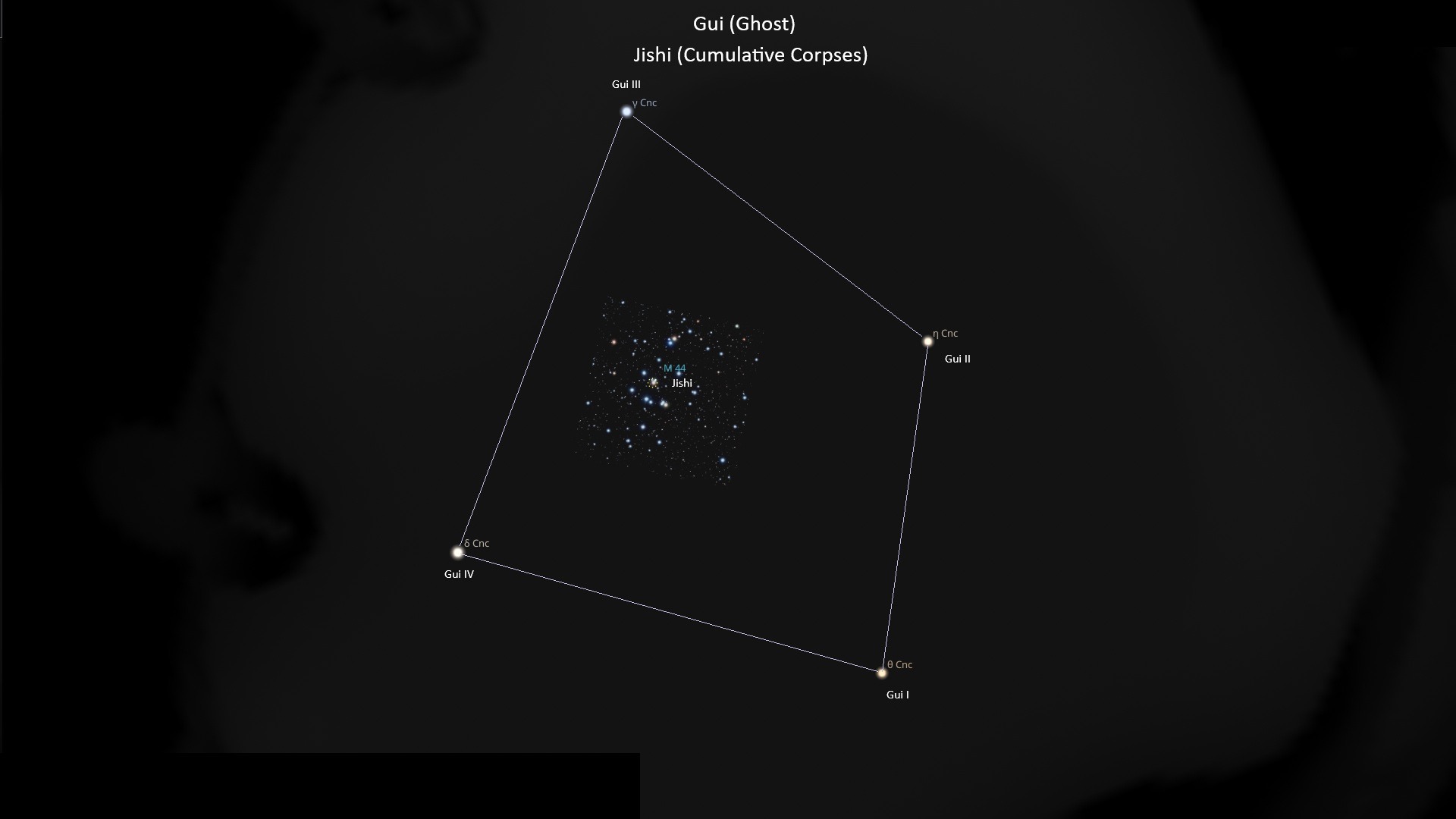
The 23rd Chinese lunar mansion is named 鬼宿 Guǐ Su, “Ghost Mansion.” It is the 2nd of the 7 mansions of the Vermilion Bird of the South.
The 1st asterism of the Ghost Mansion is also called 鬼 Guǐ, “Ghost.” It represents ghosts in a carriage and is composed of 4 stars from the constellation Cancer. Sometimes included in this asterism is M44, Jishi, “Cumulative Corpses.” [1]
Note: The name Gui is used twice in Chinese astronomy:
鬼 Guǐ, “Ghost,” is the name of the 23rd lunar mansion and its 1st asterism.
龜 Guī, “Turtle,” is the name of the 3rd asterism of the 6th lunar mansion.
| 2000 | 2050 | IAU | Chinese | Orb |
| 05♌44 | 06♌26 | θ Cnc | Gui Su Yi (1) | 1°00′ |
| 05♌25 | 06♌07 | η Cnc | Gui Su Er (2) | 1°00′ |
| 07♌33 | 08♌15 | γ Cnc | Gui Su San (3) | 1°00′ |
| 08♌44 | 09♌26 | δ Cnc | Gui Su Si (4) | 1°30′ |
| 07♌21 | 08♌04 | M44 | Jishi | 1°30′ |
Constellation Gui the Ghost
05♌25 to 08♌44
Those born under the Ghost Star are approachable, righteous, and easily popular. They are emotionally rich and experience significant life changes. They can quickly forget unpleasant things, dislike being restrained, and lack perseverance, easily missing opportunities.
The four stars of Guixiu are said to be responsible for gathering horses, soldiers, cloth, and gold and jade.
It belongs to the metal element and is associated with the sheep. It is the second constellation in the south, resembling a hat worn on the head of the Vermilion Bird. When birds are frightened, the feathers on their heads form a crest. People call the things they fear most, which do not actually exist, “ghosts,” hence the name Ghost Constellation. It governs fright and is therefore mostly inauspicious.
When the Ghost Constellation is in power on a particular day, it is not a light matter; all requests will be met with alarm. Business and profit-making will be unfavorable, and misfortune will befall the family.
The Ghost, also known as the Carriage Ghost. The character “Yu” in the Jiyun dictionary means “many,” so “Carriage Ghost” can be understood as meaning a multitude of ghosts. The Shuowen Jiezi defines “Yu” as “the bottom of a cart.” The four stars of the Ghost constellation are square, resembling a cart, which may also have another meaning. The Bu Tian Ge says, “The four stars are square like a wooden cabinet; the white in the center is the accumulated corpse qi.” The Guanxiang Wanzhan says, “The white, powdery substance in the center of the Ghost constellation is called accumulated corpse qi. It is also called the Heavenly Corpse, which governs death and funerals.”
Gui Jin Yang: Zhen, the eldest son of Qian, is ruled by the Ghost Star God. There are five eldest son gods, surnamed Zuo, given name Tu Yu. They have snake heads, black bodies, carry swords, and wear red wild robes. They are ruled by the Ghost Star God. [2]
Ghost Golden Sheep
People born under the Ghost Star (鬼宿) possess deep compassion and are adept at caring for others. When others encounter misfortune, they feel deeply for them and find it difficult to ignore it. Sometimes, they even choose to sacrifice themselves to help or save others. This kind-hearted nature is complemented by keen insight; when they sense that someone they are interacting with is not sincere, they will choose to distance themselves. However, the Ghost Star’s insight is often based on emotional judgment, so if they encounter a cunning person, they can easily be manipulated without realizing it, or only become aware of it later.
This person is born under this sign. They are upright and honest in their conduct, without any eccentricities, and possess great mental strength. They are well-read, have many wives and concubines, and abundant wealth. They are capable of discernment and are also very affectionate.
All their endeavors will be auspicious. Seeking fame, longevity, or engaging in any business, as well as wearing dignified attire, receiving official rank, or pursuing any desired outcome, will all bring good fortune and increased blessings. Furthermore, it is auspicious for long journeys, travel, hair repairs, wearing new clothes, and bathing. [2]
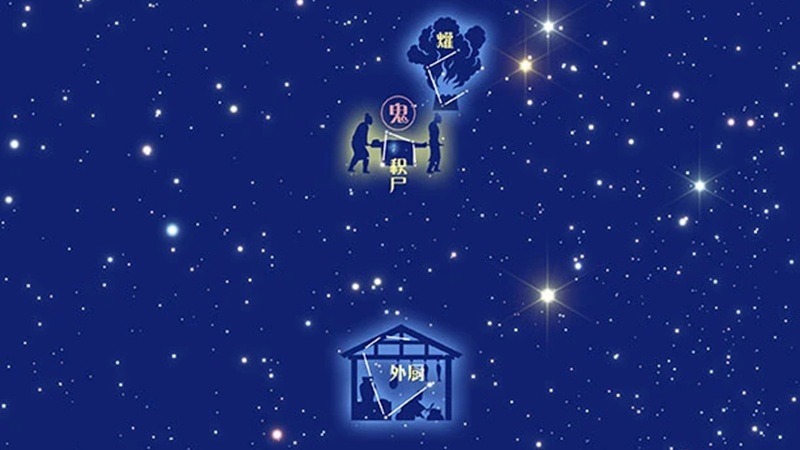
Ma Duanlin (1317)
Gui Sixing is square like a wooden cabinet, with a white center containing accumulated corpse energy.
The constellation Yu Gui (Ghost), at its second degree, is located in the center of the sun, moon, and five planets, and governs death and disease. Zhang Heng said it governs ancestral rites, the sun and moon, and also vision, enabling the discernment of treacherous schemes. The northeastern star (η Cnc) governs the accumulation of horses; the southeastern star (θ Cnc) governs the accumulation of soldiers; the southwestern star (δ Cnc) governs the accumulation of cloth and silk; and the northwestern star (γ Cnc) governs the accumulation of gold and jade. Their changes indicate their significance. The central star (M44) is called Ji Shi (Cumulative Corpses), also known as Ji Shi Qi, which only indicates visible qi and governs death, mourning, and sacrifices. It is also called Fu Zhi, which governs executions.
When the Gui star is bright, the six grains are harvested; when it is dim, people scatter. When it moves and shines, taxes are heavy, and corvée labor is abundant; when the star moves, people are distressed, and government decrees are urgent. Gui Zhi desires to be dim and unclear for peace; when it is bright, war breaks out, ministers plot against the ruler, and the lower classes flee. Gan Shi said that when Ji Shi shakes and loses its color, disease, ghostly cries, and human desolation occur. [4]
Song History (1346)
The five stars of Yu Gui (Ghost) govern the observation of treacherous schemes and are considered the “eye of heaven” (Tianmu). The northeast star (η Cnc) governs the accumulation of horses; the southeast star (θ Cnc), the accumulation of soldiers; the southwest star (δ Cnc), the accumulation of cloth and silk; and the northwest star (γ Cnc), the accumulation of gold and jade; their influence varies with the stars. The central star is the “accumulation of corpses” (Jishi), signifying death, mourning, and sacrifices; it is also called “Axe and Scythe” (Fu Tan), signifying executions and beheadings.
A bright and large star indicates a poor harvest; an unclear star indicates the scattering of the people. The scythe (Tan star) should be dim and unclear; if it is bright, war will break out, and high officials will be executed; if it moves and shines, taxes will be heavy, and labor will be burdensome, causing resentment among the people.
A solar eclipse indicates national unrest, a major mourning, and sorrow among nobles. A solar halo indicates war in the area it occupies, and the execution or demotion of high officials.
A lunar eclipse indicates sorrow among nobles and the empress, lasting for a year. A lunar halo can also indicate drought or a pardon.
If the Moon transgresses Yugu (Ghost Cart), the ruler of the Qin region suffers from worry; some sources say military generals die, high-ranking officials and female rulers face distress, while epidemics affect the people.
If Mercury transgresses Yugu, the five grains do not mature or are harvested poorly; if it guards this region for an extended duration, mourning follows with concern affecting high-ranking individuals.
When Venus enters and transits Yugu, there will be war and rebellious ministers within the state; it also signifies the impending execution of generals. If it passes through this region aggressively (guan zhi er nu), there will be rebellious ministers below. If it guards the constellation for a long time, there will be war below, drought, fire, and nothing will grow.
When Mars invades the constellation, loyal ministers are executed; some sources say that warfare breaks out and the queen loses power. If it enters this region, both the empress and the prime minister are worried; alternatively, it signifies a traitor at the emperor’s side, war, and loss. If Mars stations here, the realm issues amnesty. If it remains here for ten days, feudal lords suffer consequences; if twenty days pass, the crown prince faces trouble. If Mars completes a full circuit around this region (gou si huanrao), the emperor loses ancestral temple rites or suffers from loss of imperial legitimacy.
If Jupiter transgresses Yugu, crops are damaged, and famine follows, with the ruler neglecting state affairs; if it transgresses Tan (the execution star), law-enforcing ministers face execution.
When Saturn invades the constellation, high-ranking ministers and the empress will suffer. If it guards this region for an extended time, the suffering will be in the inner palace, and there will be drought and earthworks. If it enters the constellation of Ji Shi (accumulated corpses), the ruler will dislike it. If it transgresses Ji Shi, its position determines who is affected: in the yang direction (south) for the emperor, yin direction (north) for the empress, central position for the crown prince, and to the right side for high-ranking ministers; ill omens follow according to where it remains.
If a guest star transgresses Yugu, those who rise to power without proper authority will fail; some sources say excessive earthworks projects occur. If it enters this area, matters related to curses, oaths, and ancestral temple rituals become prominent.
If a comet transgresses Yugu (the Ghost Cart), warfare erupts, and the realm becomes unstable or in turmoil; one should cultivate virtue and perform rituals to ward off evil.
When a meteor appears here, mourning events and military conflict occur beneath its influence; it is advisable to cultivate virtue and perform rituals to avert disaster. If meteors transgress Tan (the execution star) in Yugu, there are cases of people being executed or killed; if they enter this area instead, four foreign states come to pay tribute.
If white cloud formations enter Yugu, epidemics arise; if black clouds appear, the empress is worried. Red-colored clouds indicate drought; yellow ones signify earthworks projects. If they intrude upon Jishi (Accumulated Corpses) star, high-ranking ministers face distress. Green or blue clouds portend illness and disease. [5]
References
- Yu Gui – Baidu Encyclopedia.
- Twenty-Eight Mansions – Baidu Encyclopedia.
- Comprehensive Analysis | Unveiling the Personality of the Ghost Constellation.
- General Examination of Literature, Volume 279, Part 2, Ma Duanlin, 1317.
- Song History, Volume 50, Chapter 3, 1346.