
STARS: Major | All | Constellations | Chinese | About
04♊26 to 12♊20
 The 19th Chinese lunar mansion is named 畢宿 Bì Su, “Net Mansion.” It is the 5th of the 7 mansions of the White Tiger of the West.
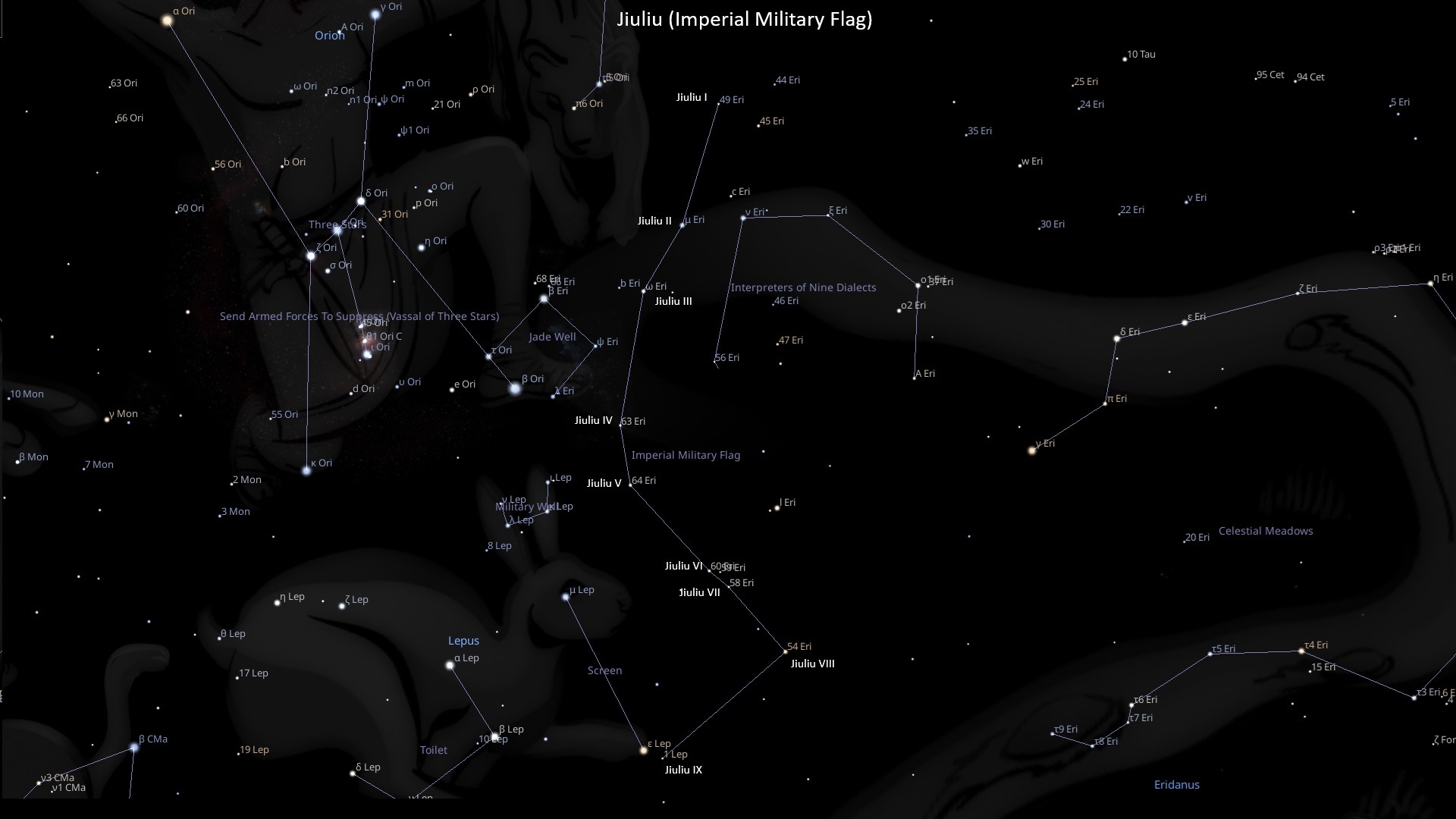
The 14th asterism of the Net Mansion is called 九斿 Jiǔliú, “Imperial Military Flag.” It represents the emperor’s military flag; the character 斿 is the same as 旒, referring to the hanging ornaments or ribbons on ancient flags. It is composed of 9 stars of the constellations Eridanus and Lepus. [1]
| 2000 | 2050 | IAU | Chinese | Orb |
| 07♊47 | 08♊30 | 49 Eri | Jiuliu Yi (1) | 1°00′ |
| 09♊21 | 10♊03 | μ Eri | Jiuliu Er (2) | 1°20′ |
| 11♊03 | 11♊45 | ω Eri | Jiuliu San (3) | 1°10′ |
| 12♊20 | 13♊02 | 63 Eri | Jiuliu Si (4) | 1°00′ |
| 12♊01 | 12♊43 | 64 Eri | Jiuliu Wu (5) | 1°00′ |
| 08♊28 | 09♊10 | 60 Eri | Jiuliu Liu (6) | 1°00′ |
| 07♊32 | 08♊14 | 58 Eri | Jiuliu Qi (7) | 1°00′ |
| 04♊26 | 05♊26 | 54 Eri | Jiuliu Ba (8) | 1°10′ |
| 11♊06 | 11♊48 | 1 Lep | Jiuliu Jiu (9) | 1°00′ |
Jiuliu the Imperial Military Flag
04♊26 to 12♊20
In ancient astrology, the Nine Star Officials (九斿星官) were associated with military affairs and regarded as the “military banner of the emperor,” symbolizing military power. Historically, the Yuan Mongol Empire used the nine-tassel white banner as a symbol of supreme power.
The Kaiyuan Zhanjing, “Kaiyuan Star Observations” (714 – 724) includes the astrological interpretations of Shi Shen and Gan De. Shi Shen stated, “When the Nine Stars shine brightly, war will break out,” while Gan De stated “When the Nine Stars are in full force, war will break out.” This reflects that the Nine Stars are related to military strategists and are part of the ancient military strategists’ “knowledge of astronomy” to observe “the will of heaven.”
Zhang Shoujie (725–735) of the Tang Dynasty annotated in the Records of the Grand Historian (91 BC) that the nine stars of Jiuyou are southwest of Yujing (Jade Well) and are the banners of the emperor’s army. Therefore, they guide the advance and retreat of the army and also govern the states and kingdoms. They do not want to be shaken, because if they are shaken, the nine provinces will be scattered and the people will lose their jobs. If the belief in fate is not understood, it will be a worry for China.
“Nine tassels” is also synonymous with “nine streamers,” referring to the nine hanging beads on an ancient crown, such as a “nine-tassel crown,” thereby linking the names of star officials to the hierarchical markers in the ritual system. [2]
Ma Duanlin (1317)
The nine stars southwest of Yujing (玉井) are called the Nine Banners (九斿), the emperor’s banner, governing the advance and retreat of border troops. If Venus and Mars guard it, war will break out. [3]
Song History (1346)
The nine stars of Jiushou, the Nine Gates (九氿), are located southwest of the Yuqing, the Jade Well (玉井), or east of Jiuzhou Shukou, the Nine Provinces (九州殊口) [Interpreters of Nine Dialects], arranged north-south, governing the military banners of the realm, also known as the Emperor’s banners. If Venus and Mars invade this area, cavalry will fill the fields in warfare. If a guest star invades this area, wars among feudal lords will erupt, and many wild animals will fall ill. [4]
References
- Twenty-Eight Mansions – Baidu Encyclopedia.
- Nine Stars Officials – Baidu Encyclopedia.
- Song History, Volume 50, Chapter 3, 1346.
- General Examination of Literature, Volume 279, Part 2, Ma Duanlin, 1317.