
STARS: Major | All | Constellations | Chinese | About
08♎51 to 11♎14
The 28th Chinese lunar mansion is named 軫宿 Zhěn Su, “Chariot Mansion.”
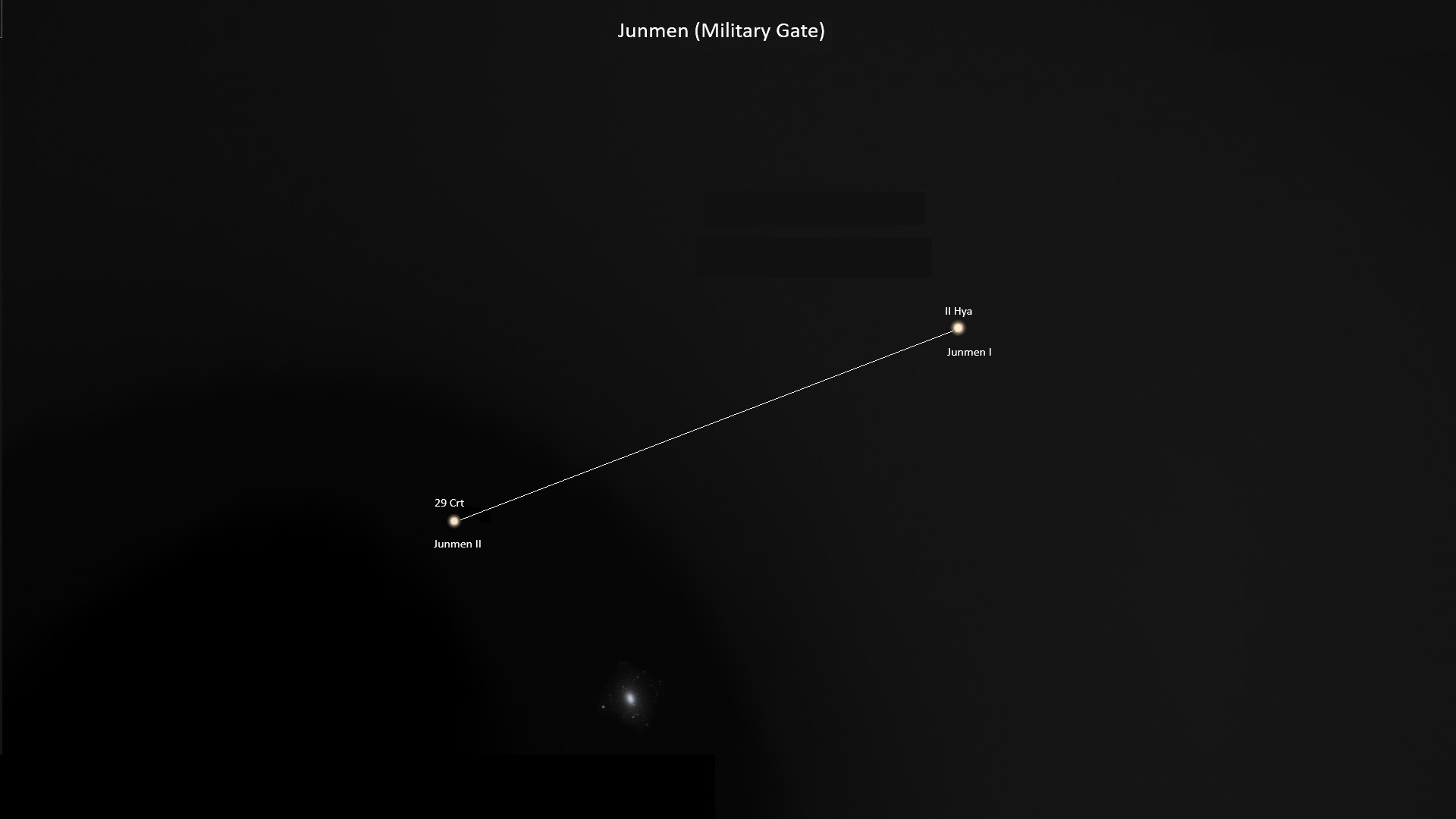
The 6th asterism of the Chariot Mansion is called 軍門 Junmen, “Military Gate,” representing the gate of the barracks. It consists of 2 stars in the constellation Hydra. [1]
This ancient Chinese asterism fell out of use during the Ming Dynasty. Its 2 stars now belong to the modern asterisms Yi (Wings) and Qingqiu (Green Hill).
| 2000 | 2050 | IAU | Chinese | Orb |
| 08♎51 | 09♎33 | II Hya | Junmen Yi (1) | 1°00′ |
| 11♎14 | 11♎56 | 29 Crt | Junmen Er (2) | 1°00′ |
Junmen the Military Gate
08♎51 to 11♎14
The History of Ming Dynasty, Treatise on Astronomy (1739) records that of the seven stars of Qingqiu in the Zhen constellation, only three remain, while the star officials Tusikong, Junmen and Qifu have disappeared. The fact that this star official could no longer be observed during the Ming Dynasty suggests its position may have shifted due to precession, stellar motion, or errors in ancient observations, eventually moving it out of its original star region. [2]
Ma Duanlin (1317)
The two yellow stars at Junmen, west of Qingqiu (Green Hill), are the gates of the emperor’s six armies. They govern the leopard-tail flags of the camp guards; their placement indicates impassable roads. [3]
Song History (1346)
The two stars of Junmen (Military Gate) lie west of Qingqiu (Green Hill); according to another account, they lie north of Tusikong (Master of Constructions), representing the gates to the Emperor’s six inner palaces. They govern military encampments and watchtowers; the “Leopard-Tail” banner is displayed there, and the stars are interpreted the same way as at the Southern Gate (Junnanmen). Any deviation from their normal state, or an encroachment by a guest star (unexpected star or nova), signifies that the roads are blocked.
Junnanmen: If the star is dim, foreign nations will rebel; if it wavers, warfare will erupt; if it shines brightly, distant lands will come to offer tribute. [4]
References
- Zhen Su – Baidu Encyclopedia.
- The Mystery of the Tusikong: From the “Star’s Demise” in the History of Ming to Modern Visible Astronomical Phenomena.
- General Examination of Literature, Volume 279, Part 2, Ma Duanlin, 1317.
- Song History, Volume 50, Chapter 3, 1346.