
STARS: Major | All | Constellations | Chinese | About
07♎59 to 13♎27
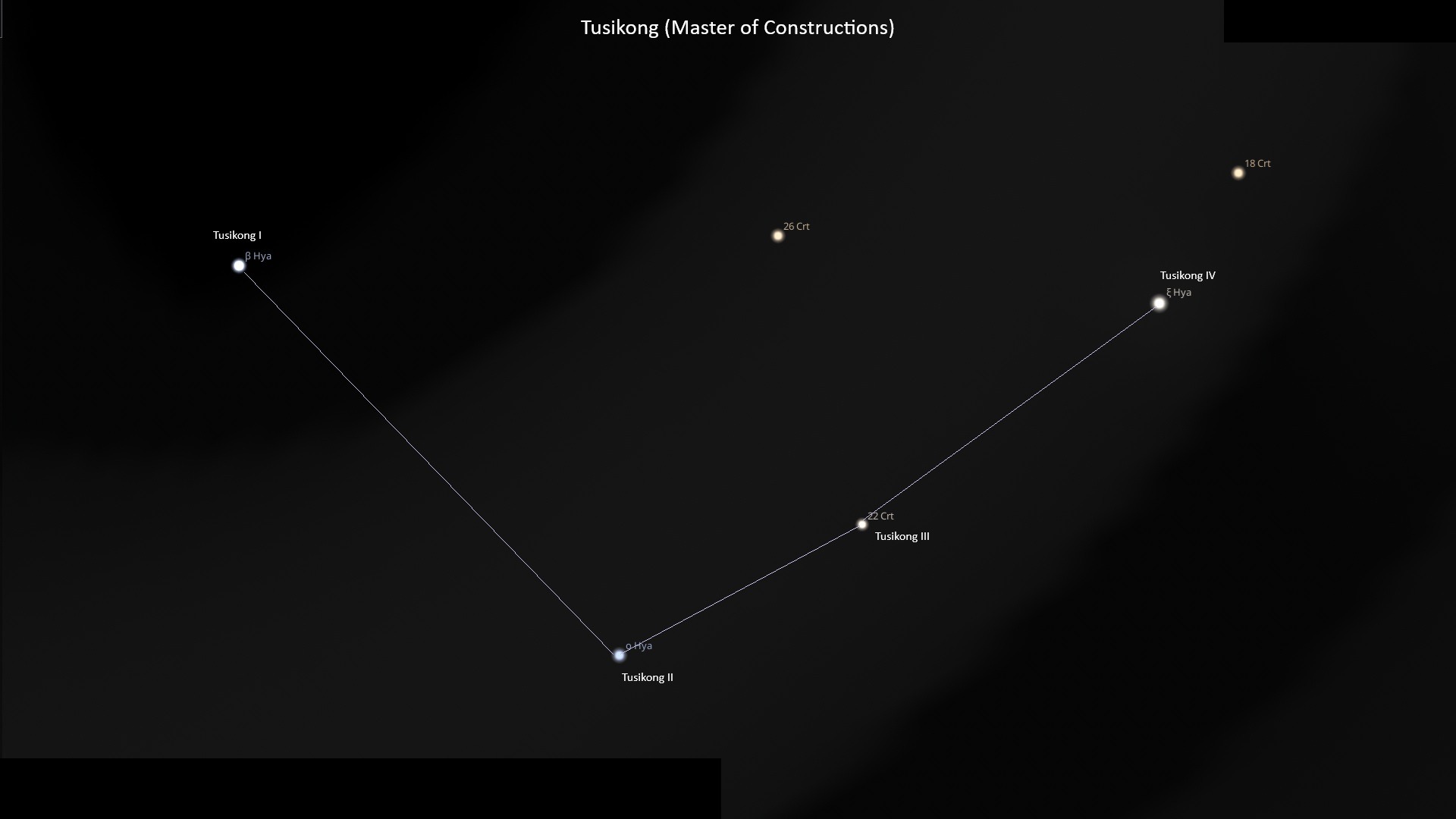
The 28th Chinese lunar mansion is 軫宿 Zhěn Su, “Chariot Mansion.”
The 7th asterism of the Chariot Mansion is called 土司空 Tusikong, “Master of Constructions.” It represents the Minister of Works, and is composed of 4 stars of the constellation Hydra. [1]
This ancient Chinese asterism fell out of use during the Ming Dynasty. Its 4 stars now belong to the modern asterism Qingqiu (Green Hill). 土司空 Tusikong, “Master of Constructions,” is now the single-star asterism of β Cet (Deneb Kaitos) of the 15th lunar mansion Kui (Legs).
| 2000 | 2050 | IAU | Chinese | Orb |
| 13♎27 | 14♎09 | β Hya | Tusikong Yi (1) | 1°20′ |
| 11♎10 | 11♎52 | ο Hya | Tusikong Er (2) | 1°00′ |
| 08♎50 | 09♎32 | 20 Crt | Tusikong San (3) | 1°00′ |
| 07♎59 | 08♎41 | ξ Hya | Tusikong Si (4) | 1°40′ |
Tusikong, the Master of Constructions
07♎59 to 13♎27
The History of Ming Dynasty, Treatise on Astronomy (1739) records that of the seven stars of Qingqiu in the Zhen constellation, only three remain, while the star officials Tusikong, Junmen and Qifu have disappeared. The fact that this star official could no longer be observed during the Ming Dynasty suggests its position may have shifted due to precession, stellar motion, or errors in ancient observations, eventually moving it out of its original star region. [2]
Ma Duanlin (1317)
The four yellow stars of Tusikong, south of Junmen (Military Gate), govern earthworks. Wu Xian (1250) said, “If Venus and Mars invade this area, the fields cannot be cultivated, and women cannot weave.” The Sui Shu (636 AD) states that the first star (β Hya) is called Situ, which governs the borders. [3]
Song History (1346)
The Tu Sikong asterism consists of four stars located west of Qingqiu; it governs territorial boundaries and is also known as Situ (Minister of Works). When these stars shine with equal brightness, the realm enjoys abundant harvests; if they appear dim, crops fail. If Venus or Mars transgresses this region, men and women abandon farming and mulberry cultivation. If a guest star or comet invades this area, it heralds war and the displacement of the populace. [4]
References
- Zhen Su – Baidu Encyclopedia.
- The Mystery of the Tusikong: From the “Star’s Demise” in the History of Ming to Modern Visible Astronomical Phenomena.
- General Examination of Literature, Volume 279, Part 2, Ma Duanlin, 1317.
- Song History, Volume 50, Chapter 3, 1346.