
20♊30 to 23♊13
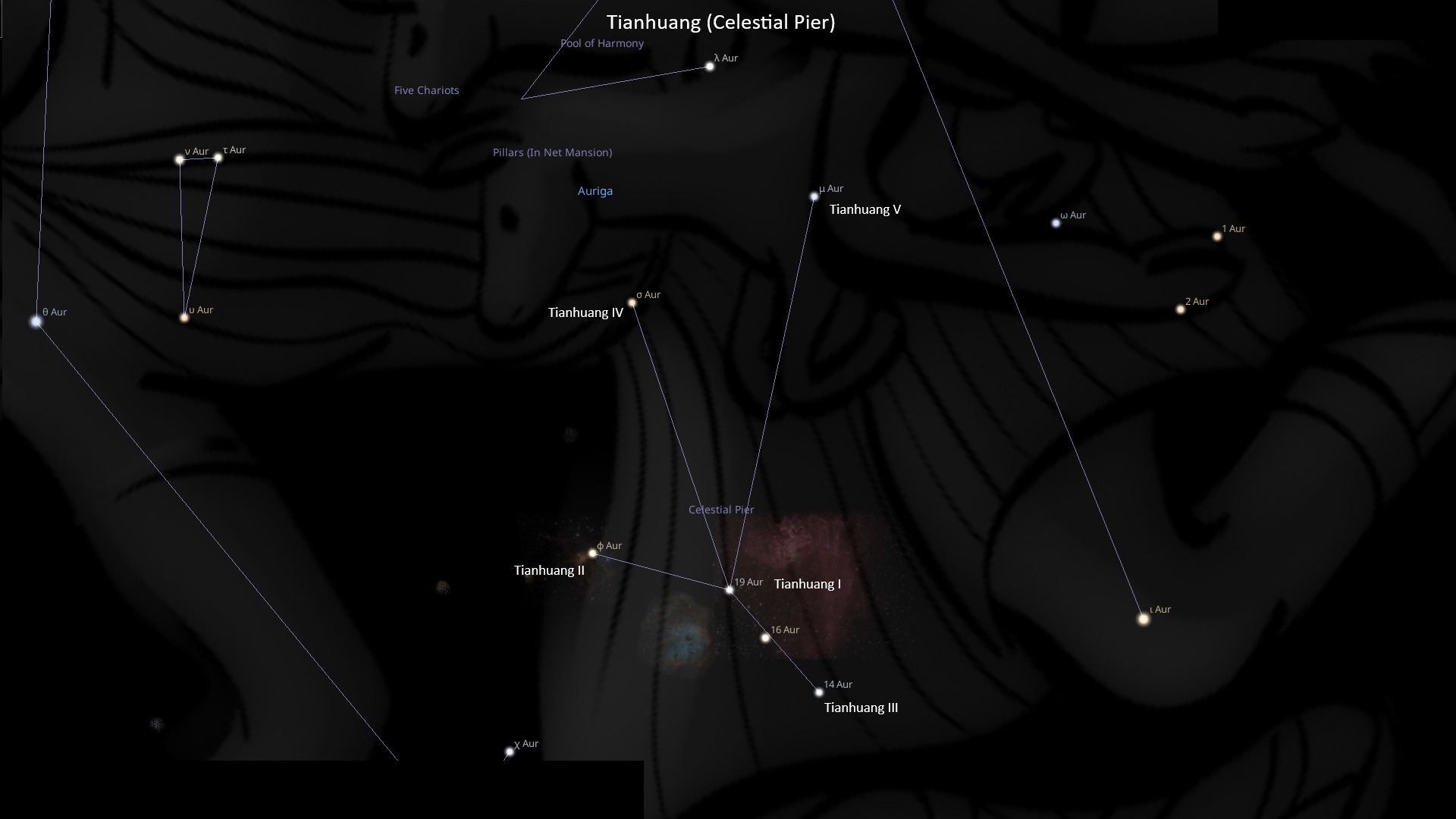
The 19th Chinese lunar mansion is named 畢宿 Bì Su, “Net Mansion.” It is the 5th of the 7 mansions of the White Tiger of the West.
The 10th asterism of the Net Mansion is called 天潢 Tiānhuáng, “Celestial Pier.” Also meaning “Heavenly River,” it governs river bridges and ferry crossings. It is composed of 5 stars of the constellation Auriga. [1]
| 2000 | 2050 | IAU | Chinese | Orb |
| 21♊35 | 22♊17 | 19 Aur | Tianhuang Yi (1) | 1°00′ |
| 23♊13 | 23♊55 | φ Aur | Tianhuang Er (2) | 1°00′ |
| 20♊30 | 21♊12 | 14 Aur | Tianhuang San (3) | 1°00′ |
| 22♊46 | 23♊29 | σ Aur | Tianhuang Si (4) | 1°00′ |
| 20♊34 | 21♊17 | μ Aur | Tianhuang Wu (5) | 1°00′ |
Tianhuang, the Heavenly River
20♊30 to 23♊13
Tianhuang (天潢) is a Chinese word, pronounced tiān huáng. Tianhuang was originally the name of an ancient Chinese star official. It has three other meanings: the Milky Way, the descendants of emperors, and a large warship used for crossing water in ancient times.
The Six Secret Teachings – Military Use (1046–771 BC) states: “Zhang Fei was used to float across the Yangtze River to the sea, which was called the Heavenly River. It was also called the Heavenly Boat.”
The Records of the Grand Historian, Treatise on Celestial Offices (91 BC) states, “Wang Liang rode his horse, and his chariots and cavalry filled the fields. Beside them were eight stars, separated from the Milky Way, called Tianhuang.”
The Yuanmingbao (9–23 AD) states that “the Milky Way governs the river channels.”
According to the Book of Han, Treatise on Astronomy (111 AD), it is written as “Tianheng.”
According to The Book of Jin, Treatise on Astronomy, Part 1 (648 A), “The three pillars are also called the Three Springs…and the five stars among them are called the Celestial River.” [2]
Ma Duanlin (1317)
Five celestial spirits reside within the chariot. The five planets of the Tianhuang (Heavenly River) are located in the Wuche (Five Chariots) constellation, governing the crossing points of rivers and lakes. If they are not visible, the crossings will be impassable. The Sui Shu states that when the moon and five planets enter the Tianhuang constellation, war breaks out, roads are blocked, the world is in chaos, and the government will change. [3]
Song History (1346)
The five planets of Tianhuang are located within Wuche (Five Chariots). They govern river bridges and ferry crossings. If the planets are not visible, the crossings will be impassable. When the moon enters Tianhuang, war breaks out. If any of the Five Planets deviate from their usual paths or remain over Tianhuang for an extended period, it signifies war in all cases. When Mars and Saturn enter Tianhuang, there will be a great drought or fire. When Mars leaves Tianhuang, there will be disease among cattle and horses, and war will break out. When Mercury appears in Tianhuang, there will be a general amnesty. When a guest star enters Tianhuang, there will be war; if it remains in its position, there will be floods. When pale or black clouds enter Tianhuang, there will be mourning; when they are red, there will be war; when they are yellow or white, there will be joy for the emperor. [4]
References
- Bì Xiù – Baidu Encyclopedia.
- Tiān Huáng – Baidu Encyclopedia.
- General Examination of Literature, Volume 279, Part 2, Ma Duanlin, 1317.
- Song History, Volume 50, Chapter 3, 1346.