
STARS: Major | All | Constellations | Chinese | About
25♌28 to 16♍33
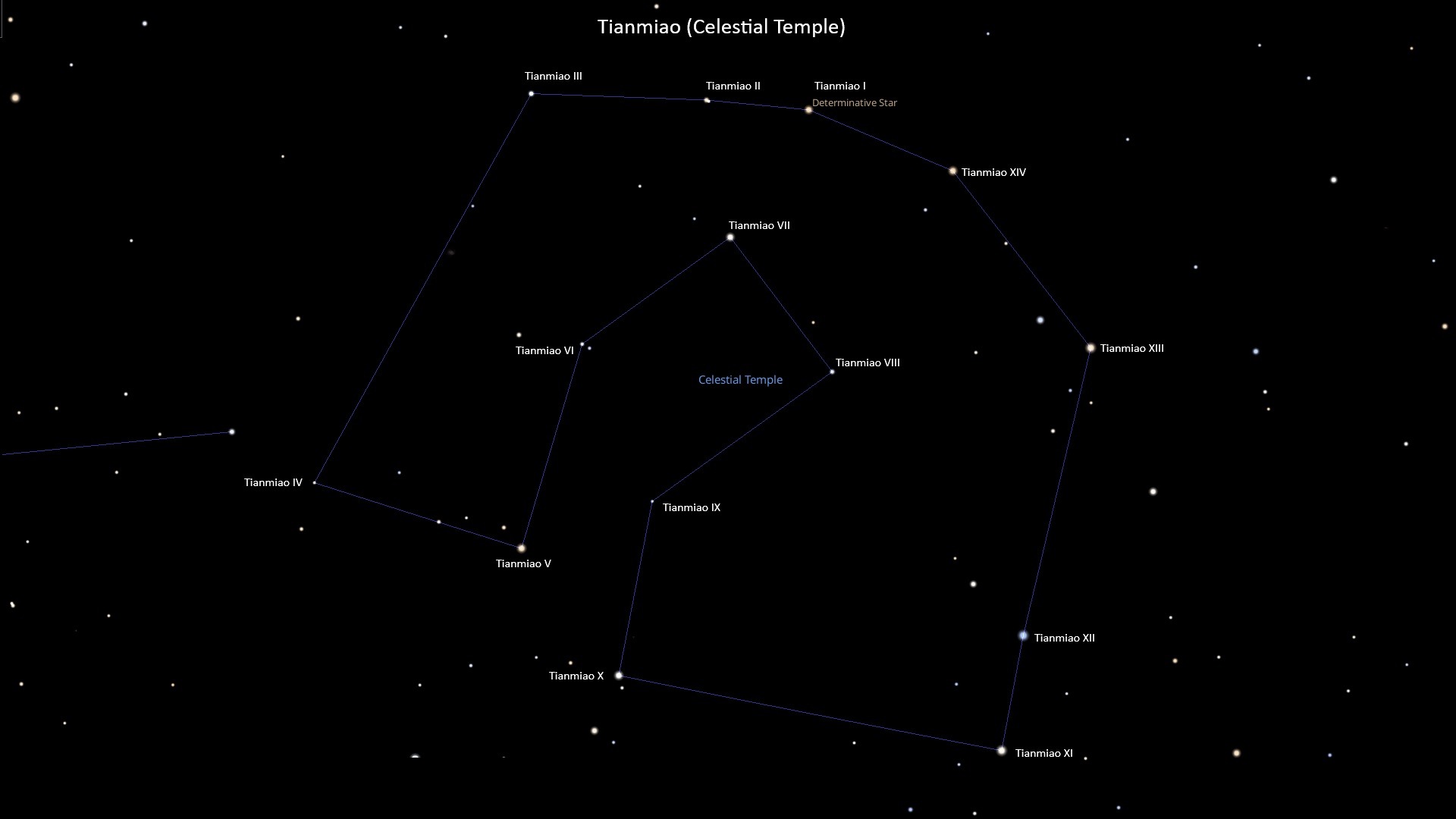
The 26th Chinese lunar mansion is 張宿 Zhāng Su, the “Extended Net Mansion.” It is the 5th of the 7 mansions of the Vermilion Bird of the South.
The 2nd asterism of the Extended Net Mansion is called 天廟 Tiānmiào, “Celestial Temple,” representing the Emperor’s Ancestral Temple. It is an ancient asterism composed of 14 stars from the constellations Antlia, Pyxis and Vela. [1]
| 2000 | 2050 | IAU | Chinese | Orb |
| 03♍04 | 03♍46 | θ Pyx | Tianmiao Yi (1) | 1°00′ |
| 05♍36 | 06♍18 | HD 82205 | Tianmiao Er (2) | 1°00′ |
| 09♍26 | 10♍38 | θ Ant | Tianmiao San (3) | 1°00′ |
| 16♍33 | 17♍15 | HD 85296 | Tianmiao Si (4) | 1°00′ |
| 11♍00 | 11♍42 | ε Ant | Tianmiao Wu (5) | 1°10′ |
| 08♍59 | 09♍41 | ζ² Ant | Tianmiao Liu (6) | 1°00′ |
| 05♍02 | 05♍44 | λ Pyx | Tianmiao Qi (7) | 1°00′ |
| 02♍18 | 03♍00 | ε Pyx | Tianmiao Ba (8) | 1°00′ |
| 07♍15 | 07♍57 | HD 80590 | Tianmiao Jiu (9) | 1°00′ |
| 08♍25 | 09♍07 | k Vel | Tianmiao Shi (10) | 1°00′ |
| 26♌48 | 27♌30 | β Pyx | Tianmiao Shiyi (11) | 1°30′ |
| 26♌30 | 27♌12 | α Pyx | Tianmiao Shier (12) | 1°40′ |
| 25♌28 | 26♌10 | γ Pyx | Tianmiao Shisan (13) | 1°00′ |
| 29♌24 | 00♍06 | κ Pyx | Tianmiao Shisi (14) | 1°20′ |
Tianmiao – Celestial Temple
25♌28 to 16♍33
Tianmiao was the emperor’s ancestral temple and held an important place in ancient astrology. It symbolized the imperial lineage and foundation. [2]
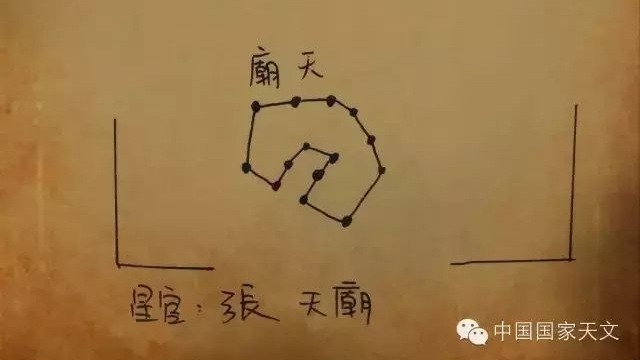
天廟 (Tianmiao) – Celestial Temple
Ma Duanlin (1317)
The fourteen stars south of Zhang (Extended Net) are called Tianmiao (Heavenly Temple), the ancestral temple of the emperor. If a guest star (unexpected star or nova) guards it, the officials in charge of sacrifices will have worries; its divination is the same as that of Xuliang (Temple):
The four stars of Xu Liang govern gardens, mausoleums, and temples. They are not places for humans. If Venus and Mars guard or invade them, there will be great war. [3]
Song History (1346)
The fourteen stars of Tianmiao (Celestial Temple) lie south of Zhang Su (Extended Net) and represent the emperor’s ancestral temple. If they are bright and distinct, it is auspicious; if faint or small, it indicates that the army will suffer from food shortages. If a guest star (unexpected star or nova) directly transgresses Tianmiao, white-clad figures will gather, signifying war. It also indicates that religious officials in charge of sacrifices will face trouble. Wu Mi said, “Its interpretation is the same as for Xuliang (Temple):”
Xu Liang governs gardens, mausoleums, temples, and prayers. They are not places for humans to reside, hence the name Xu Liang (meaning “empty beam”). Another interpretation is palaces, residences, houses, curtains, and sleeping quarters. If Venus or Mars transits here, warfare will occur. If a comet or bright guest star transits this region, wars arise, and ancestral temples are altered. [4]
References
- Zhang Yuelu – Baidu Encyclopedia.
- Exploring the Mysteries of Zhang Xingxiu: Astronomical Legends and Mysterious Destiny.
- General Examination of Literature, Volume 279, Part 2, Ma Duanlin, 1317.
- Song History, Volume 50, Chapter 3, 1346.