
STARS: Major | All | Constellations | Chinese | About
27♌22 to 04♎13
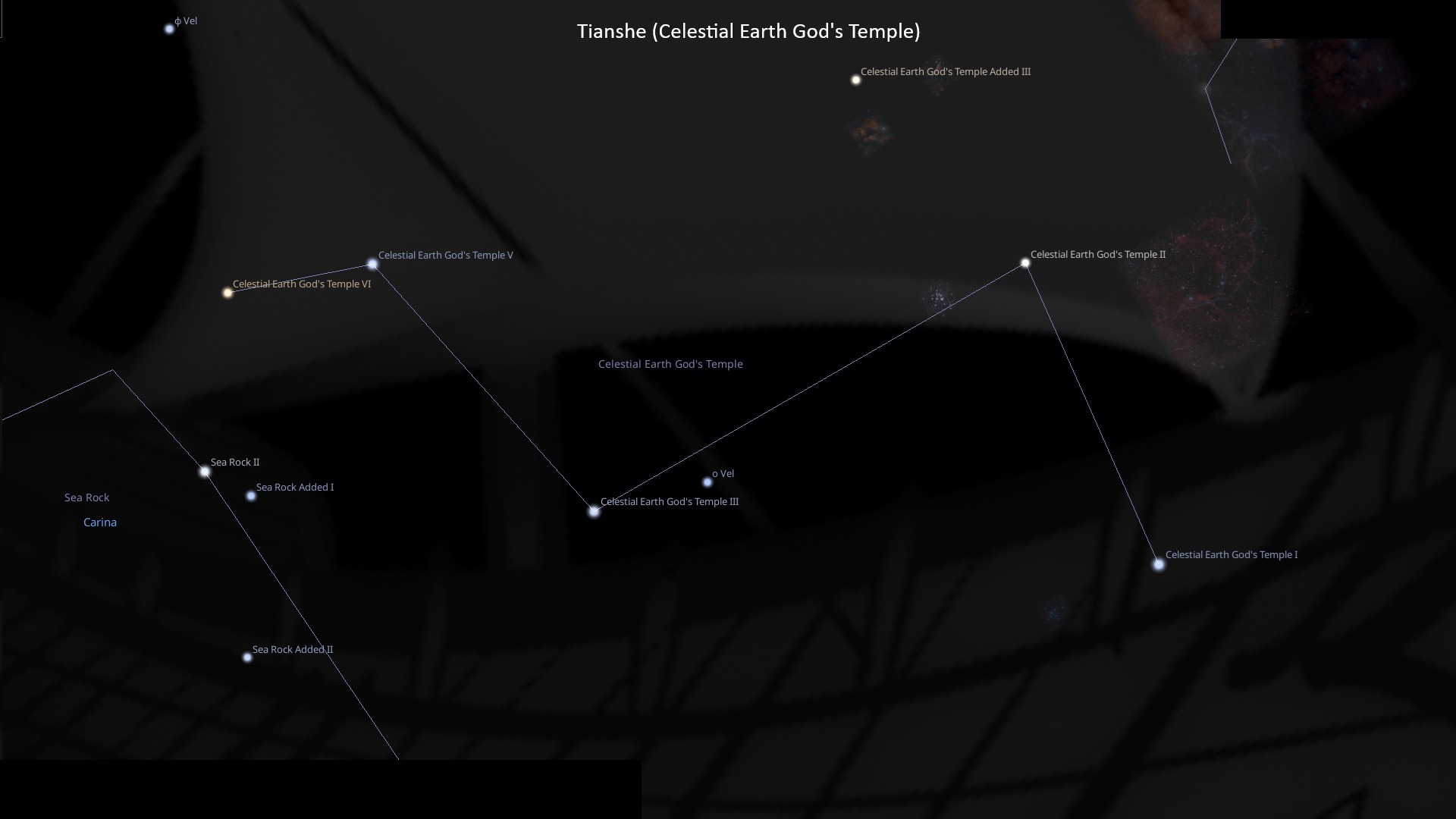
The 23rd Chinese lunar mansion is named 鬼宿 Guǐ Su, “Ghost Mansion.”
The 6th asterism of the Ghost Mansion is called 天社 Tiānshè, “Celestial Earth God’s Temple.” It represents temples dedicated to the Earth God, or the officials who manage these temples. It is composed of 6 stars of the constellation Vela. [1]
| 2000 | 2050 | IAU | Chinese | Orb |
| 27♌22 | 28♌03 | γ² Vel | Tianshe Yi (1) | 2°20′ |
| 06♍33 | 07♍14 | b Vel | Tianshe Er (2) | 1°30′ |
| 18♍57 | 19♍39 | δ Vel | Tianshe San (3) | 2°20′ |
| 05♎57 | 06♎38 | φ Vel | Tianshe Si (4) | 1°40′ |
| 28♍54 | 29♍35 | κ Vel | Tianshe Wu (5) | 2°10′ |
| 04♎13 | 04♎54 | N Vel | Tianshe Liu (6) | 1°50′ |
Tianshe the Celestial Earth God’s Temple
27♌22 to 04♎13
Ma Duanlin (1317)
The six stars south of the Arc Star are the Heavenly Soil Star (Tianshe), southeast of the Old Man Star (Canopus), resembling a willow; their direct brightness indicates good fortune. The Sui Shu states that Goulong, son of Gonggong, could control water and soil, hence he was worshipped alongside the Soil Star, and his essence became stars. [2]
Song History (1346)
The Tianshe Six Stars (Celestial Earth God’s Temple, or Heavenly Earth Deity) are located to the south of Hushi (Bow and Arrow). In ancient times, Gonggong Shi’s Kuolong (Hooked Dragon) was able to control floods and manage the land, so he was honored in sacrifices as a companion to the earth deity. His spiritual essence ascended to become these stars.
If these stars remain bright and stable, the state (society) is secure; if they appear dim or shift in position, subordinates plot against their superiors. If Venus or Mars transgresses Tianshe, the state and its foundations face instability or danger. If a guest star enters this region, sacrificial rites are conducted within the realm; if it departs from here, such ceremonies occur abroad or in foreign lands. [3]
References
- Gui Su – Baidu Encyclopedia.
- General Examination of Literature, Volume 279, Part 2, Ma Duanlin, 1317.
- Song History, Volume 50, Chapter 3, 1346.