
STARS: Major | All | Constellations | Chinese | About
01♓53 to 06♓50
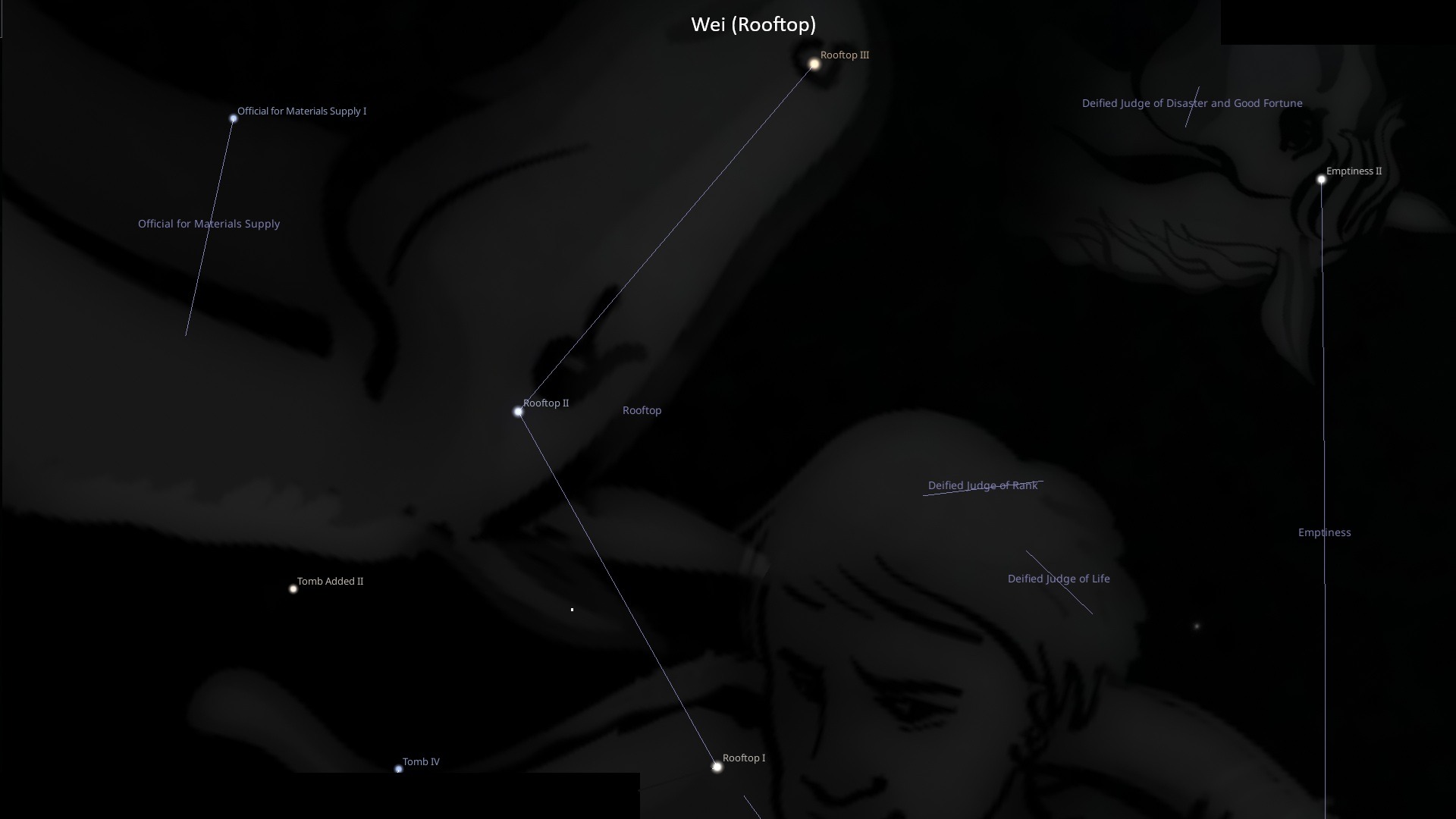
The 12th Chinese lunar mansion is named 危宿 Wēi Su, “Rooftop Mansion.” It is the 5th of the 7 mansions of the Black Tortoise of the North.
The 1st asterism of the Rooftop Mansion is also called 危 Wēi, “Rooftop,” representing a high place and danger. It is composed of 3 stars of the constellations Aquarius and Pegasus. [1]
Note: The name “Wei” appears several times in Chinese astronomy.
- The 6th mansion and its 1st asterism are named 尾 Wěi, “Tail.”
- The 12th mansion and its 1st asterism are named 危 Wēi, “Roof.”
- The 17th mansion and its 1st asterism are named 胃 Wèi, “Stomach.”
| 2000 | 2050 | IAU | Chinese | Orb |
| 03♓21 | 04♓03 | α Aqr | Wei Su Yi (1) | 1°50′ |
| 06♓50 | 07♓32 | θ Peg | Wei Su Er (2) | 1°40′ |
| 01♓53 | 02♓35 | ε Peg | Wei Su San (3) | 2°10′ |
Constellation Wei the Rooftop
01♓53 to 06♓50
Those born under the Wei constellation are prone to impatience and have a stubborn temperament. They are kind-hearted but guileless, which can make them vulnerable to being taken advantage of in interpersonal relationships. Their nature is quite polarized, ranging from good to bad, and their strength depends on how they choose to channel it.
It represents the moon and the swallow. It is the fifth constellation in the north, located at the tail of the tortoise and snake, hence the name “Wei” (meaning danger). In battle, the rear guard is often in danger. Wei means high, and high places are dangerous, so the Wei constellation is often considered inauspicious.
When the Wei constellation is in power, it is not auspicious. Disasters and plagues are inevitable. All construction and building will be unfavorable. There will be more disasters than auspicious events, and things will turn into calamities.
The presence of stars representing tombs, empty beams, and covered houses within the constellation of Wei is considered inauspicious, reflecting the unease felt by the ancients during the late autumn and approaching winter season.
The character 危 (wēi) means “above the roof beam.” The Shiji (史记) quotes the *Liji* (礼记) as saying, “Walking on the roof beam in the middle of the house is to avoid soldiers.” The Shiji (史记) also states, “危 (wēi) is a roof.” The *Jin Shu* (晋书) states, “The three stars 危 (wēi) govern the roof structure of the celestial market.” The shape of these three stars resembles a pointed roof. [2]
Dangerous Moon Swallow
People born under this sign are prone to alcoholism and licentiousness. They are hardworking but also stubborn. Their friendships are short-lived and unresolved. They are capable of handling affairs and administering antidotes, but are prone to anger.
Preparing, taking, and administering medicine is very auspicious. They are also suited for serious and wicked endeavors, such as digging rivers and ponds, planting hemp and beans, sending merchants to collect taxes, appointing officials, and hiring doctors. They are also suited for stockpiling goods, building boats, brewing wine and other beverages, and engaging in trading. It is auspicious for merchants to return home, but not for spending money.
Rooftop Advice
While it’s true that it’s good to have a big tree to lean on, what belongs to others may remain theirs for a time. They may be able to share it with you temporarily, but it will never truly belong to you. Your own tree, on the other hand, requires hard work and time to grow. But what belongs to you, no one can take away.
Sometimes saving money can feel difficult or terrifying. It’s important to understand that there is no unconditional freedom in this world. Ultimately, you’ll need to give something in return. If you can’t face your desires and correspondingly exercise self-discipline and control, your health might become the condition for that exchange. The pleasure is truly exhilarating, but the suffering can be devastating.
There’s nothing wrong with not forcing yourself to do things you’re not interested in. However, you must be prepared to handle the aftermath when you withdraw and plan your next step. Be a little more cautious, and one day you’ll thank yourself for your patience. You are a kind and innocent person; you must protect yourself, because you will bring much beauty to this world. [3]
Ma Duanlin (1317)
The three stars of Danger (Wei) are not directly related to the ancient prophets. Danger, sixteen degrees, governs the Heavenly Mansion, Heavenly Treasury, and building houses. Gan Shi said it is the Heavenly Market Temple. Nine feet below is the central path of Heaven. The main structure of houses, storage, wind and rain, tombs, and ancestral shrines.
If they move, it signifies large-scale construction work throughout the land. Zhang Heng said that Xu (Emptiness) and Wei (Rooftop) represent matters of death and mourning, as well as matters of towns, temples, and ancestral shrines, and the official positions of the chief minister. If they move, it signifies death and mourning.
If Mars guards the palace, the emperor will lead troops; if Venus guards the palace, there will be famine and war. If Xu and Wei move, construction will begin. If Mars guards the palace, there will be war; if Mercury guards the palace, the lower ranks will plot against the upper ranks. Another saying is that if Wei moves, it signifies obscurity, construction work, and war. A lunar halo or the invasion of the sun, moon, and five planets indicates disaster. [4]
Song History (1346)
The three stars of the constellation Wei (危) are located southeast of Tianjin (Celestial Ford). They govern the emperor’s ancestral temple sacrifices, as well as earthworks and the imperial palace, markets, building construction, and storage.
If they are unclear, it indicates the execution of a guest and the commencement of earthworks; if they are active or obscured, it signifies the construction of palaces and military affairs.
A solar eclipse indicates the destruction of mausoleums and temples, a major funeral, and the presence of rebellious officials. A solar halo indicates mourning
A lunar eclipse signifies worry or sorrow for ministers, funerals or mourning, and the collapse of palaces. A lunar halo also indicates war and mourning, and the defeat of the one who initiates the war.
If the moon transits here, palace structures will collapse, and ministers will rebel against their ruler; in the coming year, grain prices will rise, and great mourning will occur.
When Mercury transits here, high-ranking ministers are executed, judges face troubles, and the nation suffers many disasters. If it remains in place, ministers will rebel; another interpretation is that the empress will fall ill, and there will be war and loss.
When Venus transits here, there will be war; alternatively, if there is no war, it will begin; if there already is war, it ends; Crops fail, and fires increase. If it remains in this position, generals face troubles; droughts and fires also occur. If it stays for long, there will be an emergency.
When Mars invades its sign, there will be a general amnesty. If it remains in this position, many people will fall ill, military conflicts will arise, feudal lords will plot rebellion, and palaces will be destroyed by fire. If it resides near the upper star, commoners die; if near the middle star, feudal lords perish; if near the lower star, high-ranking ministers die—each with a time frame of a hundred or ten-day period respectively. If it remains for thirty days, eastern armies will rise up, there will be a drought, and close ministers will rebel. If it enters this region, warfare ensues, and there will be decrees of change.
If Jupiter transits or remains here, it indicates war, forced labor, numerous construction projects, events of mourning and weeping, as well as increased theft and banditry.
If Saturn remains here, it indicates drought, illness among the people, construction projects, and the country will be in great war. If it transits this area, troubles arise for the empress; warfare, loss and mourning will follow. Whether entering, exiting, lingering, or staying in position, territory is lost, and bloodshed occurs. If it enters, there will be great chaos and treacherous ministers will rise up.
When a guest star transits here, mourning and weeping occur; alternatively, it indicates excessive rainfall and failed harvests. If the guest star enters this area, construction projects begin, or there will be an amnesty within three days. If it leaves, there will be heavy rain and a poor harvest. If it remains in place for some time, the nation declines and famine occurs among the people.
When a comet transits here, there will be rebellious ministers and uprisings; its departure signifies a general leaving the country, a change in the government, and great floods and famine. When a comet invades the area, there will be rebellions and uprisings in the country.
If a meteor’s appearance signifies floods in spring and summer, and disputes or gossip in autumn and winter. If it enters the area, the lower classes will plot against the higher classes. If it reaches Wei, there will be war in the northern regions. The Yi Si Zhan states: When a meteor enters or emerges with a yellowish hue, it signifies peace for the people, a bountiful harvest, and successful construction projects and land reclamation. If they appear black, it indicates floods and disasters for high-ranking ministers.
When clouds enter the area, if they are pale or grayish-white, it signifies earthworks or construction projects; if they are blue, it signifies national worry; if they are black, it signifies floods and mourning; if they are red, it signifies fire; if they are white, it signifies worry and war; if yellow when they enter or emerge, it signifies joy. [5]
References
- Twenty-Eight Mansions – Baidu Encyclopedia.
- Weiyue Yan – Baidu Encyclopedia.
- Comprehensive Analysis | Unveiling the Personality Traits of the “Danger” Star.
- General Examination of Literature, Volume 279, Part 2, Ma Duanlin, 1317.
- Song History, Volume 50, Chapter 3, 1346.