
STARS: Major | All | Constellations | Chinese | About
00♌50 to 09♌21
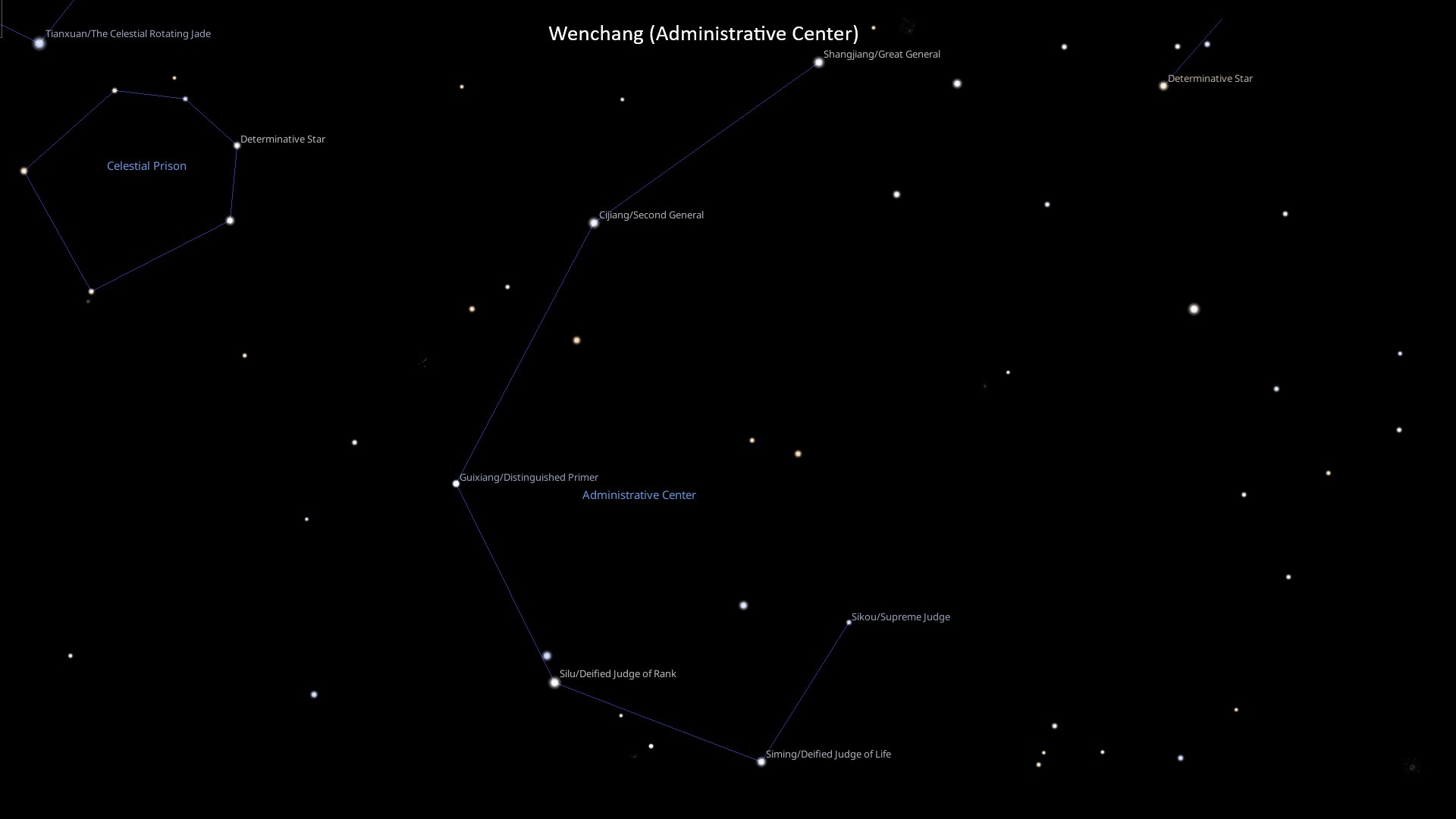
The 26th asterism of the Ziwei (Purple Forbidden) Enclosure is named 文昌 Wénchāng, “Administrative Center.” It represents government departments or officials and contains 6 stars in the constellation Ursa Major. [1]
| 2000 | 2050 | IAU | Chinese | Orb |
| 00♌50 | 01♌32 | h UMa | Wen Chang Yi (1) | 1°40′ |
| 06♌16 | 06♌59 | υ UMa | Wen Chang Er (2) | 1°30′ |
| 09♌21 | 10♌04 | φ UMa | Wen Chang San (3) | 1°00′ |
| 07♌16 | 07♌58 | θ UMa | Wen Chang Si (4) | 1°50′ |
| 03♌07 | 03♌50 | f UMa | Wen Chang Wu (5) | 1°20′ |
| 03♌20 | 04♌01 | e UMa | Wen Chang Liu (6) | 1°00′ |
Wenchang, the Administrative Center
00♌50 to 09♌21
Wenchang Palace is the general name for the six stars in front of the Big Dipper, also known as the Six Stars of Wenchang or Wenqu Star. In ancient times, it belonged to the Big Dipper star official system and was responsible for literary fortune and fame.
The six stars are named General, Vice General, Noble Minister, Master of Fate, Master of the Center, and Master of Prosperity, and are arranged in a crescent shape. They also represent six deities: Silu, Sizhong, Siming, Guixiang, Cijiang, and Shangjiang.
In 1316, Emperor Renzong of Yuan bestowed upon him the title of Wenchang Emperor, in charge of the imperial examinations and literary affairs. This gave rise to the legend of the deaf and mute protecting the examinees. There are two boys beside the Wenchang Emperor, one named Tianlong and the other named Diya. Tianlong holds a seal and stares with a frown, while Diya holds a book, symbolizing that those who can hear cannot speak and those who can speak cannot hear, to ensure the secret of the examination is not leaked.
In ancient astrology, the six stars of Wenchang were divided into “three abilities,” symbolizing the emperor, nobles, and commoners. Changes in the stars could predict the rise and fall of dynasties.
Wenchang belongs to the metal element, and its main star is the one who achieves academic success. It is the top of the literary stars. Its characteristics are that the person is upright, has artistic talent, is eloquent, has clear eyebrows and eyes, and is handsome. He is hardworking in his youth and gradually improves in his middle age. [2]
Wenchang also specifically refers to the star f UMa. In ancient legends, it governs literary fortune, hence it is also commonly known as the Wenqu Star or the Wenxing (Literary Star).
Chapter 1 of Ping Shan Leng Yan: “The former Imperial Astronomical Bureau official reported that the Wenchang star was shining brightly. The Emperor has learned scholars from the Hanlin Academy who will assist in the advancement of civilization.”
The Dongguan Memorial states: “On the first day of the month, the official reported that the Wenchang star was dim, indicating that something bad would happen in the imperial examinations.” [3]
Wenchang Emperor, also known as Wenchang Star, was considered in ancient times to be the star that governs literary fortune and academic success. He is a deity revered in Chinese folk religion and Taoism as the god in charge of the official rank and salary of scholars.
He was Zhang Zhong in the Zhou Dynasty, Zhang Liang in the Han Dynasty, Lü Guang, the King of Liang, during the Five Dynasties period, Meng Chang, the King, and Zhang Yazi during the Later Qin Dynasty. He was known for his strong and resolute nature, keen insight, benevolence, and love for the people, and was widely respected by scholars. [4]
| # | IAU | Title | Role | Diety |
| 1 | h UMa | Supreme General | Grand General | 上將 Shangjiang |
| 2 | υ UMa | Vice General | The Minster | 次將 Cijiang |
| 3 | φ UMa | Noble Minister | Grand Master of Ceremonies | 貴相o Guixiang |
| 4 | θ UMa | Minister of Prosperity | Minister of the Center | 司命 Siming |
| 5 | f UMa | Minister of Fate | Grand Historian | 司中 Sizhong |
| 6 | e UMa | Minister of Justice | Grand Judge | 司祿 Silu |
Ma Duanlin (1317)
The six stars of Wenchang, located before the handle of the Big Dipper, are the six celestial offices, governing the gathering and calculation of celestial principles.
The first is the Supreme General, establishing military might; the second is the Vice General, Minister, governing the left and right; the third is the Noble Minister, Grand Master of Ceremonies, managing literary affairs; the fourth is the Minister of Rank, Minister of the Center, Minister of the Censorate, rewarding merit and promoting rank; the fifth is the Minister of Fate, Minister of Strange Phenomena, Grand Historian, presiding over the elimination of calamities; the sixth is the Minister of Justice, Grand Judge, assisting in the administration of justice. The first star is located near the inner steps before the handle of the Big Dipper.
Bright and clear, with equal size, signifies auspicious omens. Zhang Heng said, according to divination: a bright, clear yellow signifies peace for all; equal size signifies auspicious omens; a bluish-black or fine star signifies much harm; movement and shifting signify worry for high officials. Venus and Mars guarding the area indicate war. When Bo (a comet) invades, the country is in chaos. If Wenchang moves, the Three Dukes will be executed, and the ruler will die later; the calamities and blessings will be the same as those of the Three Dukes. [5]
Song History (1346)
The six stars of Wen Chang are located in front of the Big Dipper, west of the Purple Palace Enclosure, representing the six celestial palaces, in charge of gathering and calculating the celestial way.
The first is the Supreme General, the Grand General, who establishes military might; the second is the Vice General, the Minister, who governs the left and right; the third is the Noble Minister, the Grand Master of Ceremonies, who manages the affairs of state; the fourth is the Minister of Prosperity, the Minister of the Center, the Minister of the Clerk, who rewards merit and promotes officials; the fifth is the Minister of Fate, the Minister of Strange Phenomena, the Grand Historian, who presides over the elimination of calamities; the sixth is the Minister of Justice, the Grand Judge, who assists in the administration of justice. The first is the one that rises before the Big Dipper near the inner steps.
A bright, lustrous, yellowish color, of uniform size, signifies auspicious omens and peace throughout the land; a bluish-black or fine color indicates much harm; movement indicates the dismissal of the Three Dukes.
A halo around the moon in its constellation signifies a general amnesty. If Jupiter guards it, war will break out. If Mars guards it, misfortune will befall the general. If Venus guards it, war will begin. If Saturn guards it, the country will be at peace. If a guest star guards it, ministers will rebel. If a comet invades, great chaos will ensue. If a meteor invades, chaos will occur within the palace. [6]
References
- Ziwei Enclosure – Baidu Encyclopedia.
- Wenchang Palace – Baidu Encyclopedia.
- Wen Chang Star – Baidu Encyclopedia.
- Wenchang Emperor – Baidu Encyclopedia.
- General Examination of Literature, Volume 278, Part 1, Ma Duanlin, 1317.
- Song History, Volume 49, Chapter 2, 1346.