
STARS: Major | All | Constellations | Chinese | About
16♋45 to 21♌37
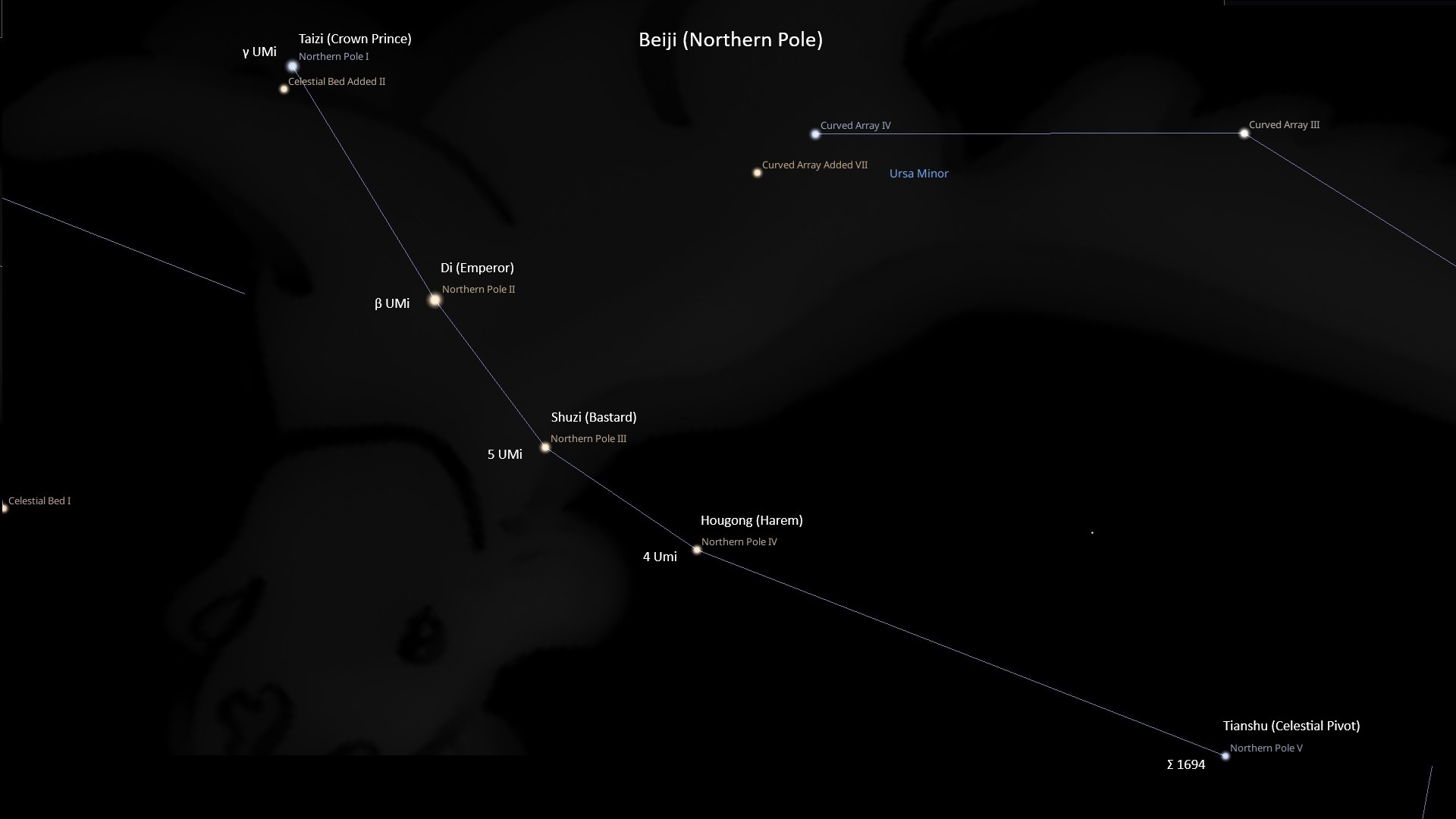
The 1st asterism of the Ziwei (Purple Forbidden) Enclosure is named 北極 Běijí, “Northern Pole.” It represents the five stars of the North Pole, symbolizing the Crown Prince, the Emperor, the Concubine, the Empress, and the Celestial Pivot. It contains 5 stars in the constellations Ursa Minor and Camelopardalis. [1]
| 2000 | 2050 | IAU | Chinese | Orb |
| 21♌37 | 22♌20 | γ UMi | Beiji Yi (1) | 1°50′ |
| 13♌20 | 14♌02 | β UMi | Beiji Er (2) | 2°10′ |
| 08♌24 | 09♌07 | 5 UMi | Beiji San (3) | 1°20′ |
| 02♌50 | 03♌33 | 4 Umi | Beiji Si (4) | 1°00′ |
| 16♋45 | 17♋28 | Σ 1694 | Beiji Wu (5) | 1°00′ |
Beiji, the Northern Pole
16♋45 to 21♌37
The five stars of the North Pole asterism, also called the Arctic Five Stars, are listed first in the official star name lists. They are located at the center of the Ziwei (Purple Palace) Enclosure, the residence of the Heavenly Emperor, and represent the Palace’s core administrative institution. This structure was finalized during the Longshan Culture period in the Central Plains (2572-2293 BC). [2]
At the core of the ancient Chinese astronomical system are the North Star and the Big Dipper asterisms. The ancients believed that the North Star was the center of the sky, with the Big Dipper revolving around it, and regarded it as a symbol of the emperor in astrology and culture, such as “governing with virtue is like the North Star.”
North Star II, also known in China as the North Star, Polaris or the Emperor Star, is actually β Ursae Minoris, Kochab. It is a symbol of the emperor, and the throne of the North Star (Taiyi), described in the Records of the Grand Historian: Treatise on Celestial Offices (91 BC) as “the constant abode of Taiyi.”
North Star I, III, and IV represent the crown prince, the concubine’s son, and the harem, respectively, thereby forming an astronomical symbol system around the emperor. [3]
| # | IAU | Star Name | Represents | English |
| 1 | γ UMi | 北極一 Běijíyī | 太子 Tàizǐ | Crown Prince |
| 2 | β UMi | 北極二 Běijíèr | 帝 Dì | Emperor |
| 3 | 5 UMi | 北極三 Běijísān | 庶子 Shùzǐ | Son of Concubine |
| 4 | 4 UMi | 北極四 Běijísì | 後宮 Hòugōng | Concubine |
| 5 | Σ 1694 | 北極五 Běijíwu | 天樞 Tiānshū | Celestial Pivot |
Ma Duanlin (1317)
The Central Palace of the Northern Purple Palace contains the five stars of the North Pole. The second pearl is the seat of the Great Emperor; the third palace is the residence of the princes; the first is called the Crown Prince; the fourth is the residence of the Empress; and the fifth is the Heavenly Pivot (or, according to another account, the third brightest is the residence of the Emperor, the fourth brightest is the residence of the fourth prince, and the youngest is the fifth Heavenly Pivot).
The five stars of the North Pole reside in the Ziwei Palace. They are also called Tianji (Heavenly Pole) and Beichen (North Star). Their pivot is the celestial pivot. The celestial movement is endless, the three lights (sun, moon, and stars) shine in succession, yet the North Star remains unmoved. Therefore, it is said, “It dwells in its place while all the stars revolve around it.”
The first star (γ UMi) governs the moon and the crown prince. The second star (β UMi) governs the sun and the emperor, and is also the seat of Taiyi, meaning the brightest star. The third star (5 UMi) governs the five planets and the sons of the emperor. The five stars of the North Pole are the most revered.
If the central star (β UMi) is dim, the emperor will not be active. If the right star is dim, the crown prince will be worried. The fourth (4 UMi) star represents the harem, and the fifth star (Σ 1694) is Tianshu (Heavenly Pivot). Zhang Heng said, “These two stars together form the harem; a bright and large North Pole star is auspicious, while a change in brightness indicates worry.”
The Zhu Xi’s Sayings (@1160) states: “The North Star is the North Pole of the heavens. The heavens are like a waterwheel, and the North Star is the axle. The waterwheel moves, but the axle never moves.” It also states: “The North Star is that point in the middle where there are no stars, yet it remains still; it is the pivot of the heavens. The North Star has no stars, but because people want to take it as the pole, they need a marker. Therefore, they take a small star next to it and call it the North Star. They ask if the North Star moves? They answer that the North Star does move, but because it is close to the North Star, they don’t notice it. Nowadays, people use a tube to observe the North Star and see it moving back and forth, but it remains still inside the tube. People in the past said that the North Pole was the North Star, and they all said that the North Pole was still. Only people in this dynasty have deduced that the North Pole is right next to the North Star, while the North Star still moves.”
My late father said: Those who record astronomy in ancient and modern times describe the names and meanings of the celestial officials and stars in a general way. The records of the two dynasties also draw from the histories of Jin and Sui, but they only differ in that they can state the number of degrees from the pole and the number of degrees of a certain constellation.
The Astronomical Records of the Song Dynasty states: Kan is due north. The North Pole is not in Kan or Qian but in Gen or Chou, because Gen is the northeast of all things, the place where the end is completed and the beginning is formed. Calendar writers trace back to thousands of years, and they must find that the sun and moon are in conjunction and the five planets are aligned, in the Jian Niu constellation, and then use it as the calendar origin, which means that the Jian Niu Gen Chou division is the place where all things are completed and the beginning is formed. Therefore, the North Pole is located in its direction, which is the pole of the sky. And the seven luminaries meet in its division, which is the origin of the calendar. When the seven celestial bodies align, their positions will inevitably be in harmony, and few will truly understand the way of Heaven. This is a matter for debate. One theory states that the second brightest star in the North Pole is called the Emperor in star charts. However, Gouchen (勾陈) refers to it as the Heavenly Emperor, which is incorrect.
According to Wu Xian’s Tongyuanjing Baojing Tu (通元经宝镜图), the North Pole has five stars, and Gouchen has six, both located in the Purple Palace. However, the palace is one, while the Emperor is two. This needs to be clarified. Another theory states that Jia Kui, Zhang Heng, Cai Yong, Wang Fan, and Lu Ji all considered the North Star to be stationary.
The Jin Shu (晋志) states that “the North Star is the most revered.” Confucius said, “It is like the North Star, which remains in its place while all the other stars revolve around it.” In celestial phenomena, it is considered supreme. Therefore, it is the first among the five planets, yet the Shu (志) incorrectly places it fifth, a gross inversion. This needs to be clarified. To consider the brightest star, the one residing at the North Pole and revolving around it, as the Emperor, instead of the North Star, is different from what Confucius said. This needs to be clarified. The North Star is not the Emperor, but the star in the mouth of Gouchen is the Heavenly Emperor. Is it because its location is not great, but its location is great? The star in the mouth is the Emperor’s seat, and should not be mistakenly identified as the Heavenly Emperor or the Radiant Treasure. This must be clarified.
The Zhi says that the five stars of the North Pole, the pivot of the celestial sphere, are the first star, representing the Moon and the Crown Prince. The second star represents the Sun and the Emperor, and is also the seat of Taiyi, the brightest star. The third star represents the five planets and the sons of the commoners, which is incorrect. According to the Da Xiang Lie Xing Tu, the first star represents the Crown Prince, the second the Emperor, and the third the sons of the commoners, while the remaining stars represent the harem. The Qian Xiang Xin Shu also records that the first star represents the Moon and the Crown Prince; the second the Sun and the Emperor; the third the Five Elements; the fourth the various kings; and the fifth the sons of the commoners. All these accounts are incorrect, but I have not had time to clarify them. What I have clarified is that the Sun, Moon, and the five planets each have their own assigned roles, which is not their intended meaning. If there must be a master, then the master is only the Emperor. How could the Crown Prince be assigned to preside over the Moon, and how could the sons of concubines be assigned to preside over the five planets, while the Emperor alone presides over the Sun? This must be clarified.
The Book of Celestial Offices, the Book of the Former Han Dynasty, and the Spring and Autumn Annals state that the central palace’s celestial pole star, the brightest of which is Taiyi, is always in residence; the three stars beside it are the Three Dukes, or some say they belong to the sons. Behind it are four stars, the last one being the Great Consort, and the remaining three stars belong to the harem. The Classic of Filial Piety and the Divine Contract states that the celestial pole is horizontal, and the four stars of the empress and consort follow, with the Great Consort being the brightest. The two accounts are roughly similar. However, examining the phenomena observed in the classics, it is certainly not right to identify the three stars as the Three Dukes, and even more so to identify them as belonging to the sons. Moreover, if they are considered as the Three Dukes, and also as belonging to the sons, why are there two conflicting accounts? The belonging to the sons are merely the two stars beside them, one for the Crown Prince and one for the sons of concubines. How could there be another belonging to the sons? The three stars south of the palace are called the inner seats of the Three Dukes, the three stars south of the handle and the three stars above the handle are also called the Three Dukes, but after the Three Sovereigns, how could there be another Three Dukes? The so-called four stars of Gou Chen, with their curved shape embracing the pole, are referred to in the Zhi as the four auxiliary stars. Therefore, the statements that the last large star is the principal wife, and the remaining three stars belong to the harem, and that the four stars following the principal wife are the brightest, are both incorrect. This needs to be clarified.
While it is incorrect to consider the last large star of the four auxiliary stars as the principal wife, the Zhi also states that it is the harem of Gou Chen, the principal wife of the Great Emperor, which is also incorrect. Gou Chen actually governs the six armies and the Grand Marshal. Wu Xian said it governs the emperor’s army. Therefore, it should not be considered the harem, nor the principal wife; this needs to be clarified.
Then, how do you explain the distinction between the five stars of the North Pole? The celestial pivot star, among the four auxiliary stars, is the Heavenly Emperor, whose spirit is called Yao Po Bao. This is correct. However, the one star in Gou Chen that he refers to as Yao Po Bao is incorrect. Therefore, the first is called Emperor; the second is called Empress; the third is called Consort; the fourth is called Crown Prince, which is the brightest; and the fifth is called the son of a concubine. Knowing that the central emperor should base his judgment on Confucius’s description of the North Star, whose essence is the North Star and whose spirit is radiant and precious, the astronomical records of Taigong Wang and Hong Tianshu are not false; this is the second point of his argument.
It is also said that the North Star is located in the Purple Enclosure, revered by all gods, and surrounded by the Seven Luminaries, the Three Enclosures, and the Twenty-Eight Mansions; thus, the North Pole is the true center of astronomy. However, since the Tang Dynasty, calendar experts have used instruments and astronomical measurements to determine that the true North and South Poles of China are actually one and a half degrees north of the North Star; this is due to the degree of the Central Plains’ terrain.
During the restoration, an armillary sphere was rebuilt, but Ding Shiren, the head of the Imperial Observatory, said: “The terrain of Lin’an Prefecture faces south, and its position relative to the North Star should be adjusted accordingly.” The official Lü Can of the Imperial Observatory said: “The system of adjusting the celestial sphere is immeasurable; if it is used in Lin’an and aligned with the heavens, its position elsewhere will inevitably be incorrect.” Therefore, the discussion was dropped.
More than ten years later, Shao E cast an instrument, and indeed, the position of the North Star in Lin’an was used. According to the current Qingtai instrument, it is indeed more than four degrees away from the pole star. As for the degrees of distance of the various constellations from the pole and their proximity to the equator, the Qingtai instrument follows the measurements made during the Huangyou era without any alteration. This is already recorded in the historical records and will not be repeated here. [4]
Song History (1346)
The Beiji Wuxing (Five Stars of the North Pole) are located within the Ziwei Palace. The northern celestial pole is the most exalted, with its central star being Tiashu. As heavenly movements are endless and the three lights shine in succession, only the polar star remains unmoved; thus it is said, “Remaining in its place while all other stars revolve around it.” The Shu Xing (Pivot Star) is at the center of heaven, with each direction being 91 degrees away from the celestial pole. Jia Kui, Zhang Heng, Cai Yong, Wang Fan, and Lu Ji all regarded the pivot star of the Beiji (North Pole) as the point that remains unmoving. It is still more than one degree away at the end of the central star. In the current Qing observatory, it is 4.5 degrees from the celestial pole.
The first star (γ UMi) governs the moon and represents the crown prince; the second star (β UMi) governs the sun and represents the emperor, also known as the seat of Taiyi — it is considered the most crimson and luminous. The third star (5 UMi) governs the Five Elements and represents the common sons. The Qian Xiang Xin Xing Shu states: “The third star governs the Five Elements, the fourth star governs various kings, and the fifth star represents the imperial concubines.”
Hong said: “The five stars of the North Pole are as follows — first is the emperor, second is the empress, third is the concubine, fourth is the crown prince, and fifth is the common son.” The fourth star representing the crown prince is the one that appears most crimson and bright. 偻 The four stars behind it, which curve to encircle it, are the emperor’s star. This is what Tai Gong Wang considered as Beichen (the Northern Dipper), Yiaopei Bao, and the emperor’s pole. Some mistakenly consider a single star in the mouth of Gouchen as Yiaopeibao; this is incorrect.
If the central star of Beiji is dim, it indicates that authority will not be exercised; if the right star is dim, the crown prince will suffer worries; if the left star is dim, common sons will suffer worries. If a bright and large star wavers or shakes, it signifies that the ruler enjoys traveling extensively; if its color appears faintly greenish, this portends ill fortune. If a guest star enters, there will be military action and mourning. If a comet enters, it signifies a change in position or power. If a shooting star enters, military conflict and earthquakes will arise. [5]
References
- Ziwei Enclosure – Baidu Encyclopedia.
- Arctic Five Stars – Baidu Encyclopedia.
- Polaris Official – Baidu Encyclopedia.
- General Examination of Literature, Volume 278, Part 1, Ma Duanlin, 1317.
- Song History, Volume 49, Chapter 2, 1346.