
STARS: Major | All | Constellations | Chinese | About
09♏07 to 19♏07
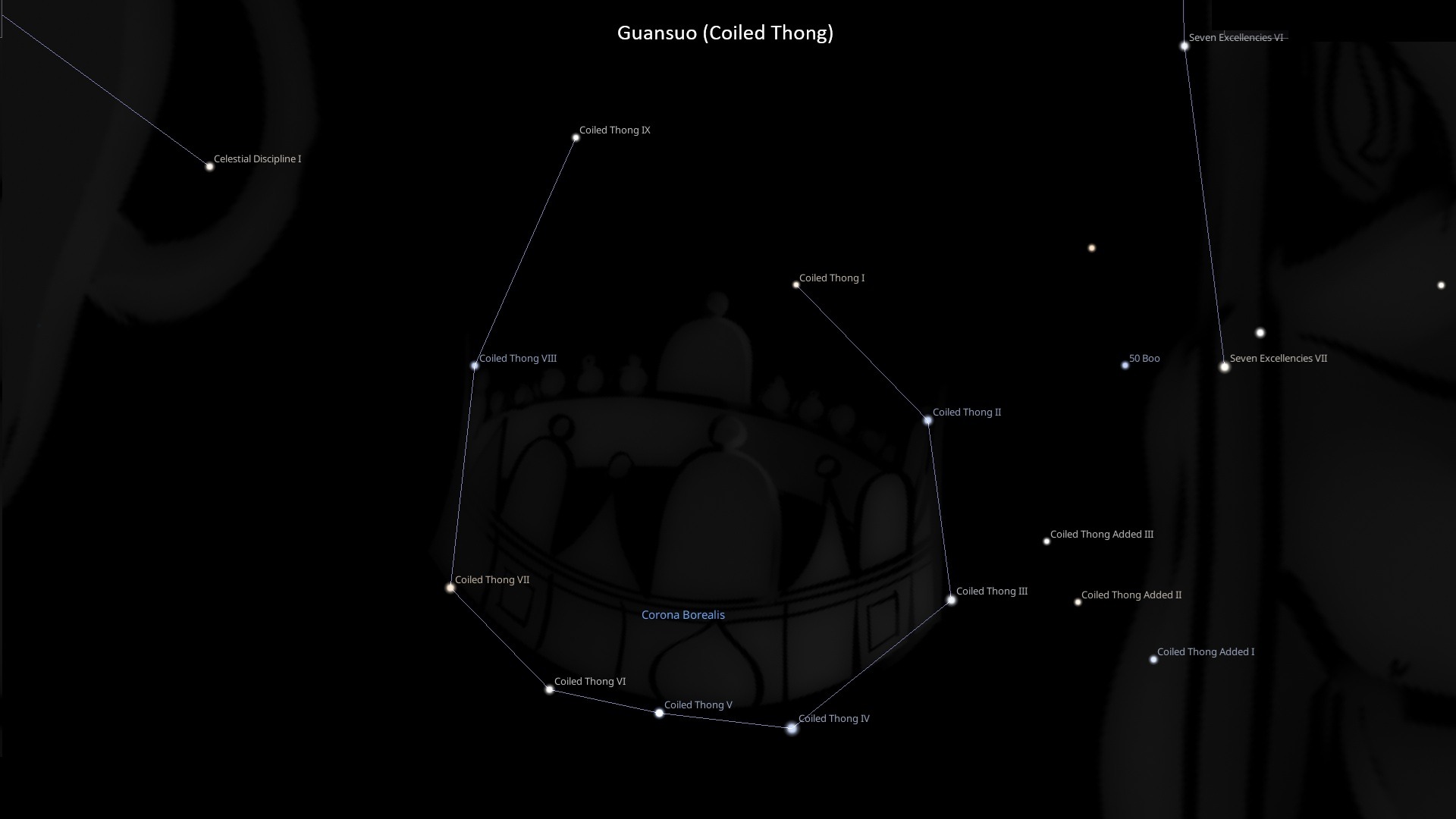
The 16th asterism of the Tianshi (Heavenly Market) Enclosure is named 貫索 Guànsuǒ, “Coiled Thong.” It represents prisons for ordinary people or rope markets and contains 9 stars in the constellation Corona Borealis. [1]
| 2000 | 2050 | IAU | Chinese | Orb |
| 12♏12 | 12♏54 | π CrB | Guansuo Yi (1) | 1°00′ |
| 09♏27 | 10♏09 | θ CrB | Guansuo Er (2) | 1°20′ |
| 09♏07 | 09♏49 | β CrB | Guansuo San (3) | 1°40′ |
| 12♏18 | 13♏00 | α CrB | Guansuo Si (4) | 2°10′ |
| 14♏52 | 15♏34 | γ CrB | Guansuo Wu (5) | 1°30′ |
| 17♏01 | 17♏44 | δ CrB | Guansuo Liu (6) | 1°10′ |
| 19♏07 | 19♏49 | ε CrB | Guansuo Qi (7) | 1°20′ |
| 19♏00 | 19♏43 | ι CrB | Guansuo Ba (8) | 1°00′ |
| 17♏10 | 17♏53 | ρ CrB | Guansuo Jiu (9) | 1°00′ |
Guansuo the Coiled Thong
09♏07 to 19♏07
Guansuo belongs to the Tianshi Enclosure and consists of nine bright stars of magnitude 5 or higher, corresponding to the constellation Corona Borealis. Its name “Guan” means rope, and “Suo” means to lock or tighten, symbolizing confinement. In ancient times, this star official was regarded as the prison in the sky, in charge of the law and prohibiting violence and tyranny; hence, it was also called the Heavenly Prison, the Linked Chains, the Linked Camps, or the Heavenly Garrison. In Chinese folklore, it is known as the “Octagonal Glazed Well.”
Although the Guansuo was called the Heavenly Prison, it was only used to imprison criminal civilians. Next to the Big Dipper was another Heavenly Prison (Tianlao) that imprisoned high-status criminals.
During the Northern Song Dynasty (960–1127), “Guansuo” served as a currency unit for a string of 1,000 coins. In the Qing Dynasty (1644–1912), it was used as a system of measurement of ten strings of ten thousand coins.
In the novel “Investiture of the Gods” (1567), Qiu Yin was named the Star of Guansuo for defending the city.
In the early Ming Dynasty (1368–1435), Zhu Yuanzhang established judicial institutions such as the Ministry of Justice, the Censorate, and the Court of Judicial Review outside Taiping Gate in Nanjing, naming it “Guancheng.” Its layout imitated the constellation Guansuo in the sky. [2]
Ma Duanlin (1317)
The nine stars of the guansuo (贯索) are before the Seven Dukes. They are also called liansuo (连索), lianying (连营), and tianlao (天牢), governing law and prohibiting violence and force. The star at the prison entrance is the gate, signifying its opening. If all nine stars are bright, the prisons will be in turmoil; if seven stars are visible, there will be a minor amnesty; if five stars are visible, there will be a major amnesty; if they move, the axe and scythe will be used; if the center is empty, a new era will begin.
The Han Shu (汉书) mentions fifteen stars. Zhang Heng said that if the guansuo is open, there will be an amnesty; if it is not visible, the prisons will be simple; if it is closed or the star enters, there will be someone imprisoned to death. It is customary to observe them at noon or midnight. If one star is not visible, there will be minor joy; if two stars are not visible, rewards will be bestowed; if three stars are not visible, the ruler’s virtue and decrees will be effective, and amnesty will be granted.
If a guest star appears, note its size: a large one indicates a major amnesty, and a small one indicates a minor amnesty. Some say the guansuo represents the prison of the lowly. One ray of light signifies good fortune; two rays signify bestowal of titles and emoluments; three rays signify a pardon. A closed gate indicates many deaths in prison. Water (Mercury) signifies disaster; fire (Mars) signifies high rice prices. [3]
Song History (1346)
The Guansuo (Coiled Rope) asterism, consisting of nine stars, lies in front of Qigong (Seven Excellencies) and represents a prison for lowly or common criminals. It is also known as Liansuo (Linked Ropes), Lianying (Linked Encampments), or Tianlao (Celestial Prison). It oversees laws and the restraining of the strong and violent.
A single star at the opening of this formation (Laokou Yixing) serves as a gate, which is auspicious when it appears open. The asterism sits north of the Tianshi Yuan (Celestial Market Enclosure). If all the stars are bright, prisons across the land become crowded. Seven stars signify a minor amnesty, while five or six stars indicate a major amnesty. If the stars move, it portends the use of executioner’s axes; if the center of the formation appears empty, it signals a change in the reign era.
Shi Shen states: If one star vanishes, titles of nobility will be bestowed; if three stars vanish, a major amnesty will be granted (within a period of up to eighty days). If the asterism appears to enter the River (the Milky Way), it foretells famine; if many central stars appear, the number of prisoners increases.
If the planet Mercury transgresses this region, floods occur and rice becomes expensive. The emergence of a comet suggests the rise of prominent figures, both within and outside the realm. If a guest star (nova or supernova) enters the formation, it indicates unjust deaths; if it appears yellow, feudal lords will offer up their territories; if blue or green, it signifies sorrow; if red, it portends warfare; if white, it is an auspicious sign. If a meteor (falling star) enters the formation, it may bring distress to a high-ranking woman or, alternatively, amnesty; if a meteor exits the formation, it signifies a noblewoman’s death. If clouds or vapors enter the formation, pale ones mean the Emperor will lose territory; blue or green ones mean military conflict will arise; black ones indicate many unjust deaths within the prisons; white ones signify joy for the Emperor. [4]
References
- Tian Shi You Yuan – Baidu Encyclopedia.
- Guan Suo Xing – Baidu Encyclopedia.
- General Examination of Literature, Volume 278, Part 1, Ma Duanlin, 1317.
- Song History, Volume 49, Chapter 2, 1346.