
STARS: Major | All | Constellations | Chinese | About
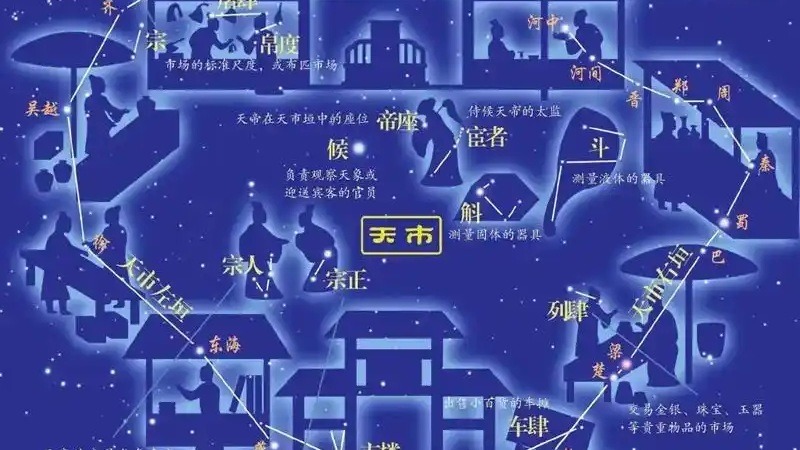
Ancient Chinese astronomers divided the night sky into three enclosures and twenty-eight mansions. The 天市垣 Tiān Shì Yuán, “Tian Shi (Heavenly Market) Enclosure,” is one of the three enclosures. It is the lowest of the Three Enclosures and represents the celestial marketplace, a bustling place where ordinary people trade.
The Heavenly Market Enclosure is located southeast of the Ziwei (Purple Palace) Enclosure, and north of the five lunar mansions of Fang, Xin, Wei, Ji, and Dou. It occupies approximately 57 degrees of the sky and forms a protective barrier around the Emperor’s Seat, the command center of the market. [1]
| # | Asterism | English | 2000 | Constellations | Stars |
|---|---|---|---|---|---|
| 1 | Tiānshìzuǒyuán | Left Wall | 14♐45 | Hercules / Serpens / Ophiuchus / Aquila | 11 |
| 2 | Tiānshìyòuyuán | Right Wall | 18♏20 | Serpens / Ophiuchus / Hercules | 11 |
| 3 | Shìlóu | Municipal Office | 20♐18 | Serpens / Ophiuchus | 6 |
| 4 | Chēsì | Commodity Market | 06♐33 | Ophiuchus | 2 |
| 5 | Zōngzhèng | Official for the Royal Clan | 25♐20 | Ophiuchus | 2 |
| 6 | Zōngrén | Official of Religious Ceremonies | 00♑04 | Ophiuchus | 4 |
| 7 | Zōng | Patriarchal Clan | 14♑46 | Hercules | 2 |
| 8 | Bódù | Textile Ruler | 00♑29 | Hercules | 2 |
| 9 | Túsì | Butcher's Shops | 01♑59 | Hercules | 2 |
| 10 | Hòu | Astrologer | 22♐27 | Ophiuchus | 1 |
| 11 | Dìzuò | Emperor's Seat | 16♐09 | Hercules | 1 |
| 12 | Huànzhě | Eunuch Official | 12♐43 | Hercules / Ophiuchus | 2 |
| 13 | Lièsì | Jewel Market | 03♐24 | Ophiuchus / Serpens | 2 |
| 14 | Dǒu | Dipper for Liquids | 28♏12 | Hercules | 5 |
| 15 | Hú | Dipper for Solids | 08♐33 | Hercules / Ophiuchus | 4 |
| 16 | Guànsuǒ | Coiled Thong | 09♏07 | Corona Borealis | 9 |
| 17 | Qīgōng | Seven Excellencies | 02♏32 | Hercules / Boötes | 7 |
| 18 | Tiānjì | Celestial Discipline | 25♏14 | Hercules / Corona Borealis | 9 |
| 19 | Nǚchuáng | Woman's Bed | 12♐03 | Hercules | 3 |
Ma Duanlin (1317)
The first palace of the Lower Yuan is named Tianshi, with two walls and twenty-two sections. The six-cornered Black Market Tower stands at the entrance, and two stars to the left of the gate mark the carriage market. Two Zongzheng and four Zongren stars follow in order. The Zongxing stars are in front of the butcher market, and the Houxing star is still beside the Emperor’s throne. The Emperor’s throne has one ever-shining star, and four faint eunuch stars. The next two stars are named Lishi, and the Dipper and Hu stars follow in order before the Emperor. The Dipper has five stars, and the Hu has four. There are nine Guansuo stars to the north of the enclosure, and the horizontal one of the Guansuo stars is the Seven Dukes. Tianji is exactly the shape of the Seven Dukes, and there are two more stars. Three stars to the north of Ji are named Nüchuang, and this seat is next to the Weaver Girl. The images of the three lights do not interfere with each other, and the twenty-eight constellations follow their shadows. Water, fire, wood, earth, and metal are also present, and there are five elements in order.
The twenty-two stars of the Heavenly Market Enclosure, located northeast of the Fang and Xin stars, govern power and the gathering of people. Another name is Heavenly Flag Court, which governs executions. If the stars in the market are numerous and bright, the year will be bountiful; if few, the year will be barren. If Mars guards it, disloyal ministers will be executed. It is also said that if the Angry Horn guards it, ministers will kill their ruler. The appearance of a comet indicates a relocation of the market or capital. The entry of a guest star indicates a major war; its exit indicates a noble death. Zhang Heng said that if the Heavenly Market Enclosure is bright, market profits are hidden, and merchants will not profit; if it suddenly dims, the opposite is true.
The six stars of the Market Tower, located in the market and above the Winnowing Basket star, govern the market. Brightness is auspicious; dimness indicates poor market profits. According to the Sui Shu, the Market Tower is the market government, governing market prices and regulations; its yang aspect represents money, and its yin aspect represents pearls and jade. Its appearance varies, and each star is interpreted according to its corresponding meaning.
The two stars of the Carriage Market, located inside the south gate of the Heavenly Market Enclosure, govern carriages. If dim, all carriages in the country will travel. According to the Sui Shu, they govern the area of merchants.
The two stars of the Imperial Clan Court are located southeast of the Emperor’s Seat, representing the Grand Master of the Imperial Clan. If a comet guards these stars and their color fades, it indicates trouble for the Imperial Clan Court. If a guest star guards or moves in these stars, it signifies changes within the Emperor’s family. It is also said that if a guest star guards these stars, a noble person will die. Furthermore, it is said that if the Imperial Clan Court is bright, the Imperial Clan will be orderly; if it is dim, the state will suffer misfortune.
The four stars of the Imperial Clan Members are located east of the Imperial Clan Court, responsible for recording the offerings of relatives and friends. If they are bright and clear, the clan will be orderly. The two stars of the Imperial Clan Stars are located northeast of the Imperial Clan Members, east of the Hou Stars, representing the Imperial Clan and the ministers of the Emperor’s bloodline. If a guest star guards these stars, the Imperial Clan will be discordant.
The two stars of the Imperial Clan Measurements are located northeast of the Imperial Clan Stars, governing measurement. If they are bright, measurements will be fair, and merchants will not cheat; if dim, this is not the case.
The two stars of the Imperial Butcher’s Market are located northeast of the Imperial Clan Measurementst, governing slaughtering. If they are bright and large, slaughtering will be frequent in the market.
The one star of the Hou Star is located northeast of the Emperor’s Seat, governing the observation of yin and yang. A bright and prominent star indicates strong ministers and open borders to foreign tribes; a faint and subtle star indicates national security; a fallen star indicates the emperor’s loss of power; a shifting star indicates the emperor’s unrest; a stable star indicates good fortune.
The Emperor’s Seat is one star, located in the Heavenly Market, west of the Hou Star, which represents the Heavenly Court. A bright and lustrous star indicates good fortune for the emperor and the implementation of his commands; a faint and subtle star indicates misfortune, and the great man will suffer. Some say that a dim star indicates the great man is not upright. Zhang Heng said that the Emperor’s Seat is the seat of the emperor. There are five Emperor’s Seats: one in the Purple Palace, one in the Great Horn, one in the Heart Palace, one in the Heavenly Market Enclosure, and one in the Supreme Palace. It is said that the Emperor’s Seat is the abode of Shennong; if it is not visible, the great man will suffer the consequences.
The four stars of the Eunuchs are southwest of the Emperor’s Seat, representing the eunuchs beside the emperor. A faint star indicates good fortune, a bright star indicates misfortune; if it is not normal, the eunuchs will have worries. Its divination is the same as that of the Power Star.
The two stars of the Marketplace are northwest of the Hu Star, representing precious goods. A shifting star indicates unrest in the marketplace; a shifting star indicates a major war.
The five stars of the Dipper are southwest of the Eunuchs, representing fair trade. If the stars are upside down, the year will be bountiful; if they are upside down, there will be a great famine. Their brightness is the same as the measurement of silk.
The four stars of the hu (斛) are north of the market tower, also called the Heavenly hu, which governs measurement. Their divination is the same as the dou (斗).
The nine stars of the guansuo (贯索) are before the Seven Dukes. They are also called liansuo (连索), lianying (连营), and tianlao (天牢), governing law and prohibiting violence and force. The star at the prison entrance is the gate, signifying its opening. If all nine stars are bright, the prisons will be in turmoil; if seven stars are visible, there will be a minor amnesty; if five stars are visible, there will be a major amnesty; if they move, the axe and scythe will be used; if the center is empty, a new era will begin. The Han Shu (汉书) mentions fifteen stars. Zhang Heng said that if the guansuo is open, there will be an amnesty; if it is not visible, the prisons will be simple; if it is closed or the star enters, there will be someone imprisoned to death. It is customary to observe them at noon or midnight. If one star is not visible, there will be a minor joy; if two stars are not visible, there will be a bestowal of rewards; if three stars are not visible, the ruler’s virtue and decrees will be effective and an amnesty will be granted. If a guest star appears, observe its size; a large size indicates a major amnesty, a small size indicates a minor amnesty. Some say the guansuo represents the prison of the lowly. One ray of light signifies good fortune; two rays signify bestowal of titles and emoluments; three rays signify a pardon. A closed gate indicates many deaths in prison. Water signifies disaster; fire signifies high rice prices.
The Seven Dukes and Seven Stars, located east of the Zhaoyao constellation, are celestial signs and symbols of the Three Dukes. Zhang Heng said that the Seven Dukes, arranged horizontally at the mouth of the Guansuo constellation, govern the enforcement of the law and the ranking of officials of good and evil. When the stars are aligned and in harmony, the national law is fair; when they are misaligned, there will be many unjust and cruel cases in prison. Some say that when a star enters the river, rice prices will be high; when fire invades it, war will break out.
The Nine Stars of Tianji, located east of the Guansuo constellation, are the Nine Ministers and the Nine Rivers, governing all affairs and resolving disputes. When they are bright, there will be many lawsuits throughout the land; when they are gone, the government will be corrupt and the national order will be chaotic; when they are scattered and cut off, there will be earthquakes and landslides.
The Three Stars of Nüchuang, located north of Tianji, represent the imperial concubines and govern women’s affairs. When they are bright, palace women will act arbitrarily; when they are not bright, there will be no misfortune.
The Song Dynasty Astronomical Records states: The Tianshi Enclosure has twenty-two stars, eleven in each direction. Its eastern enclosure: The first star in the south is Song, the second is Nanhai, the third is Yan, the fourth is Donghai, the fifth is Xu, the sixth is Wuyue, the seventh is Qi, the eighth is Zhongshan, the ninth is Jiuhe, the tenth is Zhao, and the eleventh is Wei. Its western enclosure: The first star is Han, the second is Chu, the third is Liang, the fourth is Ba, the fifth is Shu, the sixth is Qin, the seventh is Zhou, the eighth is Zheng, the ninth is Jin, the tenth is Hejian, and the eleventh is Hezhong. The first star in the southern part of the eastern enclosure, Song, is 15.5 degrees from the pole and enters the Wei constellation by 7 degrees. The first star in the western enclosure, Han, is 98.5 degrees from the pole and enters the Xin constellation by 5 degrees. The first star, Shilou, is 98 degrees from the southeast star and enters the Wei constellation by 12 degrees. The second star, Dongsi, is 100 degrees from the west star and enters the Wei constellation by 3 degrees. The fourth star, Hu, is 87.5 degrees from the southwest star and enters the Wei constellation by 3 degrees. The two stars of Lie Si are 86 degrees from the East Star, entering the Heart Constellation at 3.5 degrees. The star of Di Zuo is 75 degrees from the East Star, entering the Tail Constellation at 10 degrees. The star of Hou is 78.5 degrees from the East Star, entering the Tail Constellation at 16 degrees. The four stars of Huan Zhe are 76.5 degrees from the South Star, entering the Tail Constellation at 9.5 degrees. The five stars of Dou are 79 degrees from the East Star, entering the Tail Constellation at 6.5 degrees. The two stars of Zong Zheng are 85.5 degrees from the North Star, entering the Tail Constellation at 16 degrees. The four stars of Zong Ren are 86 degrees from the East Star, entering the Winnowing Basket at 1 degree. The two stars of Zong Shi are 80.5 degrees from the North Star, entering the Winnowing Basket at 5 degrees. The two stars of Bo Du are 69 degrees from the West Star, entering the Winnowing Basket at 3 degrees. The two stars of Tu Si are 68.5 degrees from the West Star, entering the Winnowing Basket at 3 degrees.
The Song Zhongxing Astronomical Records states: “The brightest and largest star in the Tian Shi Enclosure is called the Emperor’s Seat.” The star northeast of the Emperor’s Seat is the Empress, formerly mistakenly written as the Marquis; the three stars southwest of the Emperor’s Seat are the Consorts, their positions previously incorrect. The star north of the Consort is to the Emperor’s right, and the star north of the Empress is to the Emperor’s left; these are the Left and Right Attendants. The four stars south of the Consort are the Eunuchs; the star south of the Eunuchs is the Gatekeeper; and the four stars south of the Gatekeeper are the Inner Screen—this is their distinction. However, the old interpretation incorrectly identified the star of the Right Attendant and the three stars of the Consort as Eunuchs, and also incorrectly identified the five stars of the Eunuchs and Gatekeepers as the Dipper, and the four stars of the Inner Screen as the Measure—all these are errors. [2]
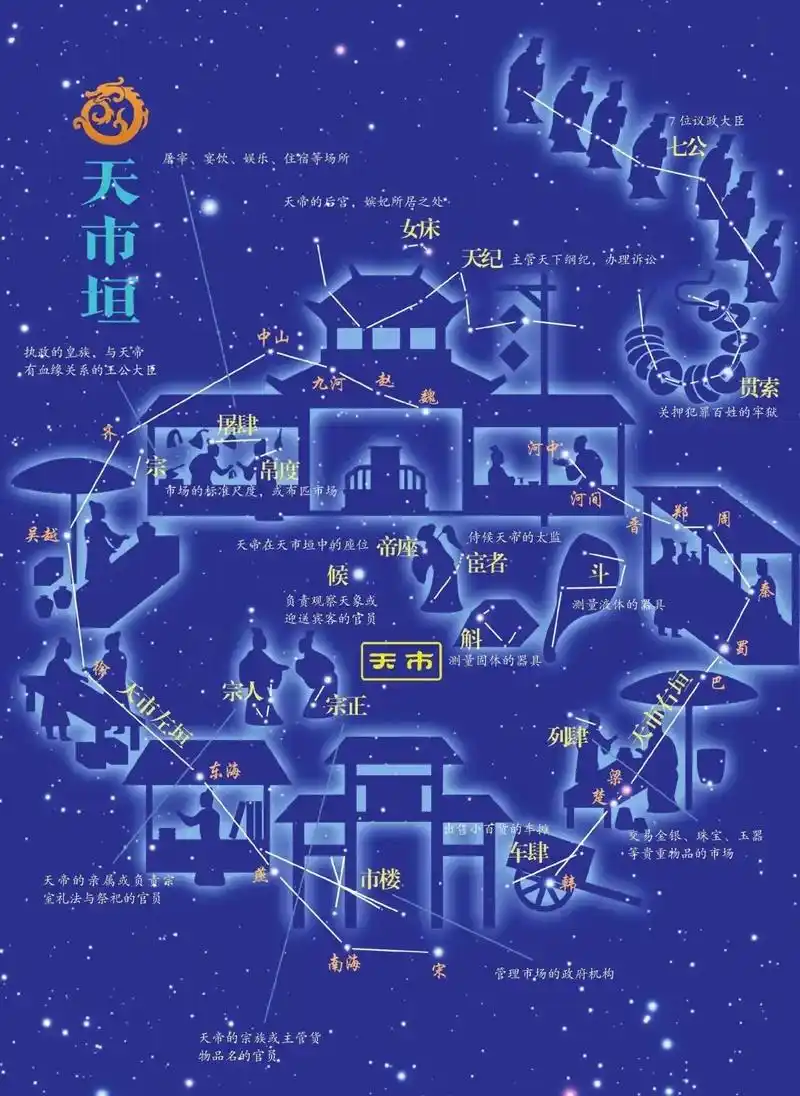
Tian Shi Enclosure
Song History (1346)
Tianshi Yuan Ershier Xing are twenty-two stars located within the inner palaces of Di, Fang, Xin, Wei, Ji, and Dou (constellations). The eleven stars of the eastern蕃 (boundary): first in the south is Song, second Nanhai, third Yan, fourth Donghai, fifth Xu, sixth Wu Yue, seventh Qi, eighth Zhongshan, ninth Jiuhuo, tenth Zhao, and eleventh Wei. The eleven stars of the western蕃: first in the south is Han, second Chu, third Liang, fourth Ba, fifth Shu, sixth Qin, seventh Zhou, eighth Zheng, ninth Jin, tenth Hejian, and eleventh Hezhong. They resemble the Son of Heaven above, with feudal lords paying homage. When the king holds a grand court at Gaomen (a ceremonial gate), western lords stand to the left of Yingmen (another gate), and eastern lords to its right. The same arrangement applies when feudal lords accompany the emperor on visits to commercial cities. Another interpretation states: Located northeast of Fang and Xin, it oversees authority and balance, as well as gathering crowds. It is also called Tianqi Ting (Celestial Flag Court), which presides over matters of execution and punishment. The Qianxiang Xinshu states: If the stars within Tianshi Yuan are numerous, moist, and lustrous — then it will be a year of abundant harvest. If Mars (Yinghuo) remains stationed here, unfaithful ministers will be executed. If a comet sweeps over it — the capital city’s market district will be relocated or changed. When a guest star enters, war will arise; when it departs, a noble person will die. The Tianwen Lu states: The Son of Heaven’s market is where the whole world converges. If the stars are bright and large, market officials will be strict, and merchants will gain no profit; if small, the opposite occurs. If they suddenly become dim — grain prices rise; if many small stars appear in the middle — then the people will prosper. When the Moon enters Tianshi Yuan, political changes and corruption occur; nearby ministers face punishment for crimes, and warfare arises. If the Moon remains stationed within it — female rulers will be troubled, and high-ranking officials will suffer calamity. When any of the five planets enter Tianshi Yuan — generals and prime ministers worry, and officials in charge of various functions suffer disaster; if they remain stationed there — market disturbances and administrative changes occur. It is also said: When any of the five planets enters Tianshi Yuan, warfare arises. If Mars (Yinghuo), remains stationed there — great famine and fire disasters will occur. If it appears with a red, blood-like hue and sharp芒角 (radiant points) — market officials rebel. If Saturn (Tianxing) remains stationed there — grain prices rise sharply. When Venus (Taibai) enters Tianshi Yuan — armies are mobilized, and grain becomes expensive. If the Planet of the Hour Star (Chenxing) remains stationed there, a foreign chieftain will die. If a guest star remains stationed — measurements and standards become unbalanced; if the star’s color is white, market chaos ensues; when it departs Tianshi Yuan, there will be mourning. If a comet remains stationed — grain becomes expensive; when it departs from Tianshi Yuan, outstanding individuals rise up, and the capital’s market district is relocated or changed; if it sweeps over the emperor’s position (Di Zuo) and exits Tianshi Yuan — then old systems are removed and new ones established. If a falling star enters, with a pale blue color — goods become expensive; if red — fire disasters and epidemics among the people occur. Another interpretation says: When a falling star exits Tianshi Yuan, it signifies foreign military action. If cloud qi (atmospheric phenomena) enters, with a pale blue hue — many people fall ill; if dark blue-black — goods become expensive; when it exits — goods are cheap; if yellow and white — goods are also cheap; if black — the overseer of markets will die.
Di Zuo Yixing is one star located within Tianshi Yuan, representing an outer seat to Tianhuang Dadi (the Celestial Emperor). If it shines brightly and is moist — it signifies good fortune, with imperial authority respected; if dim or small — high-ranking officials worry. When the Moon transgresses this star — the ruler becomes troubled. If any of the five planets transgress it, ministers plot against the sovereign and rebellion occurs below; Mars (Yinghuo)’s transgression is especially severe. If a guest star enters with a red color — warfare arises; if it remains stationed there, high-ranking ministers will cause disorder. If comets or孛 (bright comets) transgress this star — the people become chaotic and temples are relocated. When a falling star transgresses it, feudal lords raise armies, ministers plot against their sovereign, and noble officials issue new decrees.
Hou Yixing is a single star located northeast of Di Zuo; sometimes written as Hou, it represents the official responsible for observing yin and yang. If bright and large — the prime minister is powerful; if faint or small — the nation remains peaceful; if it disappears, the ruler loses his position; if it shifts — unrest prevails. If the Moon (Taiyin) transgresses this star, the prime minister becomes troubled. If a guest star or comet remains stationed here — the prime minister will be dismissed from office. If a孛 (bright comet) transgresses it — ministers plot rebellion.
Huansha Suxing are four stars located southwest of Di Zuo, representing eunuchs or officials who serve the emperor — they oversee those who have been punished and remain in office. If these stars are faint — it is auspicious; if their positions deviate from normal — eunuchs will face troubles.
Dou Wuxing, located south of Huansha, oversee the standardization of measurements and weights. Qianxiang Xinshu: Located west of Di Zuo — if they appear covered (obscured), the year will be bountiful; if upturned or exposed, it will be a time of famine. If transgressed by guest stars or comets — famine occurs.
Hu Suxing are four stars south of Dou, overseeing measurements, weight divisions (such as zhu), and calculations. If these stars appear dim — it is an ill omen; if they disappear — the year will be one of famine. Another interpretation says: Located north of Shilou, they are known as Tianhu (Celestial Measure).
Liesi Erxing are two stars located northwest of Hu, overseeing the trade of gold, jade, pearls, and precious ornaments.
Tusi Erxing are two stars northeast of Baidu, presiding over butchering and cooking for slaughter. Qianxiang Xinshu: Located within the Tianshi Yuan at fifteen degrees.
Chusi Erxing are two stars in the center of Tian Shi Men (Celestial Market Gate), overseeing a wide variety of goods and commodities. If these stars appear dim, then all carriages will be in motion; if bright — it is auspicious. If a guest star or comet stations here — war chariots from across the land are mobilized. Qianxiang Xinshu: Located at the eastern side of the southern gate of Tianshi Yuan.
Zongzheng Erxing are two stars southeast of Di Zuo, representing ministers in charge of royal clan affairs (Zongdaifu). Wu Mi said: They oversee the officials responsible for managing the gains and losses of the imperial lineage. Qianxiang Xinshu: Located west of Zongren (Ancestors’ Officials). If a comet stations here or the stars lose their color — officials in charge of the royal lineage will face affairs or troubles. If a guest star stations here, decrees and commands are changed; if it transgresses — the ruler does not personally attend ancestral temple rituals. If a孛 (bright comet or abnormal celestial phenomenon) appears in this region — Zongzheng officials are dismissed from office.
Zongren Suxing are four stars east of Zongzheng, overseeing the recording and distinction between close and distant relatives for sacrificial rites. If the imperial clan is orderly — these stars appear as beautiful patterns, bright and upright; if they move or change — the emperor’s relatives face upheaval. If a guest star stations here — noble persons will die.
Zongxing Erxing are two stars east of Hou Xing, representing the imperial clan and blood-related ministers who assist the emperor. Qianxiang Xinshu: Located north of Zongren. If a guest star stations here — branches of the imperial family will be discordant; if these stars are dim — the imperial lineage weakens.
Baidu Erxing are two stars northeast of Zongxing, overseeing fair measurement and trade in market transactions. Qianxiang Xinshu: Located south of Tusi. If these stars are bright and large — measurements will be fair, and merchants do not deceive. If a guest star or comet stationed here — silk and cotton become extremely expensive.
Shilou Liuxing are six stars located in the center of Tianshi Yuan, above Jixing (Ji Star), representing the market office and overseeing trade regulations. The yang aspect represents gold and money; the yin aspect, pearls and jade. If changes occur — their meanings are interpreted according to what is observed. Qianxiang Xinshu: They oversee marketplaces, standard measurements, and regulations within Tianshi Yuan. If these stars are bright — it is auspicious; if dim — market officials neglect their duties. If a comet or guest star stations here — many market gates remain closed.
Qigong Qixing are seven stars east of Zhaoyao, representing the Celestial Chancellor (Tianxiang), symbolizing the Three Dukes and overseeing the Seven Policies. If bright — the prime ministers are strong; if large and moving — warfare arises. If aligned in order, national laws remain just; if chaotic — prisons fill with prisoners. If they form a connected line like a rope (lian guan suo) — it signifies a time of disorder. If entering Hezhong (a region or star), grain prices rise and the people face famine. If Venus (Taibai) stations here — chaos spreads across the land, and warfare erupts. If a guest star stations here for long — it will be a year of famine, and the ruler faces danger. When a falling star emerges from this region — high-ranking generals are dismissed.
Guansuo Jiuxing are nine stars in front of Qigong Xing, representing prisons for lowly or common criminals. Another name is Liansuo; another is Lianying; and still another is Tianlao (Celestial Prison). They oversee laws, restraining the strong and violent. Laokou Yixing represents a gate — it should remain open. These stars are located in the northern part of Tianshi Yuan (Celestial Market Enclosure). If all stars are bright — prisons across the land become crowded; if seven stars appear — a minor pardon is issued; five or six stars — a major pardon occurs. If they move — capital punishment is carried out; if the center appears empty — an era name will be changed. Shi Shen said: If one star disappears — a noble title is bestowed; if three stars disappear, a major pardon will occur, with the earliest date being eighty days later. If they enter Hezhong (a specific region or star) — famine arises; if many central stars appear — prisoners increase in number. If the Planet of Hour Star (Chenxing, Mercury) transgresses this region — floods occur and rice becomes expensive. When a comet emerges from here — outstanding individuals within and outside the empire rise up. When a guest star enters — there will be unjust deaths; if its color is yellow, feudal lords offer land; green signifies worry; red indicates warfare; white is auspicious. When a falling star enters — female rulers become troubled or issue pardons; when it exits, noble women die. If cloud qi enters with a pale blue color — the Son of Heaven loses territory; if green, warfare arises; black indicates many unjust deaths in prison; white signifies imperial joy.
Tianji Jiuxing are nine stars east of Guansuo, symbolizing the Nine Ministers (Jiuqing), overseeing all matters and legal order — they preside over prisons and lawsuits. If these stars are bright, lawsuits multiply across the land; if they disappear, governance collapses and national order falls into chaos; if scattered or absent — earthquakes and mountain collapses occur. If they align with Nuchuang (a star group) — the ruler neglects propriety and female influence prevails in court affairs. If a guest star stations here long-term, the sovereign is endangered and the people face famine. When transgressed by a guest star — feudal lords raise armies. If comets or孛 (Bo, a type of comet) transgress this region — earthquakes occur. When guest stars and comets station together here — lawsuits in the empire remain unresolved.
łoży Nuchuang Sanxing are three stars north of Tianji, representing female attendants and concubines in the imperial harem — they oversee women’s affairs. If bright, palace attendants grow arrogant; if dispersed, concubines replace the female ruler; if stationary — it is auspicious; if unseen — many women suffer illness. If guest stars or comets station here long-term — palace attendants conspire against the sovereign. When a guest star enters, women face worries; the imperial harem becomes unruly and female influence dominates court affairs. When cloud qi emerges, if yellow — the imperial harem enjoys blessings; white indicates mourning; black signifies misfortune; green means many women suffer illness.
Within the Right Tian Shi Yuan, seventeen constellations have identifiable names, totaling eighty-eight stars in number. Stars such as Shilou, Tianhu, Liesi, Chusi, Dou, Bodu, and Tusisi are not recorded in the “Jin Zhi” (History of Jin Dynasty), but appear in the “Sui Zhi” (History of Sui Dynasty) under the Tian Shi Yuan — this aligns with the “Bu Tian Ge.” Moreover, Guansuo, Qigong, Nuchuang, and Tianji are classified under the Taiwei Yuan in the “Jin Zhi.” According to the Qian Xiang Xin Shu: Tianji is located north of the Tian Shi Yuan; Nuchuang belongs to Ji Su (the Star of Jishu); Guansuo belongs to Fang Su (the Star of Fangshu); and Qigong belongs to Di Su (the Star of Dishu). Wu Mi classified Qigong as belonging to Fang Su and also Weisu; Guansuo belonged to Fang Su, as well as Dishu and Xin Su (the Star of Xishu); Nuchuang was assigned to Weisu and Jisu. The interpretations differ in all cases. [3]
References
- Tian Shi Yuan – Baidu Encyclopedia.
- General Examination of Literature, Volume 278, Part 1, Ma Duanlin, 1317.
- Song History, Volume 49, Chapter 2, 1346.