
18♏20 to 09♐14
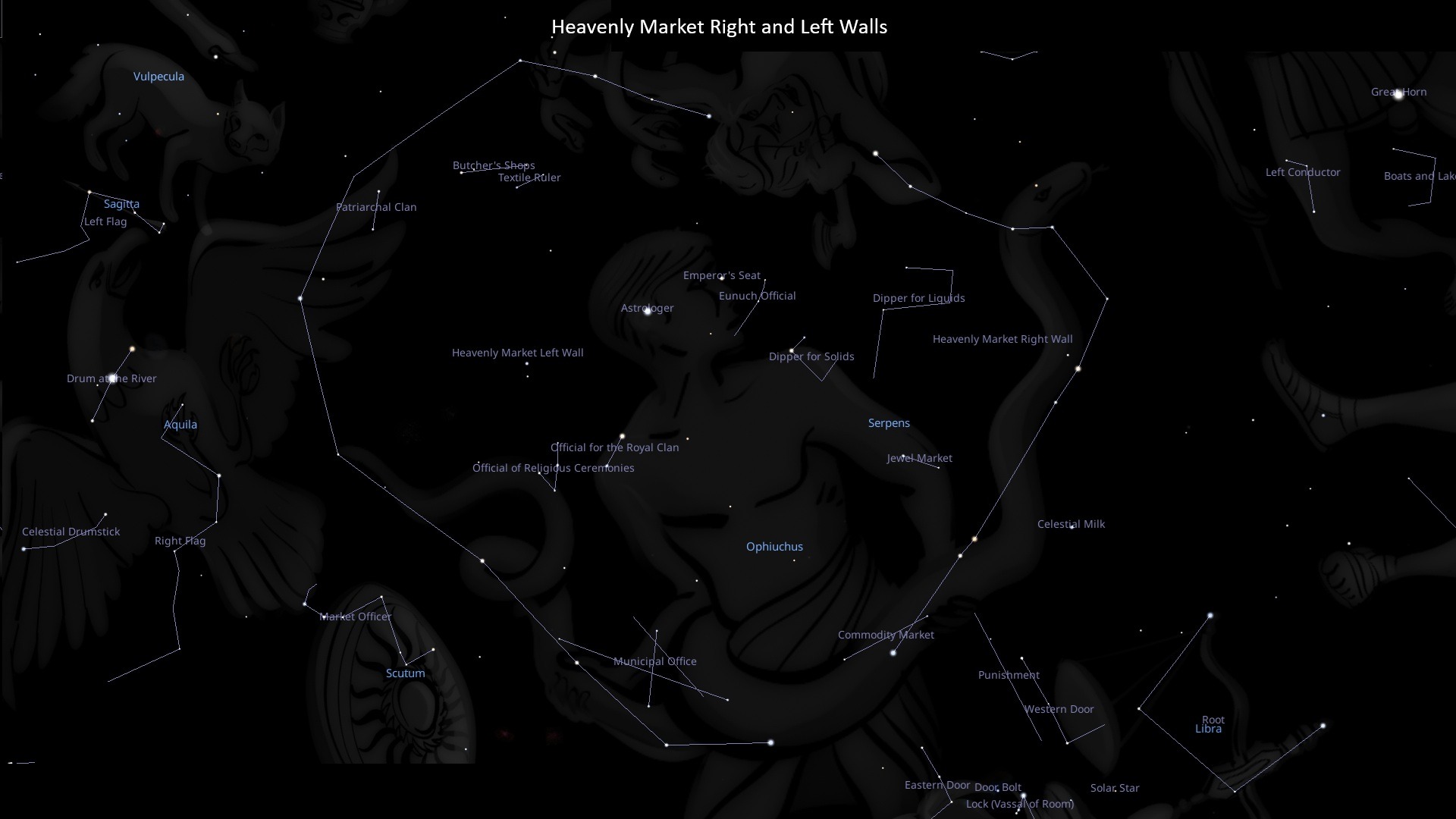
The 2nd asterism of the Tianshi (Heavenly Market) Enclosure is named 天市右垣 Tiānshìyòuyuán, “Heavenly Market Right Wall.” It represents the right wall of the city and contains 11 stars in the constellations Hercules, Ophiuchus and Serpens. Together with the Left Wall, it forms the main framework of the Heavenly Market Enclosure. [1]
| 2000 | 2050 | IAU | Chinese | Orb |
| 01♐05 | 01♐47 | β Her | Tianshiyouyuan Yi (1) | 2°00′ |
| 29♏12 | 29♏55 | γ Her | Tianshiyouyuan Er (2) | 1°30′ |
| 25♏43 | 26♏25 | κ Her | Tianshiyouyuan San (3) | 1°00′ |
| 22♏47 | 23♏30 | γ Ser | Tianshiyouyuan Si (4) | 1°00′ |
| 19♏57 | 20♏39 | β Ser | Tianshiyouyuan Wu (5) | 1°40′ |
| 18♏20 | 29♏02 | δ Ser | Tianshiyouyuan Liu (6) | 1°30′ |
| 22♏04 | 22♏47 | α Ser | Tianshiyouyuan Qi (7) | 2°00′ |
| 24♏20 | 25♏02 | ε Ser | Tianshiyouyuan Ba (8) | 1°30′ |
| 02♐18 | 03♐00 | δ Oph | Tianshiyouyuan Jiu (9) | 2°00′ |
| 03♐30 | 04♐13 | ε Oph | Tianshiyouyuan Shi (10) | 1°40′ |
| 09♐14 | 09♐56 | ζ Oph | Tianshiyouyuan Shiyi (11) | 2°00′ |
Asterism Tian Shi You Yuan, the Heavenly Market Right Wall
18♏20 to 09♐14
The walls of the Heavenly Market east and west vassal states each have 11 stars, named after the names of the vassal states during the Warring States period (such as “Qin”, “Chu”, “Qi”, “Zhao”) and geographical names (such as “Donghai” and “Hezhong”). The arrangement of the star names roughly corresponds to the geographical locations, symbolizing the trade participants from various places. [2]
Ma Duanlin (1317)
The Lower Yuan Palace is named Tian Shi, with two walls and twenty-two gates.
The Heavenly Market Enclosure, with its twenty-two stars, lies northeast of the Fang and Xin constellations, governing power and the gathering of the masses. It is also called the Heavenly Flag Court, governing matters of execution.
A multitude of stars in the market enclosure signifies a bountiful harvest; few stars indicate a poor harvest. If Mars guards it, disloyal ministers will be executed. It is also said that if the Angry Horn guards it, ministers will kill their ruler. The appearance of a comet signifies a relocation of the market or capital. The entry of a guest star signifies a major war; its exit signifies the death of a noble. Zhang Heng said, “When the Heavenly Market Enclosure is bright, market profits are hidden, and merchants will not profit; if it suddenly dims, the opposite is true.”
The Song Dynasty Astronomical Records states: The Tianshi Enclosure has twenty-two stars, eleven in each direction.
Its eastern enclosure: The first star in the south is Song, the second is Nanhai, the third is Yan, the fourth is Donghai, the fifth is Xu, the sixth is Wuyue, the seventh is Qi, the eighth is Zhongshan, the ninth is Jiuhe, the tenth is Zhao, and the eleventh is Wei.
Its western enclosure: The first in the south is Han, the second is Chu, the third is Liang, the fourth is Ba, the fifth is Shu, the sixth is Qin, the seventh is Zhou, the eighth is Zheng, the ninth is Jin, the tenth is Hejian, and the eleventh is Hezhong. [3]
Song History (1346)
Market Enclosure (天市垣) has twenty-two stars, located within the inner palaces of Di, Fang, Xin, Wei, Ji, and Dou (constellations). The eleven stars of the eastern boundary: first in the south is Song, second Nanhai, third Yan, fourth Donghai, fifth Xu, sixth Wu Yue, seventh Qi, eighth Zhongshan, ninth Jiuhuo, tenth Zhao, and eleventh Wei. The eleven stars of the western boundary: first in the south is Han, second Chu, third Liang, fourth Ba, fifth Shu, sixth Qin, seventh Zhou, eighth Zheng, ninth Jin, tenth Hejian, and eleventh Hezhong.
They resemble the Heavenly King above, with feudal lords paying homage to the King. When the king holds a grand court at Gaomen (a ceremonial gate), western lords stand to the left of Yingmen (another gate), and eastern lords to its right. The same arrangement applies when feudal lords accompany the emperor on visits to commercial cities.
Another interpretation states: Located northeast of Fang and Xin, it oversees authority and balance, as well as gathering crowds. It is also called Tianqi Ting (Celestial Flag Court), which presides over matters of execution and punishment. The Qianxiang Xinshu states: “When the stars in the market are abundant and lustrous, then it will be a year of abundant harvest.”
If Mars remains stationed here, unfaithful ministers will be executed. If a comet sweeps over it, the capital city’s market district will be relocated or changed. When a guest star enters, war will arise; when it departs, a noble person will die.
The Tianwen Lu states: The Son of Heaven’s market is where the whole world converges. If the stars are bright and large, market officials will be strict, and merchants will gain no profit; if small, the opposite occurs. If they suddenly become dim — grain prices rise; if many small stars appear in the middle — then the people will prosper.
When the Moon enters Tianshi Yuan, political changes and corruption occur; nearby ministers face punishment for crimes, and warfare arises. If the Moon remains stationed within it, female rulers will be troubled, and high-ranking officials will suffer calamity.
When any of the five planets enter Tianshi Yuan, generals and prime ministers worry, and officials in charge of various functions suffer disaster; if they remain stationed there, market disturbances and administrative changes occur. It is also said: When any of the five planets enters Tianshi Yuan, warfare arises.
If Mars remains stationed there, great famine and fire disasters will occur. If it appears with a red, blood-like hue and sharp 芒角 (radiant points), market officials rebel.
If Saturn remains stationed there, grain prices rise sharply.
When Venus enters Tianshi Yuan, armies are mobilized, and grain becomes expensive. If Venus remains stationed there, a foreign chieftain will die.
If a guest star remains stationed, measurements and standards become unbalanced (injustice); if the star’s color is white, market chaos ensues; when it departs Tianshi Yuan, there will be mourning.
If a comet remains stationary, grain becomes expensive; when it departs from Tianshi Yuan, outstanding individuals rise up, and the capital’s market district is relocated or changed; its appearance in the Heavenly Market signifies the sweeping away of the emperor’s throne and the establishment of a new order.
If a falling star enters, with a pale blue color, goods become expensive; if red, fire disasters and epidemics among the people occur. Another interpretation holds that when a falling star exits Tianshi Yuan, it signifies foreign military action.
Clouds entering the market, with a pale blue hue, indicate widespread illness; if dark blue-black, goods become expensive; when it exits, goods are cheap; if yellow and white, goods are also cheap; if black, the overseer of markets will die. [4]
References
- Tian Shi You Yuan – Baidu Encyclopedia.
- Tian Shi Yuan – Baidu Encyclopedia.
- General Examination of Literature, Volume 278, Part 1, Ma Duanlin, 1317.
- Song History, Volume 49, Chapter 2, 1346.