
STARS: Major | All | Constellations | Chinese | About
15♏33 to 29♏24
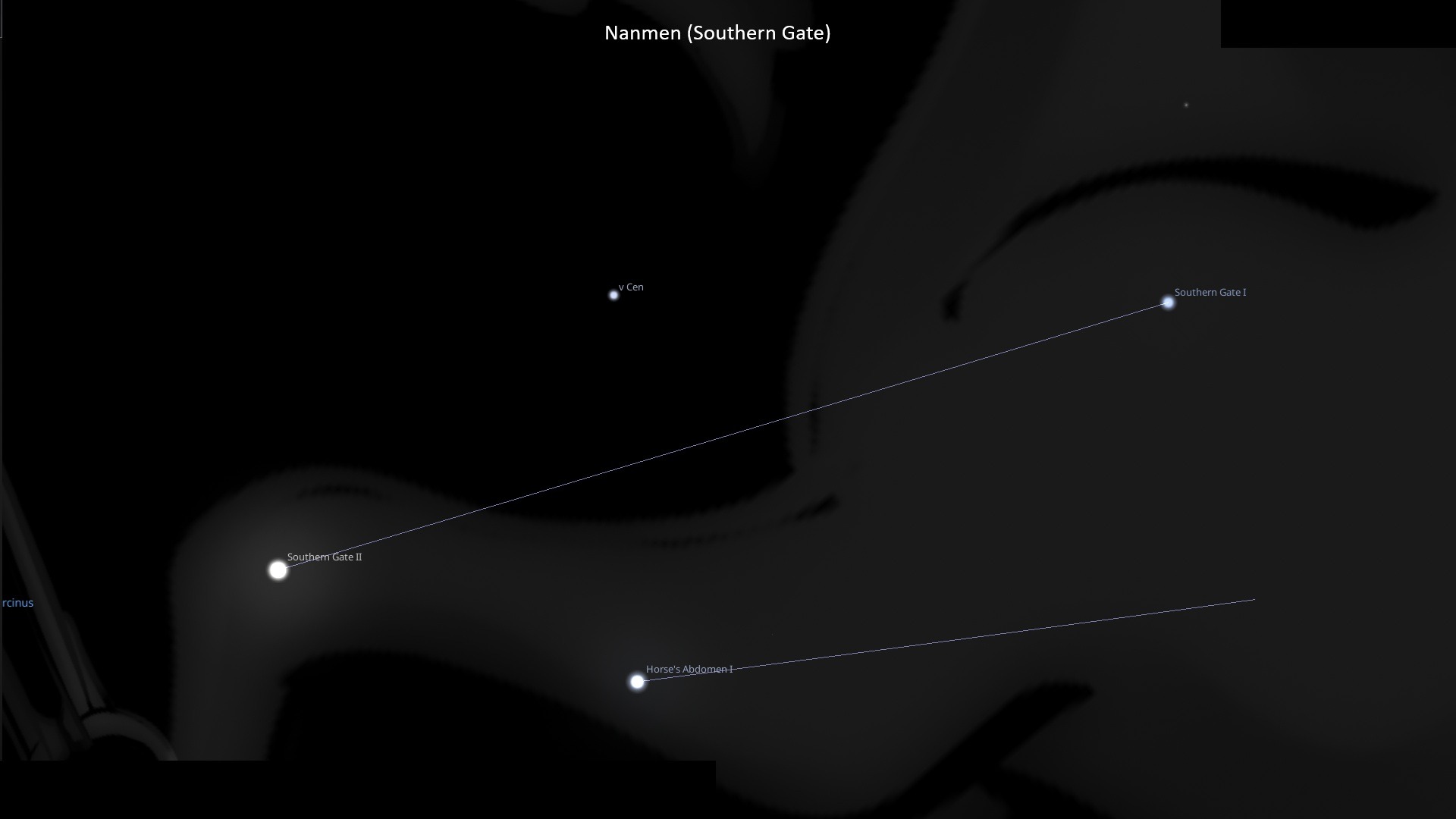
The 1st Chinese lunar mansion is named 角宿 Jiǎo Su, “Horn Mansion.”
The 11th asterism of the Horn Mansion is called 南門 Nánmén, “Southern Gate,” representing the south gate of the warehouse or the Library House South Gate. It consists of 2 stars in the constellation Centaurus. [1]
| 2000 | 2050 | IAU | Chinese | Orb |
| 15♏33 | 16♏15 | ε Cen | Nanmen Yi (1) | 2°10′ |
| 29♏24 | 00♐06 | α Cen | Nanmen Er (2) | 2°40′ |
Nanmen – Southern Gate
15♏33 to 29♏24
Nanmen comprises two stars, ε and α Centauri. Nanmen II (α Centauri) is one of Earth’s closest star systems.
In July of the seventh year of the Chongzhen reign of the Ming Dynasty (1634), a new star map, the General Star Map of the North and South Equator, was published. The South Gate is the southernmost star official visible in most parts of ancient China. This star map was drawn by Western missionaries such as Johann Adam Schall von Bell and Robert Louis, and supplemented the star officials in the southern sky.
Nanmen II (α Centauri) is one of Earth’s closest star systems. It is a triple star system, serving as the prototype for the “Three-Body” star system in the Chinese science fiction novel “The Three-Body Problem,” and also as the interstellar travel target set in the “Wandering Earth” project. [2]
Ma Duanlin (1317)
The two stars of Nanmen, south of Kulou, are the outer gate of heaven, governing the defense of troops. When they are bright, distant lands send tribute; when they are dark, barbarians rebel. A guest star guards the area, and the main force arrives. [3]
Song History (1346)
The two stars at Nanmen (the South Gate) are located south of Koulou (the Arsenal), representing the outer gate of the heavens and presiding over military defense and restrictions. If the stars are bright, they signify tribute from afar; if they are dim, they indicate barbarian rebellion. A small star within them indicates military activity. If a guest or a comet guards the stars, war will break out. [4]
References
- Jiǎo Xiù – Baidu Encyclopedia.
- South Gate – Baidu Encyclopedia.
- General Examination of Literature, Volume 279, Part 2, Ma Duanlin, 1317.
- Song History, Volume 50, Chapter 3, 1346.