
STARS: Major | All | Constellations | Chinese | About
22♎47 to 26♎08
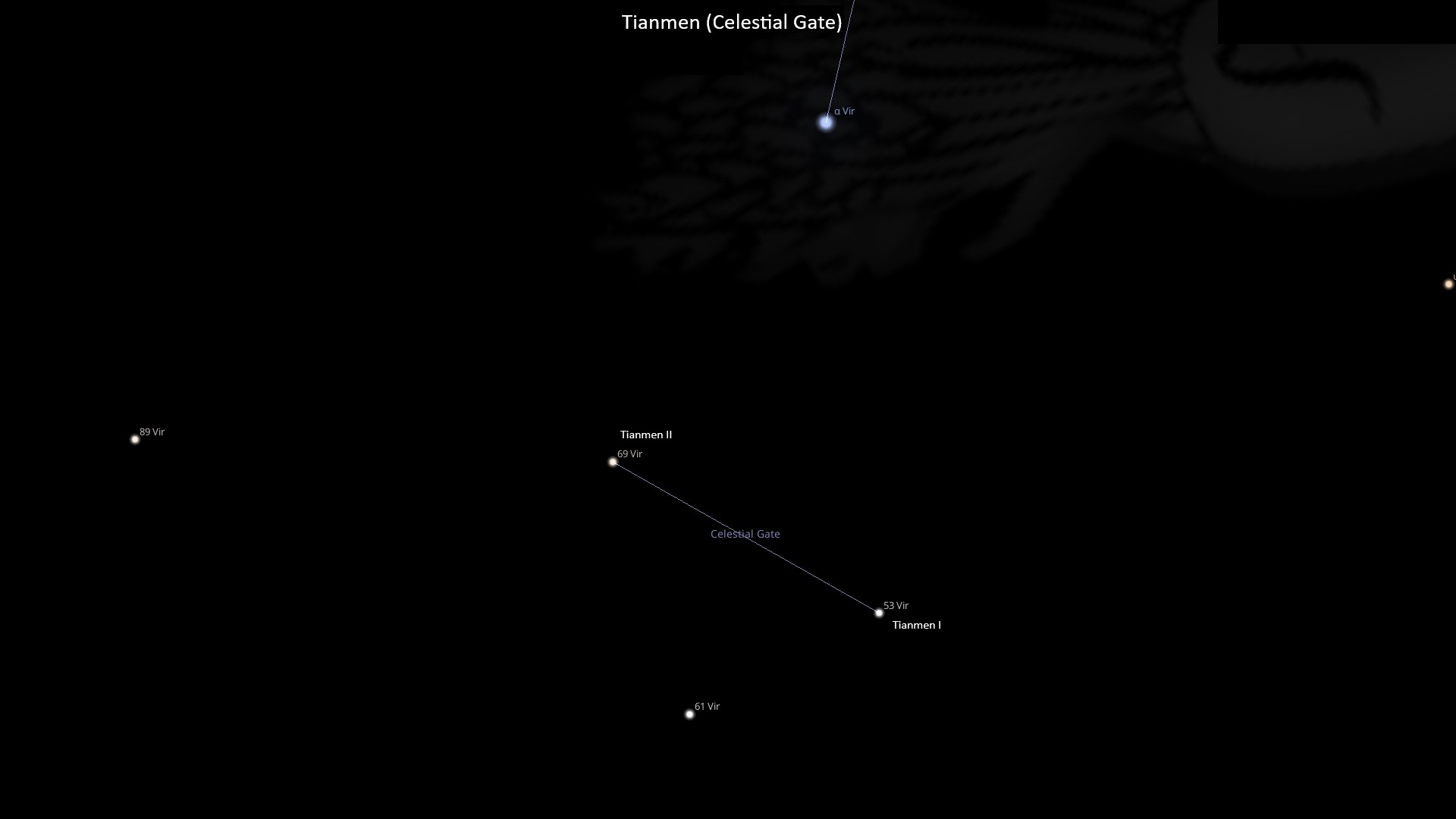
The 1st Chinese lunar mansion is 角宿 Jiao Su, “Horn Mansion.”
The 1st asterism of the Horn Mansion is also called 天門 Tiānmén, “Celestial Gate.” It represents the Gates of the zodiac and is composed of two stars in the Virgo constellation. [1]
| 2000 | 2050 | IAU | Chinese | Orb |
| 22♎47 | 23♎29 | 53 Vir | Tianmen Yi (1) | 1°00′ |
| 26♎08 | 26♎51 | 69 Vir | Tianmen Si (4) | 1°00′ |
Tianmen the Celestial Gate
22♎47 to 26♎08
Tianmen (Heavenly Gate) is an ancient Chinese star constellation in the Horn Mansion, containing two stars. It marks the start of the Twenty-Eight Mansions. According to the Treatise on Astronomy in the Book of Jin (648 AD), “The two stars of Jiao in the east of the Twenty-Eight Mansions are Tianguan, and the Tianmen is in between, which is the inner heavenly court.”
The construction of the “Ling Xing Gate” in the Confucian Temple symbolizes “honoring Confucius as honoring Heaven,” and also implies that Confucius can be compared with the celestial officials who impart knowledge and cultivate talents. Next to Tianmen (Heavenly Gate) is the Jin Xian (Advancing the Worthy) or (Recommending Virtuous Men), implying that wise and virtuous people and scholars from around the world can gather there.
“Tianmen” is also an alternative name for the Jiao (Horn) constellation. In ancient times, Jiao also had multiple meanings such as Jiaoxing (Horn Star), Tianguan (Heavenly Gate), Tianzhu (Heavenly Pillar), Shouxing (Longevity Star), Chenjiao (Chen Horn). [2]
Ma Duanlin (1317)
The “Tianmen” (Heaven’s Gate) consists of two black stars, situated north of Pingxing (Justice) and south of Jiao (Horn); they preside over the celestial gateway, representing the place where the sovereign receives envoys and guests. When they shine brightly, the four quarters of the realm submit in harmony; when they are invisible, warfare erupts and treacherous, sycophantic elements arise. [3]
Song History (1346)
The two stars of Tianmen are north of Pingxing (Justice). Wu Mi says, “They lie to the south of the left horn (Spica), representing a place for receiving envoys and guests.” If the stars are bright, all regions will submit; if dim, foreign troops will arrive. A lunar halo outside of it indicates war. If Mars enters, border crossings will be blocked; if it remains there, etiquette and propriety will be lost. If Venus remains in Tianmen, an ambush awaits. If a guest star transgresses it, someone will plot against the emperor. [4]
References
- Jiǎo Xiù – Baidu Encyclopedia.
- Heavenly Gate Star Official – Baidu Encyclopedia.
- General Examination of Literature, Volume 279, Part 2, Ma Duanlin, 1317.
- Song History, Volume 50, Chapter 3, 1346.