
STARS: Major | All | Constellations | Chinese | About
02♉07 to 23♉52
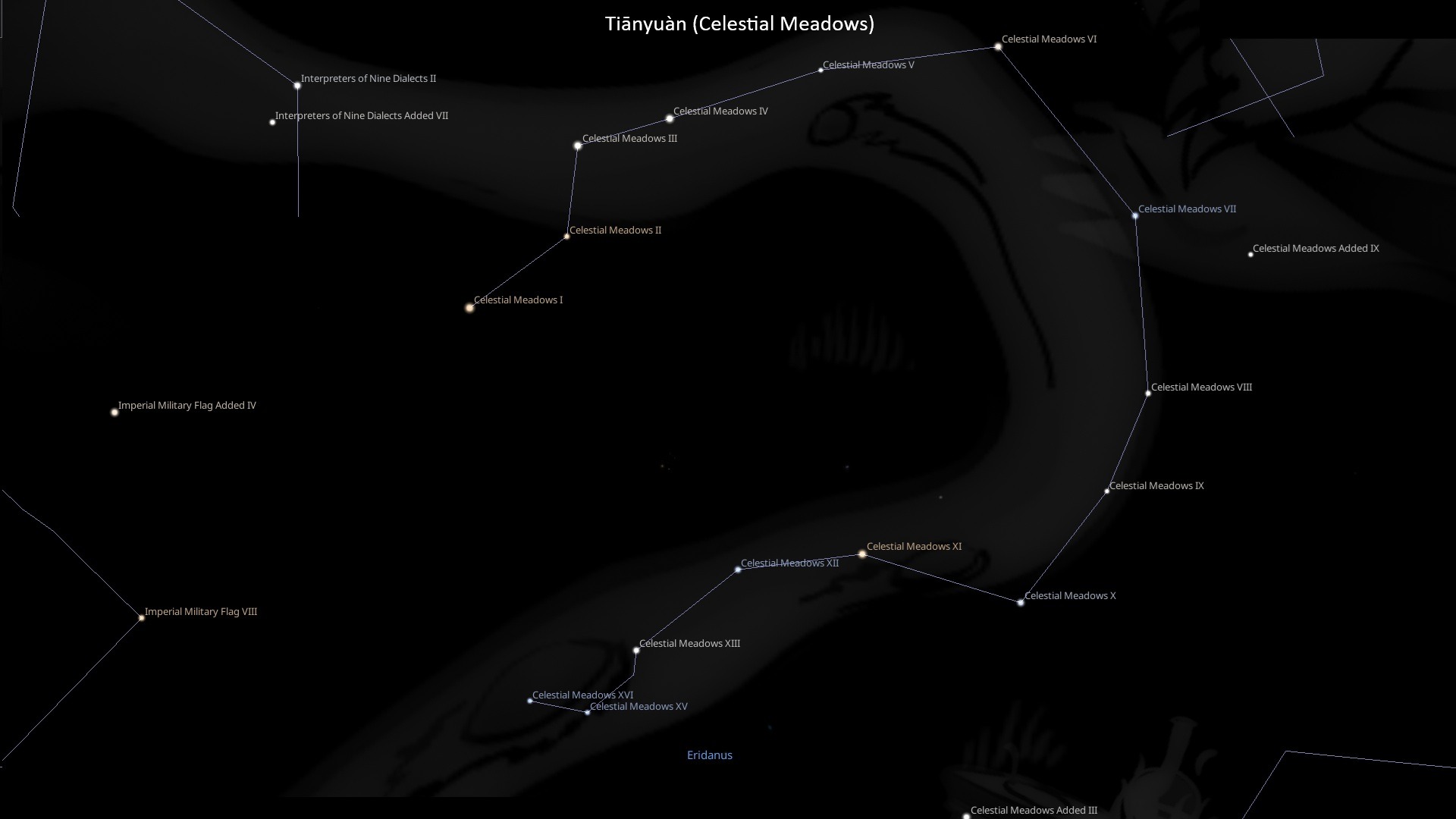
The 18th Chinese lunar mansion is 昴宿 (Mǎo Su), “Hairy Head Mansion.”
The 6th asterism of the Hairy Head Mansion is called 天苑 (Tiānyuàn), “Celestial Meadows,” representing the royal ranch and composed of 16 stars from the constellations Eridanus and Cetus. [1]
Note: Chinese astronomy has 3 Tianyuan asterisms.
天淵 Tiānyuān, “Celestial Spring,” is the 8th asterism of the 8th lunar mansion Dou (Dipper).
天苑 Tiānyuàn, “Celestial Meadows,” is the 6th asterism of the 18th lunar mansion Mao (Hairy Head).
天園 Tiānyuán, “Celestial Orchard,” is the 15th asterism of the 19th lunar mansion Bì (Net).
| 2000 | 2050 | IAU | Chinese | Orb |
| 23♉52 | 24♉35 | γ Eri | Tiānyuàn Yi (1) | 1°50′ |
| 20♉58 | 21♉41 | π Eri | Tiānyuàn Er (2) | 1°10′ |
| 20♉52 | 21♉34 | δ Eri | Tiānyuàn San (3) | 1°40′ |
| 18♉09 | 18♉52 | ε Eri | Tiānyuàn Si (4) | 1°30′ |
| 13♉20 | 14♉32 | ζ Eri | Tiānyuàn Wu (5) | 1°00′ |
| 08♉45 | 09♉27 | η Eri | Tiānyuàn Liu (6) | 1°30′ |
| 03♉45 | 04♉28 | π Cet | Tiānyuàn Qi (7) | 1°10′ |
| 02♉07 | 02♉49 | τ1 Eri | Tiānyuàn Ba (8) | 1°10′ |
| 02♉38 | 03♉21 | τ2 Eri | Tiānyuàn Jiu (9) | 1°00′ |
| 04♉32 | 05♉15 | τ3 Eri | Tiānyuàn Shi (10) | 1°20′ |
| 10♉07 | 10♉49 | τ4 Eri | Tiānyuàn Shiyi (11) | 1°30′ |
| 14♉13 | 14♉55 | τ5 Eri | Tiānyuàn Shier (12) | 1°20′ |
| 17♉22 | 18♉04 | τ6 Eri | Tiānyuàn Shisan (13) | 1°20′ |
| 17♉22 | 18♉04 | τ7 Eri | Tiānyuàn Shisi (14) | 1°00′ |
| 18♉52 | 19♉35 | τ8 Eri | Tiānyuàn Shiwu (15) | 1°00′ |
| 20♉59 | 21♉41 | τ9 Eri | Tiānyuàn Shiliu (16) | 1°00′ |
Tiānyuàn the Celestial Meadows
02♉07 to 23♉52
Ma Duanlin (1317)
The sixteen stars of Tianyuan, south of the Pleiades and Hyades, form a ring, representing the emperor’s imperial gardens, a place for raising birds and beasts, and governing horses, cattle, and sheep. Their brightness indicates an abundance of horses, cattle, and sheep; their scarcity indicates death. [2]
Song History (1346)
The Tianyuan (Celestial Enclosure) asterism, consisting of sixteen stars, lies south of the Mao (Hairy Head) and Bi (Net) and is arranged in a ring-like shape; it represents the Emperor’s enclosure for raising birds and beasts.
If these stars are bright, livestock such as cattle, horses, and wild animals will be abundant; if they appear dim, many will become emaciated or die of famine; if these stars are incomplete or missing, there will be slaughter or culling.
If any of the five planets transgress Tianyuan, war will break out.
If a guest star (an unexpected star or nova) or comet transgresses it, war will break out, and many wild animals will die.
If a meteor (shooting star) enters Tianyuan and is black, many birds and beasts will die; if it is yellow, they will multiply and thrive. The same applies to clouds and vapors. [3]
References
- Pleiades Constellation – Baidu Encyclopedia.
- General Examination of Literature, Volume 279, Part 2, Ma Duanlin, 1317.
- Song History, Volume 50, Chapter 3, 1346.