
STARS: Major | All | Constellations | Chinese | About
03♑12 to 02♒29
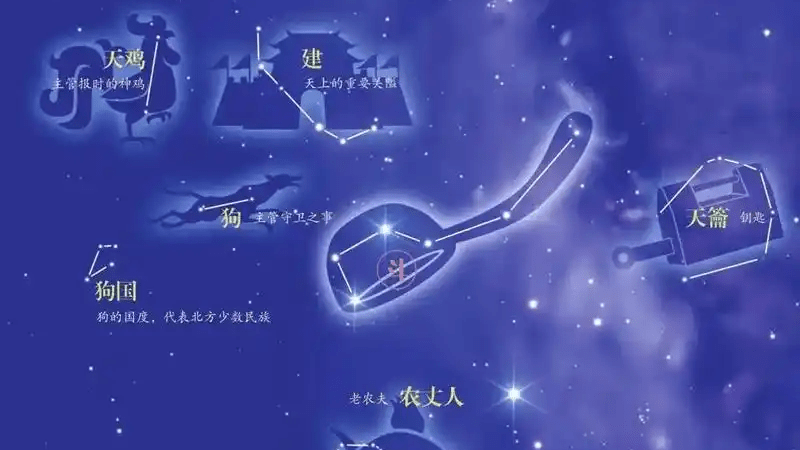
The 8th Chinese lunar mansion is named 斗宿 Dǒu Su, “Dipper Mansion.” It is the 1st of the 7 mansions of the Black Tortoise of the North. It represents the head and body of the Tortoise.
The Dipper Mansion contains 10 star officials (asterisms) and a total of 93 stars, distributed in the constellations Aquila, Corona Australis, Ophiuchus, Sagittarius, Scutum and Telescopium. [1]
Note: There is another “Dou” in Chinese astronomy. 斗 Dǒu, “Dipper for Liquids,” is the name of the 14th asterism of the Tian Shi (Heavenly Market) Enclosure.
| # | Asterism | English | 2000 | Constellations | Stars |
|---|---|---|---|---|---|
| 1 | Dǒu | Dipper | 03♑12 | Sagittarius | 6 |
| 2 | Jiàn | Establishment | 13♑24 | Sagittarius | 6 |
| 3 | Tiānbiàn | Market Officer | 09♑01 | Aquila / Scutum | 9 |
| 4 | Biē | River Turtle | 05♑04 | Telescopium / Corona Australis | 11 |
| 5 | Tiānjī | Celestial Cock | 24♑37 | Sagittarius | 2 |
| 6 | Tiānyuè | Celestial Keyhole | 23♐28 | Ophiuchus / Sagittarius | 8 |
| 7 | Gǒuguó | Dog Territory | 25♑51 | Sagittarius | 4 |
| 8 | Tiānyuān | Celestial Spring | 15♑46 | Sagittarius | 3 |
| 9 | Gǒu | Dog | 19♑20 | Sagittarius | 2 |
| 10 | Nóngzhàngrén | Peasant | 09♑12 | Sagittarius | 1 |
Mansion Dou the (Southern) Dipper
03♑12 to 02♒29
Those born under the Dou constellation become stronger when facing stronger opponents and weaker when facing weaker ones. They experience significant mood swings but possess the power to overcome adversity and are highly creative. However, they tend to be reserved and secretive, which can lead to misunderstandings, and they need a calm and stable mind.
The Dipper constellation is the head of the Northern Black Tortoise, consisting of six stars shaped like a dipper. It is generally called the Southern Dipper. Together with the Northern Dipper, it governs the power of life and death.
It belongs to the Wood element and is associated with the mythical beast Xie. It is the first constellation of the North. The ancients also called it Tianmiao, “Heavenly Temple,” and it was the star official belonging to the emperor. Ordinary people should not easily offend the emperor’s star; hence, it is often considered inauspicious.
Doumu Xie: Xin is an official, a Yin deity, and is governed by the Southern Dipper Star God. There are four Yin deities, surnamed Yang, named Duo, dressed in a single blue robe, holding spears, and governed by the Southern Dipper Star God. [2]
Doumu Xie
Dipper is one of the most auspicious mansions, representing the typical late bloomers. It gives a generally stable and reliable nature, a strong fighting spirit, a love of conquest, and a refusal to easily admit defeat. Dipper people are suited to riding horses and exploring mountains and forests. They love prayer and making friends with virtuous people. They are skilled in many arts and have abundant wealth.
Those born under the Dou constellation are auspicious for wearing new clothes and undertaking long-term projects. They are also suited for acquiring treasures, repairing gardens and forests, building vehicles and other vehicles, constructing fields, houses, cities, temples, and other auspicious structures. The construction of war equipment and other necessities is also auspicious.
Dou Advice
In a stable period of fortune, Dou Su may feel that he has no place to use his skills. However, this is indeed a good opportunity to accumulate strength.
Sometimes, when faced with relationship issues, the Dou constellation can appear overly shrewd and capable. However, in relationships, there are often no winners or losers. Some Dou constellations channel their fighting spirit into emotions, winning the game but potentially losing the relationship.
Those born under the sign of Dou need a window, a good friend with whom they can talk about anything. Too much grievance and pressure bottled up inside is detrimental to mental health. Having a confidant with whom one can talk about anything is a treasure in the life of someone born under the sign of Dou. [3]
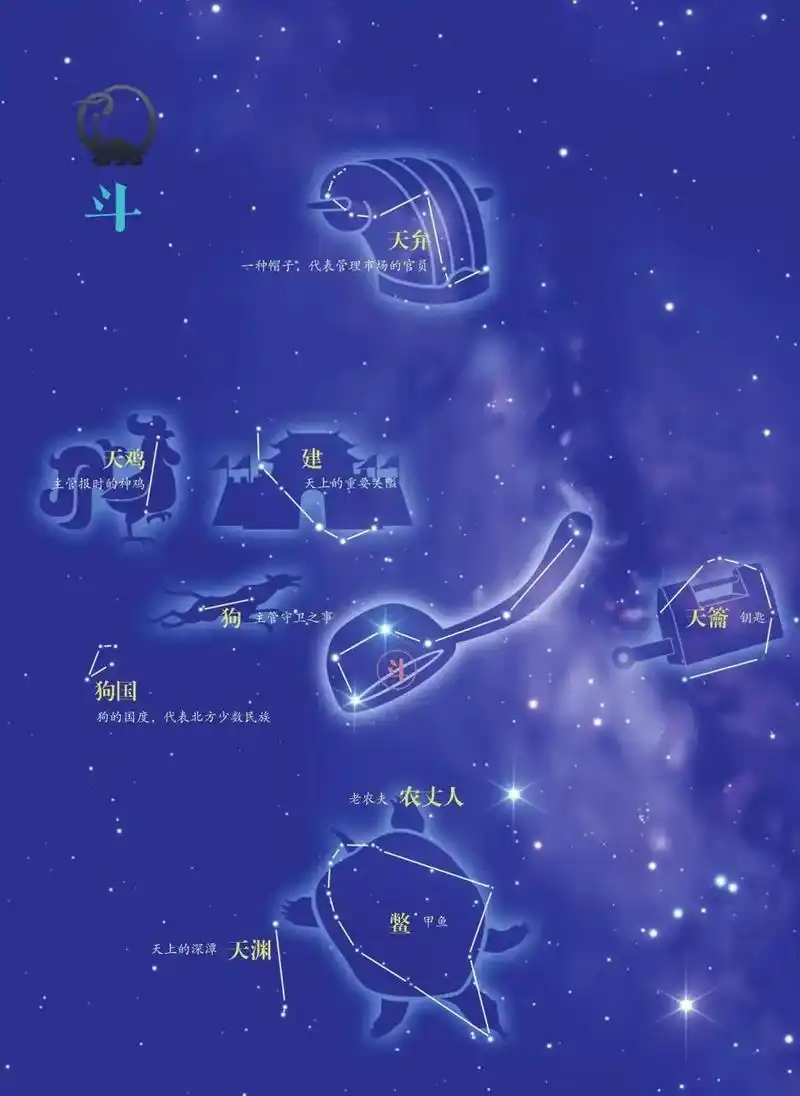
Dou Su – Dipper Mansion
Ma Duanlin (1317)
The six stars of the Dipper resemble the Big Dipper. Three stars are opposite the top of the Dipper’s head, and three, three, nine stars are above the Heavenly Cap. The Dipper is not round, with fourteen stars, though named after a turtle with a rope-like shape. The Heavenly Rooster has two black stars on its back. The Heavenly Crow has eight yellow stars in front of its handle. The Dog Kingdom is in the four directions, with chickens born below. The Heavenly Abyss has ten stars to the east of the turtle. There are also two dogs in front of the Dipper’s head. The farmer’s father-in-law sleeps below the dog. The Heavenly Abyss has ten yellow dog-colored stars.
The Dipper, at twenty-five degrees, is the Heavenly Temple, also called the Heavenly Mechanism. The five planets pass through the center, the sun and moon are on their proper paths. The position of Chancellor and Grand Chancellor is responsible for assessing appropriate political affairs, promoting the virtuous and capable, bestowing titles and stipends, and overseeing military matters. The two southern stars, Kui and Tianliang, represent Heavenly Beam; the two central stars, Tianxiang; and the two northern stars, Shao and Tianfuting, also indicate lifespan. When matters concerning the emperor arise, the Southern Dipper is consulted.
Bright stars signify unity between the emperor and his ministers, peace throughout the land, and the bestowal of titles and stipends. Bright or shifting stars indicate the emperor’s distress and the outbreak of war; shifting stars indicate the expulsion of his ministers. When the sun, moon, and five planets move in the opposite direction into the Dipper, the land is in turmoil. A comet encroaching upon it signifies war. Dim stars indicate the dethronement or death of the Chancellor.
The fourteen stars of the Turtle constellation, located south of the Southern Dipper, represent a water creature associated with the moon. If a planet guards this constellation, it signifies a meeting of white-clad figures, indicating water. If Mars guards it, it signifies drought.
The six stars of Jian, located behind the Dipper, also called the Heavenly Flag, lie on the ecliptic, representing the capital of heaven. Between Jian and the Dipper lies the path of the seven luminaries. Jian represents planning, the Heavenly Drum, and the Heavenly Horse. The two southern stars represent the celestial storehouse; the two central stars represent the market and the executioner’s block; the two upper stars represent the flag and tassel. If the Jian star is shaken, people will suffer. A lunar halo indicates the appearance of a dragon and disease in cattle and horses. A lunar eclipse, with the five planets encroaching on the Jian star, signifies ministers slandering each other, ministers plotting against their ruler, blocked passes, and great floods.
The nine stars of Tianbian, north of Jian and entering the river, represent the head of the market officials, in charge of shops, markets, and market registers, indicating the availability of goods. Bright stars are auspicious. A comet encroaching on the Jian star indicates high prices for grain and war.
The two stars of Tianji, north of Gouguo, represent the timing of events. Venus and Mars encroaching on them signify a major war.
The eight stars of Tianzhu, south of the Dipper and west of its handle, represent the sealing and closure of gates. Bright stars are auspicious, while dark stars are inauspicious.
The four stars of Gouguo, northeast of Jian, represent the Xianbei, Wuhuan, and Woju. Bright stars indicate border raids. Venus and Mars encroaching on the Jian star signify foreign disturbances. When Venus is in opposition, the country is in chaos. When a guest star guards or invades it, a great thief will appear, and the king will come.
The ten stars of Tianyuan, southeast of Bie, are also called Tianhai, which governs irrigation. If Mars guards it, there will be a great drought. If Mercury guards it, there will be a great flood. It is also said to govern fish and turtles in the sea.
The two black stars of Gou, in front of the Dipper, govern barking and guarding against traitors. If it does not reside in its usual place, it will bring great disaster.
The star of Nongzhangren, southwest of the Southern Dipper, governs the old farmer and crops. Its divination is similar to that of chaff. [4]
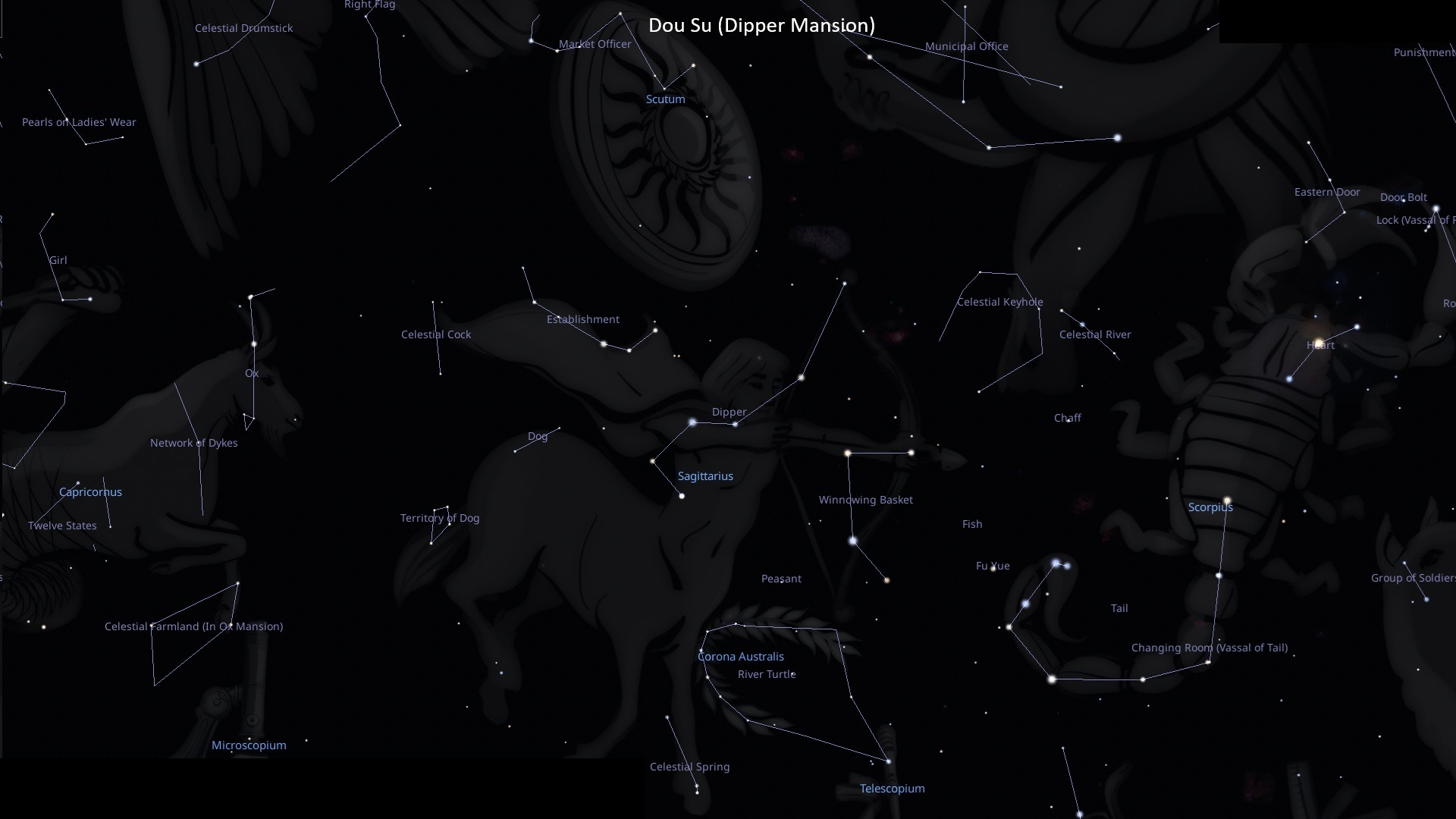
Song History (1346)
The six stars of the Southern Dipper (南斗) are the Heavenly Rewards and Salaries (official rank) Palace. It oversees the emperor’s longevity and symbolizes the positions of prime ministers in terms of titles and salary; classical texts refer to it as 天庙 “Tianmiao,” or the Heavenly Temple. It represents the positions of the Prime Minister and the Grand Minister, who are responsible for honoring virtuous individuals and advancing scholars in official ranks. It also oversees military affairs. Another name for it is 天机 Tianji (Heavenly Mechanism).
The two southern stars, Kui (魁), are known as Tianliang, the Heavenly Beam (天梁). The two central stars are the Tianxiang, the Heavenly Minister (天相). The two northern stars are Tianfu and Ting. The southern star is also called Kuixing. It is also said that the southern stars are Kuixing (the Northern Dipper’s handle), while the northern stars form the dipper’s ladle.
The first star in this group is called Beiting, alternatively known as Tiankai or Fuwan. Shi Shen said: “The first Kui star governs Wu, the second Kuaiji, the third Danyang, the fourth Yuzhang, the fifth Lujiang, and the sixth Jiujiang.”
If the stars are bright and prominent, the king’s rule is peaceful; the emperor enjoys a long life, and generals and ministers work together harmoniously. If they appear dim or irregularly arranged, then officials of all ranks lose their proper order. If any star has sharp spines (mangjiao) or wavers, it indicates that loyal ministers are lost from the state, military conflict arises, and people suffer distress.
A solar eclipse in the Dipper signifies worry for generals and ministers, war, disaster for the empress, and war arises in the region of Wu. A solar halo signifies worry for the prime minister and unrest in the ancestral temple.
A lunar eclipse signifies famine in the corresponding state, minor war, and distress for the empress and her ladies-in-waiting. Three lunar eclipses in a year signify a general amnesty. A lunar halo signifies the death of a great general and a lack of harvest.
If the moon transits the Dipper, ministers and generals are demoted; winds and rains become irregular, and high-ranking officials face execution. Another divination: if the moon enters here, it signifies distress for the female ruler, with military conflict arising in the Zhao and Wei regions; an ominous color signifies the death of a minister.
If Mercury transits the Dipper, there will be floods, grain will not grow, and there will be war. If it remains for an extended time, warfare or mourning events arise.
If Venus transits the Dipper, military conflict and ministerial rebellion follow. If it remains or lingers, armies are destroyed and generals killed; if both Venus and Mars enter together, there will be a white blaze, and ministers will rebel. If it remains for a long time, the disaster will be great.
Mars in the Dipper signifies that an amnesty occurs, but there will be the destruction of the army and the killing of generals, and fire disasters; if it enters for twenty days, grain prices will be high; if it enters for forty days, there will be virtuous decrees; if it remains, there will be war and bandits; if it remains for a long time, the disaster will be severe; if it emerges from the Dipper and moves upward, the whole country will be worried; if it does not move, the ministers will be worried. If it enters, there will be conspiracies both inside and outside the court; if it remains for seven days, the crown prince will fall ill.
If Jupiter enters, there will be an amnesty or pardon; if it remains in place for a long time, floods and rising grain prices follow. If it remains for a hundred days, there will be military action and the death of high-ranking officials.
If Saturn afflicts, there will be rebellion or disorder; if it enters, there will be loss of territory; if it moves in retrograde, there will be earthquakes; if it emerges, enters, or remains for twenty days, a major mourning event occurs; if it remains, high-ranking officials will rebel; another divination: if Saturn moves in retrograde here, there will be floods followed by drought; if it remains for some time, the state produces many righteous and virtuous men.
If a guest star invades, war breaks out, and the country is in chaos; if it enters, feudal lords attack each other, there is much theft, severe drought, palace and temple fires, and high grain prices. If the guest star remains for seven days without departing, an amnesty will be issued.
When a comet invades, the ruler is worried; if it appears, its part is plotting, and there will be floods, palace fires, subordinates plotting against superiors, and rebellious armies; if it enters, there will be fire and ministers will rebel.
When a meteor enters, barbarians come to pay tribute; if it invades, the prime minister is worried; in spring, it signifies longevity; in summer, it signifies floods; in autumn, it signifies the dismissal of ministers; in winter, it signifies ministers rebelling; if it is red and appears as a star, it signifies the death of a minister. When clouds enter, if they are pale, there will be much wind; if they are red, there will be drought; if they appear, there will be war and palace and temple fires; if they enter, there will be two red clouds, and there will be war; if they are black, it signifies disease.
If a comet invades, the ruler faces distress. If it exits this region, plots will arise, and there will be floods, palace fires, subordinates plotting against superiors, and rebellious armies; if it appears, there will be war, disease, and national worry.
When a meteor enters, southern and western barbarians come to pay tribute; the prime minister is distressed; subordinates plot against superiors; and rebellious forces arise. If it exits the Dipper, military conflict or disease follows, bringing distress to the state. In spring, it signifies the emperor’s longevity; in summer, floods occur; in autumn, the prime minister is demoted or removed from office; in winter, high-ranking ministers act rebelliously. If meteors appear red and exits, then a high-ranking minister dies.
When clouds enter, if they are pale, there will be much wind; if they are red, there will be drought; if they emerge, there will be war and palace and temple fires; if two red clouds enter, there will be war; if they are black, it signifies disease.
According to the Han Yongyuan bronze instrument, the Dipper is 24.4 degrees; the Tang Kaiyuan aurora instrument is 26 degrees. The distance from the pole is 116 degrees, now it is 119 degrees. The Jingyou divination also indicated a distance of 26 degrees, 122 degrees from the pole of the fourth star of the Dipper.
The fourteen stars of Bie, the Turtle constellation, located south of the Southern Dipper, govern aquatic creatures and indicate that rivers or streams have changed their courses. govern aquatic life. If Mars remains in Bie for an extended period, a drought occurs. If Mercury resides here, fires break out. If a guest star remains in this region, floods follow. A meteor or shooting star appearing, bluish-black in color, indicates flooding; yellow, indicates drought. The same applies to cloud formations. Another interpretation states that if a star remains in this region, it indicates gatherings of people dressed in plain or mourning clothes (white clothing), signifying floods.
Tianyuan consists of ten stars, also known as Tianchi, Tianquan, and Tianhai. It is located nine dan southeast of the Turtle constellation; it is also called Taiyin, overseeing irrigation ditches and canals. If any of the Five Planets remain here for an extended period, great floods occur with rivers breaking their banks. If Mars enters this region, a drought occurs. If a guest star enters here, sea fish emerge from the water. If a comet remains in this region for an extended period, rivers overflow and injure people.
Gou (dog) consists of two stars, located in front of Kuixing of the Souther Dipper; they oversee barking and guarding. Disasters occur if these stars do not remain in their usual positions. If Mars transits through Gou, a drought occurs. If a guest star enters this region, there will be many earthworks and famine in the northern border areas; if it remains here for an extended period, guards or defenders of the state will rebel.
Jian consists of six stars located to the northeast of the Southern Dipper’s head, near the ecliptic. It is also known as Tianqi and represents Heavenly Flag, the Heavenly Capital Gate. It signifies planning matters, heavenly drums, and heavenly horses. The two stars to the south are Tianku, the Heavenly Treasury, representing the heavenly granary or storehouse. The two central stars represent the Market and the Axe and Cudgel, or the forges of heaven (fudan). The upper two stars are Qifa, the Flag’s Foot, representing flag bases or standards. Between the Dipper and Jian lies the path of the Three Lights, overseeing the proper or improper movements of the Seven Luminaries. On the Jiazi day of the eleventh month, this marks the winter solstice in the celestial calendar, the starting point for major calendrical calculations.
If stars move or shift in this region, people will be burdened with labor and toil. If the Moon transits through Jian, ministers will change the laws of the emperor; if it occults a star in this region, there will be surrendering troops.
A lunar eclipse indicates that the emperor’s sister-in-law or female relatives should be demoted from their positions of favor. If a lunar halo appears here, a great general will die; the five grains fail to mature; dragons appear; and cattle and horses suffer from plague. If the Moon or any of the Five Planets transit through Jian, high-ranking ministers will falsely accuse each other and plot against one another; it also signifies blocked passes and bridges as well as great floods.
If Jupiter remains in this region for a prolonged period, drought occurs, grain prices rise sharply, many people die, and feudal lords plot rebellion; if it enters here, military conflict arises.
If Mars remains in this region for an extended time, officials will be demoted, feudal lords plot rebellion, and grain prices rise; if it enters here, then passes and bridges become blocked, and horse prices increase. If Mars guards the flag (Qifa) for thirty days, there will be war.
If Saturn remains in this region, the ruler will face plots or conspiracies. If Venus resides here for a prolonged time, foreign envoys arrive. If Mercury remains in this region, there will be floods, rice will be expensive, and there will be many illnesses. If a comet, a bright comet, or a guest star transits through this region, it indicates the ruler has lost virtue and loyal ministers are demoted. If a guest star resides in this region for an extended duration, roads become impassable and bandits proliferate. If meteors or shooting star enter here, there is plotting among the lower ranks; if they appear red in color, it signifies prosperity or success.
Tianbian consists of nine stars (one source also writes Bian as Bian). Located north of Jian, it represents the chief official in charge of markets. It oversees market stalls, commercial activities, and records of merchants to understand the value of goods traded in the marketplace. If these stars are bright and prominent, all things flourish; if they dim or if a comet or guest star transits here, grain prices rise. If any celestial body remains in this region for an extended length of time, prisoners will rebel with arms.
Tianji consists of two stars; one is located west of Niu (Ox), and the other to the north of Gouguo. They oversee strange birds or signify the duty of watching for time changes, also known as “guarding the hour.” If Mars resides in this region, a drought occurs and chickens crow frequently at night. When Venus and Mars invade, it signifies war. If Saturn transits here, the people will flee and become displaced. If a guest star transits Tianji, floods or droughts occur at inappropriate times; if it enters this region, great flooding follows.
Gouguo, the Dog Kingdom, consists of four stars located to the southeast of Jian; they oversee the Three Han, Xianbei, Wuhuan, Xianyun, and Woqie peoples. If these stars are incomplete or missing, there will be thieves in the land; if they remain dim, peace prevails; but if they become bright, border bandits rise up. If the Moon transits Gouguo, then the Wuhuan and Xianbei states experience disorder or rebellion. If Mars remains in this region, foreign barbarians raise arms for war. If Venus resides here, Xianbei suffers attacks or invasions. If a guest star remains in Gouguo, their king will come to China.
Tianyao, the Celestial Keyhole, consists of eight stars located west of the second star of the Southern Dipper; they oversee the opening and closing of doors. If these stars are bright, it is auspicious; if incomplete or dim, then gates and locks become unguarded. If a guest star or comet resides in Tianyao for an extended time, passes and bridges are blocked off.
Nongzhangren, the Farmer or Peasant, is one star located to the southwest of the Southern Dipper; it represents an elderly farmer in charge of planting and harvesting, as well as overseeing Xinnong (the god of agriculture) and the official responsible for agricultural affairs. If this star is bright, the year will be bountiful; if dim, people lose their livelihoods; and if it moves or shifts position, a famine occurs. If a guest star or comet remains in Nongzhangren for an extended time, the people lose their ability to farm, leading to a year of famine.
According to the Bu Tian Ge (Step-by-Step Celestial Song), all the stars mentioned above belong to the Southern Dipper. The Book of Jin classifies the Gouguo (Dog Kingdom), Tianji (Heavenly Rooster), Tianyao (Heavenly Cap), Tianyao (Heavenly Keyhole), and Jianxing as belonging to the Tianshi (Heavenly Market) Enclosure, with the rest outside the Twenty-Eight Mansions. The Qian Xiang Xin Shu (New Book of Qianxiang) classifies Tianyao (the Heavenly Keyhole) and Nongzhangren (the Farmer’s Elder) as belonging to Ji (Winnowing Basket), while the Wu Mi classifies Tianyao (the Heavenly Keyhole) as belonging to Wei (Tail), showing some discrepancies. [5]
References
- Dou Su – Baidu Encyclopedia.
- Twenty-Eight Mansions – Baidu Encyclopedia.
- Comprehensive Analysis | Unveiling the Personality of the [Dou Su] Constellation.
- General Examination of Literature, Volume 279, Part 2, Ma Duanlin, 1317.
- Song History, Volume 50, Chapter 3, 1346.