
STARS: Major | All | Constellations | Chinese | About
03♑12 to 14♑50
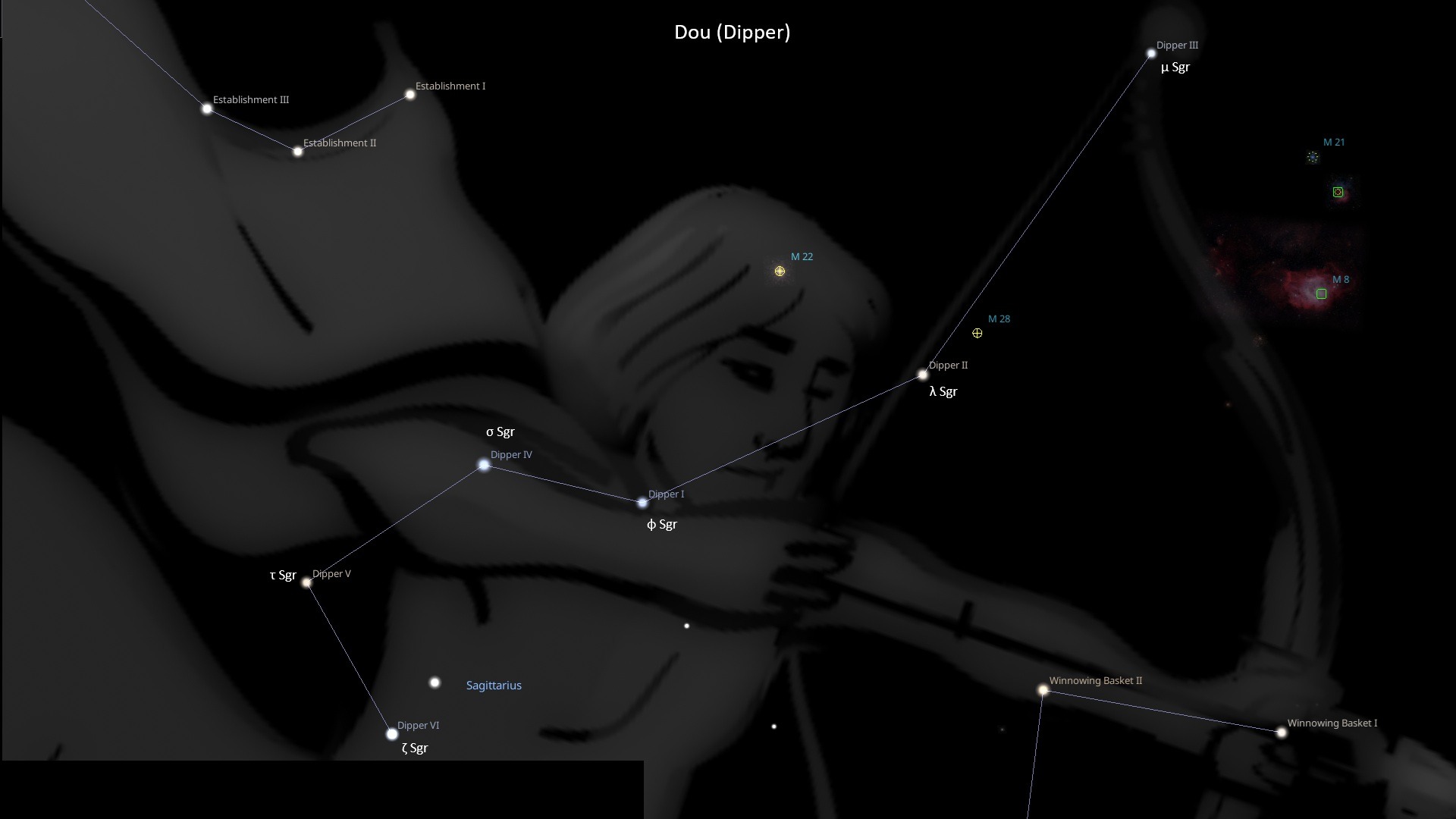
The 8th Chinese lunar mansion is named 斗宿 Dǒu Su, “Dipper Mansion.” It is the 1st of the 7 mansions of the Black Tortoise of the North.
The 1st asterism of the Dipper Mansion is also called 斗 Dǒu, “Dipper.” Shaped like the Big (Northern) Dipper, the Southern Dipper represents the head and body of the Black Tortoise of the North. The ancients called it Tianmiao, “Heavenly Temple,” and it belonged to the emperor. It contains 6 stars in the constellation Sagittarius. [1]
Note: There is another “Dou” in Chinese astronomy. 斗 Dǒu, “Dipper for Liquids,” is the name of the 14th asterism of the Tian Shi (Heavenly Market) Enclosure.
| 2000 | 2050 | IAU | Chinese | Orb |
| 10♑11 | 10♑53 | φ Sgr | Dou Su Yi (1) | 1°50′ |
| 06♑19 | 07♑01 | λ Sgr | Dou Su Er (2) | 2°00′ |
| 03♑12 | 03♑55 | μ Sgr | Dou Su San (3) | 1°30′ |
| 12♑23 | 13♑05 | σ Sgr | Dou Su Si (4) | 2°10′ |
| 14♑50 | 15♑32 | τ Sgr | Dou Su Wu (5) | 1°40′ |
| 13♑38 | 14♑20 | ζ Sgr | Dou Su Liu (6) | 2°00′ |
Constellation Dou the (Southern) Dipper
03♑12 to 14♑50
Those born under the Dou constellation become stronger when facing stronger opponents and weaker when facing weaker ones. They experience significant mood swings but possess the power to overcome adversity and are highly creative. However, they tend to be reserved and secretive, which can lead to misunderstandings, and they need a calm and stable mind.
The Dipper constellation is the head of the Northern Black Tortoise, consisting of six stars shaped like a dipper. It is generally called the Southern Dipper. Together with the Northern Dipper, it governs the power of life and death.
It belongs to the Wood element and is associated with the mythical beast Xie. It is the first constellation of the North. The ancients also called it Tianmiao, “Heavenly Temple,” and it was the star official belonging to the emperor. Ordinary people should not easily offend the emperor’s star; hence, it is often considered inauspicious.
Doumu Xie: Xin is an official, a Yin deity, and is governed by the Southern Dipper Star God. There are four Yin deities, surnamed Yang, named Duo, dressed in a single blue robe, holding spears, and governed by the Southern Dipper Star God. [2]
Doumu Xie
Dipper is one of the most auspicious mansions, representing the typical late bloomers. It gives a generally stable and reliable nature, a strong fighting spirit, a love of conquest, and a refusal to easily admit defeat. Dipper people are suited to riding horses and exploring mountains and forests. They love prayer and making friends with virtuous people. They are skilled in many arts and have abundant wealth.
Those born under the Dou constellation are auspicious for wearing new clothes and undertaking long-term projects. They are also suited for acquiring treasures, repairing gardens and forests, building vehicles and other vehicles, constructing fields, houses, cities, temples, and other auspicious structures. The construction of war equipment and other necessities is also auspicious.
Dou Advice
In a stable period of fortune, Dou Su may feel that he has no place to use his skills. However, this is indeed a good opportunity to accumulate strength.
Sometimes, when faced with relationship issues, the Dou constellation can appear overly shrewd and capable. However, in relationships, there are often no winners or losers. Some Dou constellations channel their fighting spirit into emotions, winning the game but potentially losing the relationship.
Those born under the sign of Dou need a window, a good friend with whom they can talk about anything. Too much grievance and pressure bottled up inside is detrimental to mental health. Having a confidant with whom one can talk about anything is a treasure in the life of someone born under the sign of Dou. [3]
There are 12 main Chinese Fixed Stars: [4]
Five belong to the Big Dipper: Dubhe, Merak, Alioth, Mizar and Alkaid.
Six in the Southern Dipper: Tianfu, Kaus Borealis, Polis, Nunki, τ Sge, and Ascella.
The remaining fixed star is Kochab.
Ma Duanlin (1317)
The Dipper, at twenty-five degrees, is the Heavenly Temple, also called the Heavenly Mechanism. The five planets pass through the center, the sun and moon are on their proper paths. The position of Chancellor and Grand Chancellor is responsible for assessing appropriate political affairs, promoting the virtuous and capable, bestowing titles and stipends, and overseeing military matters. The two southern stars, Kui and Tianliang, represent Heavenly Beam; the two central stars, Tianxiang; and the two northern stars, Shao and Tianfuting, also indicate lifespan. When matters concerning the emperor arise, the Southern Dipper is consulted.
Bright stars signify unity between the emperor and his ministers, peace throughout the land, and the bestowal of titles and stipends. Bright or shifting stars indicate the emperor’s distress and the outbreak of war; shifting stars indicate the expulsion of his ministers. When the sun, moon, and five planets move in the opposite direction into the Dipper, the land is in turmoil. A comet encroaching upon it signifies war. Dim stars indicate the dethronement or death of the Chancellor. [5]
Song History (1346)
The six stars of the Southern Dipper (南斗) are the Heavenly Rewards and Salaries (official rank) Palace. It oversees the emperor’s longevity and symbolizes the positions of prime ministers in terms of titles and salary; classical texts refer to it as 天庙 “Tianmiao,” or the Heavenly Temple. It represents the positions of the Prime Minister and the Grand Minister, who are responsible for honoring virtuous individuals and advancing scholars in official ranks. It also oversees military affairs. Another name for it is 天机 Tianji (Heavenly Mechanism).
The two southern stars, Kui (魁), are known as Tianliang, the Heavenly Beam (天梁). The two central stars are the Tianxiang, the Heavenly Minister (天相). The two northern stars are Tianfu and Ting. The southern star is also called Kuixing. It is also said that the southern stars are Kuixing (the Northern Dipper’s handle), while the northern stars form the dipper’s ladle.
The first star in this group is called Beiting, alternatively known as Tiankai or Fuwan. Shi Shen said: “The first Kui star governs Wu, the second Kuaiji, the third Danyang, the fourth Yuzhang, the fifth Lujiang, and the sixth Jiujiang.”
If the stars are bright and prominent, the king’s rule is peaceful; the emperor enjoys a long life, and generals and ministers work together harmoniously. If they appear dim or irregularly arranged, then officials of all ranks lose their proper order. If any star has sharp spines (mangjiao) or wavers, it indicates that loyal ministers are lost from the state, military conflict arises, and people suffer distress.
A solar eclipse in the Dipper signifies worry for generals and ministers, war, disaster for the empress, and war arises in the region of Wu. A solar halo signifies worry for the prime minister and unrest in the ancestral temple.
A lunar eclipse signifies famine in the corresponding state, minor war, and distress for the empress and her ladies-in-waiting. Three lunar eclipses in a year signify a general amnesty. A lunar halo signifies the death of a great general and a lack of harvest.
If the moon transits the Dipper, ministers and generals are demoted; winds and rains become irregular, and high-ranking officials face execution. Another divination: if the moon enters here, it signifies distress for the female ruler, with military conflict arising in the Zhao and Wei regions; an ominous color signifies the death of a minister.
If Mercury transits the Dipper, there will be floods, grain will not grow, and there will be war. If it remains for an extended time, warfare or mourning events arise.
If Venus transits the Dipper, military conflict and ministerial rebellion follow. If it remains or lingers, armies are destroyed and generals killed; if both Venus and Mars enter together, there will be a white blaze, and ministers will rebel. If it remains for a long time, the disaster will be great.
Mars in the Dipper signifies that an amnesty occurs, but there will be the destruction of the army and the killing of generals, and fire disasters; if it enters for twenty days, grain prices will be high; if it enters for forty days, there will be virtuous decrees; if it remains, there will be war and bandits; if it remains for a long time, the disaster will be severe; if it emerges from the Dipper and moves upward, the whole country will be worried; if it does not move, the ministers will be worried. If it enters, there will be conspiracies both inside and outside the court; if it remains for seven days, the crown prince will fall ill.
If Jupiter enters, there will be an amnesty or pardon; if it remains in place for a long time, floods and rising grain prices follow. If it remains for a hundred days, there will be military action and the death of high-ranking officials.
If Saturn afflicts, there will be rebellion or disorder; if it enters, there will be loss of territory; if it moves in retrograde, there will be earthquakes; if it emerges, enters, or remains for twenty days, a major mourning event occurs; if it remains, high-ranking officials will rebel; another divination: if Saturn moves in retrograde here, there will be floods followed by drought; if it remains for some time, the state produces many righteous and virtuous men.
If a guest star invades, war breaks out, and the country is in chaos; if it enters, feudal lords attack each other, there is much theft, severe drought, palace and temple fires, and high grain prices. If the guest star remains for seven days without departing, an amnesty will be issued.
When a comet invades, the ruler is worried; if it appears, its part is plotting, and there will be floods, palace fires, subordinates plotting against superiors, and rebellious armies; if it enters, there will be fire and ministers will rebel.
When a meteor enters, barbarians come to pay tribute; if it invades, the prime minister is worried; in spring, it signifies longevity; in summer, it signifies floods; in autumn, it signifies the dismissal of ministers; in winter, it signifies ministers rebelling; if it is red and appears as a star, it signifies the death of a minister. When clouds enter, if they are pale, there will be much wind; if they are red, there will be drought; if they appear, there will be war and palace and temple fires; if they enter, there will be two red clouds, and there will be war; if they are black, it signifies disease.
If a comet invades, the ruler faces distress. If it exits this region, plots will arise, and there will be floods, palace fires, subordinates plotting against superiors, and rebellious armies; if it appears, there will be war, disease, and national worry.
When a meteor enters, southern and western barbarians come to pay tribute; the prime minister is distressed; subordinates plot against superiors; and rebellious forces arise. If it exits the Dipper, military conflict or disease follows, bringing distress to the state. In spring, it signifies the emperor’s longevity; in summer, floods occur; in autumn, the prime minister is demoted or removed from office; in winter, high-ranking ministers act rebelliously. If meteors appear red and exits, then a high-ranking minister dies.
When clouds enter, if they are pale, there will be much wind; if they are red, there will be drought; if they emerge, there will be war and palace and temple fires; if two red clouds enter, there will be war; if they are black, it signifies disease. [6]
References
- Dou Su – Baidu Encyclopedia.
- Twenty-Eight Mansions – Baidu Encyclopedia.
- Comprehensive Analysis | Unveiling the Personality of the [Dou Su] Constellation.
- Fourteen Major Stars – Baidu Encyclopedia.
- General Examination of Literature, Volume 279, Part 2, Ma Duanlin, 1317.
- Song History, Volume 50, Chapter 3, 1346.