
23♊37 to 24♊08
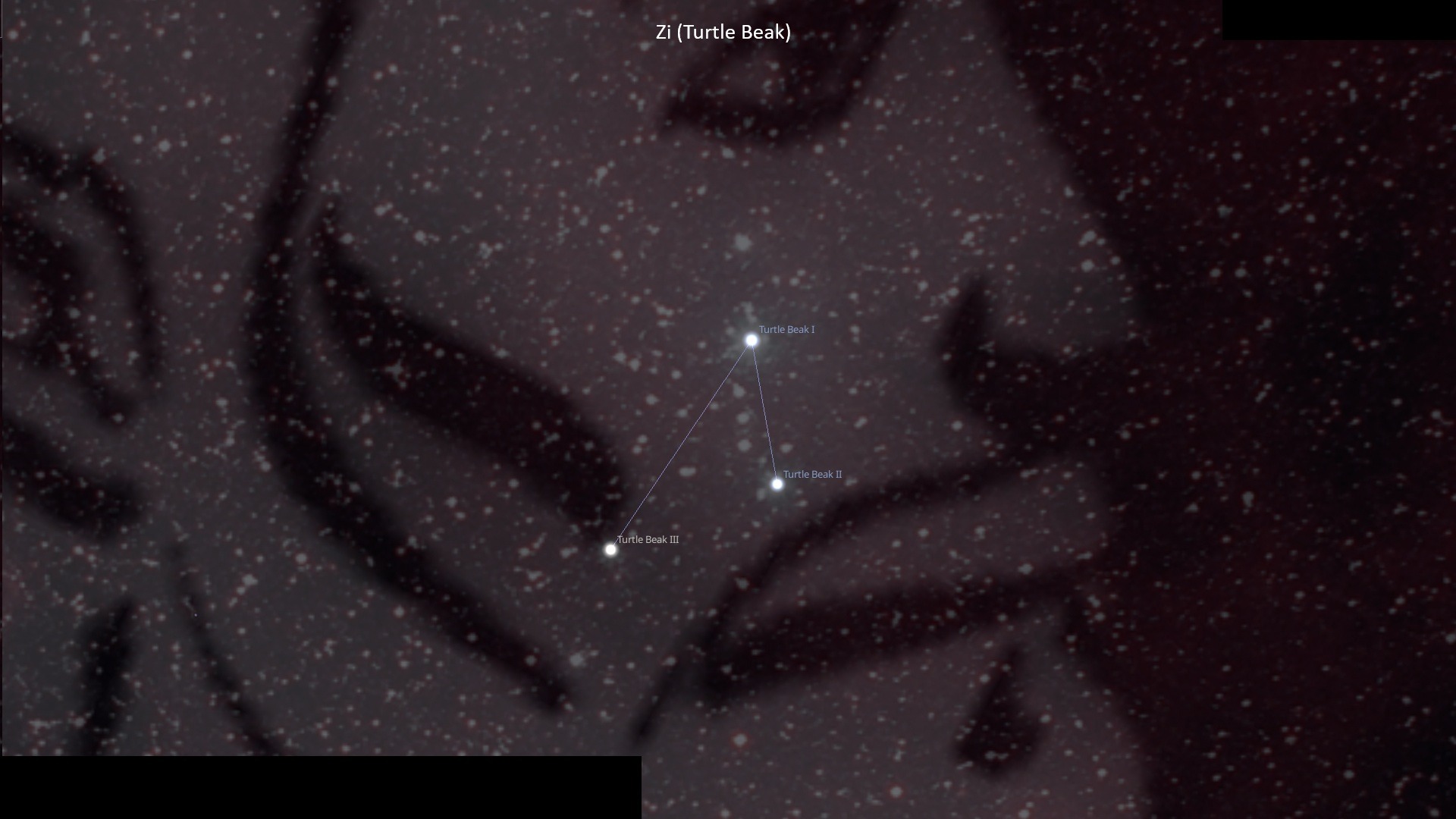
The 20th Chinese lunar mansion is named 觜宿 Zī Su, “Turtle Beak Mansion.” It is the 6th of the 7 mansions of the Vermilion Bird of the South.
The 1st asterism of the Turtle Beak Mansion is also called 觜Zī, “Turtle Beak.” It represents the feathers on an owl’s head or the beak. It is composed of 3 stars of the constellation Orion. [1]
Note: “Zi” occurs twice in Chinese astronomy. There is 觜 Zī, “Turtle Beak” Mansion and its 1st asterism. Then there is an asterism in the Well Mansion called 子 Zǐ, “Son.”
| 2000 | 2050 | IAU | Chinese | Orb |
| 23♊43 | 24♊25 | λ Ori | Zi Su Yi (1) | 1°40′ |
| 23♊37 | 24♊19 | φ¹ Ori | Zi Su Er (2) | 1°10′ |
| 24♊08 | 24♊50 | φ² Ori | Zi Su San (3) | 1°20′ |
Constellation Zi the Turtle Beak
23♊37 to 24♊08
Those born under the constellation Zi are cautious in their words and actions, principled, and articulate. They dislike violence and are kind-hearted and compassionate. Their weakness lies in their overconfidence, which can easily make them enemies, and in their limited popularity, which can lead to setbacks.
It belongs to the fire element and is associated with the monkey. It is the sixth constellation in the west, located at the mouth of the White Tiger, symbolizing good fortune in food and drink; therefore, the constellation Zi is generally considered auspicious.
When the constellation Zi is in charge of a day, it is considered auspicious. Burials and constructions will bring prosperity. If a marriage is held on this day, a unicorn will be born within three years.
The three stars of the constellation Zi are almost completely close together, resembling a tiny cherry mouth.
The character 觜, according to the Shuowen Jiezi, is “the beak on the head of an owl.” The annotation states, “The beak of all feathered creatures is sharp, hence the beak of a bird is called 觜.” The three small stars of the constellation 觜 are located above the shoulders of the constellation Orion, and their shape can be associated with the horn-shaped beak of a bird, hence the name.
The Fire Monkey (觜火猴): Hai (亥) is an official position, the first month of the year, and is ruled by the Star God of the Beak (觜星). There are eleven first-month gods, surnamed Wang, named Ping. They wear a dragon-patterned blue robe and are ruled by the Star God of the Beak (觜星). [2]
According to the literature and cultural relics, the image of the White Tiger in the Western Palace is mainly composed of the constellations Zi and Shen, with Zi representing the tiger’s head. In cultural relics, the three gems on the tiger’s head—the ears, eyes, and nostrils—represent the constellation Zi.
People of this zodiac sign are renowned, virtuous, and handsome, and are respected for their cautious and prudent conduct. They are not prone to rash actions, are adept at turning good fortune into their own, and enjoy culture and art. They value principles but can be somewhat timid and dislike conflict and violence. They should abstain from alcohol, be wary of water-related disasters, and cultivate good deeds to accumulate blessings.
People born under Zi are capable of working independently. They are inherently kind, virtuous, upright, cautious in speech and action, and gentle and kind. Their early life may be difficult, but they gradually accumulate strength in middle age. Their later years are prosperous. This describes Zi’s kind-hearted nature.
Another type is evil, inherently wicked, driven by self-interest, and highly rebellious. Although they may rise to a considerably high position, their status and wealth can be lost in sudden upheavals, resulting in dramatic fluctuations.
Women of this zodiac sign are truly legendary; they rise to prominence early in life and remain devoted housewives who manage their husbands’ finances throughout their lives.
People of this zodiac sign experience vastly different fates, with their successes and failures largely determined by their distinct personalities. Eloquent and argumentative, they are intelligent theorists, but ill-suited for power struggles. They possess strong endurance and a relentless drive to overpower their opponents. However, they can be overly cautious, timid, distrustful, overconfident, and prone to looking down on others – these are their biggest weaknesses, easily making enemies. They can be sharp-tongued, judging others by their own standards, and their arrogance can negatively impact their interpersonal relationships, potentially leading to failure. Women of this sign often struggle to express their true feelings and are somewhat jealous, though they are generally more level-headed. After marriage, they dedicate themselves to domestic affairs, handle matters quickly and efficiently, and effectively balance family and career.
People born under the constellation Zi are suited to starting their own businesses. In their early years, they can work, develop skills, and cultivate their minds and bodies. In middle age, it’s advisable to gradually establish an independent career, as their personality leans towards solitude and freedom, making independent work a suitable fit. Some women will have their own careers and may even excel more than men. Men can become educators, writers, lawyers, or work in religious fields, while women can pursue design, crafts, tea ceremony, or tourism. Both men and women are well-suited for careers in the performing arts.
In the Lunar Mansions, the constellation Zi (觜) and Fang (房) are both considered “wealth” stars, representing a “treasure trove.” Those born under this sign possess innate eloquence and ingenuity, enabling them to amass considerable wealth. They are exceptionally skilled at managing money and calculations, and enjoy good fortune. Inherited wealth from relatives tends to increase rather than decrease. They are diligent in both work and life, but dislike an overly stressful lifestyle and are not concerned about their spending. They are confident, believing that wealth can be earned back and that they can contribute to national prosperity. Women of this constellation tend to be frugal and adept at saving money.
In matters of love, people of this constellation tend to be very possessive, especially towards those they love. Because men of the Zi constellation are handsome, intelligent, cultured, artistic, eloquent, and enjoy praising others, they are very popular with women. A few men of the Zi constellation yearn for a life of ease and comfort.
Women of this zodiac sign are mostly attracted to tall, strong men who provide a sense of security, are generous, responsible, hardworking, skilled, and unpretentious, hoping to win their hearts. After marriage, they are devoted wives and mothers, wholeheartedly caring for their husbands and children. However, some of these women may be prone to jealousy and scrutinize their husbands closely.
People born under the Zi sign are generally healthy. However, from middle age to early old age, due to accumulated stress and overwork, they should be wary of sudden illnesses, accidents, and other disasters. They should pay attention to liver and kidney diseases, as well as urinary problems such as urinary secretions and urinary stones. They should also try to reduce stress. Women should pay attention to gynecological issues. [1]
Ma Duanlin (1317)
The three stars of the Zi constellation are close together, forming the core of Orion. The flag sits atop Zi, pointing straight to the sky, with nine stars in a row representing the ranks of the nobility. The constellation Si Guai stands beside the flag, with four large crows near the Well and Axe constellations.
The four stars of the Si Guai star are located in front of the Jing Yue star. They observe changes in heaven and earth, the sun, moon, stars, birds, beasts, insects, snakes, and plants, and they are the same as the celestial divination.
The Zi constellation, one degree high, is located in the right corner of Orion, shaped like the legs of a tripod, and governs the gates of heaven. When it is bright and large, the world is at peace, and the five grains are plentiful. When it moves, the ruler and ministers lose their positions, and the world suffers drought. The Sui Shu states that the Zi constellation is the scout, storehouse and guardian of the three armies, responsible for collecting all things. When it is bright, the army’s supplies are plentiful, and the generals gain power. When it moves and becomes bright, thieves roam freely, and the army rises up. When it moves, there will be pursuers. Zhang Heng said that the army is associated with wild, edible things. When Venus and Mars guard it, the country changes its government, and war breaks out, bringing disaster. A solar eclipse indicates disloyal ministers; a lunar eclipse indicates the ruler harms his ministers. When the five planets are in conflict, disaster occurs; when the comet is in conflict, war breaks out. The nine stars of Zuo Qi (Flags) are located northwest of the constellation Si Guai, governing the distinction between the ranks of the ruler and ministers. When it is bright, the country is orderly; when it is dark, the opposite is true. The four stars of the Si Guai (Bureau of Strange Phenomena) are located before the Well and Axe constellations. They observe changes in heaven and earth, the sun, moon, stars, birds, beasts, insects, snakes, and plants, and have the same celestial divination.
The Astronomical Records of the Song and Liang Dynasties state that the three stars of the Beak constellation are 82.5 degrees from the Southwest Star. The nine stars of the Sitting Flag constellation are 61.5 degrees from the South Star, entering the constellation Orion at 8 degrees. The four stars of the Bureau of Strange Phenomena are 71 degrees from the West Star, entering the constellation Orion at 6.5 degrees. [3]
Song History (1346)
Zi Xi consists of three stars, representing the vanguard of the three armies and serving as a repository for military supplies. It signifies the gathering and storage of troops and all things.
If these stars are bright, the army’s provisions will be sufficient, and generals will gain advantage; if they move or change, thieves and bandits will act, and military forces will mobilize. If dim, it is not advisable to wage war.
If a solar eclipse occurs, it signifies that subordinates are transgressing their superiors; the warning lies with generals and ministers. If halos appear around this region, reaching three layers in thickness, the grain harvest below will fail, and a plague will afflict the people; if five layers form, a great pardon or amnesty is decreed within sixty days.
If a lunar eclipse occurs over this region, it signifies drought and distress for the high-ranking general; there will also be someone who rebels against their ruler. If a halo appears around the Moon in the first month, it signifies an amnesty; foreign forces will not prevail, and the high-ranking general will be anxious. Some subordinate officers may die.
If Jupiter transgresses Zi, warfare erupts in its corresponding region; if it remains over this area for an extended period, farmers will lose their livelihoods and later face distress. Many strong men will die suddenly, there will be rebels among the people, and epidemics will spread widely. If Jupiter enters this region, bandit activity increases, weather conditions become abnormal, and the ruler’s punishments become inappropriate, leading to rebellion.
If Mars transgresses Zi, there will be rebels in its corresponding region, droughts occur, fires break out, warfare erupts, and grain prices rise. If it aligns with the stars of Zui Xi, officials from Zhao’s territory face distress; if Mars enters this area, military conflict occurs below.
If Saturn enters or transgresses this region, it signifies warfare and large-scale earthworks; its corresponding territory will lose land. If a female ruler acts recklessly or with excessive power, Saturn may move in reverse and appear yellow in color.
When Saturn invades, it signifies war, earthworks and the loss of territory. If the female ruler is tyrannical, Saturn will retrograde and turn yellow.
If Venus transgresses or remains over it for an extended period, warfare erupts; in its corresponding region, officials will be replaced frequently and high-ranking ministers may rebel. Crops fail to mature, and plagues afflict the people.
If Mercury transgresses, war should not be waged; alternatively, this indicates flooding and rebellion in the Zhao territory. If Mercury remains over the region, a famine occurs there.
If a guest star enters or exits this constellation, a green or blue color signifies anxiety, red indicates warfare, black portends flooding, white foretells mourning and yellow and white together signify good fortune.
When a comet invades, war breaks out; if it enters or leaves its constellation, land is lost, and the people become displaced as refugees. If a comet flares or suddenly brightens in this region, it indicates military chaos and the defeat of an army. Its interpretation is the same as that for a guest star based on its color.
If a meteor enters or transgresses this region, there will be rebels and a defeated army.
When clouds invade, red signifies war; a pale or bluish-white hue signifies war and worry; black signifies distress for high-ranking individuals in the Zhao territory; and yellow signifies the arrival of a divine treasure or sacred objects.
According to the Han Dynasty Yongyuan Bronze Instrument and the Tang Dynasty Kaiyuan Traveling Instrument, Zu Xi is measured as three degrees in size. Previously recorded as 84 degrees from the celestial pole. During the Jingyou measurement and verification, Zui Xi’s three stars span one degree; the distance from the southwest star to the celestial pole is 84 degrees, and the southwest star is located seven degrees within the ecliptic. [4]
References
- Zi Su – Baidu Encyclopedia.
- Twenty-Eight Mansions – Baidu Encyclopedia.
- General Examination of Literature, Volume 279, Part 2, Ma Duanlin, 1317.
- Song History, Volume 51, Chapter 4, 1346.