Ursa Major
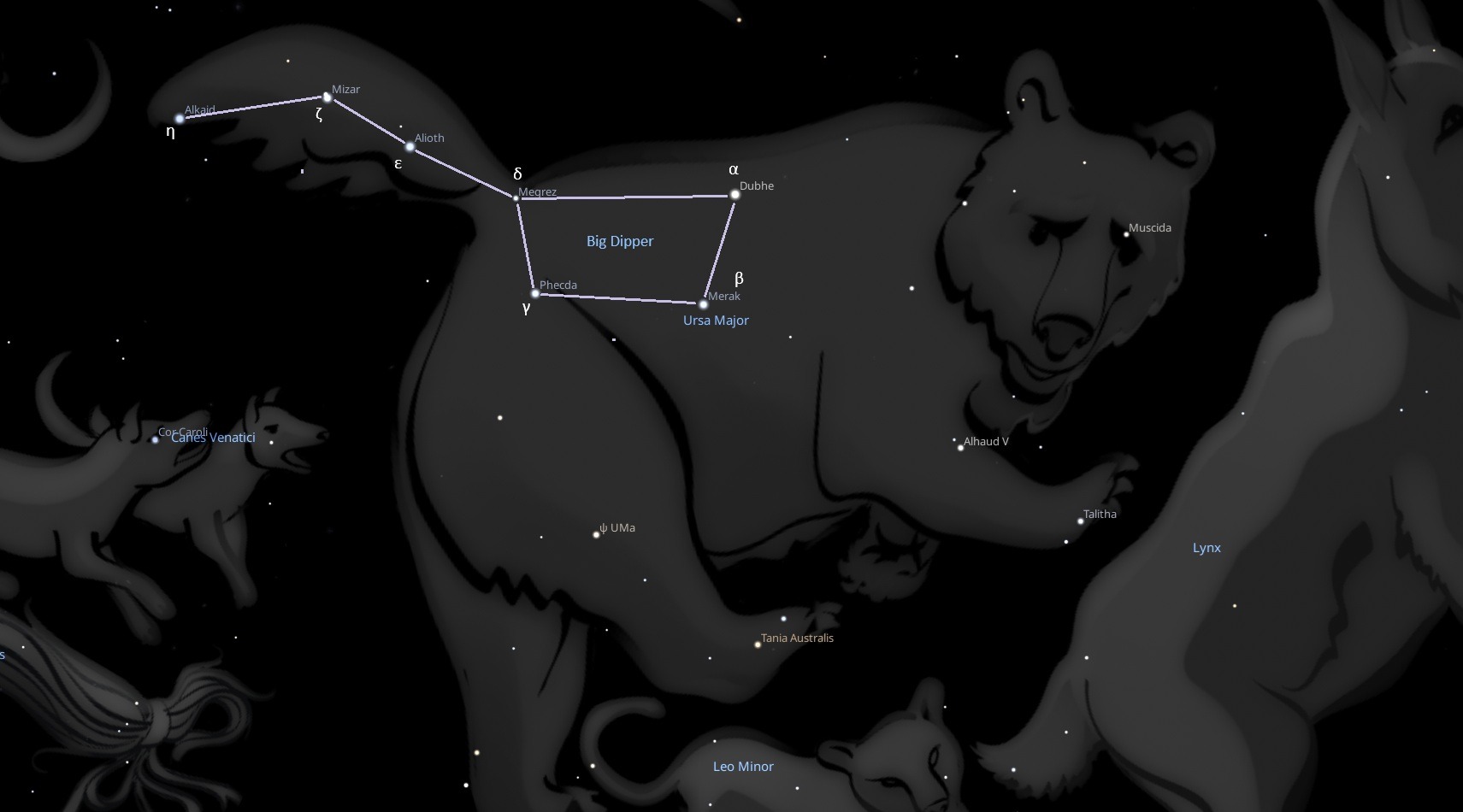
The Big Dipper is an asterism of seven bright stars from the constellation Ursa Major. It has been one of the most recognizable groupings of stars throughout history, across many cultures.
Despite this, Western astrology has basically ignored these stars. Ptolemy and Robson did not even mention them. Thankfully, they are of great importance in Chinese astrology, and there is a wealth of information available online.
The Ladel
The Big Dipper depicts a ladle, with the bright stars on the tail of the Big Bear forming the handle, while those on the back make up the bowl. The handle and the bowl meet at Delta Ursae Majoris (δ UMa), also known as Megrez.
In the pattern of the Big Dipper, the Mesopotamians and many others saw a wagon, the Greeks a Bear, the Dutch a Saucepan, and in Ireland and the UK, they saw a plough. The Arabs saw a funeral Bier (the bowl) followed by mourning daughters (the handle). Vedic astronomers observed not only a Bear but also the Saptarishi, “Seven Sages.”
Ancient Chinese astronomers saw a dipper or a chariot, but it has always been known as Bei Dou, “Northern Dipper,” as distinct from Dou, “Dipper,” or the Southern Dipper in the constellation Sagittarius.
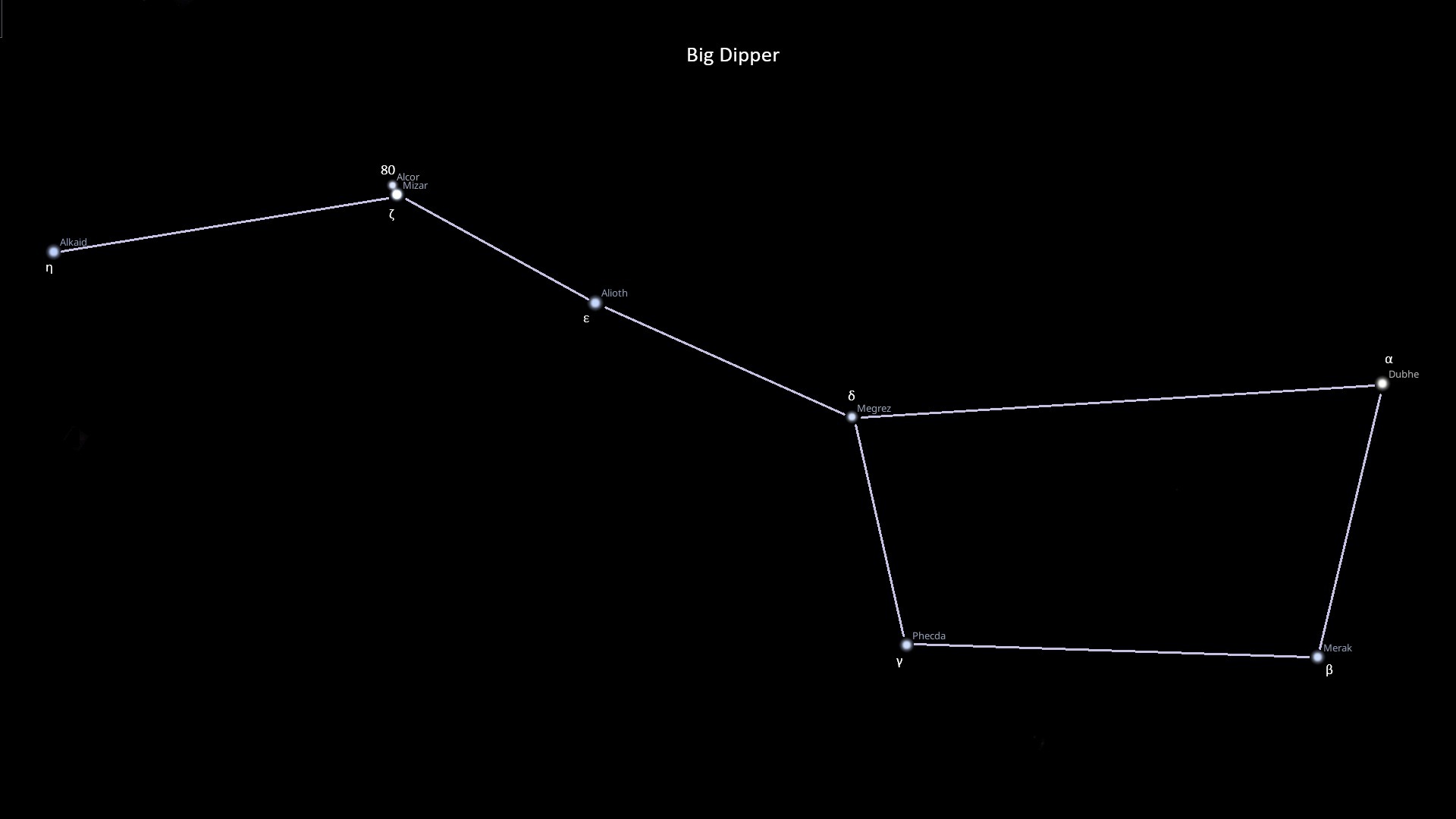
The Big Dipper
Big Dipper Astronomy
The inner five stars of the Big Dipper (not Dubhe or Alkaid) are at the core of the Ursa Major Moving Group (Collinder 285). This group of stars shares a common origin in space and time, forming about 300 million years ago. They move in the same direction at similar velocities and share similar chemical compositions.
The stars of the Ursa Major Moving Group are all heading towards a common point in Sagittarius. Dubhe and Alkaid are moving in opposite directions. [1] So over time, the shape of the Big Dipper changes significantly. In 50,000 years, the Big Dipper will face the opposite way. The stars Alkaid to Phecda will then constitute the bowl, while Phecda, Merak, and Dubhe will be the handle. [2]
Big Dipper Astrology
Ptolemy, Lily or Robson mentioned the Ursa Major constellation but wrote nothing about the Big Dipper asterism or any of its seven stars.
Vedic astrologers identify them with the seven Sages and their spiritual significance, but have not interpreted the fixed stars astrologically.
The only reference specifically to the Big Dipper asterism I have found was, “With the early Arab poets, the Banāt stars were an emblem of inactivity and laziness.” [3]
That is, until I searched on the Chinese search engine Baidu.
Fourteen Main Stars in Chinese Astrology
There are Fourteen Main Stars used in Chinese Astrology. [4] They include the Sun, Moon, and twelve fixed stars:
- Five belong to the Big Dipper: Dubhe, Merak, Alioth, Mizar and Alkaid.
- Six in the Southern Dipper: φ Sge, Kaus Borealis, Polis, Nunki, τ Sge, and Ascella.
- The remaining fixed star is Polaris.
I have updated the Big Dipper stars with Chinese astrological interpretation. Next, I will do the Southern Dipper stars.
Beidou, the Northern Dipper
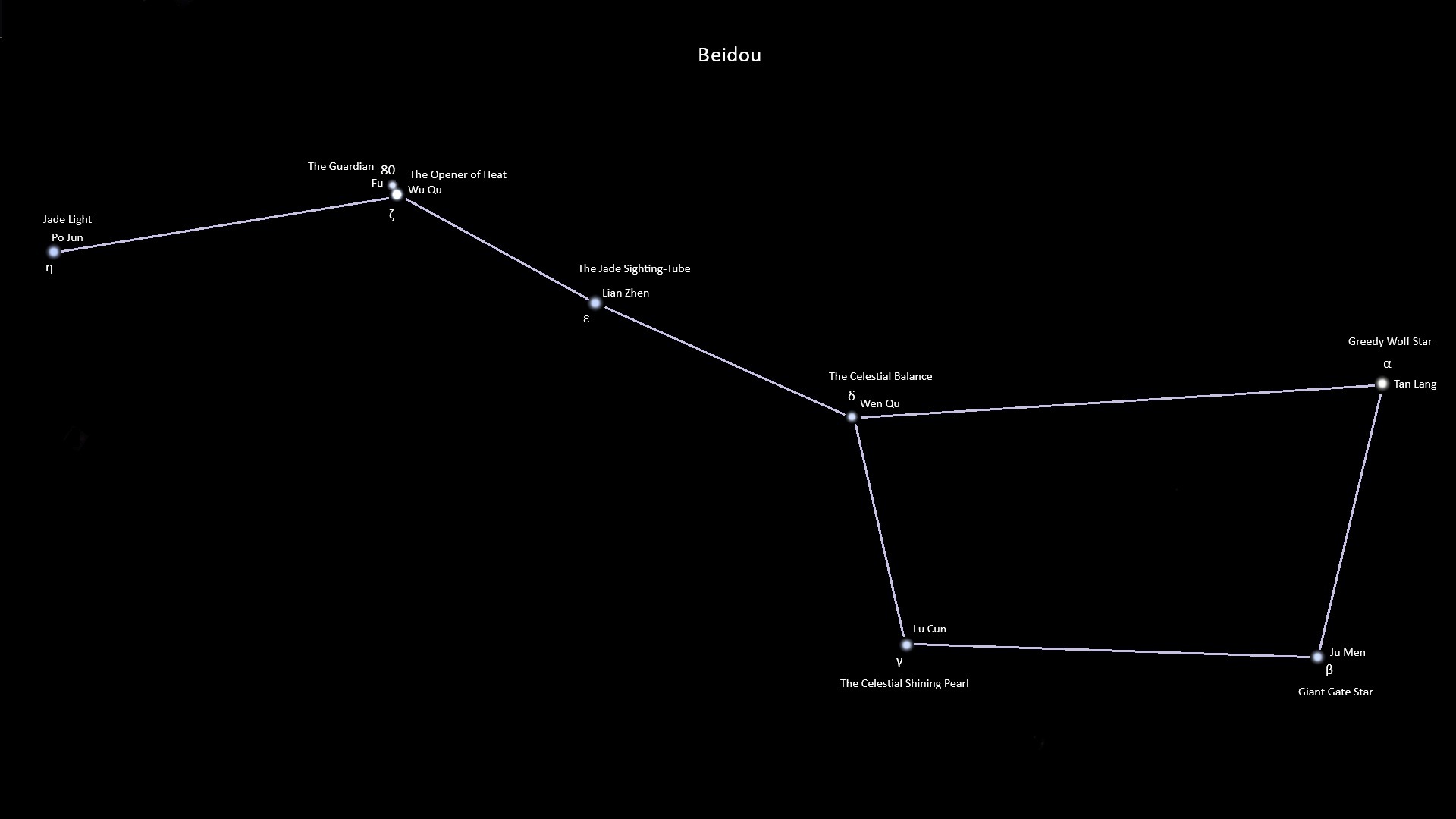
| 2000 | UMa | IAU | Chinese Name | Alternative |
| 15♌12 | α | Dubhe | Tan Lang Gredy Wolf Star | Tian Shu Heavenly Pivot |
| 19♌27 | β | Merak | Ju Men Giant Gate Star | Tianxuan Celestial Rotating Jade |
| 00♍29 | γ | Phecda | Lu Cun Celestial Shining Pearl | Tianji Standing-official Salary |
| 01♍04 | δ | Megrez | Wen Qu Star of Wrong-Writing | Tianquan Celestial Balance |
| 08♍56 | ε | Alioth | Lain Zhen Honest and Chaste | Yuheng Jade Sighting-Tube |
| 15♍42 | ζ | Mizar | Wu Qu Wrong Martial | Kaiyang Opener of Heat |
| 26♍56 | η | Alkaid | Po Jun Broken Army Star | Yao Guang Jade Light |
In ancient Chinese astronomy and modern Chinese astrology, the Big Dipper is known as Beidou, “Northern Dipper.” It is the arbiter of the order of heaven and earth, and the seasons of spring, summer, autumn, and winter all follow its direction. The rotation and direction of the Big Dipper’s handle served as a basis for dividing the days and years on Earth, to determine the Doujian, the twelve lunar months, and to provide a timely guide for agricultural production.
The changes in the Big Dipper can indicate changes in annual climate and daily temperature. At the same time, it can also encompass the cycle of cold, heat, dryness, and dampness and clarify geographical location.
The Gan Shi Xing Jing, compiled during the Warring States period (475 – 221 BC), records: “The Big Dipper is called the Seven Luminaries, the princes of heaven, and also the emperor’s chariot.” The king sat on the Big Dipper to inspect the four directions, determine the four seasons, and divide the cold and heat. [5]
Beidou
Ancient people believed that each of the seven stars in the Big Dipper had a specific meaning. The Book of Jin, Treatise on Astronomy (1903), states that the seven stars of the Big Dipper are located north of Taiwei, with Shu (Dubhe) representing heaven, Xuan (Merak) representing earth, Ji (Phecda) representing humanity, Quan (Megresz) epresenting time, Heng (Alioth) representing music, Kaiyang (Mizar) representing law, and Yaoguang (Alkaid) representing stars. [6]
The Big Dipper is located north of Taiwei, its handle carrying the dragon’s horns, its balance resting on the southern Dipper, its head resting on the head of Shen. It is the Emperor’s chariot, moving in the center, overseeing the four seas, establishing the four seasons, balancing the five elements, shifting the seasons, and determining the cycles. It is the pivot of the seven celestial bodies and the origin of Yin and Yang.
Dubhe: The first star, Kui, is called Tian Shu, the main star, governing the heavens. It is also said that Shu represents heaven, governing yang virtue, and symbolizing the emperor. Its division corresponds to Qin, and according to the Records of the Han Dynasty, it governs Xuzhou. A celestial divination states: “If the emperor is not respectful to ancestral temples and disrespectful to spirits, then he will be confused and change color.”
Merak: The second star, Xuan, is the law star, governing the earth. It is also said that Xuan represents earth, governing yin punishment, and symbolizing women. Its division corresponds to Chu, and according to the Records of the Han Dynasty, it governs Yizhou. A celestial divination states: “If he extensively constructs palaces and recklessly digs mountains and tombs, then he will be confused and change color.”
Phecda: The third star, Ji, represents man, governs fire, is a commanding star, and governs misfortune. Its division corresponds to Liang, and according to the Records of the Han Dynasty, it governs Jizhou. If the ruler does not care for the people and imposes sudden conscription, then he will be confused and change color.
Megrez: The fourth star, Quan, represents time, governs water, is a punishing star, governs heavenly principles, and punishes the wicked. Its division corresponds to Wu, and according to the Records of the Han Dynasty, it governs Jingzhou. If commands do not align with the four seasons, then the ruler will be confused and change color.
Alioth: The fifth is Yuheng, which represents music, governs earth, is a killing star, governs the center, assists the four directions, and punishes the guilty. Its division is Yan, and according to the Book of Han, it governs Yanzhou. If proper music is abandoned and licentious sounds are indulged in, then the ruler will be confused and change color.
Mizar: The sixth is Kaiyang, which represents law, governs wood, is a dangerous star, and governs the granary and the five grains. Its division is Zhao, and according to the Book of Han, it governs Yangzhou. If agriculture and sericulture are not encouraged, laws are strict, and virtuous and capable individuals are dismissed, then the ruler will be confused and change color.
Alkaid: The seventh is Yaoguang, which represents stars, governs metal, is a regional star, a responding star, and governs military affairs. Its division is Qi, and according to the Book of Han, it governs Yuzhou. If a ruler hoards gold and treasures but does not cultivate virtue, then the ruler will be confused and change color.
It is also said that stars one through four are the Kui, which is the Xuanji; stars five through seven are the Shao, which is the Yuheng: these are the seven celestial bodies, and bright stars indicate a prosperous nation.
The eighth star is the Bixing, to the right of the seventh star, and is not visible. According to the Book of Han, it governs Youzhou.
Alcor: The ninth star is the Fuxing, to the left of the sixth star, and is usually visible. According to the Book of Han, it governs Bingzhou. According to the Book of Jin, the Fuxing is associated with Kaiyang, assisting the Dipper in achieving success, and is an image of the prime minister. Its color is blue-yellow in spring, red-yellow in summer, white-yellow in autumn, and black-yellow in winter. If it changes from its normal color, the nation will suffer war and calamity; if it is bright, the ministers will be strong.
Many stars near the Dipper indicate peace, while few stars in the Dipper indicate fear. If the Taiyin (Moon) is present, it indicates war, death, or a general amnesty. A white halo passing through three stars is disliked by the ruler. A comet near the Big Dipper indicates danger. A comet indicates a change of ruler. A meteor indicates foreign war. A guest star indicates war. When the five stars are in conflict, the country falls into chaos and the ruler changes. [6]
The First Four Stars of the Big Dipper
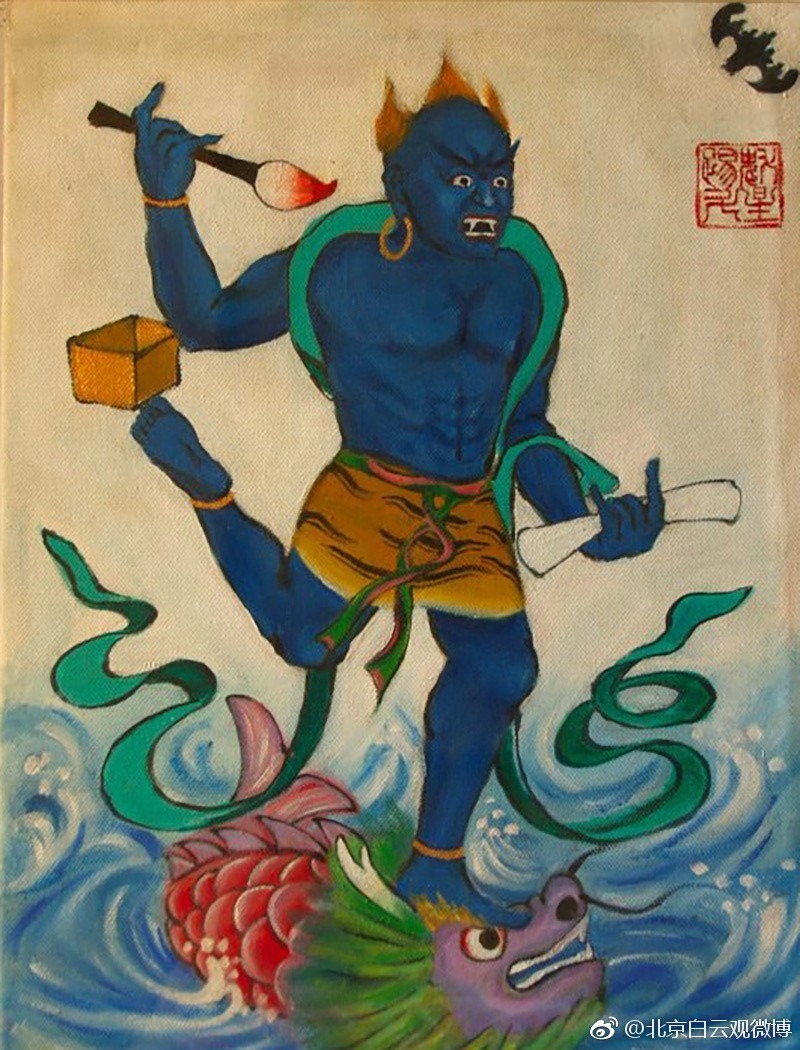
The Chinese term Kui Xing refers to the four stars of the Big Dipper: Dubhe, Merak, Phecda and Megrez. It governs literary fortune and literature.
Kui Xing was also the deity of the imperial examination system that originated in the Song Dynasty (960 to 1279). Its image resembles a ghost with red hair and bulging eyes, holding a writing brush in its right hand and standing on the head of a dragon, symbolizing “standing out from the crowd.”
Kui Xing used a vermilion brush to mark the names of candidates, and those who achieved the highest rank were called “Duo Kui.” Scholars worshipped Kui Xing to seek good fortune in examinations, and during the Ming and Qing dynasties, Kui Xing Pavilions and Kui Xing Towers were built in various locations.
The Kui Xing Pavilion was built in 1034 and still exists in Nanjing. It is 15 meters high. The fifth-floor stone carving of “Kui Xing Pointing at the Dipper” depicts Kui Xing holding a writing brush and pointing at the top of a turtle’s head. Embedded on the south side is a plaque that reads Wen Yun Kai Tian, “Literary Fortune Opens the Heavens.” [7]
Kui Xing
The Big Dipper governs death, the Southern Dipper governs life
The saying “The Big Dipper governs death, the Southern Dipper governs life” originates from a system of beliefs about life and death that combines ancient Chinese star worship with Taoist beliefs.
The belief in the Big Dipper and the Southern Dipper can be traced back to the Neolithic Age (5,300 years ago). The Qin Dynasty’s sacrificial system included the Big Dipper and the Southern Dipper. By the Wei and Jin Dynasties, a doctrine formally proposed that “when the Big Dipper falls, one dies; when the Southern Dipper rises, one is born.”
Taoism places the Six Star Lords of the Southern Dipper under the jurisdiction of the Great Emperor of Longevity of the South Pole, whose Heavenly Palace Star Lord governs the continuation of life, while the Seven Star Lords of the Northern Dipper are responsible for judging the register of life and death. This belief spread widely through literary works and took concrete form in architectural practices, such as the construction of the Nanjing Ming City Wall. This system was integrated into Taoist rituals during the Northern and Southern Dynasties, forming complete rituals for warding off misfortune, including lamp and banner ceremonies.
The six stars of the Southern Dipper are located in the Sagittarius Constellation and can be seen in the southern sky on summer nights. The seven stars of the Northern Dipper are visible all year round. Chinese astrology holds that the Southern Dipper corresponds to the vitality of midsummer and the Northern Dipper to the desolation of autumn, forming an astronomical correspondence: “the Southern Dipper governs life, and the Northern Dipper governs death.” Taoist classics regard the Northern Dipper as the “pivot of Yin and Yang,” responsible for judging the souls of the dead and revising the register of life and death.
The Taoist Southern Dipper Scripture stipulates that believers should offer lamps, banners, incense, and candles to pray for longevity, while the Northern Dipper Scripture emphasizes repentance to eliminate disasters. In the Han Dynasty, it was believed that “when the seven celestial stars are bright, the country will prosper; when they are dark, disaster will occur.”
The folk funeral customs of placing the Seven Star Board and painting the Big Dipper on the coffin all reflect the belief of “the soul returning to the Big Dipper.” In Taoist rituals, believers pray for blessings and longevity from the Southern Dipper by lighting Seven-Star Lamps and erecting Longevity Banners.
Astrological beliefs hold that one should worship the Dippers to ward off disasters in one’s birth year. Some temples have halls dedicated to the Northern and Southern Dippers; the Southern Dipper hall houses statues of the Star Lords in red robes, while the Northern Dipper hall houses statues of the Star Lords in white robes, corresponding to the classic description: “The Southern Dipper governs life, those born wear red; the Northern Dipper governs death, those born wear white.” [8]
References
- Ursa Major moving group – Wikipedia.
- Big Dipper – Wikipedia.
- Star Names: Their Lore and Meaning, Richard H. Allen, 1889, p.433.
- Fourteen Major Stars – Baidu Encyclopedia.
- The Big Dipper – Baidu Encyclopedia.
- Song History, Volume 49, Chapter 2, Section 2, 1346.
- Kui Xing – Baidu Encyclopedia.
- The Big Dipper governs death, the Southern Dipper governs life – Baidu Encyclopedia.
