
STARS: Major | All | Constellations | Chinese | About
26♓07 to 01♉04
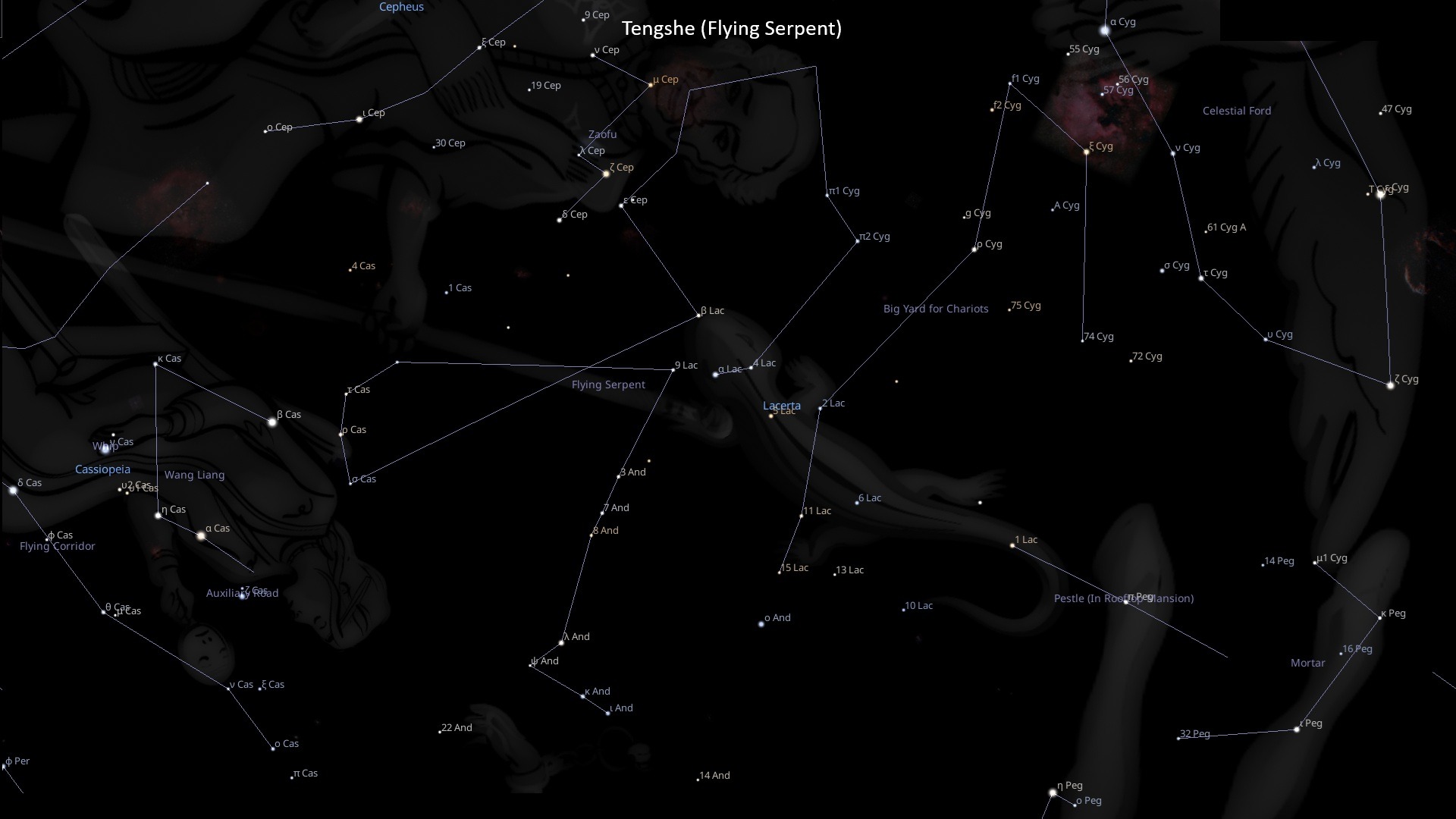
The 13th Chinese lunar mansion is named 室宿 Shi Su, “Room or Encampment Mansion.” It is the 6th of the 7 mansions of the Black Tortoise of the North.
The 11th asterism of the Encampment Mansion is called 螣蛇 Téngshé, “Flying Serpent.” It represents the legless mythical beast in ancient Chinese legends and is composed of 22 stars distributed in the constellations Andromeda, Cassiopeia, Cepheus, Cygnus and Lacerta. [1]
| 2000 | 2050 | IAU | Chinese | Orb |
| 08♈09 | 08♈50 | α Lac | Tengshe Yi (1) | 1°30′ |
| 05♈52 | 06♈34 | 4 Lac | Tengshe Er (2) | 1°10′ |
| 27♓11 | 27♓52 | π² Cyg | Tengshe San (3) | 1°20′ |
| 28♓16 | 28♓58 | π¹ Cyg | Tengshe Si (4) | 1°00′ |
| ? | Tengshe Wu (5) | |||
| 26♓07 | 26♓49 | HD202923 | Tengshe Liu (6) | 1°00′ |
| 06♈36 | 07♈17 | HD206267 | Tengshe Uqi (7) | 1°00′ |
| 08♈28 | 09♈09 | 13 Cep | Tengshe Ba (8) | 1°00′ |
| 13♈03 | 13♈45 | ε Cep | Tengshe Jiu (9) | 1°20′ |
| 08♈38 | 09♈19 | β Lac | Tengshe Shi (10) | 1°10′ |
| 00♉08 | 00♉50 | σ Cas | Tengshe Shiyi (11) | 1°00′ |
| 01♉04 | 01♉45 | ρ Cas | Tengshe Shier (12) | 1°10′ |
| 01♉04 | 01♉45 | τ Cas | Tengshe Shisan (13) | 1°00′ |
| 28♈10 | 28♈52 | AR Cas | Tengshe Shisi (14) | 1°00′ |
| 10♈43 | 11♈25 | 9 Lac | Tengshe Shiwu (15) | 1°00′ |
| 14♈39 | 15♈21 | 3 And | Tengshe Shiliu (16) | 1°00′ |
| 15♈44 | 16♈26 | 7 And | Tengshe Shiqi (17) | 1°10′ |
| 16♈25 | 17♈07 | 8 And | Tengshe Shiba (18) | 1°00′ |
| 18♈17 | 18♈59 | λ And | Tengshe Shijiu (19) | 1°30′ |
| 19♈56 | 20♈39 | ψ And | Tengshe Ershi (20) | 1°00′ |
| 17♈18 | 18♈00 | κ And | Tengshe Ershiyi (21) | 1°20′ |
| 16♈05 | 16♈47 | ι And | Tengshe Ershiser (22) | 1°20′ |
Tengshe the Flying Serpent
26♓07 to 01♉04
The Tengshe star official is known for its winding and meandering star arrangement. According to the Shishi Xingjing, it is located north of the Shi constellation and is described as a “male snake that mates with a tortoise,” and is associated with the leader of aquatic creatures. The special shape of this star official is unique in the ancient star official system. Its establishment may be to fill the gap in the image of the Northern Black Tortoise, which lacks snake elements.
The Tengshe star official is not recorded in the Book of Celestial Offices (100 BC). It is speculated that it may have been incorporated into the Shi family star official system after the Taichu calendar reform. Its name is related to the image of a spirit snake in ancient legends. [2]
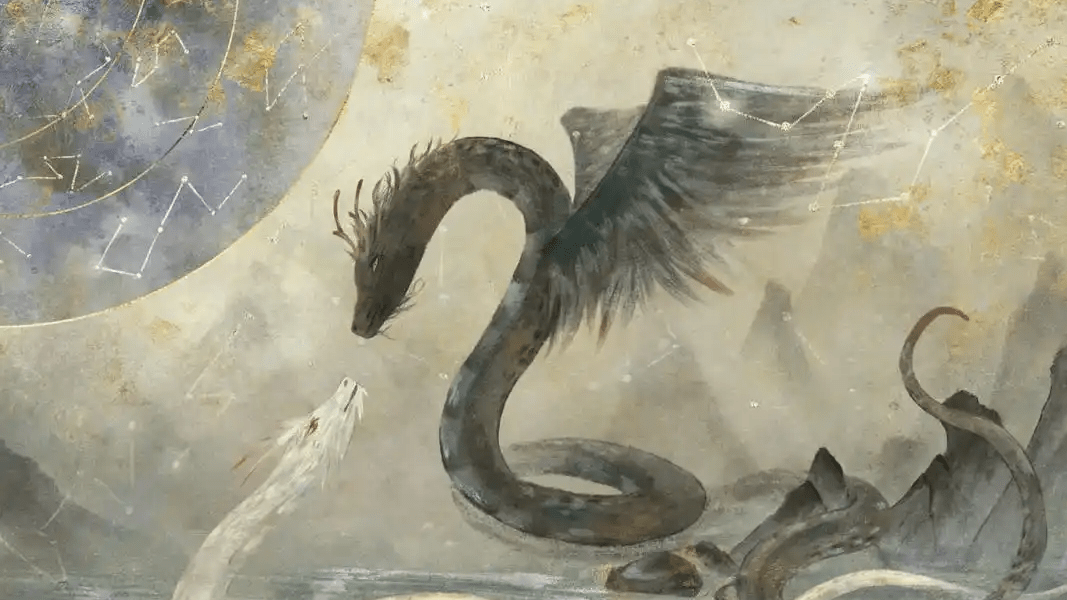
In ancient Chinese legends, Tengshe is a legless mythical beast that can summon clouds and mist to travel among them. It was first recorded in Xunzi’s Encouraging Learning as “Tengshe has no feet but flies, while the flying squirrel has five skills but is still in a predicament.” This is used as a metaphor for how ordinary people should concentrate on their work in order to succeed. He emphasized that focusing on expertise is better than dabbling.
The Erya·Shiyu classifies it as a dragon, and Guo Pu commented that it “can raise clouds and mist and swim in them.” It is also described as a flying divine serpent or dragon capable of soaring through the clouds and traversing the cosmos. It is often mentioned together with the divine tortoise as the incarnation of Xuanwu.
In astrology, Tenshe belongs to the twelve heavenly generals, symbolizing ominous signs. The first heavenly generals is Tengshe Fire God, whose home is in Si (Encampment Mansion), and is an ominous general who brings fear and terror.
Some documents also list Tengshe as the central divine beast among the five divine beasts, and its color is yellow. Tengshe, the god of fire, is gentle in nature but venomous in speech. He governs fire, the strange, frightening, nightmares, demons, and bewitching matters.
The palace he resides in signifies strange events, fire, and theft; mutual generation brings secret benefits, while mutual restraint brings secret harm. His presence at the Jing Gate signifies candlelight, while at the Jing Gate signifies disaster. He is associated with the fire of the south and is a god of deception. The direction from which Tengshe emerges signifies mental confusion, nightmares, and palpitations; however, if the appropriate gate is encountered, there will be no harm.
The Tengshe (螣蛇) in divination; The Tengshe is oriented in the center , possessing the element of Earth (己土) . It signifies unexplained and strange events, and also imprisonment. Things represented by the Tengshe include: snakes, pythons, gods, ghosts, immortals, premature death, strange events, and incomprehensible occurrences. It also represents thin, long objects, things with a coiled shape, such as ropes, threads, flexible tubes, and anything that can be coiled; it represents light rain and small rivers.
In Feng Shui, it represents roads (small, winding paths). The snake signifies binding, entanglement, and being entangled, resembling handcuffs . In terms of personality, a strong Tengshe indicates a person who is shrewd and resourceful, while a weak Tengshe indicates a person with a strange, hypocritical, deceitful, scheming, and boastful nature. The informational implications of the Tengshe in combination with different family relationships are as follows:
The Official Ghost Yao.
In divination regarding lawsuits, it signifies misfortune. If the official element (官爻) is activated and attacks the self-element (世爻) or the useful god (用神), it indicates imprisonment. In fortune-telling, if the official element (官爻) is activated and attacks the self-element, it indicates that a villain or man is setting a trap or using underhanded tactics to frame you. When the Tengshe (螣蛇) is in the self-element position, the person is skillful and shrewd. In dream divination, it indicates nightmares, strange dreams, or unsettling dreams. In divination regarding the home, it indicates strange events ( if the official element is in the self-element position) involving demons, immortals, ghosts, or unusual sounds and noises (if the official element is in the second, third, or fourth position, it indicates within the home). In divination regarding illness, it indicates a false illness, a strange illness that hospitals cannot diagnose, or a neurological condition. For a woman divining about her son-in-law, if the official element is in the Tengshe position, it indicates a predestined husband (because it implies binding).
The Parents Line.
When the Self is bound by documents and contracts, it indicates that the parents are suffering from strange illnesses, unusual events, or mental instability, or are prone to excessive worry and suspicion. When divining about contracts, if the Father element is accompanied by the Tengshe (螣蛇) and attacks the Self element, it also indicates that the signed contract is either a trap set by the other party to harm the party, or an invalid contract or document, or a false document (meaning it is untrue and contains false information). When divining about safety, if the Tengshe is accompanied by the Father element and attacks the Self element or the Useful God (用神), it indicates a car accident (because the Tengshe represents the road and the Father element represents the vehicle).
The Brother Yao.
If the divination indicates a lawsuit, it suggests imprisonment; if it indicates a partnership, beware of the other party deliberately setting traps to harm you.
Lin Cai Yao.
For a man divining about marriage, it indicates his destined wife (who is unlikely to leave him); for business, it indicates deserved wealth (predestined), or wealth acquired through clever means and cunning; for illness (especially his wife’s illness), it indicates a false illness; for lawsuits, it indicates his wife may face imprisonment; for fortune, if the wealth element clashes with the self element, it indicates harm from women, being tricked by them, or being cheated or deceived due to dishonest dealings with wages or money. This interpretation is particularly relevant if the wealth element is in the self element and accompanied by the Tengshe (a mythical creature).
Lin Zisun Yao.
When a woman is possessed, it means that she is destined to have a daughter. If the fortune of the daughter is in question, and the woman is afflicted by the Tengshe (螣蛇), it indicates that she will be plagued by illness on the one hand, and on the other hand, it also indicates that the daughter will suffer from imprisonment (because the Tengshe has the image of detention and binding). When the offspring is in the earthly branch and is accompanied by the Tengshe, it indicates that the person is scheming, boastful and unrealistic (the offspring represents the saying , and the Tengshe represents falsehood, so the combination has this image). On the other hand, it can also mean that the person is skillful, smooth in dealing with things, and adept at handling all situations, making them suitable for diplomatic reception work .
The character “螣” in 螣蛇 (Teng She) was created specifically for this divine snake. The Shuowen Jiezi records: “螣, a divine snake, is composed of the radical 虫 (insect) and the phonetic component 腾 (teng).” [3]
Ma Duanlin (1317)
The twenty-two stars of the Soaring Serpent, located north of the Chamber, resemble a coiled serpent, situated on the riverbank, and are called the Heavenly Serpent Stars, governing aquatic creatures. A slight disturbance brings national peace; a bright one brings unrest. A southward shift brings severe drought; a northward shift brings severe floods. A guest star guarding the area signifies floods and disasters, with no harvest. [4]
Song History (1346)
The Tengshe constellation, with its twenty-two stars, is located north of the Shi constellation. It governs water creatures and those residing along riverbanks. If these stars are faintly bright, the nation remains at peace; if they shift southward, drought follows; if northward, great floods occur. If a comet or bright guest star transits here, waterways become blocked and impassable. If a guest star transits through this region, aquatic life fails to thrive. [5]
References
- Shu Xiu – Baidu Encyclopedia.
- Tengshe Star Official– Baidu Encyclopedia.
- Teng Snake – Baidu Encyclopedia.
- General Examination of Literature, Volume 279, Part 2, Ma Duanlin, 1317.
- Song History, Volume 50, Chapter 3, 1346.