
STARS: Major | All | Constellations | Chinese | About
10♎43 to 22♎07
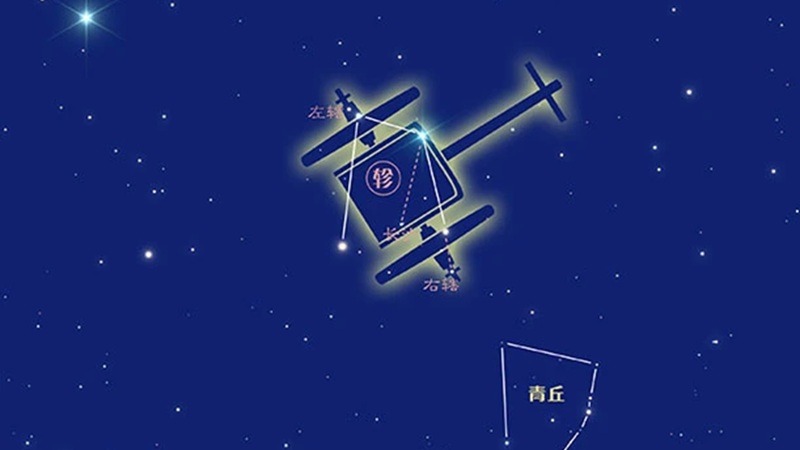
The 28th Chinese lunar mansion is 軫宿 (Zhěn Su), “Chariot Mansion.” It is the 7th of the 7 mansions of the Vermilion Bird of the South and represents the bird’s tail.
The Zhen Mansion contains 8 star officials (asterisms) and 52 stars, distributed in the constellations Centaurus, Corvus and Hydra. [1]
| # | Asterism | English | 2000 | Constellations | Stars |
|---|---|---|---|---|---|
| 1 | Zhěn | Chariot | 10♎43 | Corvus | 4 |
| 2 | Chángshā | Changsha | 13♎48 | Corvus | 1 |
| 3 | Zuǒxiá | Left Linchpin | 13♎49 | Corvus | 1 |
| 4 | Yòuxiá | Right Linchpin | 12♎15 | Corvus | 1 |
| 5 | Qīngqiū | Green Hill | 06♎27 | Hydra | 7 |
| 6 | Junmen | Military Gate | 08♎51 | Hydra | 2 |
| 7 | Tusikong | Master of Constructions | 07♎33 | Hydra | 4 |
| 8 | Qifu | House for Musical Instruments | 22♎12 | Centaurus | 32 |
Mansion Zhen the Chariot
10♎43 to 22♎07
Constellation Zhen, also known as “Tianche” (Heavenly Chariot), is the seventh mansion in the Vermilion Bird of the south. It sits at the bird’s tail, which it uses for navigation. Located southwest of Spica, the four stars of the Zhen asterism correspond to the constellation Corvus. In Greek mythology, this raven was Zeus’s messenger, with silvery-white wings and the ability to understand language. In ancient Babylon, it was considered the wind star. [2]
It is believed the chariot governs chariots, horses, and the wind. Another theory suggests that the character “衡” in Hengshan (Hengshan Mountain) may derive from the Zhen constellation, which balances a carriage. [1] The Zhen constellation is the celestial war chariot. Like modern tanks, it symbolized a state’s military power. Changes in the constellation foreshadowed the mobilization and outbreak of war. [4]
“Zhen” carries connotations of sorrow; thus, the Zhen mansion is inauspicious. It can bring separation, financial ruin, constant fear and unease. Traveling to the north is considered unlucky. Suitable activities include buying farmland, enrolling in school, building, weddings, and tailoring. Wealth and honor bring longevity and prosperity; full granaries bring good fortune. A scholar’s burial brings blessings, ensuring peace and tranquility in the dwelling and preventing misfortune.
Zhen Personality
People born under the Zhen constellation are blessed throughout their lives, and their fortune increases with age. They are quick-witted, efficient, adaptable, steady, and insightful, and learn new skills quickly. With a thirst for truth and philosophical thought, they enjoy art and religion and prefer to immerse themselves in the spiritual world. They can do great things, are destined to have daughters, and are suited for immigrating abroad. Developing their careers in the south is auspicious.
However, they are impatient, introverted, timid, prone to jealousy and tend to have poorer health. With their low-key approach to life and penchant for keeping a low profile, they suit behind-the-scenes or decision-making roles where they can better use their abilities. Most people born under this sign are gentle and soft-spoken, which can make them seem quiet and delicate. However, deep down, they won’t allow others to cross their boundaries or get too close. They tend to isolate themselves in their own world. [2]
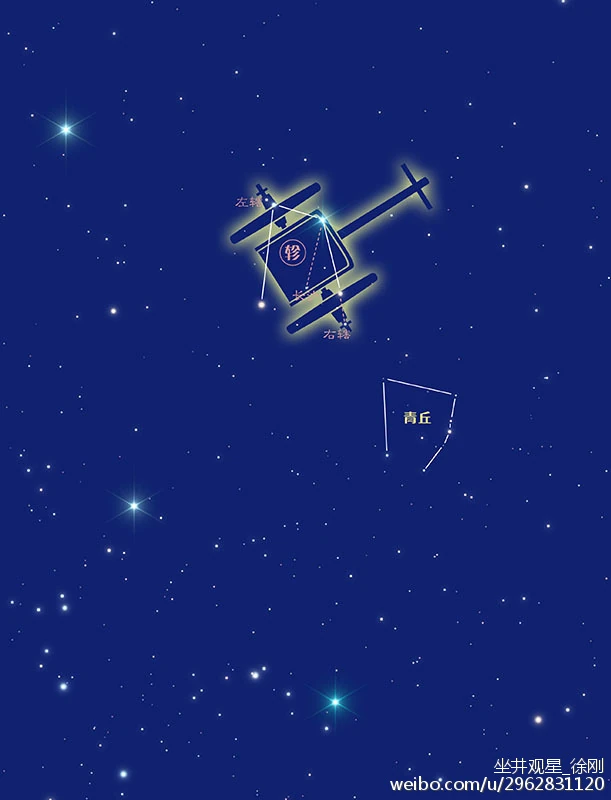
Mansion XXVIII – Zhen (Chariot)
Zhen History
- The character 轸 (zhen) is written as 车 (che) on the lacquered box lid of the tomb of Marquis Yi of Zeng (433 BC). [3]
- The Records of the Grand Historian, Treatise on Celestial Offices (91 BC), states: “The chariot is a vehicle and governs the wind.” [1]
- The Shuowen Jiezi (100 AD) defines Zhen as “the crossbar at the back of a chariot.” [3]
- The Western Steps to Heaven Song (600 AD) states: “The four stars of Zhen are not of equal size, a black star hidden in the middle is Changsha.” [3]
- According to the Book of Jin, Treatise on Astronomy (648 AD), the four stars of Zhen symbolized “chariots and cavalry” and “carrying duties,” that is, war chariots and war missions. [4]
- The Suoyin commentary (745 AD) explains: “The four stars of Zhen are in the center, with two more stars forming the left and right axles, symbolizing a chariot.” [3]
References
- Zhen Su – Baidu Encyclopedia.
- Zhen (Zhen Water Earthworm).
- Twenty-Eight Mansions – Baidu Encyclopedia.
- Notes on Ancient Chinese Astronomy (8) – Swift as the Wind.