
STARS: Major | All | Constellations | Chinese | About
19♋06 to 23♋12
The 22nd Chinese lunar mansion is named 井宿 Jǐng Su, “Well Mansion.”
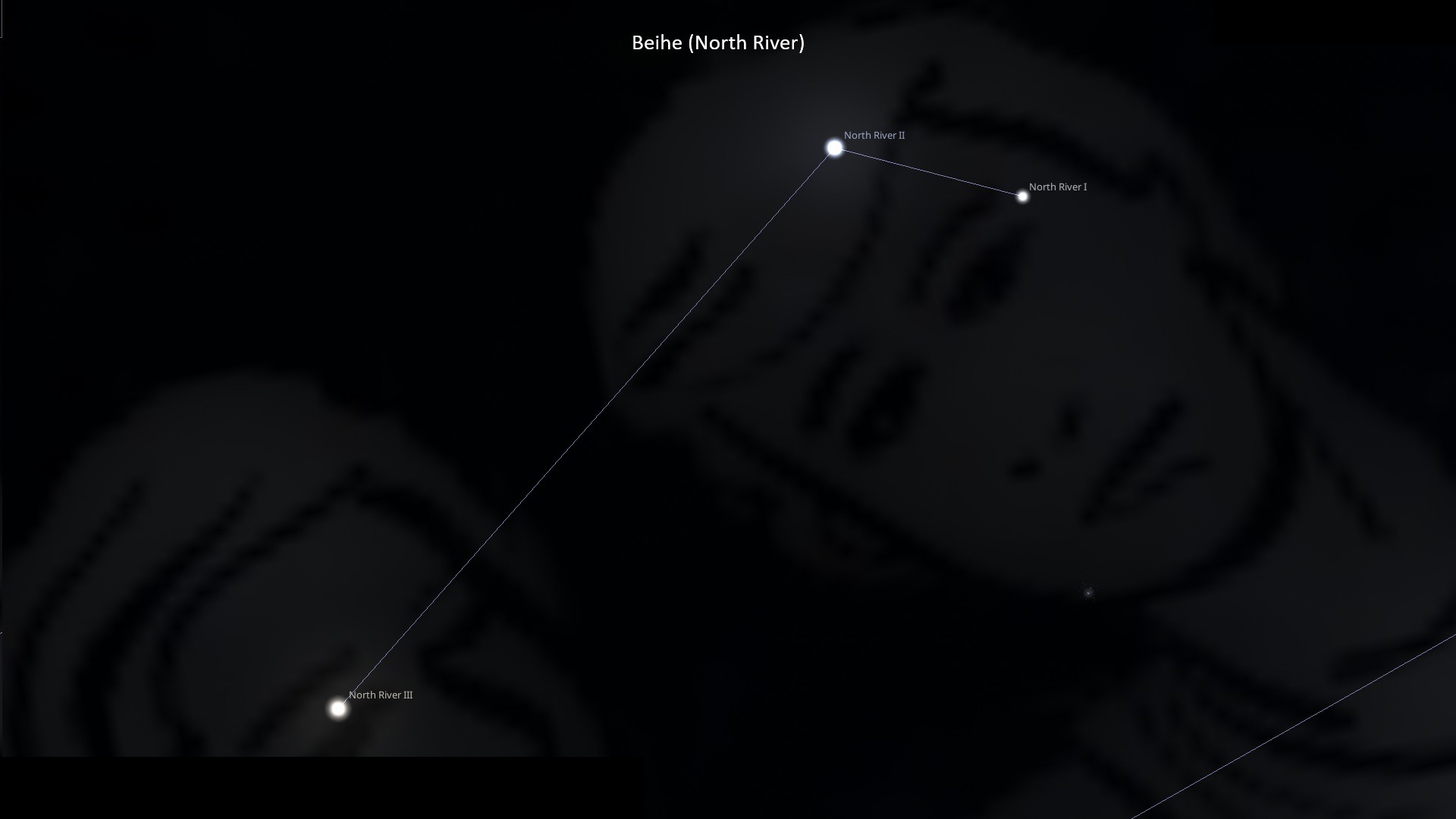
The 4th asterism of the Well Mansion is called 北河 Běihé, “North River.” It represents the River north of Jingxiu and is also called the Northern Garrison. It is composed of 3 stars of the constellation Gemini. [1]
| 2000 | 2050 | IAU | Chinese | Orb |
| 19♋06 | 19♋48 | ρ Gem | Beihe Yi (1) | 1°20′ |
| 20♋14 | 20♋57 | α Gem, Castor | Beihe Er (2) | 2°20′ |
| 23♋12 | 23♋55 | β Gem, Pollux | Beihe San (3) | 2°30′ |
Asterism Beihe, the North River
19♋06 to 23♋12
The North River and the South River are actually garrisons. In winter, they form a crossing point between the Milky Way and the ecliptic called the “gateway on the ecliptic.” The North and South Rivers, situated on either side of the ecliptic, guard this vital passageway, also called the “Heavenly Gate.” [2]
Ma Duanlin (1317)
There are three stars each in the north and south rivers, flanking the eastern well. One is called Tian Gao, the gate of heaven, in charge of passes and bridges. The south river is called Nan Xu, Nan Guan, Yang Men, Yue Men, and Quan Xing, in charge of fire. The Northern River is also called the Northern Garrison, the Northern Palace, the Yin Gate, the Hu Gate, and the Heng Star, and it governs water. Between the two garrisons lies the constant path of the three luminaries (sun, moon, and planets). If the River Garrison is disturbed, war will break out in China. [3]
Song History (1346)
The three stars of Nanhe (Southern River), together with Beihe (Northern River), flank the Dongjing (Eastern Well) asterism, known as the “Gateway of Heaven”; they govern passes and bridges. The space between these two “river garrisons” is the regular path for the sun, moon, and five planets.
Beihe (Northern River) consists of three stars; it is also known as Beishu (Northern Garrison), Beigong (Northern Palace), Yinmen (Gate of Yin), Humen (Gate of Hu), or Hengxing (Beam Star), and it governs water.
If the stars of the river garrisons waver or shake, warfare breaks out in the Central Kingdom. If the stars are incomplete or missing, travel routes are blocked, and waters overflow. Bright stars are auspicious; if they are dim or wavering, border wars arise, distant peoples rebel, and the ruler suffers anxiety.
If the Five Planets emerge from, enter, linger in, or station themselves at Beihe, warfare erupts; if they encroach upon it, a noblewoman dies; if they ride over it, the northern ruler faces distress.
If the moon passes along the central path between the Two Rivers, the people are at peace, the harvest is bountiful, and there is no war; if it passes south of the central path, the ruler faces misfortune and high officials become disloyal. If the moon encroaches upon them, the Central Kingdom faces trouble—specifically war, mourning, drought, or epidemic; if it moves southwest, war and drought ensue.
If Mercury stations itself in Beihe, external warfare arises and a frontier official plots rebellion; if it lingers there, warfare erupts in all directions.
If Venus lingers at the Two Rivers, war breaks out. If Venus lodges at Beihe, a noblewoman dies within thirty days, and internal plotting occurs; if it stations itself at Beihe, warfare breaks out across the realm within one hundred days.
If Mars encroaches upon the Two Rivers, war ensues; if it lingers for over thirty days, rivers overflow. If Mars enters Beihe from the west, a death occurs within sixty days; if it enters from the east, warfare breaks out within ninety days; alternatively, if it emerges from Beihe and stations itself to the north, a frontier general will achieve victory by engaging in unauthorized military action against a foreign state.
If Mars transgresses either Nan He or Bei He, military conflict follows. If it lingers for more than thirty days in this region, rivers overflow; if it resides over Nan He (South River), crops fail to mature and the queen consort feels worry; if it guards the west of Nan Shu (Southern Garrison), fruits do not bear well; if it is located eastward, then attacks and battles occur.
When Mars invades the Two Rivers, it signifies war; if it stays there for more than thirty days, rivers will overflow.
If Jupiter encroaches upon the Two Rivers, the northern ruler faces anxiety. If Jupiter enters Beihe, a high official is executed.
If Saturn stations itself in Beihe, warfare erupts, followed by an amnesty or major earthworks within sixty days; if it stations itself at the western part of the garrison, the grain crops fail to mature.
If a guest star lingers at the Two Rivers, drought and epidemics occur. If a guest star encroaches upon Beihe, a death occurs abroad while traitors lurk within; entry from the east signals warfare within ninety days; entry from the west signals a death within sixty days; stationing there portends a great flood.
The appearance of a comet signals war; if it lingers, drought follows.
If a meteor passes between the Two Rivers, the realm faces calamity; if it enters Beihe, northern forces invade the Central Kingdom, and passage through mountain passes and across bridges is blocked.
A shooting star signals war, mourning and trouble at the border garrisons.
If pale or white clouds enter the Two Rivers, river routes are blocked; if they emerge red, the Emperor’s forces are marching against the feudal lords. If yellow clouds enter, virtuous decrees are issued; if it emerges, disaster follows. If pale, bluish-white clouds encroach upon Beihe, there is warfare and epidemic disease at the frontier, as well as distress for the northern ruler. [4]
References
- Well Constellation – Baidu Encyclopedia.
- The starry sky calls to me (9) — Your Name (Part 2)
- General Examination of Literature, Volume 279, Part 2, Ma Duanlin, 1317.
- Song History, Volume 51, Chapter 4, 1346.