
STARS: Major | All | Constellations | Chinese | About
11♋08 to 25♋15
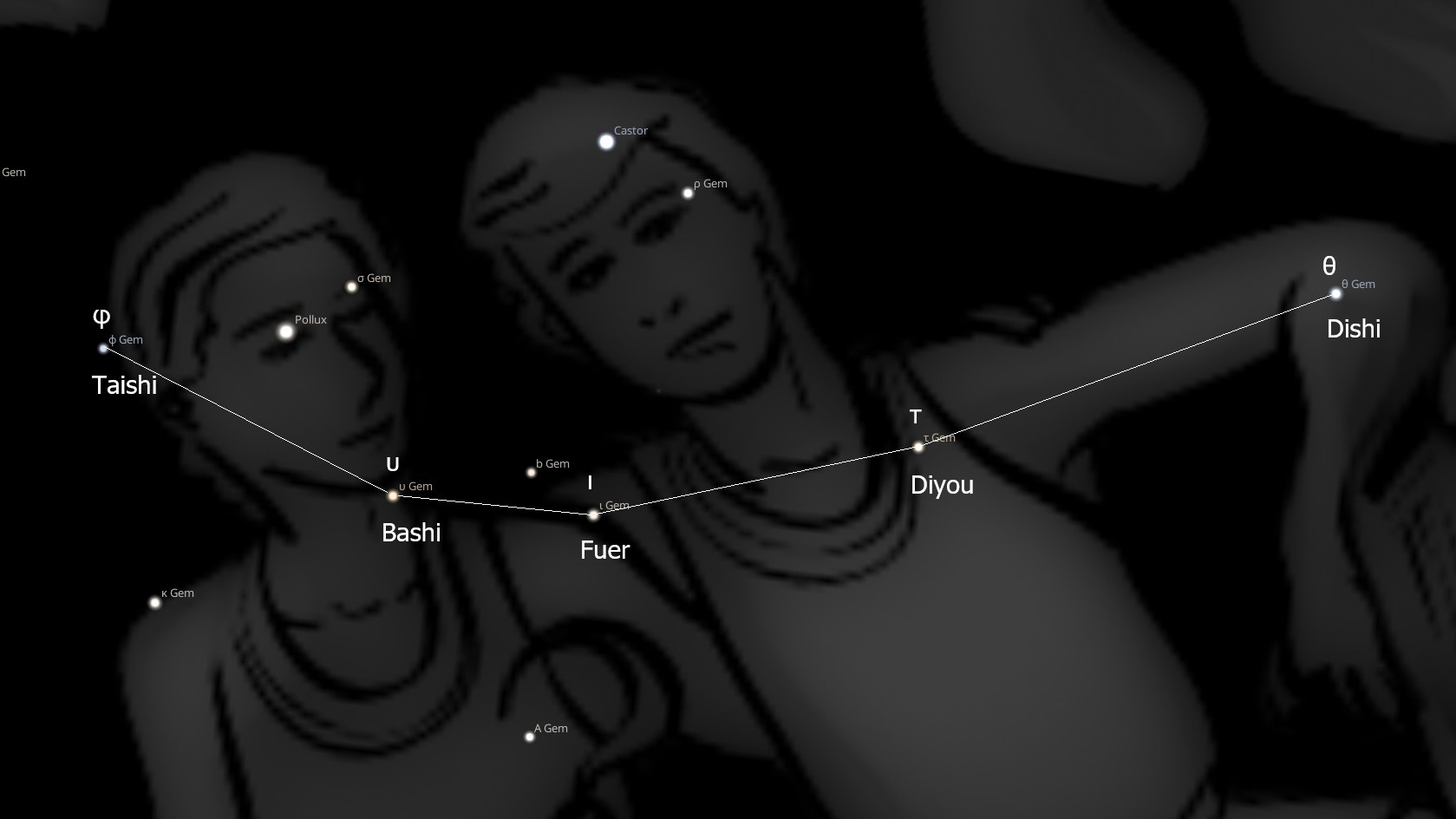
Five Feudal Kings Asterism
The 22nd Chinese lunar mansion is named 井宿 Jǐng Su, “Well Mansion.”
The 6th asterism of the Well Mansion is named 五諸侯 Wuzhūhóu, “Five Feudal Kings.” It comprises five stars from the constellation Gemini.
Note: 五諸侯 Wǔzhūhóu, “Five Lords,” or “Five Princes,” is the name of an asterism in the Tài Wēi Enclosure.
Although they share the same name, they belong to different star official systems. Documents such as Lingtai Miyuan and Yixiang Kaocheng clearly distinguish between them. The Ming Dynasty Xingli Kaoyuan specifically states that “the Lords of the Jing constellation are in charge of supervision,” thereby clarifying the differences between the two star official systems in terms of their functional attributes. [1]
| 2000 | 2050 | Star | Name | Represents | Orb |
| 11♋08 | 11♋50 | θ Gem | Dishī | Imperial Tutor | 1°40′ |
| 15♋27 | 16♋09 | τ Gem | Dìyǒu | Imperial Friend | 1°10′ |
| 18♋58 | 19♋40 | ι Gem | Fùěr | Three Dukes | 1°30′ |
| 21♋21 | 22♋03 | υ Gem | Bàshì | Doctor | 1°20′ |
| 25♋15 | 25♋57 | φ Gem | Tàishì | Grand Historian | 1°00′ |
Constellation Wuzhuhou the Five Feudal Kings
11♋08 to 25♋15
The Five Feudal Kings asterism represented five lords who served as political advisors and jointly assisted the emperor in decision-making. Their main functions were to scare away trouble and warn against unforeseen events. They also presided over the rise and fall of the Princes.
The five advisors did not go to the country but served the emperor in the inner court, symbolizing the core political group permanently stationed in the Heavenly Court. In astrology, they were given a warning function.
The five stars of the Five Feudal Kings asterism were ranked in order of rank as:
1. θ Gem – 帝師 Dishī, Imperial Tutor. Primarily responsible for oversight.
2. τ Gem – 帝友 Dìyǒu, Imperial Friend. Symbolizes military preparedness.
3. ι Gem – 附耳 Fùěr, Three Dukes. Corresponds to the system of etiquette and law.
4. υ Gem – 伯是 Bàshì, Doctor. In charge of agricultural taxation.
5. φ Gem – 太史 Tàishì, Grand Historian. Associated with judicial and criminal law. [2]
Ma Duanlin (1317)
The five stars of the Five Princes are northeast of the Eastern Well, near the Northern River, and govern spies and warnings against unforeseen events. They also govern yin and yang, observe gains and losses, and govern the emperor’s heart. They are: 1. Imperial Teacher, 2. Imperial Friend, 3. Three Dukes, 4. Erudite Scholar, 5. Grand Historian. Also, 5. Grand Master. These five often resolve doubts for the emperor.
Bright and lustrous stars indicate great order in the world; sharp points indicate impending disaster. Zhang Heng also said that the Five Princes govern yin and yang, observe gains and losses, and if they are bright and lustrous, and of equal size, it is a blessing for the country. He also said that red indicates abundance, and darkness indicates desolation. [3]
Song History (1346)
The five stars of the five princes are located north of the constellation Jing in the east. They are in charge of resolving doubts, investigating and punishing, guarding against unforeseen events, regulating yin and yang, and observing gains and losses. They are also said to govern the emperor’s heart.
The first is the Imperial Tutor, the second the Imperial Friend, the third the Three Dukes, the fourth the Erudite Scholars, and the fifth the Grand Historian; these five are always there to resolve the Emperor’s doubts.
If a star is bright and lustrous, the world is at peace. If the five rites are complete, the stars will shine brightly and not encroach upon each other; if they are dim, nobles will plot against the Emperor; if they are sharp or pointed, disaster is imminent.
If Jupiter (Jupiter) afflicts it, war will break out for three years. If Mars (Mars) afflicts it, ministers will rebel but fail. If Venus (Venus) afflicts it, feudal lords will raise armies and lose their states; if it is visible in broad daylight, feudal lords will be executed. If a guest star afflicts it, the royal court will be in chaos, feudal lords will lose their territories, and the Qin state will suffer; if it is present, the relatives of feudal lords will lose their positions. If a comet or a comet afflicts it, law-abiding officials will be executed, or, according to another interpretation, a high-ranking official will be responsible, for a period of one year. If clouds afflict it and turn pale, feudal lords will suffer loss; if not, ministers will be executed. [4]
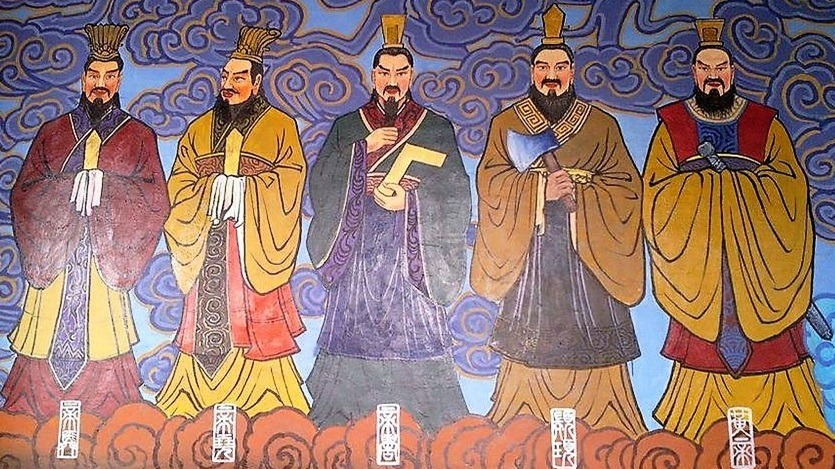
Dìyǒu – The Emperor’s Friend
The core functions of the Emperor’s Friend (τ Gem) include:
Reporting and exposing misconduct: Monitoring the conduct of officials and reporting illegal activities.
Preventing Unexpected Events: Preventing Sudden Events and Natural Disasters.
Regulating Yin and Yang: Harmonizing the laws governing the operation of heaven and earth.
Observe gains and losses: assist the emperor in examining the advantages and disadvantages of his policies. [5]
Dishī – The Imperial Tutor
The Imperial Tutor (θ Gem) corresponds to the minister who assists the monarch in the traditional astronomical observation system. It was a harbinger of “great floods under heaven.” The Imperial Tutor bears the astrological connotation of assisting the monarch and correcting gains and losses. It ranked next to the Three Dukes and was responsible for planning and deliberation. In the traditional astrological system, the Imperial Tutor Star has a dual symbolic function:
Political Implication: Represents the highest advisor to the monarch, echoing the Three Dukes Star (ι Gem) in the Purple Palace.
Disaster Warning: Changes in brightness are correlated with major floods. This star was incorporated into hydrological prediction models during the Ming and Qing dynasties, and its observational data corresponded to rainfall records. [6]
References
- Five Princes and Star Officials – Baidu Encyclopedia.
- Five feudal lords – Baidu Encyclopedia.
- General Examination of Literature, Volume 279, Part 2, Ma Duanlin, 1317.
- Song History, Volume 50, Chapter 3, 1346.
- Emperor’s Friend (ancient star name) – Baidu Encyclopedia.
- Imperial Tutor (one of the Five Princes) – Baidu Encyclopedia.