
STARS: Major | All | Constellations | Chinese | About
Kochab at 13°20′ Leo has an orb of 2°10′
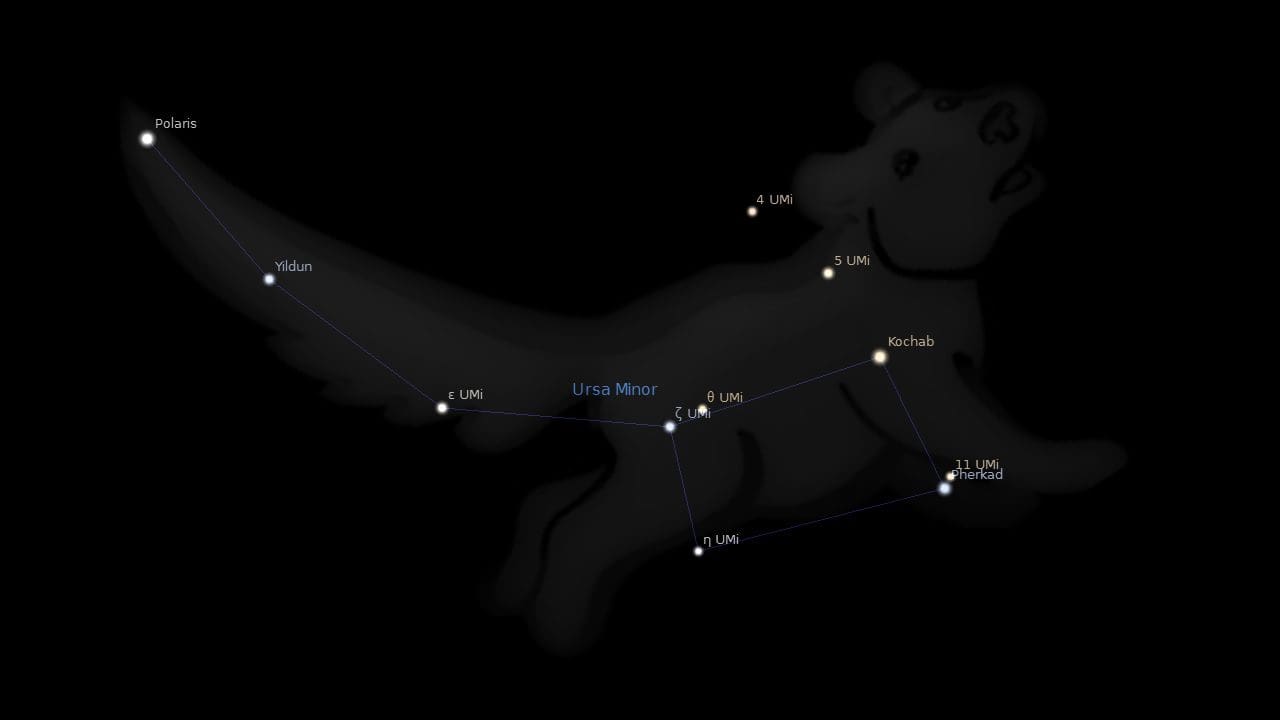
Ursa Minor Constellation [Stellarium]
The Sun joins Kochab on August 6
Fixed star Kochab, Beta Ursae Minoris (β UMi), is a 2nd-magnitude single star on the front hip of the Little Bear, Ursa Minor Constellation.
Magnitude 2.08, spectral type K4 III, color orange. It is a slow spinner, with a projected rotational velocity of only 8 km/s. [1]
β UMi is officially named Kochab.
Applied to β UMi in Renaissance times and of uncertain derivation. It is probably from one of the names Alrucaba, Rucaba, etc., [“the knee (of the Greater Bear)”] that were first applied to θ UMa, then to α UMi, in medieval times. However, the name may also be from the Arabic word kaukab, or the Hebrew word kōkhābh, both meaning “star.” [2]
Kochab is a name that appeared at the end of the 16th century. This name does not come from the Arabic kaucab-al-Shemali, as Camille Flammarion, followed by Richard Hinckley Allen, believed, but it results from the convergence of two phenomena. The first is the alteration of the name given to α UMi, by transforming r into k ‒ Rucaba > Kuca[b], again by shifting the name الركبة al-Rukba, “the Knee,” which corresponds, in the Greco-Arabic representation, that is, the one that Arab astronomers borrowed from the Greeks in the 9th century, to the star θ UMa. The second phenomenon is the influence, in the search for a Hebrew origin for this Arabic name, dear to Renaissance philologists, of kochab, a then common spelling of the transcription of the Hebrew כוכב kokab, “star.”
Kochab forms with γ UMi (Pherkad) a small asterism called, in popular imagination, the Guards, or the Guardians of the Pole (north).
In Mesopotamia, this star MAR.GÍD.DA.AN.NA = Eriqq samē, “The Celestial Chariot.” It is associated with the goddess Damkina, the equivalent of the Sumerian DAM.GAL.NUN.NA, literally “the Wife of the Great Prince,” or NINKI, “Lady Earth.” It appears in the Enūma Eliš, the Epic of Creation, compiled and arranged at the end of the 12th century BCE in Babylon, when Marduk, whom the Greeks saw as the equivalent of Zeus, gained preeminence over the other gods: “Marduk was born / Aea, his father, ‖ And gave birth to him / His mother, Damkina.” ENKI = Aea, is “the Lord of the Earth,” the god of the Earth and Waters, of Wisdom, of Fertility, the one who invented writing, the Guardian of Divine Laws, and the Creator of human beings. Damkina is the Mother Goddess, the mother of Marduk, who at that time became the principal god in Babylon, whom the Greeks would later recognize, and who, in Enūma Eliš, fathered Marduk with ENKI = Ea. The symbolic value given to this star is understandable, as its circular path at the summit of the celestial sphere allows it to dominate the latter. This star is the origin of the figure MAR.GÍD.DA.AN.NA = Eriqq samē, which the Greeks inherited under the name Άμαξα. We know from Diogenes Laertius that Callimachus of Cyrene (ca. 305- ca. 240) wrote about Thales of Miletus (ca. 625- 620- ca. 548-545): “It was he, it is said, who recognized ‘the constellation of the Chariot [ Άμαξα in the text] / on which the Phoenicians regulate their navigation.” [3]
β, 2, reddish. Kochab is from the Arabic title that it shared with α UMi, and it was perhaps this star that the Greek astronomers called Πόλος, “Pole,” for it was near the pole 1000 years before our era.
Alrucaba, variously written, is also common to it and Polaris, as well as to its constellation, Smyth saying that this was the Alfonsine Reicchabba.
Nā᾽ir al Farḳadāin and Anwār al Farḳadāin, “the Bright One,” and “the Lights,” “of the Two Calves,” were titles in the Desert for this star, from an early figure here, in the Fold, of these timid creatures keeping close to their mother. β was often designated by pre-Islamic poets as the faithful and, from its ever-visible position, the constant companion of the night traveler. Indeed, the Badāwiyy claimed that they had a perpetual treaty with Al Farḳad to this effect, and their poets made the Two Pherkads, β and γ Umi, symbols of constancy. Chilmead cited Alferkathan.
α, β, γ¹, γ², δ, and ε UMi constituted the group Circitores, Saltatores, Ludentes, or Ludiones, “the Circlers, Leapers, or Dancers” around the early pole, well known from classical times to late astronomy. [4]
The Pole Star
β UMi belongs to the Chinese asterism Beiji, “Northern Pole,” representing the Five Stars of the North Pole. Beiji is the 1st asterism of the Ziwei (Purple Forbidden) Enclosure.
The Chinese astronomical name for Kochab is Beiji Er, “Northern Pole Two.” It is also known as the Ziwei Star and the Emperor Star.
Of the five stars of the Beiji Asterism, Kochab was the most revered. Along with the Big Dipper, it is the core of Chinese astronomy. The ancients believed that Kochab was the center of the sky, with the Big Dipper revolving around it.
When the Chinese astronomical system was developed around 1300 BC, the Pole Star was Kochab, the brightest of the Northern Pole stars at that time, even brighter than Polaris. [5]
Research on Chinese sources regarding the Pole Star is confusing, as “North Star” translates to “Polaris.” Some pages on Baidu mention Polaris, but they are referring to β UMi, Kochab.
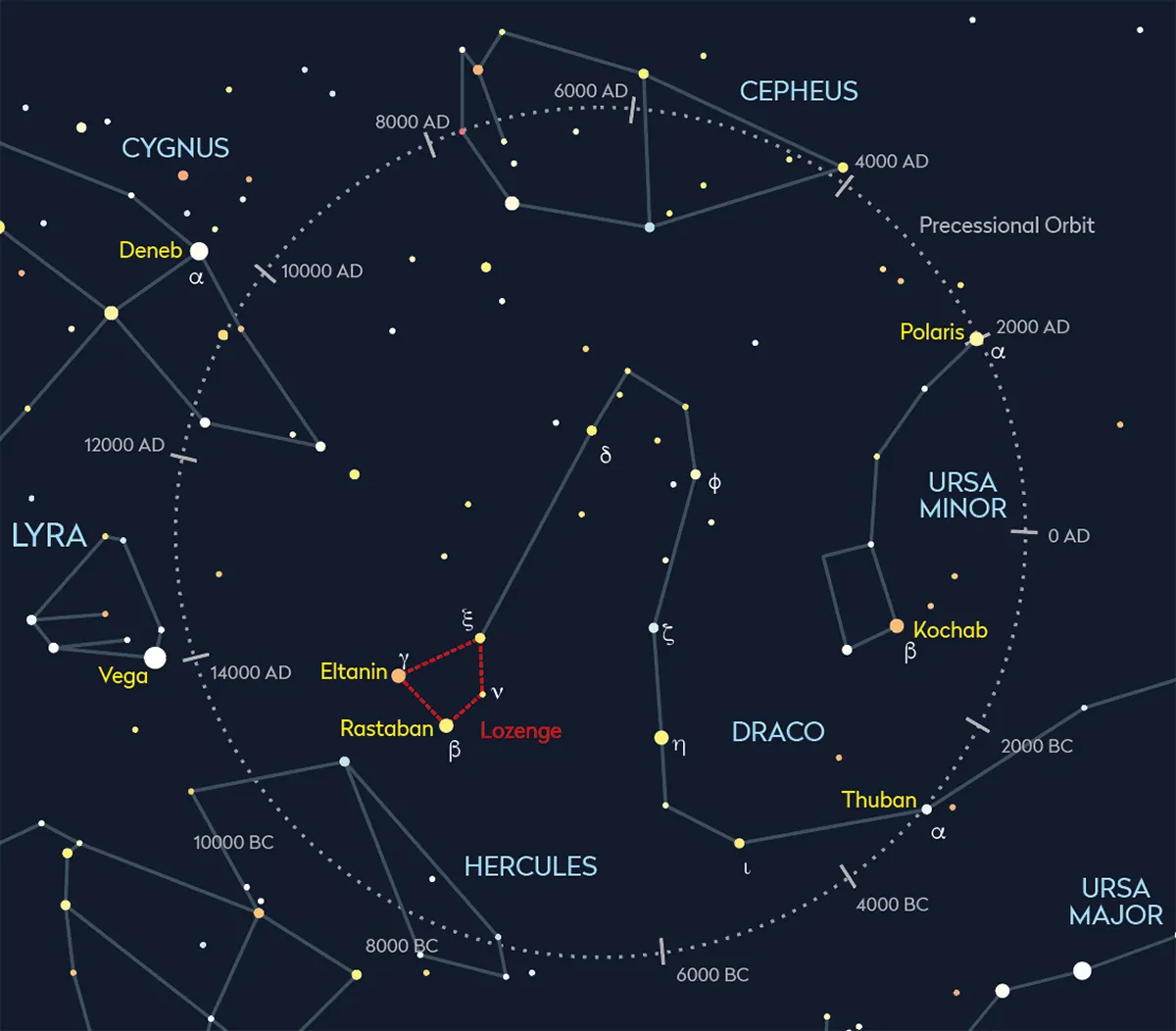
Arc of Precession
| 2000* | 2050 | Name | Orb |
| 07♌33 | 08♌15 | Asellus Borealis | 1°00′ |
| 08♌44 | 09♌26 | Asellus Australis | 1°30′ |
| 13♌20 | 14♌02 | Kochab | 2°10′ |
| 13♌39 | 14♌21 | Acubens | 1°20′ |
| 15♌12 | 15♌55 | Dubhe | 2°20′ |
Kochab Astrology
Fixed star Kochab has a spectral type of K4, indicating a planetary nature like that of Mars.
KOCHAB. β Ursae Minor.
A giant orange star. Spectral class K4, in the small Bear. This star is 135 times the luminosity of the Sun.
BASIC INFLUENCES: This star imparts to its natives endless courage, martial gains, rashness, violence, a rise to authority, malicious mischief. This star in general, should be used with negative nativities. Use caution in delineation. [6]
Kochab: Arabic: kaukhab schemali “North Star,” Little Bear, Mars nature, primarily probably of adverse influence on the mind: With a poorly positioned Sun: suicide attempts. [7]
Kochab, Beta Ursa Minoris
Kochub, meaning in Arabic “Buck,” is in The Small Bear, or on the back of the Little Dipper. With an afflicted Sun, suicide is indicated. This star has not been researched much and, therefore, is only briefly mentioned here. [8]
The astrological natures of the stars are akin to those of the planets. They are given by Ptolemy in Tetrabiblos, albeit in a most cursory manner. He writes:
“…the bright stars in the constellation of the Little Bear have a similar quality to that of Saturn, and to a lesser degree, to that of Venus.”
Modern astrologers have taken this to mean that since Polaris (α UMi) is the brightest star of those in the Little Bear, it must therefore have the nature of both Saturn and Venus.
To begin with, Ptolemy did not even consdier Polaris the brightest star in Ursa Minor, listing it as dimmer than both Kochab (β UMi) and Pherkad (γ UMi). The star closest to the north pole at the time Ptolemy wrote was Kochab, and Polaris was not even mentioned in the literature until after 500 A.D. Furthermore, reading classical astrology in context indicates that the classicists did not consdier the stars in general to have the natures of a multiude of planets individually. What Ptolemy meant is that in the constellation of Little Bear there are star with the nature of Saturn and that there are other stars of the nature of Venus. But Ptolemy mentions very few stars by name, and some of these do have mutiple natures. Hence the confusion that permeates modern astrology in this matter.
In addition to assigning (erroneously) a dual nature of Saturn and Venus to Polaris, Robson (in Fixed Stars and Constellations in Astrology) also asserts that “the Arabs were of the opinion that the contemplation of Polaris cured ophthalmia.” He got this wrong, too, as it was the star Al-Kiblah (or Kochab) for which this power was asserted. [9]
Kochab, β U-Minoris, takes its name from the Arabic Al Kaukab, simply “The Star,” for beyond 1000 years ago it was more nearly our Pole Star than the one we use now. And the same name was used, only a little differently spelled, in Babylonian and other pre-Arabic tongues. The Earth’s tilt has been changing gradually ever since the Disaster, so our present Pole Star has only acquired its status (and name) by succession from a long lineage of polar indicators. Kochab is close in longitude to α Cancri, Acubens. It is noteworthy that the latter star has just the Saturn-Mercury simile that goes with a guiding quality, like the Saturn-Venus of Polaris, so that, in the absence of attention from Ptolemy, Kochab can be given either of those ratings. Being in the (Leo)–Cancer region, it will often show in people a more reliable capacity for guiding than the less mature, Geminarian, Polaris. [10]
The Emperor Star
In Chinese astronomy, fixed star Kochab is the first star of Beiji, the “Northern Pole” asterism, within the Ziwei (Purple Forbidden) Enclosure. It is known as Běijíèr, “North Pole Two,” Di, “The Emperor,” Tiāndì, “God of Heaven,” the Emperor Star, the Purple Star, the Ziwei Emperor Star, but is most commonly referred to as the Ziwei Star. It is one of the 12 Main Chinese Fixed Stars.
In Chinese astrology, Kochab is the core star of the Zi Wei Dou Shu system, belonging to the Earth element, signifying power, wealth, status, nobility, and official rank, and possessing the ability to resolve difficulties, prolong life, and control negative influences. It favors the assistance of the Sun and Moon as its deities. In a person’s destiny, it indicates a loyal and upright character with a strong thirst for knowledge.
Kochab is the emperor star among the fourteen major stars. If all the stars in the natal chart are considered a political group, then Kochab is the head of state, wielding the power of life and death. Kochab is indeed like an emperor in nature.
With Kochab in the natal chart, one’s life is mostly focused on material things, and one’s spiritual life is often empty. One likes to associate with people of high status and those who are virtuous and talented.
Women with Kochab in the natal chart can only pursue these people with a high-class attitude, and they are not easy to win over.
Kochab advantages: being steady and mature, hospitable, having many friends, being filial to parents, receiving help from noble people throughout life, learning many skills but not mastering any, being intelligent, and being flexible.
Kochab disadvantages: being easily swayed by the words of others, being fickle, frequently changing jobs, and expecting something in return for giving to others. [11]
Domination and Control
Kochab is the supreme “Emperor Star,” symbolizing power, nobility, and leadership. Its energy endows the individual with innate majesty and confidence, making them naturally the center of attention and entrusted with the mission of leading others. Kochab signifies domination and control. People born under Kochab have a strong desire for control, clear plans for their lives and environment, and a yearning to dominate in all areas, using their wisdom and decision-making ability to manage situations.
Kochab Personality Traits.
Confident, authoritative, and decisive: People born under Kochab are extremely confident, unwavering in their beliefs, and never back down when faced with challenges. They possess an innate aura of authority, make decisive decisions, and demonstrate strong leadership.
Possess lofty ambitions and far-sighted vision: They are ambitious, dissatisfied with mediocrity, and eager to achieve brilliant success. They possess a long-term vision, identify opportunities and achieve success through insight and action.
Strong sense of responsibility and authority: A strong sense of responsibility and will go all out when they shoulder it. They value power and strive to use it to benefit others. However, they have a strong desire for control, so they need to delegate appropriately and listen to others’ opinions when collaborating.
Kochab Physical Characteristics.
Well-groomed and dignified facial features: People born under Kochab have imposing features and well-defined contours. A broad forehead indicating wisdom, deep and sharp eyes, a straight nose, and upturned lips exude authority, making them appear noble and extraordinary overall.
Possessing a noble and extraordinary temperament: They possess a noble air, elegant manners, and composed movements; they stand out from the crowd with their unique charisma without needing to put on a show.
Pay attention to quality in clothing: They emphasize quality and style, preferring a simple yet luxurious look, and often choose dark colors such as black, dark blue, and dark purple to highlight their composure and nobility.
Kochab Destiny.
Career Leadership Achievements: In their careers, those born under Kochab possess confidence, decisiveness, and leadership skills that help them succeed in various fields, making them well-suited for leadership roles and industry leadership.
Complex and diverse interpersonal relationships: Interpersonal relationships can be complex. A strong presence and leadership position can inspire awe and create distance, and the pursuit of power may lead to competitive conflicts. However, respecting others’ opinions and leveraging personal charisma can help build a solid network of connections.
Life is full of ups and downs; overall, people born under Kochab face many challenges and opportunities. Although they may encounter setbacks, they overcome difficulties with their firm beliefs and abilities, realize their life values, and forge an extraordinary life. [12]
Kochab and Ascella in the same chart: Wisdom and courage, willing to take on responsibilities, drive, nobility, a domineering presence, and naturally exude extraordinary charisma. [13]
Asterism Beiji, the Northern Pole
16♋45 to 21♌37
Beiji represents the residence of the Heavenly Emperor and the Palace’s core administrative institution. Kochab governs the sun and the emperor. If it is dim, the emperor will not be active (authority will not be exercised). If a bright and large star wavers or shakes, it signifies that the ruler enjoys traveling extensively; if its color appears faintly greenish, this portends ill fortune. If a guest star enters, there will be military action and mourning. If a comet enters, it signifies a change in position or power. If a shooting star enters, military conflict and earthquakes will arise. [14]
Constellation Ursa Minor, the Lesser Bear
22♊09 to 17♍52
URSA MINOR. The Lesser Bear.
Legend. According to some accounts this constellation represents Arcas, son of Callisto and Jupiter (see BOÖTES and URSA MAJOR). Other writers state that it is meant to represent Cynosura, one of the Nymphs of Crete who reared the infant Jupiter; the other, Helice, being Ursa Major.
Influence. According to Ptolemy the bright stars are like Saturn and in some degree like Venus. It is said to give indifference and improvidence of spirit, and to lead to many troubles. By the Kabalists it is associated with the Hebrew letter Tau and the 21st Tarot Trump “The Universe.” [15]
Astrologically both Bears were said to presage an evil influence. They are particularly injurious as regards to the affairs of nations and kings. [9]
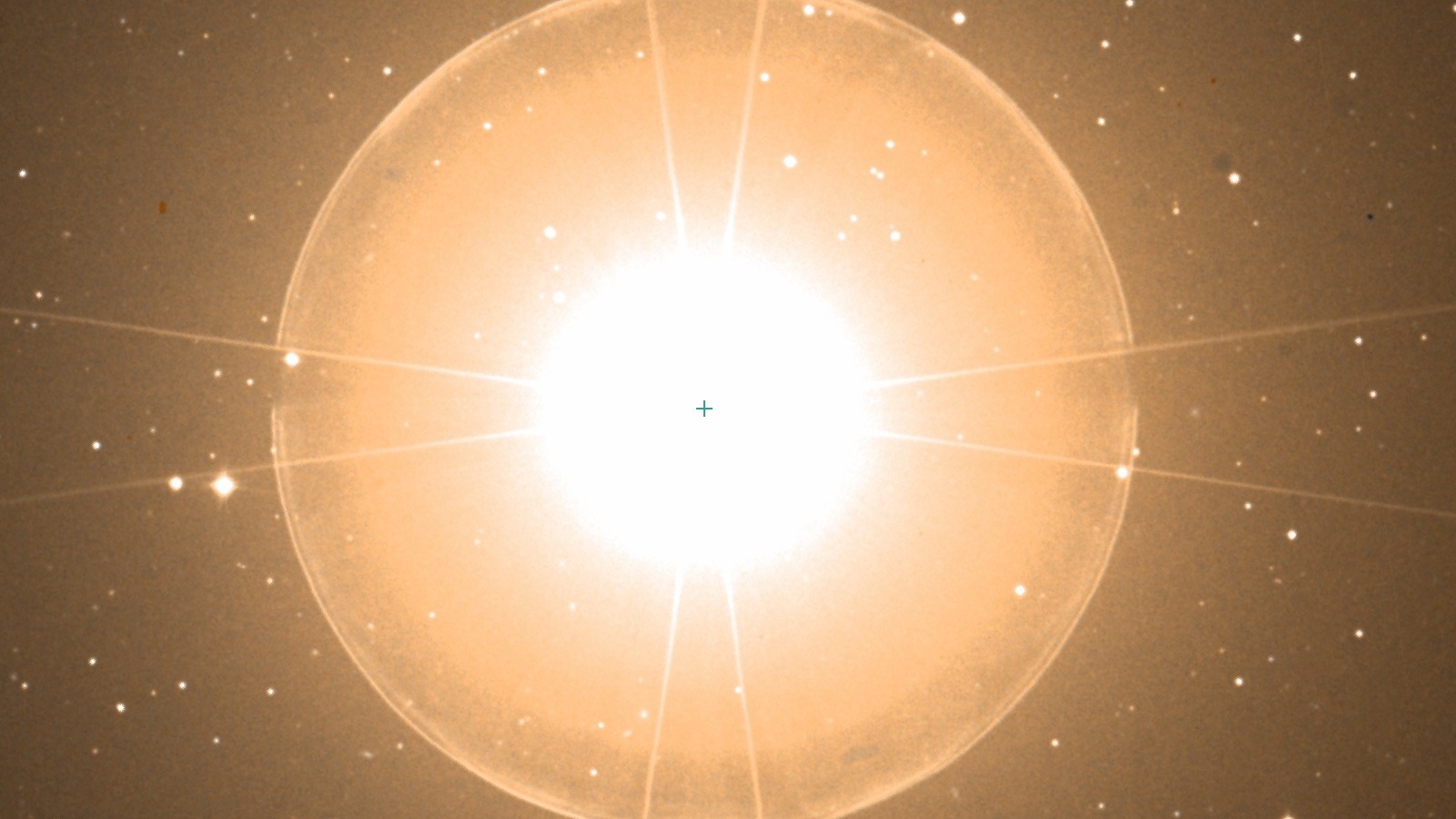
Beta Ursae Minoris, Kochab [SIMBAD]
Fixed Star Kochab Conjunctions
Ascendant conjunct Kochab: Wealth, power, courage, generosity, ingenuity, rise to authority, martial success, subject to cuts, wounds, accidents, sores and injuries to the face, pains in the head and fevers (Mars nature.) [15]
Walks with feet firmly on the ground, slow and deliberate movements, often silent, proud and arrogant, unwilling to be subservient to others, somewhat aloof, enjoys associating with people more capable than themself, skilled at flattery, has wide social circles, and expects something in return for their generosity, has unique insights into things and is unwilling to blindly follow others. If the overall structure is well-balanced, the person will be insightful, discerning, and adaptable. If the person doesn’t make any effort in their personal life, they will become stubborn, domineering, and foolish. Regardless of their understanding, they are often not recognized by others at the time, and their spiritual life is very empty. [11]
Neville Heath 0°02′, Carson Daly 0°08′, Giorgia Meloni 0°17′ (and Saturn), Johnny Depp 0°20′, Alan Whicker 0°23′, Harper Beckham 0°24 (and Mercury)′, Vicki Morgan 0°24′, Marilyn 0°33′ (and Mars), Andy Kaufman 0°38′, Anthony Eden 0°38′, Holly Parker 0°39′ (and Venus, Mars, Jupiter), Alice A. Bailey 0°39′, Augusta Foss Heindel 0°47′, Daniel Gooch 0°47′, Marilyn Monroe 0°49′, Jake Gyllenhaal 0°50′ (and N. Node), John Hurt 1°00′, Glenn Close 1°00′ (and Pluto), Petrarch 1°42′ (and Sun, Mercury), Andy Warhol 2°07′ (and Sun), James Earl Ray 2°09′.
Midheaven conjunct Kochab: Martial eminence, success in trade and in occupations of a Mars nature. [15]
Upton Sinclair 0°17′ (and S. Node), Nastassja Kinski 0°18′, Robin Gibb 0°26′, Halsey 0°32′, Victor Hugo 0°33′, Johnny Carson 0°43′, Brody Jenner 0°44′, Paul Cézanne 0°45′, Zulfikar Ali Bhutto 0°47′, Lleyton Hewitt 0°50′, River Phoenix 0°55′, Robert Ambelain 0°59′, Charlton Heston 1°22′.
Descendant conjunct Kochab: Cicero 0°10′, Sri Sri Ravi Shankar 1°20′, Ayrton Senna 1°30′, Tori Spelling 2°04′.
Part of Fortune conjunct Kochab: Max Heindel 0°02′, Dolores O’Riordan 0°26′ (and S. Node), Robert Hand 0°53′, Michael Richards 1°17′, Rollie Fingers 1°29′ (and Moon, Mercury, Pluto).
Sun conjunct Kochab: Imparts to its natives activity, preferment in dealings with the public. The natives courage is endless, almost with a do-or-die attitude. There is danger of deceit. [6]
With an afflicted Sun, suicide attempts. [7]
Harold Holt 0°03′, Louis Armstrong 0°06′, Kajol 0°08′, William Henry Ireland 0°09′, Marine Le Pen 0°11′ (and Mercury), Sydney Omar 0°11′, Barack Obama 0°12′, Loni Anderson 0°13′, Neil Armstrong 0°14′, Richard Kleindienst 0°14′ (and Mars), JonBenét Ramsey 0°20′, Kevin Mitnick 0°23′, William Rowan Hamilton 0°34′, Ever Carradine 0°42′, Maureen McCormick 0°44′, Bunny Breckinridge 0°49′, Martin Sheen 0°57′ (and Moon), Meghan, Duchess of Sussex 1°02′, Petrarch 1°14′ (and AC, Mercury), Geri Halliwell 1°14′, Billy Bob Thorton 1°17′ (and Jupiter), Mary Decker 1°18′ (and Uranus), Sabbatai Zevi 1°22′, Andy Warhol 1°24′ (and AC).
Moon conjunct Kochab: The native is ‘bold’, daring in their approach to various situations as they arise and in their everyday affairs. High preferment in dealing with the public. Self-destruction is a possibility, this may be by way of health habits, actions in their career, or operations that affect others. [6]
Stephen Fry 0°06′, Elizabeth II 0°08′, Sonny Bono 0°16′, Brian Jones 0°25′, Kirsten Dunst 0°26′, Ted Danson 0°27′, Brian Eno 0°36′, Al Parker 0°43′, John III Sobieski 0°55′, Rollie Fingers 1°30′ (and Mercury, Pluto, POF), Martin Sheen 1°48 (and Sun),
Mercury conjunct Kochab: The native, in a generally unobtrusive manner get what they go after, they are persistent to the end and can be very blunt in their speech when they deem it advisable. Some of these natives can be rash and some will experience domestic or romantic problems of a sort. [6]
If afflicting Mercury, deafness (Mars nature). [15]
Jim Keer 0°05′ (and Uranus), Alexis Arquette 0°05′, Georges Louis Duvernoy 0°07′ (and Jupiter), Bon Scott 0°07′ (and Pluto), Stuart Christie 0°13′, George Estregan 0°27′, Dana White 0°29′, Jerry Rubin 0°30′, L. Q. Jones 0°33′, Harper Beckham 0°39′ (and AC), Piero Manzoni 0°39′ (and Venus), Stephen Miller 0°42′, Amelia Earhart 0°47′, Gus Arriola 0°48′, Lindsay Swanberg 0°56′, Claude Bernard 1°03′ (and Jupiter, N. Node), Gerard Manley Hopkins 1°07′, Rollie Fingers 1°26′ (and Moon, Pluto, POF), Petrarch 1°29′ (and AC, Sun), Ray Bradbury 1°32′ (and Neptune), Marine Le Pen 2°04′ (and Sun).
Venus conjunct Kochab: The native seems to be very impartial, looking at life in a cold detached manner. This might appear as a ‘cold streak,’ but actually, while these natives have emotions, they can very well contain them. Some of these natives are totally insensitive to their environment. [6]
Piero Manzoni 0°48′ (and Mercury), Mojtaba Khamenei 1°17′, Edward Snowden 1°37′, Holly Parker 1°43′ (and AC, Mars, Jupiter),
Mars conjunct Kochab: A tendency to be combative, almost explosive and forceful, creates enemies, generally not purposely. Some such natives are not above falsifying. Impulsive. [6]
Alexandra David-Néel 0°31′, Hera Mirtel 0°34′, Alex Ferrari 1°04′, J. P. Morgan 1°09′, Richard Kleindienst 1°09′ (and Sun), Albert Anastasia 1°38′, Marilyn 1°51′ (and AC), Holly Parker 2°19′ (and AC, Venus, Jupiter).
Jupiter conjunct Kochab: Preferment in careers dealing with public matters. These natives are opportunists and develop the ability to project themselves favorably. [6]
Holly Parker 0°36′ (and AC, Venus, Mars), Vera Atkins 0°37′, Simone de Beauvoir 0°47′, Billy Bob Thorton 1°31′ (and Sun), Ulrich Siegmund 1°35′, Jenna Ortega 1°43′, Georges Louis Duvernoy 1°58′ (and Mercury), Claude Bernard 2°26′ (and Mercury, N. Node).
Saturn conjunct Kochab: Kanye West 0°13′, Charlie Chaplin 1°41′, Giorgia Meloni 1°49′ (and AC).
Uranus conjunct Kochab: James Van Praagh 0°25′, Mary Decker 0°46′ (and Sun), Michael Jackson 0°47′, Andrea Bocelli 2°02′, Jim Keer 2°03′ (and Mercury).
Neptune conjunct Kochab: Ray Bradbury 0°12′ (and Mercury), Pier Paolo Pasolini 1°35′.
Pluto conjunct Kochab: Al Gore 0°05′, Queen Camilla 0°09′, Rollie Fingers 0°30′ (and Moon, Mercury, POF), Bernadette Peters 0°35′, Deepak Chopra 0°41′, Marina Abramović 0°44′, Clarence Thomas 0°45′, Luiz Inácio Lula da Silva 0°47′, Glenn Close 1°19′ (and AC), Bon Scott 1°51′ (and Mercury).
North Node conjunct Kochab: Claude Bernard 0°03′ (and Mercury, Jupiter), Jake Gyllenhaal 0°04′ (and AC), Ed Gein 0°23′, Léon Degrelle 1°06′, Ilse Koch 1°24′, Oliver North 1°35′, Paris Hilton 2°08′.
South Node conjunct Kochab: Machine Gun Kelly 0°06′, Princess Märtha Louise of Norway 0°38′, Upton Sinclair 0°50′ (and MC), Tatiana Schlossberg 1°22′, Dolores O’Riordan 1°24′ (and POF), Niccolo Machiavelli 1°27′, Benny Hinn 1°34′, Corey Feldman 1°48′.
References
- Kochab (Beta Ursae Minoris): Star Facts.
- A Dictionary of Modern Star Names, Kunitzch, Smart, 2006, p.58.
- Beta Ursae Minoris – French Wikipedia.
- Star Names: Their Lore and Meaning, Richard H. Allen, 1889, p.458-59.
- Beta Ursae Minoris – Baidu Encyclopedia.
- The Power of the Fixed Stars, Joseph E. Rigor, 1979, pp. 113-114.
- Course in scientific natal astrology; Volume 2, Johannes Vehlow, 1934, p.263.
- Fixed Stars and Their Interpretation, Elsbeth Ebertin, 1971, p.42.
- Fixed Stars and Judicial Astrology, George Noonan, 1990, p.3, 7.
- The Living Stars, Dr. Eric Morse, 1988, p.145.
- Ziwei Emperor Star – Baidu Encyclopedia.
- Personality traits, appearance, and destiny of people born under the Ziwei star, Ziwei Xingjun,
- Seven Killings Star – Baidu Encyclopedia.
- Song History, Volume 49, Chapter 2, 1346.
- Fixed Stars and Constellations in Astrology, Vivian E. Robson, 1923, p. 66, 100.
Thank you!
Very helpful. I knew a sun conj Kochab well. That preferment thing, yes. But he was a nervous Nelly. A big part of him was undeveloped. I guess he didn’t have to do that part. His obituary said he was good at everything he did. Well I knew him beyond all that. It has helped me to understand the conditions of his existence and I can now let go of the residual pain.